-
-
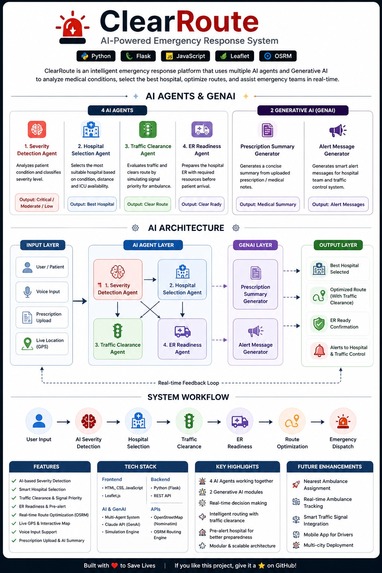
-
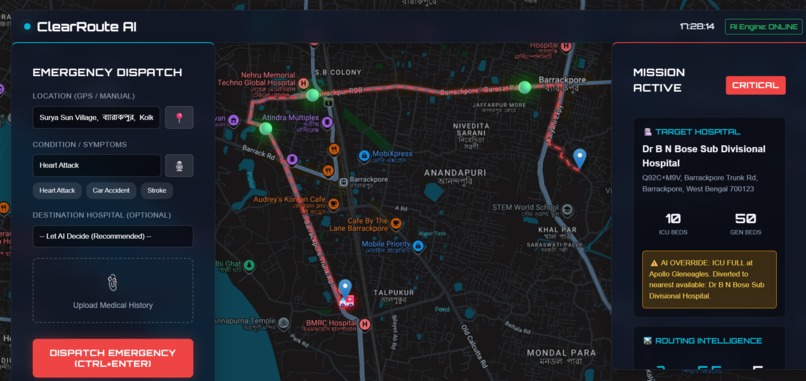
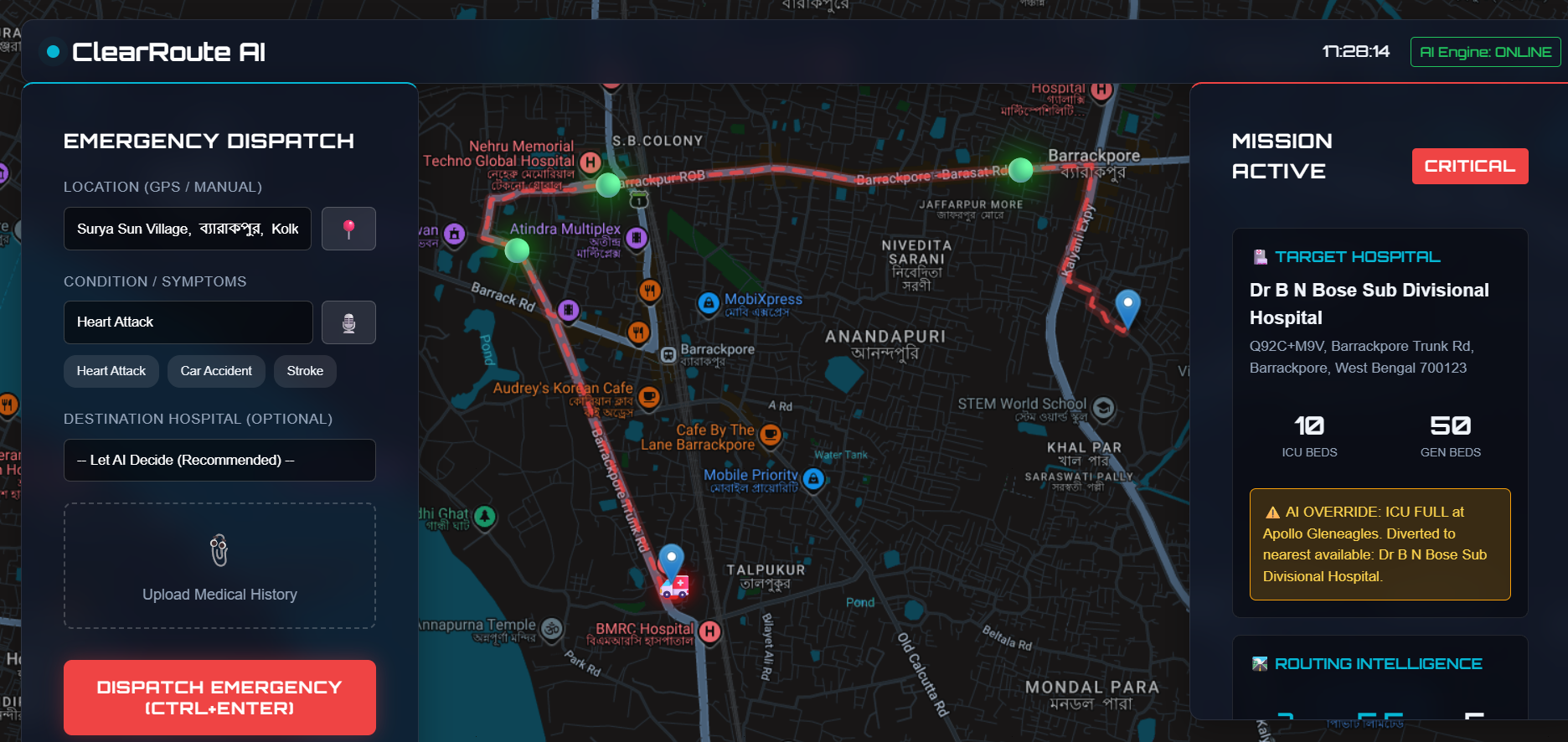
Dashboard (route & hospital data)
-
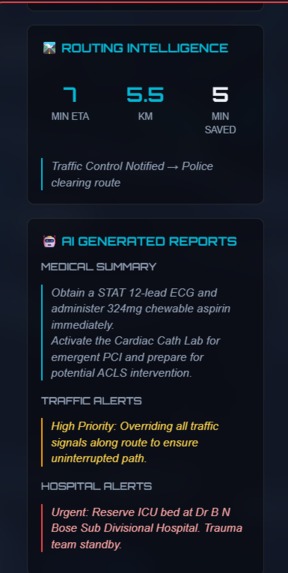
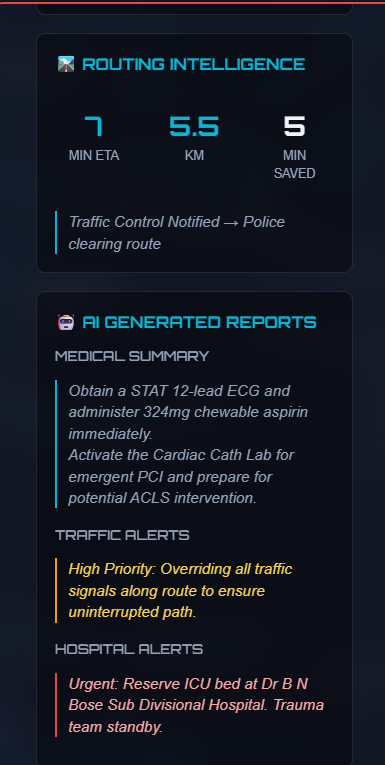
Route alerts, Hospital alerts, AI reports
-
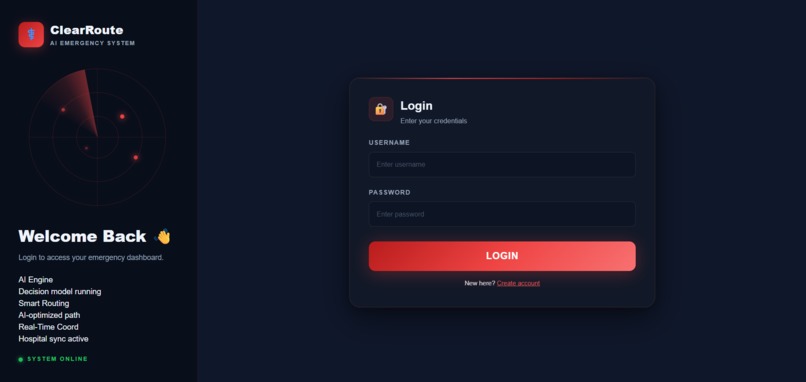
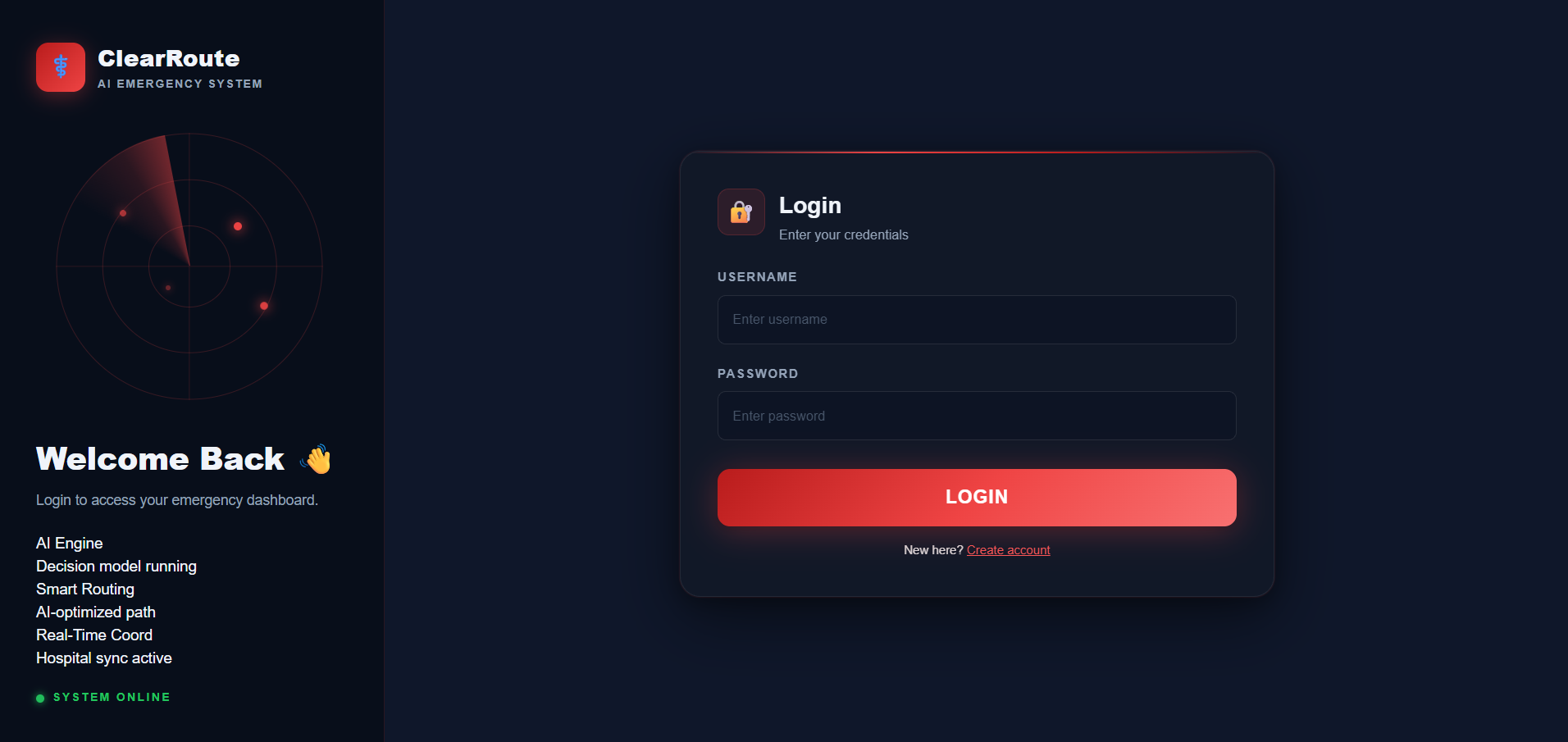
Login Page
ClearRoute
Inspiration
Every minute matters during a medical emergency. Patients often lose their life because hospitals are overcrowded, emergency services lack coordination, traffic congestion and no preparedness for emergency response. We were inspired by the idea of creating an intelligent emergency response network that not only identifies the nearest hospital but also coordinates hospitals, ambulances, and traffic authorities in real time, provides concise summary for precautions and actions during emergencies.
What it does
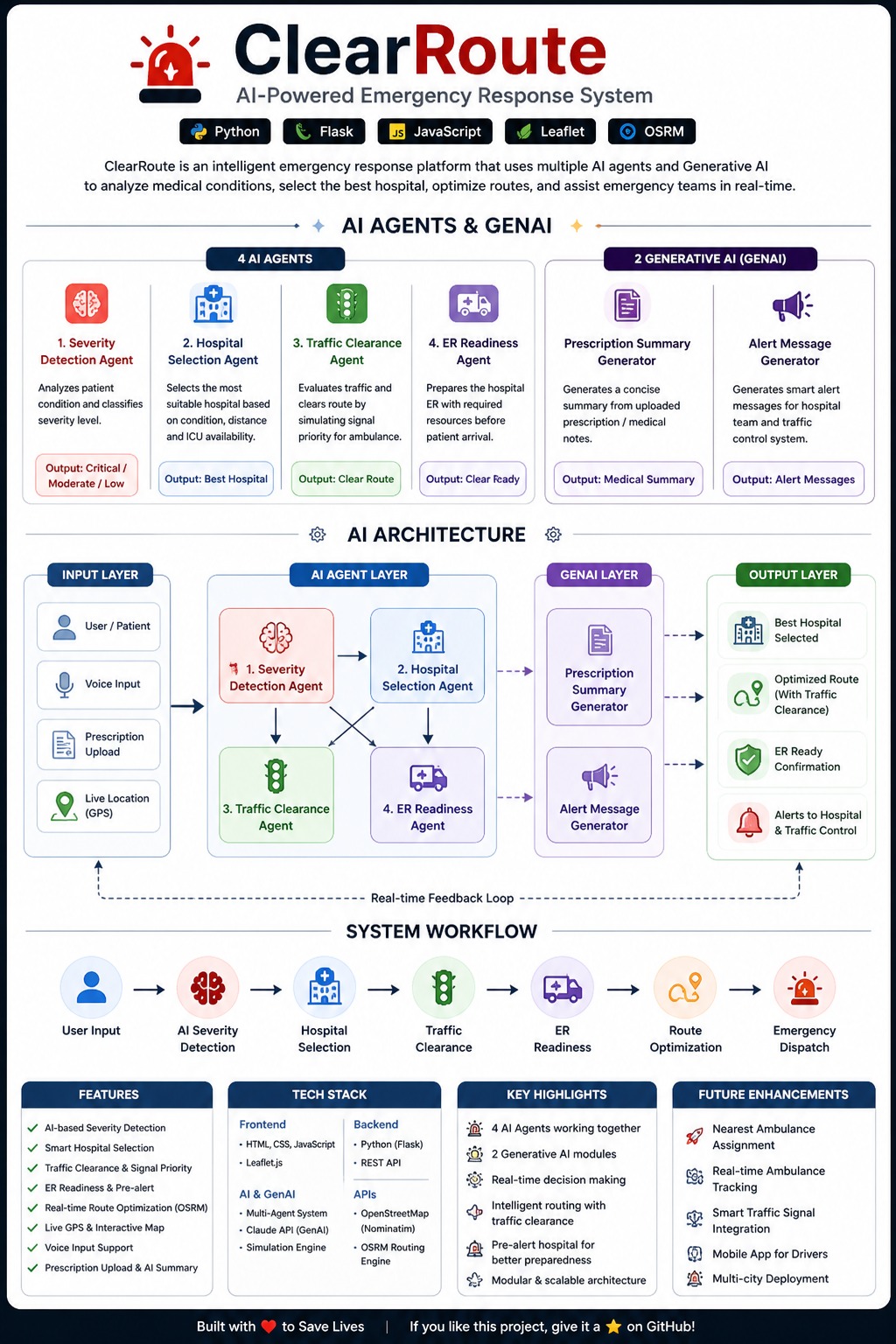
ClearRoute is an AI-powered emergency response orchestration platform.
When a user reports an emergency, the system:
- Determines the severity of the medical condition using AI-assisted triage.
- Identifies the most suitable hospital based on specialization and ICU availability.
- Automatically reroutes patients if the nearest hospital lacks critical resources.
- Generates an AI-powered medical briefing for the receiving emergency team.
- Sends automated SMS alerts and emergency voice calls to hospitals.
- Sends traffic clearance alerts to authorities.
- Calculates optimized ambulance routes and visualizes them on a live map.
- Simulates smart traffic signal overrides and real-time ambulance tracking.
- Provides a centralized emergency dashboard for monitoring the entire incident lifecycle.
The objective is to reduce emergency response delays and improve coordination between all stakeholders involved in patient transport.
How we built it
ClearRoute was developed as a full-stack AI-driven web application.
Frontend
- HTML5
- CSS3
- JavaScript
- Leaflet.js
- OpenStreetMap
- OSRM Routing Engine
Backend
- Python
- Flask
- Flask-CORS
- SQLite
AI Layer
- Google Gemini API for medical briefing generation
- Rule-based emergency triage and decision orchestration
Communication Layer
- Twilio SMS API
- Twilio Voice Calling API
Infrastructure
- GitHub
- Render Deployment
The system follows a multi-agent architecture:
- Triage Agent analyzes patient symptoms and determines severity.
- Hospital Agent selects the most appropriate hospital and performs ICU-aware load balancing.
- Traffic Agent generates emergency corridor alerts.
- Communication Agent sends automated notifications and voice calls to hospitals and authorities.
Challenges we ran into
Building a realistic emergency response system introduced several challenges:
- Integrating multiple third-party APIs while managing free-tier limitations.
- Handling deployment issues and environment variable security.
- Designing hospital load-balancing logic for ICU-aware routing.
- Managing geocoding and routing failures gracefully.
- Creating a reliable fallback mechanism when external services become unavailable.
- Simulating real-world emergency infrastructure without access to government or hospital systems.
- Ensuring the system remained responsive despite multiple API calls occurring simultaneously.
Accomplishments that we're proud of
- Successfully built a complete end-to-end emergency response platform.
- Integrated AI-generated emergency medical briefings.
- Implemented hospital auto-diversion when ICU capacity is unavailable.
- Added automated hospital notifications via SMS and voice calls.
- Developed real-time ambulance tracking and route visualization.
- Built a multi-agent orchestration workflow that mimics real emergency operations.
- Deployed a functional web application capable of handling realistic emergency scenarios.
Most importantly, we transformed a complex real-world problem into a working prototype within a hackathon timeframe.
What we learned
Through this project we learned:
- Full-stack application development using Flask and JavaScript.
- API integration and management in production environments.
- AI-assisted decision-making workflows.
- Geolocation, routing, and mapping technologies.
- Cloud deployment and environment variable management.
- Event-driven system design and multi-agent orchestration.
- Communication automation using SMS and voice APIs.
The project also taught us how difficult real-world emergency coordination is and how technology can help bridge those gaps.
What's next for ClearRoute
The current version is a prototype, but the vision is much larger.
Future developments include:
- Real-time hospital bed and ICU availability integration.
- Direct integration with ambulance GPS systems.
- Smart city traffic signal connectivity.
- Government emergency service integration.
- Electronic Health Record (EHR) synchronization.
- Predictive emergency demand forecasting using machine learning.
- Nationwide emergency coordination network deployment.
- Mobile applications for patients, hospitals, and emergency responders.
Ultimately, we envision ClearRoute becoming a unified AI-powered emergency response ecosystem capable of reducing response times and helping save lives at scale.
Built With
- agent
- cors
- css3
- flask
- gemini
- genai
- git
- github
- html5
- javascript
- leaflet.js
- openstreetmap
- osrm-routing
- python
- render
- rest-api
- sqlite
- twilio


Log in or sign up for Devpost to join the conversation.