Inspiration
We noticed a frustrating pattern in local communities: people regularly notice problems—broken infrastructure, overflowing waste, unsafe roads, inaccessible public spaces, recurring service issues—but reporting those problems is often fragmented, repetitive, and difficult to prioritize.
A single neighborhood can have dozens of complaints scattered across social media, messages, forms, and conversations, while the people trying to solve them may not have a clear picture of what is happening.
We wanted to build something that could turn those disconnected signals into something actionable.
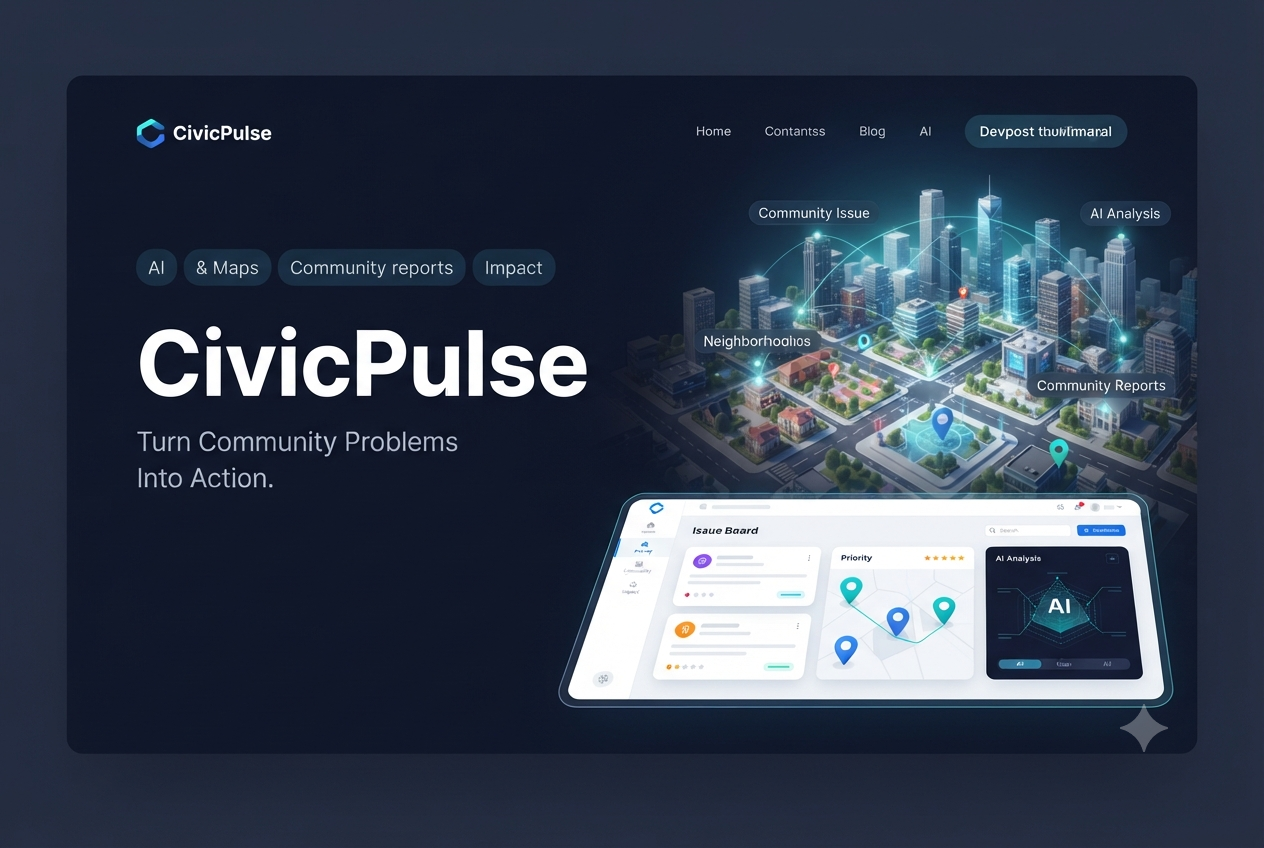
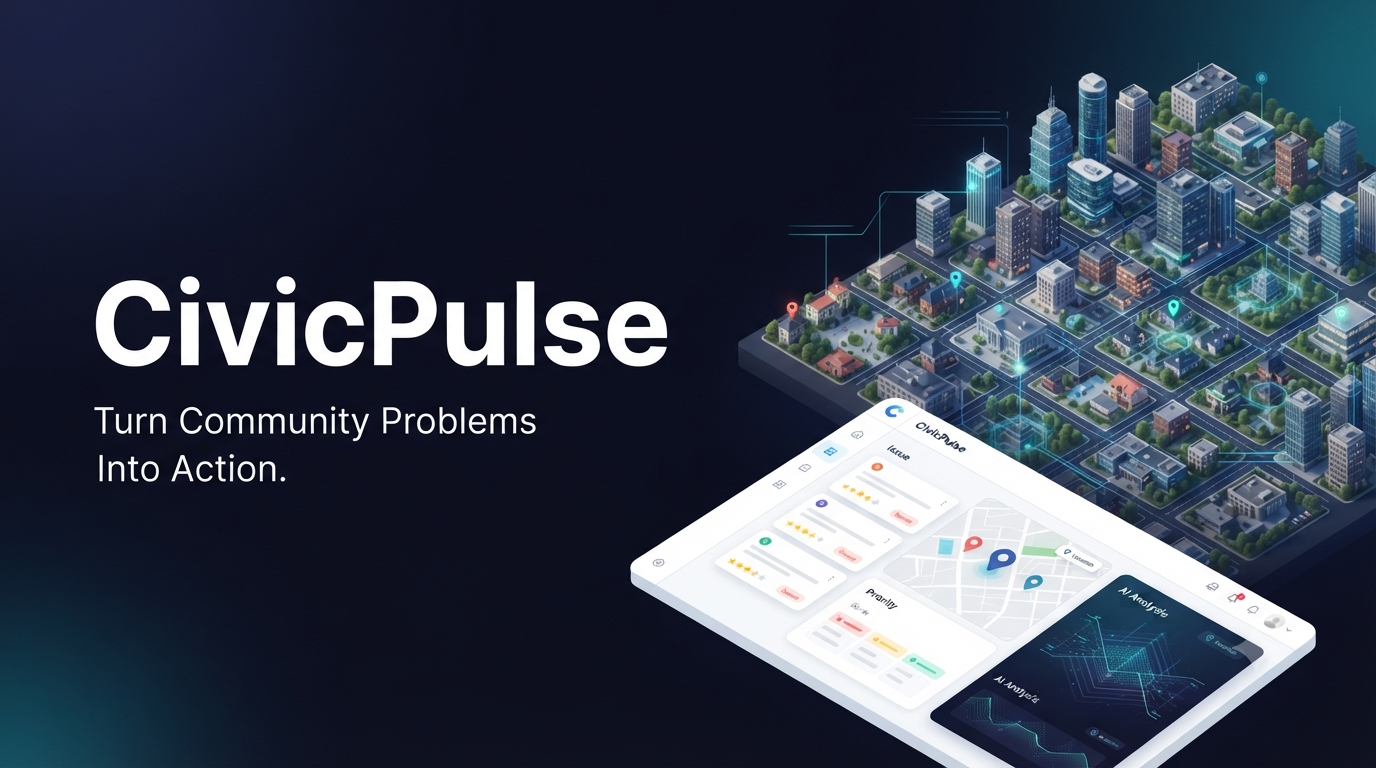
That idea became CivicPulse: a platform that uses AI to organize community-reported problems, identify patterns, estimate urgency, and help communities understand which issues deserve attention first.
What it does
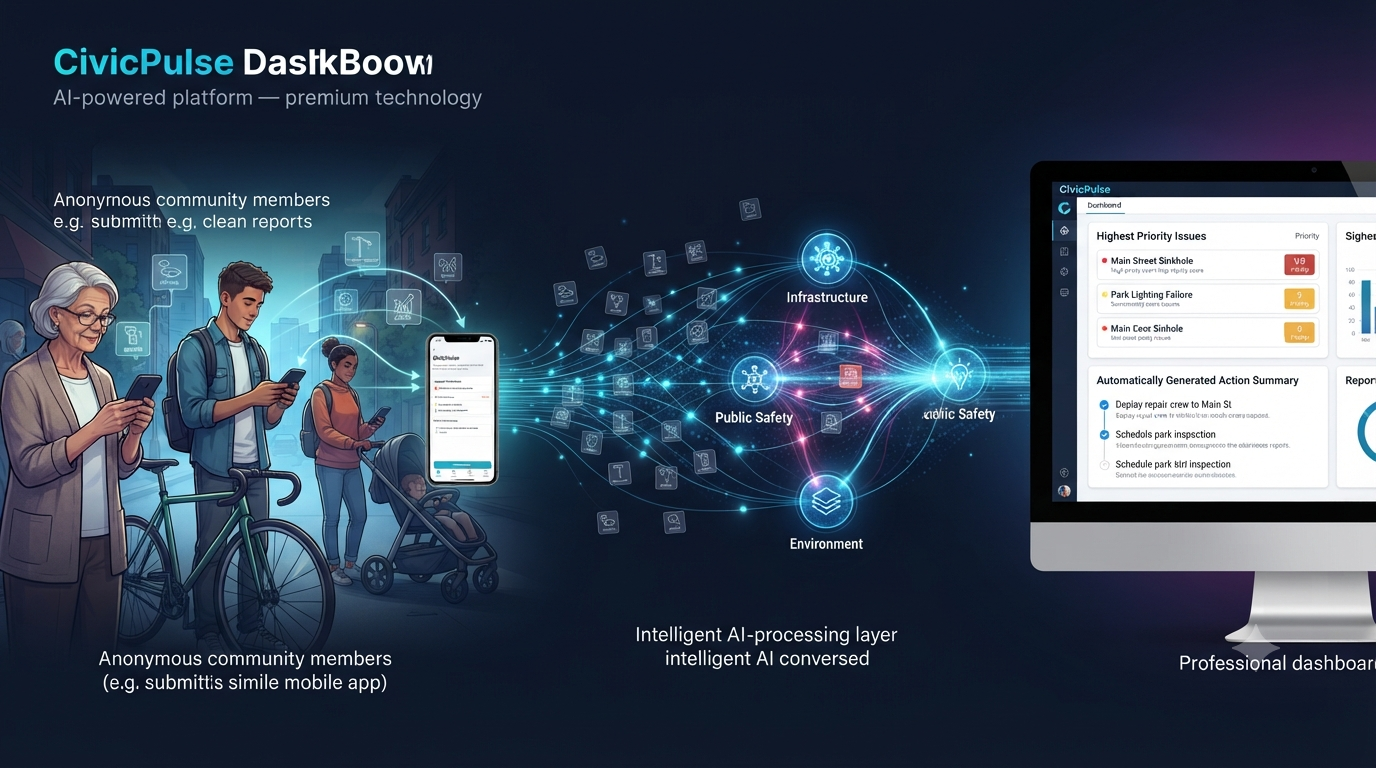
CivicPulse gives residents a simple way to report a local problem using text, an optional location, and supporting information such as a photo.
Instead of treating every report as an isolated complaint, CivicPulse analyzes reports collectively.
The platform can:
Group similar reports into the same underlying issue.
Detect potential duplicate reports.
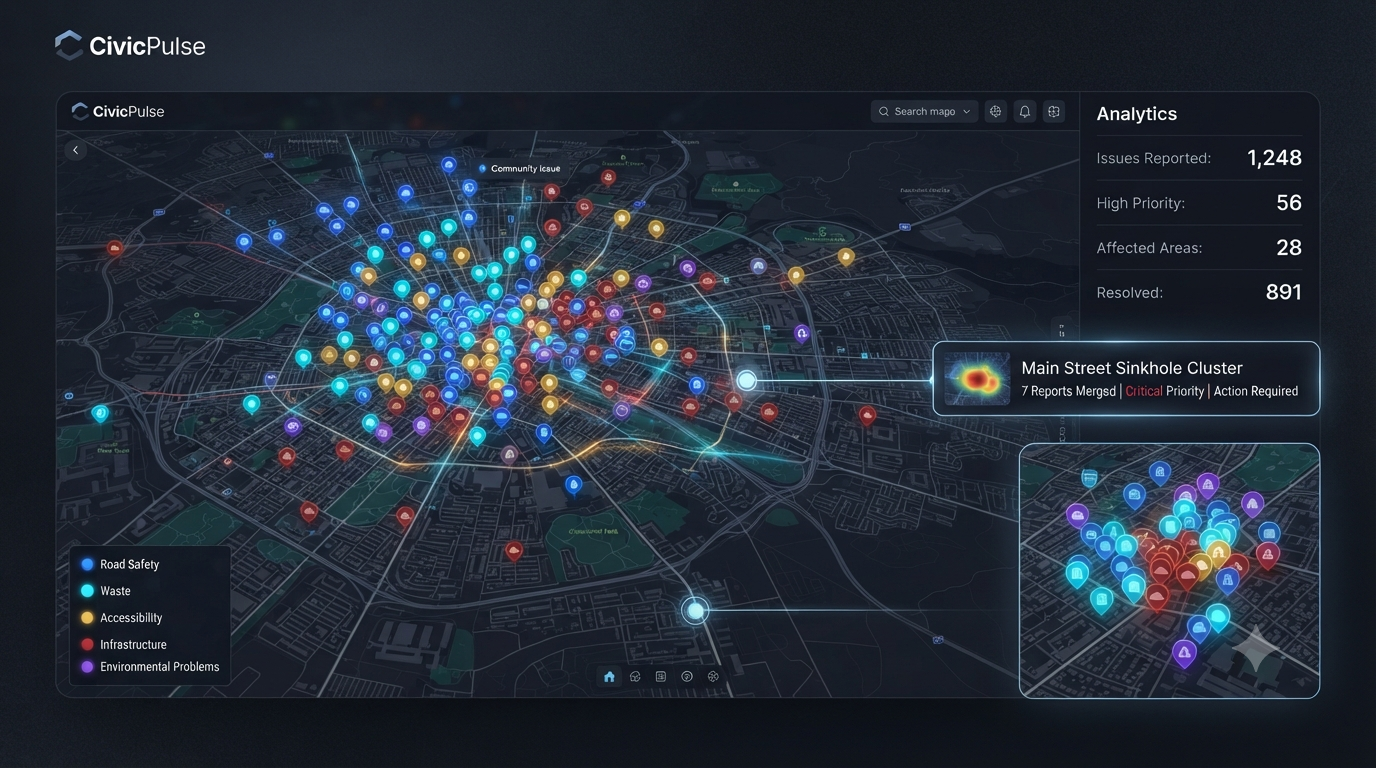
Categorize problems such as road safety, waste, accessibility, public infrastructure, and environmental concerns.
Estimate priority using factors such as frequency, severity, location, and community impact.
Display emerging issues on an easy-to-understand community dashboard.
Generate concise summaries that explain what is happening and why an issue may deserve attention.
Turn a collection of complaints into a structured problem statement that can be shared with community organizations or local decision-makers.
The goal isn't to replace existing government reporting systems. Instead, CivicPulse acts as an intelligence layer that helps communities understand their problems before deciding how to respond.
How we built it
We designed CivicPulse as a modular web application with separate layers for reporting, processing, analysis, and visualization.
Users submit reports through a lightweight interface. The backend processes the information and sends relevant text through an AI classification and clustering pipeline.
At a high level, the workflow is:
Reports → Classification → Similarity Detection → Priority Scoring → Community Insights
Reports are converted into structured data so that similar problems can be compared instead of simply being displayed as a chronological list.
The dashboard then presents these results through issue cards, statistics, and geographic or category-based views.
We also designed the system so that the AI is used to assist organization and prioritization rather than make authoritative decisions about people's communities.
Challenges we ran into
One of our biggest challenges was deciding how to prioritize a community problem fairly.
A report with many submissions isn't necessarily more important than a less frequently reported problem. Similarly, an issue that sounds minor in text could have a much larger impact depending on where it occurs.
We therefore had to think carefully about how different signals should contribute to priority without allowing a single metric to dominate.
Another challenge was handling duplicate and slightly different descriptions of the same issue. Two people might describe the same problem using completely different words, so simple keyword matching wasn't enough.
We also had to balance AI capabilities with reliability. We wanted AI to make the system more useful without presenting uncertain predictions as facts.
Finally, building something that is technically interesting while remaining simple enough for a first-time user required several iterations of the interface.
Accomplishments that we're proud of
We're proud that CivicPulse doesn't simply collect reports—it attempts to find the underlying problems connecting them.
The most important part of the project is the transformation from:
"Here are 50 complaints."
to:
"Here are the 5 major issues affecting this community, where they are occurring, how frequently they are being reported, and why they may deserve attention."
We are also proud of designing the project around a real-world workflow rather than building AI functionality simply for the sake of using AI.
What we learned
We learned that solving a community problem is much harder than identifying one.
The technical challenge isn't only building a model or connecting an API. It is deciding what information actually matters, designing useful feedback loops, communicating uncertainty, and making the final experience understandable to people who don't care about the technology behind it.
We also learned that AI is most useful when it reduces complexity for users rather than adding another layer of complexity.
What's next for CivicPulse
Our next step is to make CivicPulse useful at a larger scale.
We would like to add stronger geospatial analysis, image-assisted issue classification, historical trends, multilingual reporting, community verification, and integrations with existing civic reporting systems.
We also want to explore a feedback loop where communities can indicate whether an issue was resolved. This would allow CivicPulse to move beyond identifying problems and begin measuring whether community action actually produced results.
Our long-term vision is simple: make it easier for communities to turn everyday observations into organized, evidence-based action.
Built With
- ai/llm
- cloud
- css
- database
- embeddings
- fastapi
- github
- gps
- maps
- next.js
- postgresql
- python
- react
- similarity
- tailwind
- typescript
- vector
- vercel

Log in or sign up for Devpost to join the conversation.