-
-
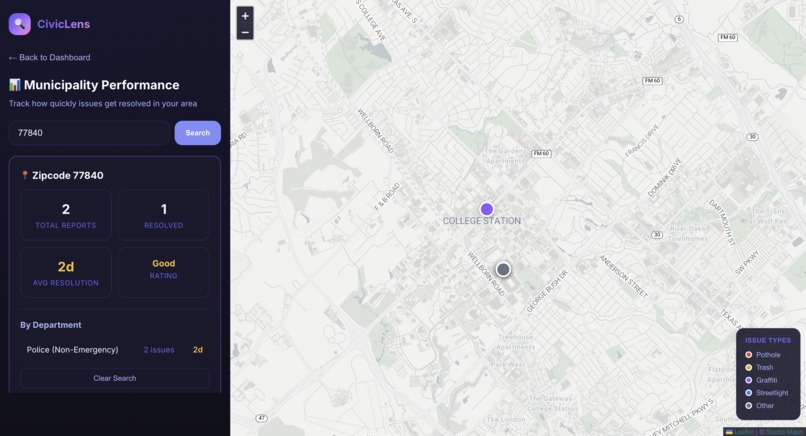
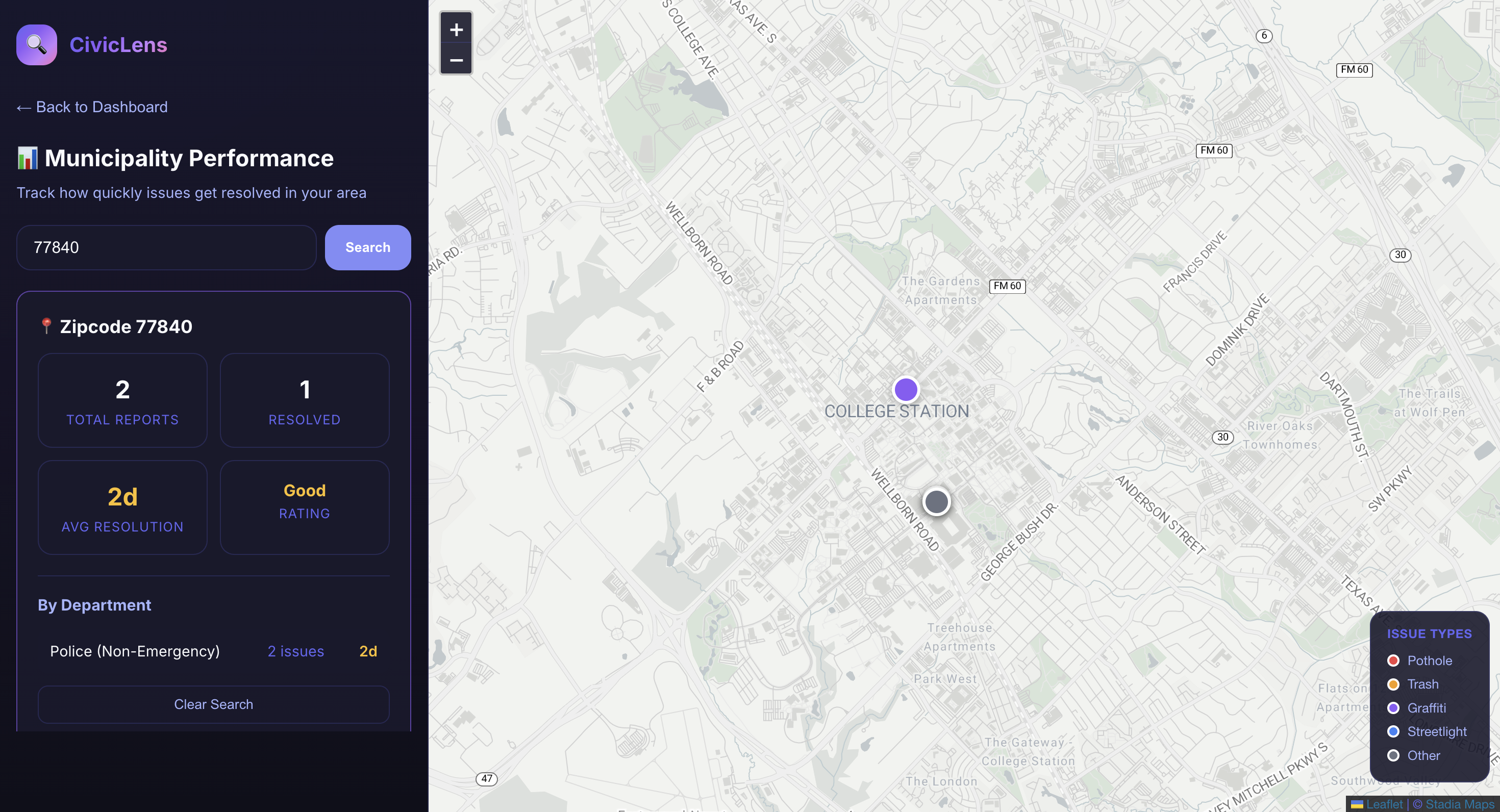
Satistic page
-
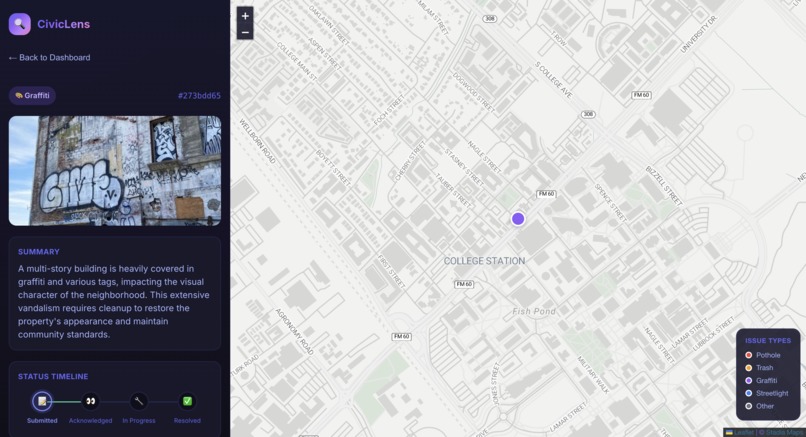
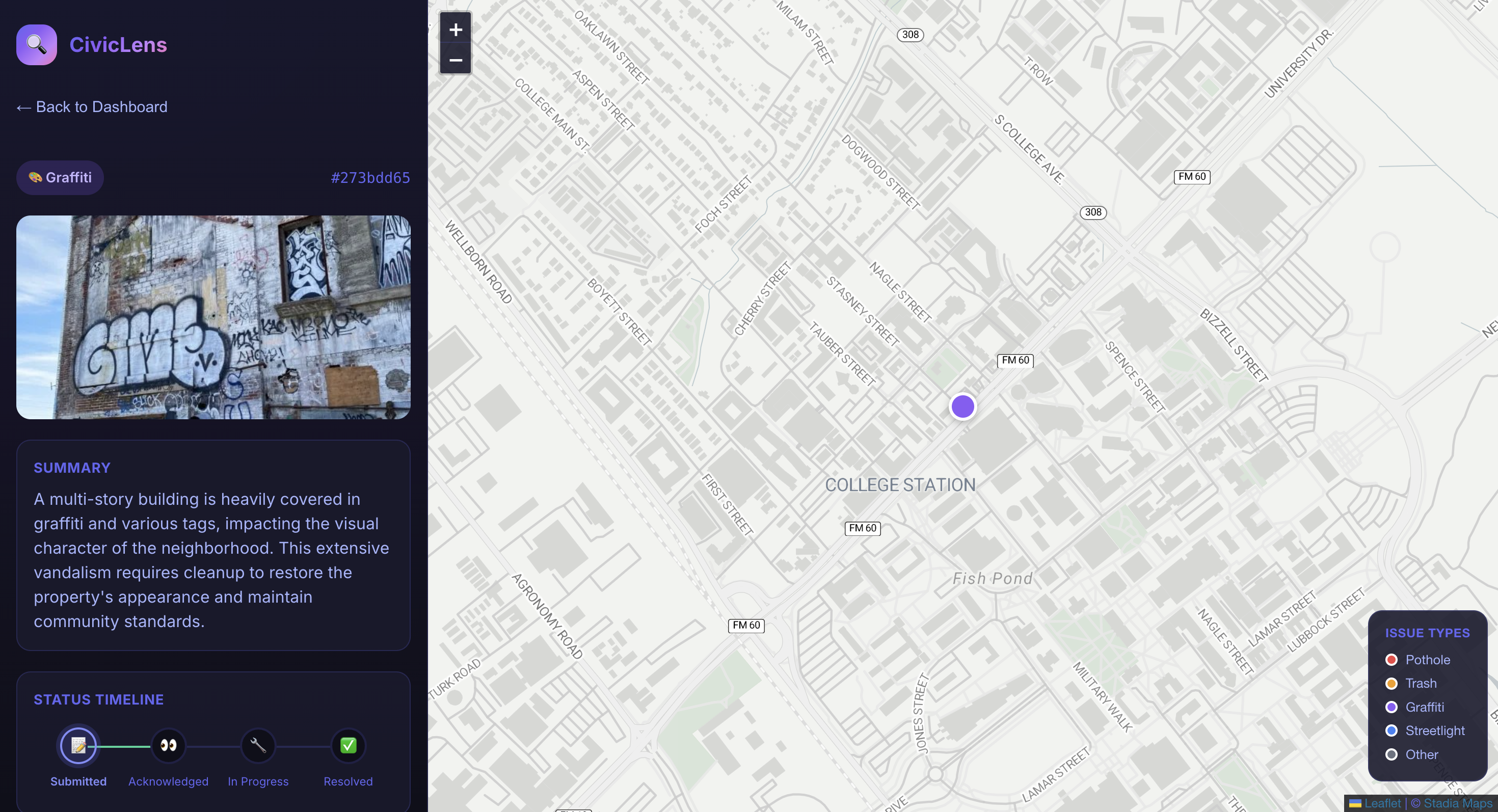
Sample Graffiti
-
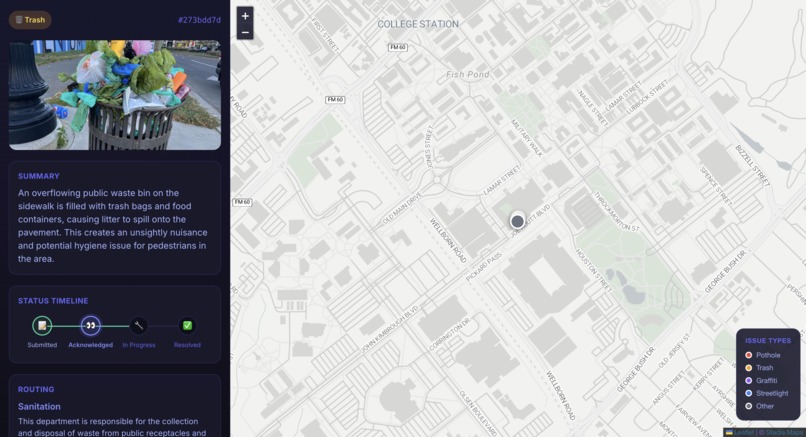
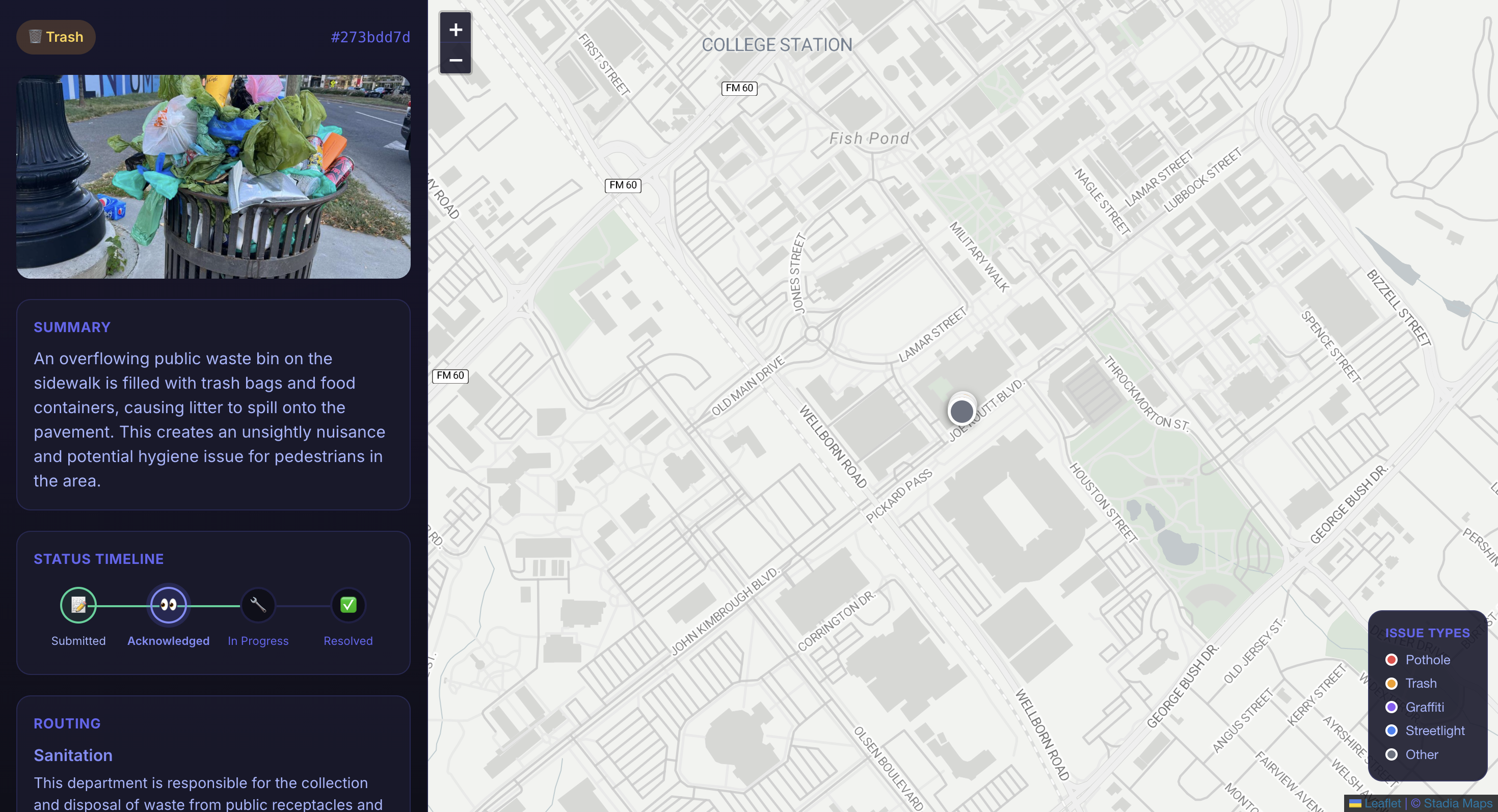
Sample Trash
-
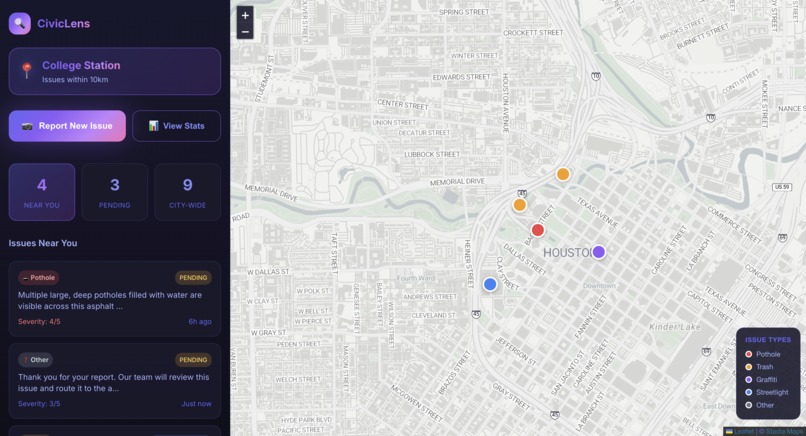
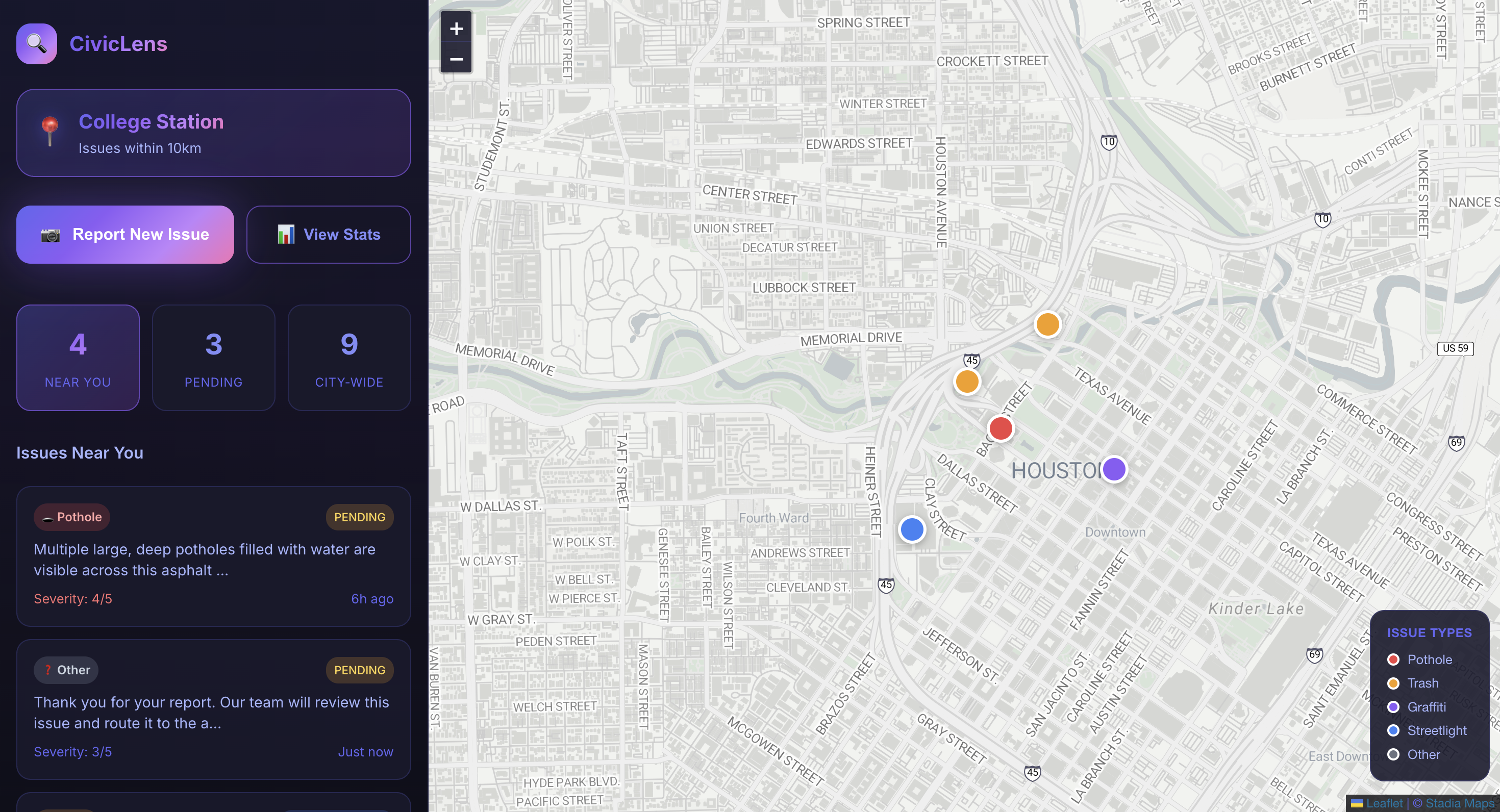
Dashboard
-
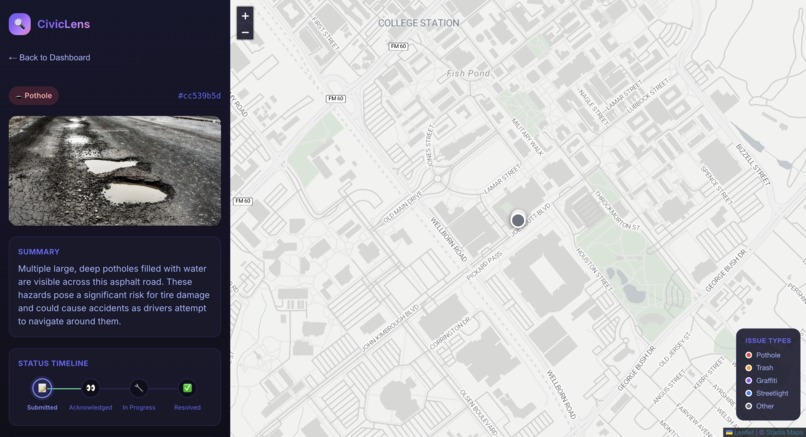
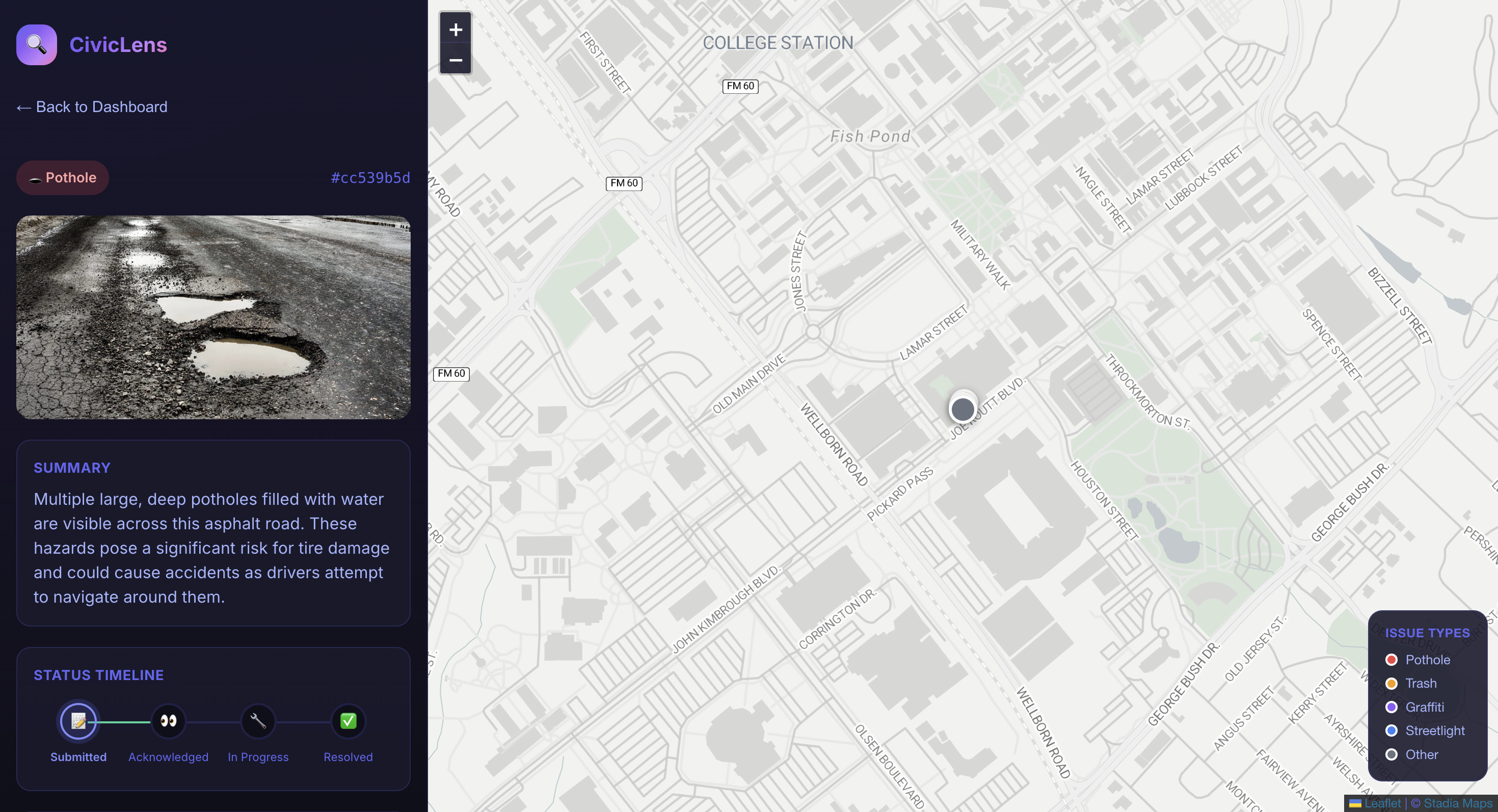
Sample Pothole

Inspiration
The idea for CivicLens came from something almost everyone experiences regularly: stepping outside and immediately noticing things that shouldn’t be broken—but are. Overflowing garbage, dangerous potholes, broken street lights. These are not rare edge cases; they are everyday civic issues that affect safety, health, and quality of life.
What struck us most is not just that these problems exist, but that reporting and resolving them is often harder than it should be. People don’t know where to report issues, reports get lost across departments, and authorities lack clear prioritization. This gap between citizens and action is where frustration grows—and where we saw an opportunity.
Our short animated story with Edward captures this exact moment: a normal morning disrupted by avoidable problems, followed by a simple but powerful question — what if reporting these issues were actually easy, intelligent, and fast?
What We Built
We built CivicLens, an AI-powered civic issue reporting and prioritization platform that helps citizens report problems instantly and helps authorities act on them faster.
Instead of just collecting complaints, CivicLens focuses on decision support:
- understanding what the issue is,
- estimating how severe it might be,
- and determining what should be addressed first.
Users simply upload an image of a real-world issue, and the system turns that raw input into structured, actionable insights.
How We Built It
Image Understanding & Classification
- Featherless.ai is used for image classification on user-submitted photos.
- The model identifies the type of civic issue (e.g., garbage, pothole, broken infrastructure) directly from the image.
- Featherless enables fast, scalable inference, making image understanding a core capability rather than a demo-only feature.
AI Reasoning & Prioritization
- Google Gemini serves as the reasoning engine of CivicLens.
- Gemini takes the classified issue along with user-provided context and:
- categorizes the problem,
- assesses potential severity and public impact,
- generates clear, human-readable summaries,
- and suggests priority levels for action.
The prioritization logic follows a simple but effective principle:
[ \text{Priority} = f(\text{severity}, \text{frequency}, \text{risk}) ]
where Gemini helps infer severity and risk from unstructured, real-world inputs.
Backend & Data Layer
- All reports, classifications, and AI-generated insights are stored in MongoDB Atlas.
- This allows tracking of repeated issues, trend analysis over time, and a clean foundation for scaling.
Deployment
- The backend is deployed on DigitalOcean, ensuring a stable, live, and fast demo.
- The entire pipeline is designed to feel production-ready, not just hackathon-ready.
Demo Video Generation
- Google Veo was used to generate the animated demo video shown in our submission.
- Veo allowed us to visually tell the story of everyday civic issues in a cinematic and intuitive way, helping judges immediately understand the problem before seeing the product.
- This made the demo more engaging and ensured the narrative and product were tightly aligned.
What We Learned
- AI is most effective when it improves decisions, not just automation.
- Images are a universal interface. Asking users to “just take a photo” dramatically lowers friction.
- Clear scope wins. Focusing on reporting → understanding → prioritization made the system coherent and impactful.
- Relatable problems resonate. Judges immediately connected with the problem because they live it too.
Challenges We Faced
- Ambiguous real-world images: Photos can be messy or incomplete, requiring robust classification and reasoning.
- Avoiding a chatbot wrapper: AI had to be structurally necessary, not decorative.
- 24-hour constraints: Choosing what not to build was just as important as what to build.
- Narrative alignment: Ensuring the video, demo, and story reinforced the same core message took careful iteration.
Closing Thoughts
CivicLens is about closing the loop between observation and action. Civic problems don’t persist because people don’t care—they persist because reporting is fragmented and prioritization is unclear.
By combining image-based understanding with intelligent reasoning, CivicLens shows how AI can help cities respond faster, smarter, and more human-centrically.
The problems Edward sees on his morning walk are familiar to all of us.
Our goal was to make the solution feel just as obvious.
Built With
- css3
- express.js
- featherless-ai-api
- google-gemini-api
- javascript
- leaflet.js
- mongodb
- node.js
- openstreetmap
- qwen
- react.js
- vite


Log in or sign up for Devpost to join the conversation.