-
-
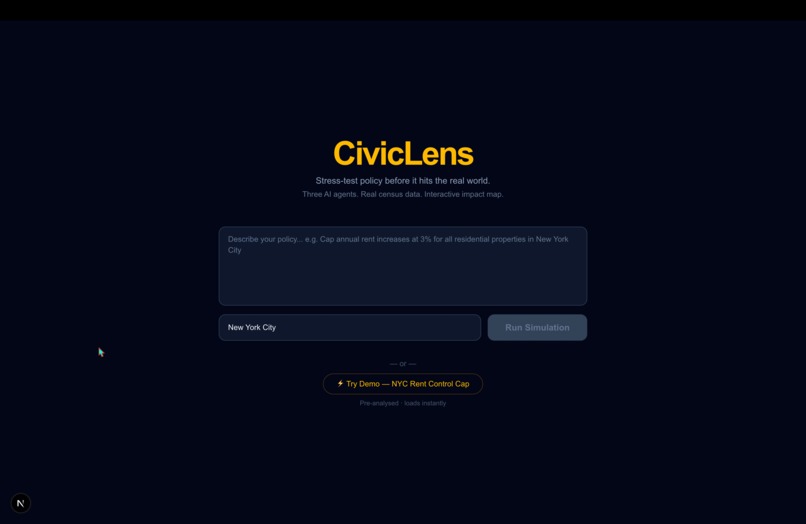
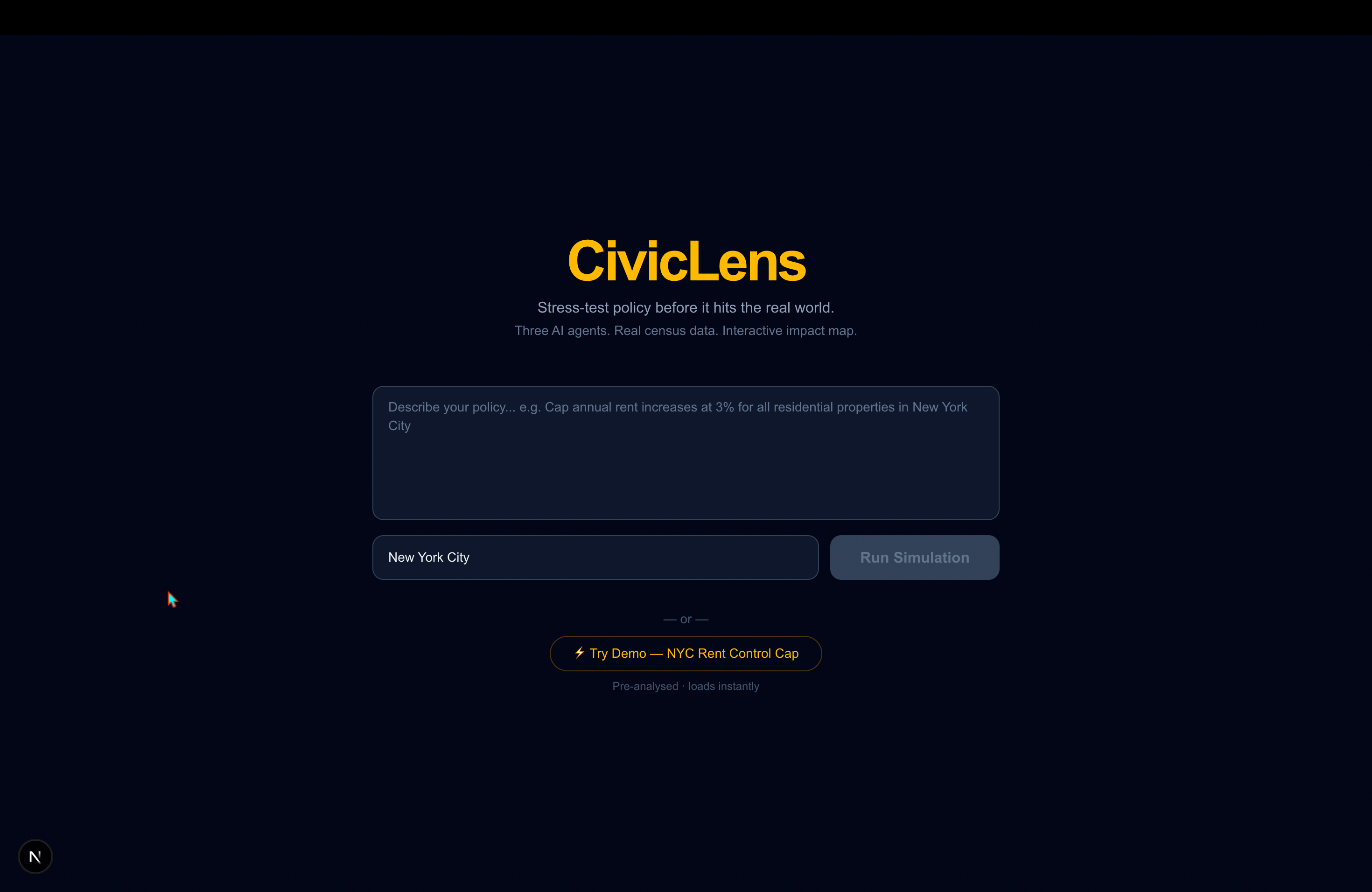
Landing Page
-
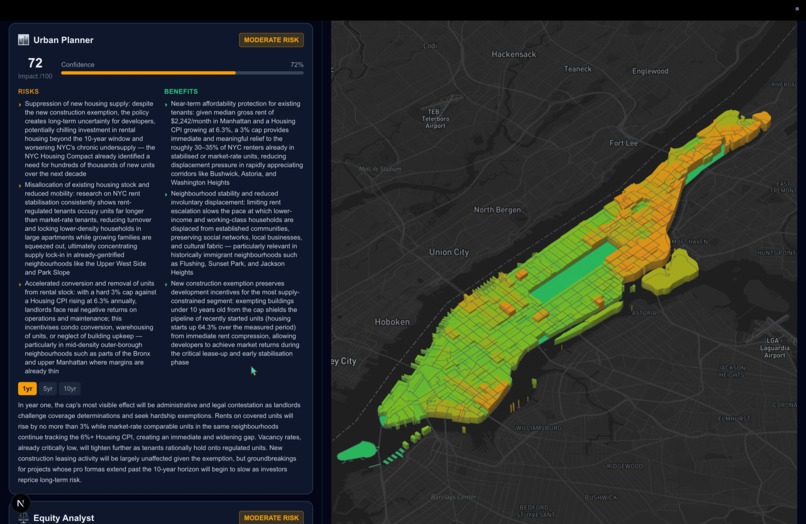
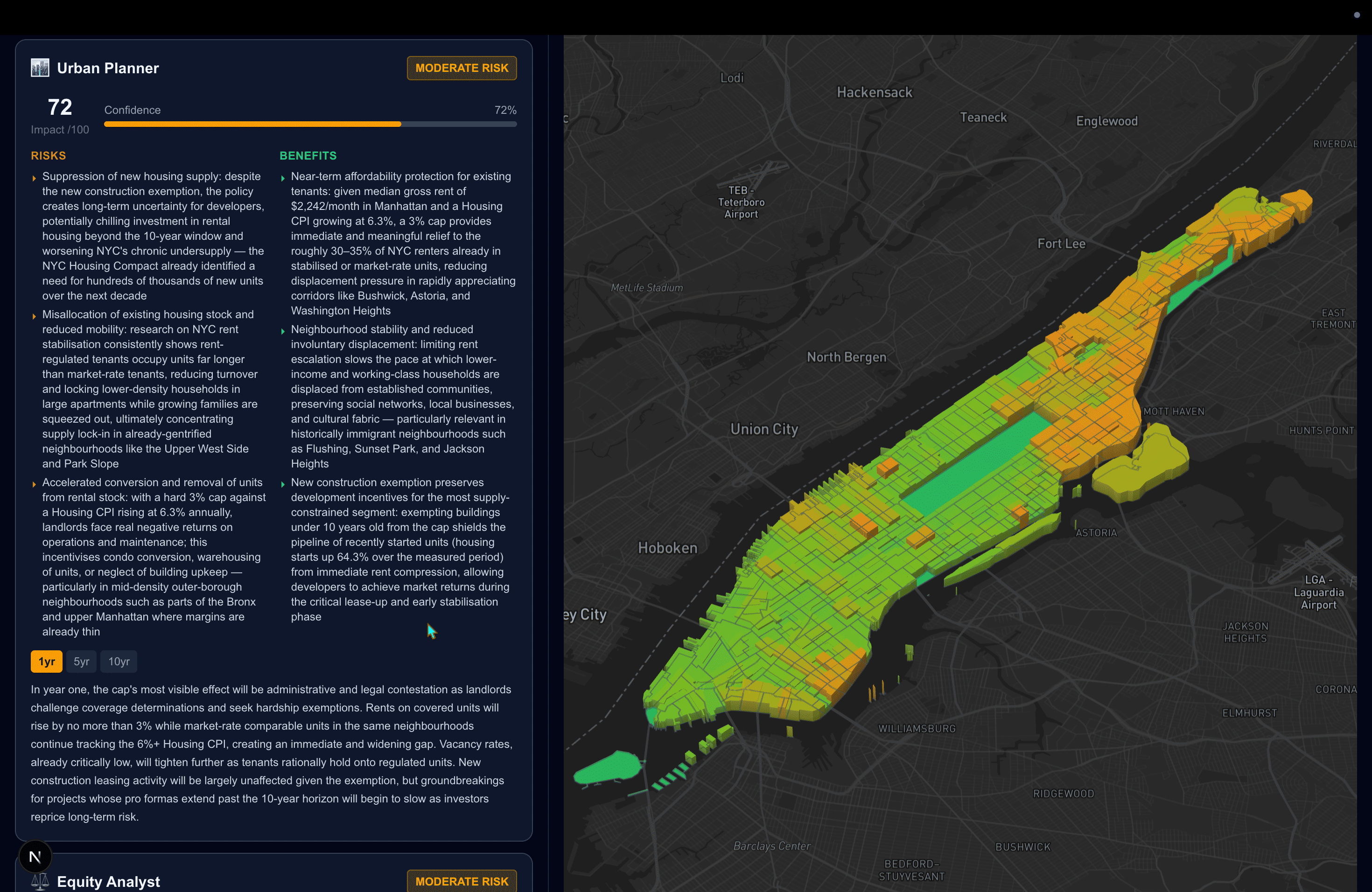
Urban Planning Agent, Map Simulation
-
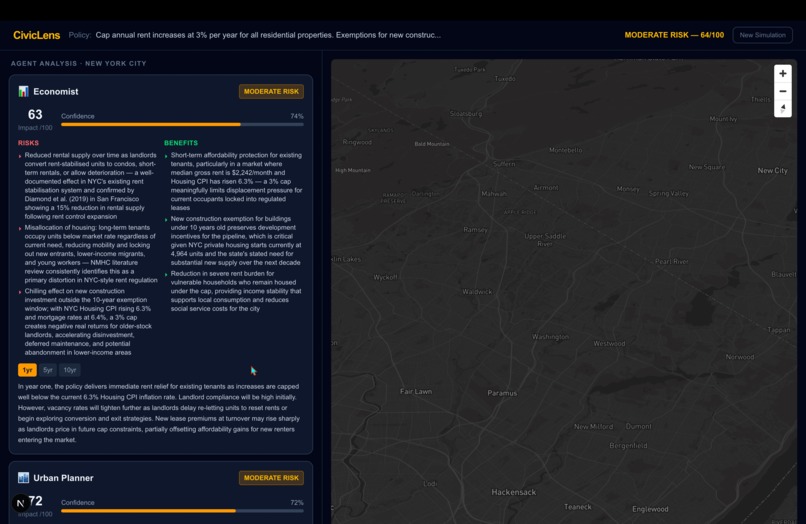
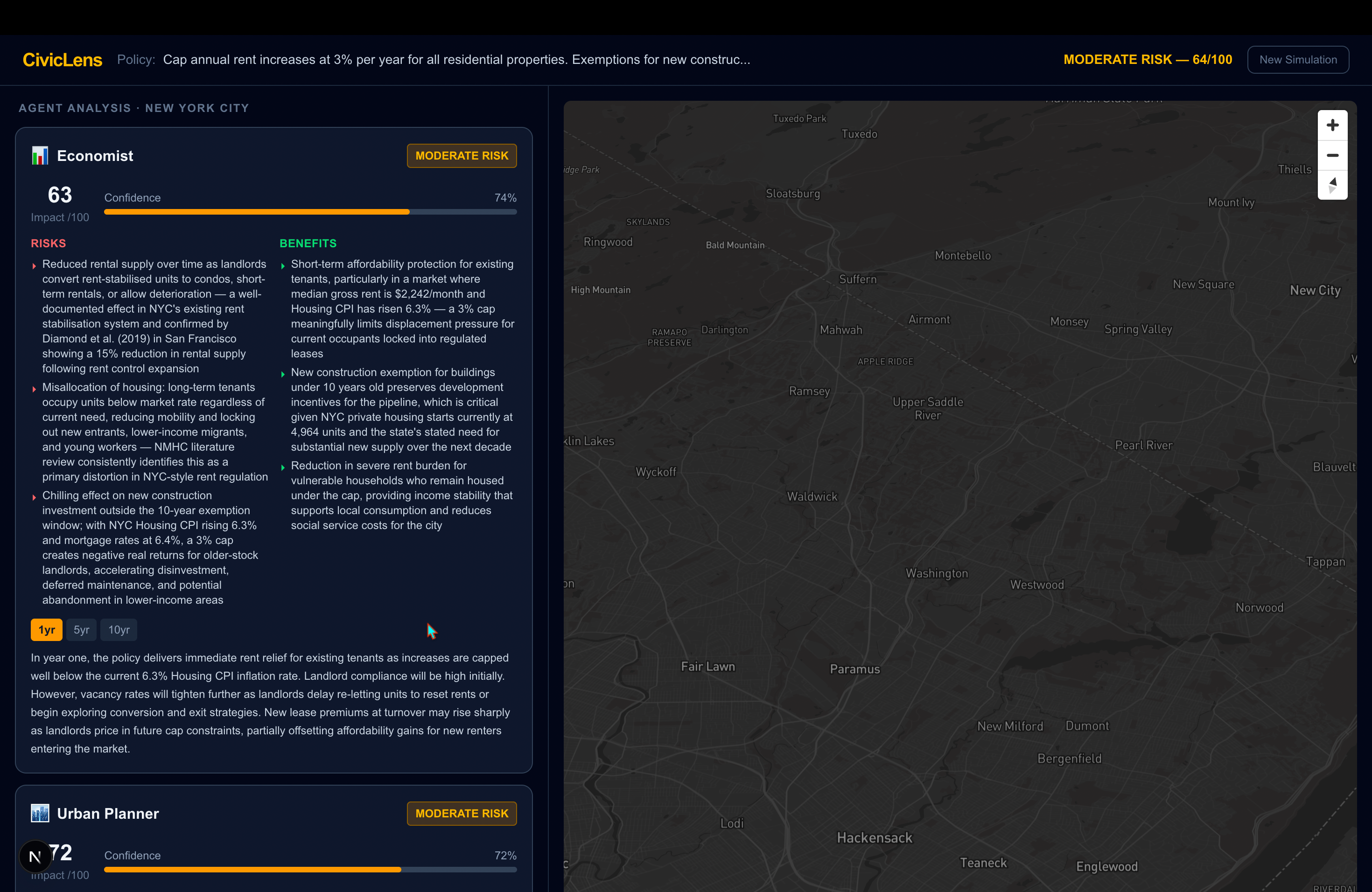
Economist Agent
-
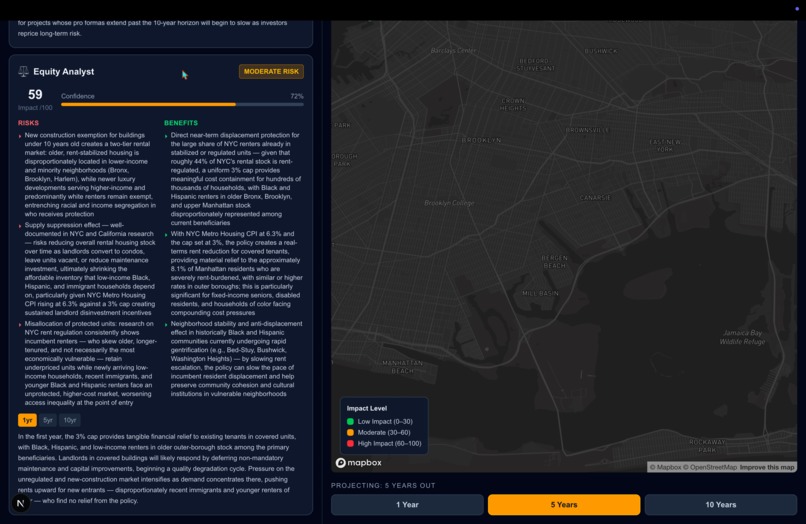
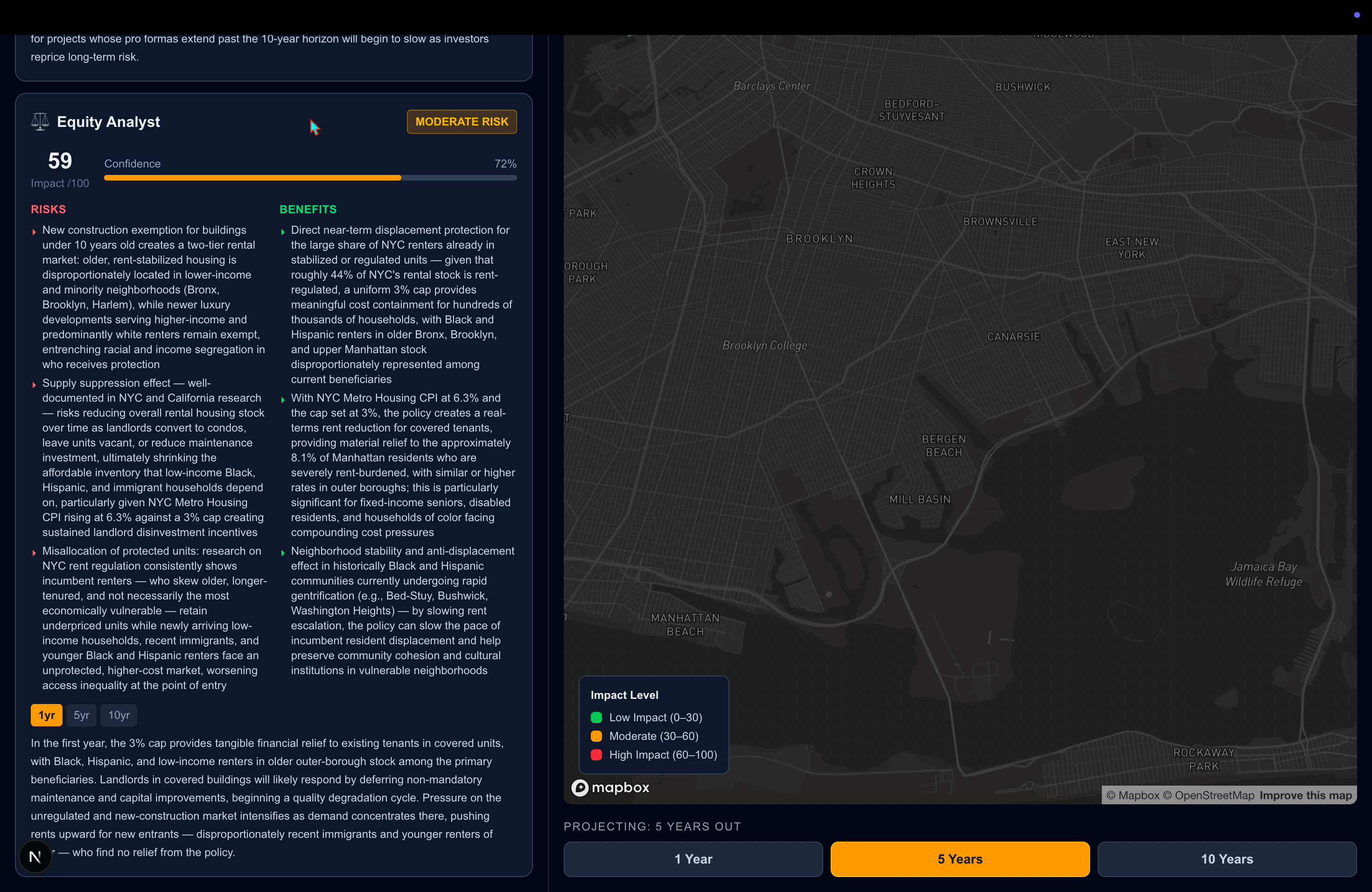
Equity Agent
Project Name
CivicLens
Project Category
Engineering and Infrastructure
Inspiration
In 2019, Berlin introduced strict rent control laws. Within 18 months, rental supply dropped by 56%. Ironically, the very people the policy aimed to help were worse off. Eventually, the policy was overturned-but only after years of damage.
That raised a simple but powerful question:
Every critical system in the world is tested before it goes live-planes use simulators, bridges are stress-tested, medicines go through trials.
So why are public policies deployed directly on millions of people without simulation?
It’s not because governments don’t care-it’s because tools like this don’t exist at an accessible scale.
We built CivicLens to change that.
What it does
CivicLens is a policy simulation platform-think of it as a flight simulator for government decisions.
A policymaker can:
- Type or upload a policy in plain English
- Instantly simulate its impact using real-world data
- View outcomes through multiple perspectives
- Explore results visually on an interactive 3D map
Behind the scenes:
- We pull live economic and demographic data
- Run three specialized AI agents (Economist, Urban Planner, Equity Analyst)
- Combine their insights into a unified risk and impact score
The result?
A clear, data-driven preview of what might happen before the policy affects real lives.
How we built it
We designed CivicLens as a full-stack, multi-agent AI system:
Data Layer
- US Census API -> demographic + housing data
- FRED API -> macroeconomic indicators
- Web search -> real-world policy outcomes
Intelligence Layer
- Built a RAG pipeline using ChromaDB + sentence-transformers
- Retrieved only the most relevant context per query to keep responses focused
Multi-Agent System
- Economist -> market dynamics & incentives
- Urban Planner -> spatial and infrastructure impact
- Equity Analyst -> social and demographic effects
These agents run in parallel, each producing structured insights.
Orchestration
- Used LangGraph to manage workflow:
- Fetch context
- Run agents
- Combine results
- Fetch context
Frontend
- Built with Next.js, TypeScript, Tailwind CSS
- Integrated Mapbox 3D visualization
- Neighborhoods are rendered using:
- Height -> impact intensity
- Color -> risk level
- Height -> impact intensity
- Includes a time slider for long-term projections
Challenges we ran into
- Census API returned HTML instead of JSON due to delayed key activation
- Naming conflict (
tavily.py) shadowed the actual library - NumPy version mismatch broke PyTorch dependencies
- Mapbox race condition caused silent rendering failures
- LLM outputs occasionally broke strict validation constraints
Each challenge pushed us to build more resilient and reliable systems.
Accomplishments that we're proud of
- Built a working multi-agent AI system with real-time reasoning
- Integrated live data, AI, and 3D visualization into one platform
- Reduced response time from ~45s to ~15s using parallel execution
- Designed a system that is both technically robust and user-friendly
- Delivered a fast, reliable demo experience
What we learned
- Multi-agent systems produce more balanced insights than single models
- RAG is an architectural decision, not just a feature
- Reliable demos matter more than complex ones
- Most failures happen at system edges, not core logic
- Visualization is key to making complex systems understandable
Impact
- CivicLens enables policymakers to simulate outcomes before real-world implementation, shifting governance from guesswork to data-driven decision-making.
- It helps identify unintended consequences, promotes more equitable policies by highlighting affected communities, and makes advanced policy analysis accessible to smaller governments.
- Ultimately, it improves transparency, reduces risk, and supports better decisions that impact millions of lives.
What's next for CivicLens
We want to evolve CivicLens into a real-world decision-making platform:
- Expand beyond housing -> transportation, healthcare, climate policy
- Improve simulation accuracy with richer datasets
- Add interactive scenario comparison
- Enable customizable AI agents for policymakers
- Scale for use by governments, researchers, and organizations
Our vision:
Make policy decisions testable, transparent, and accountable before they impact real lives.

Log in or sign up for Devpost to join the conversation.