-
-
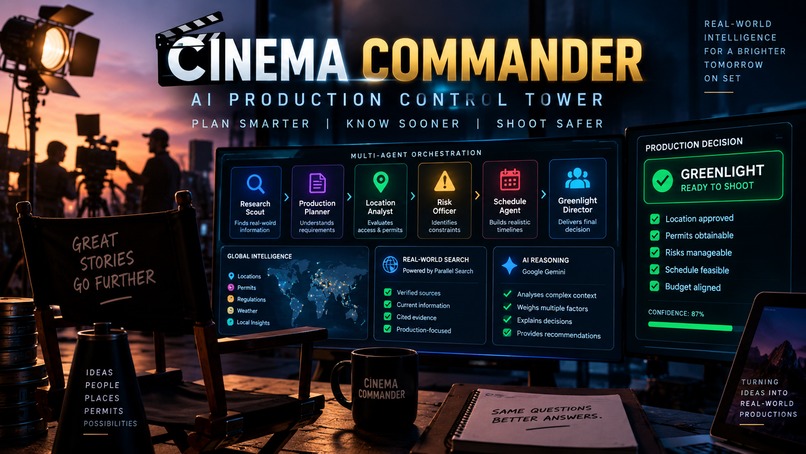
Cinema Commander : The Cinema Production Project 2026 by AdmnWizard AI, Wyoming, USA
-
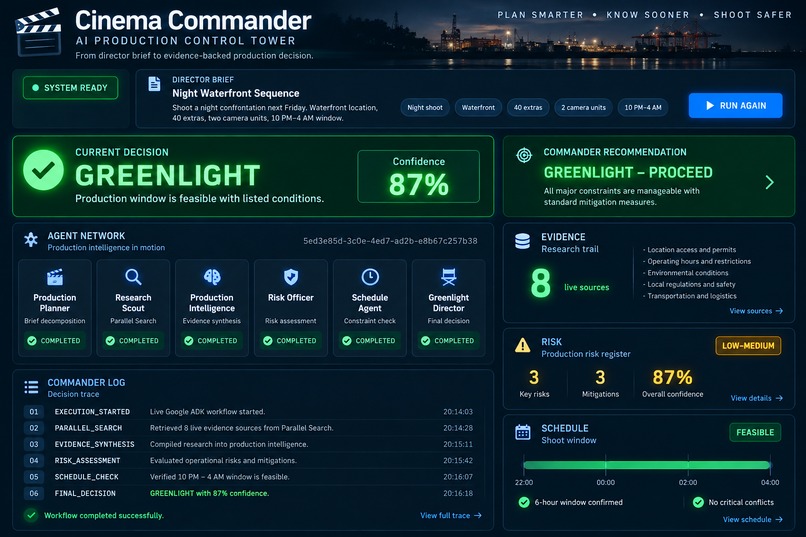
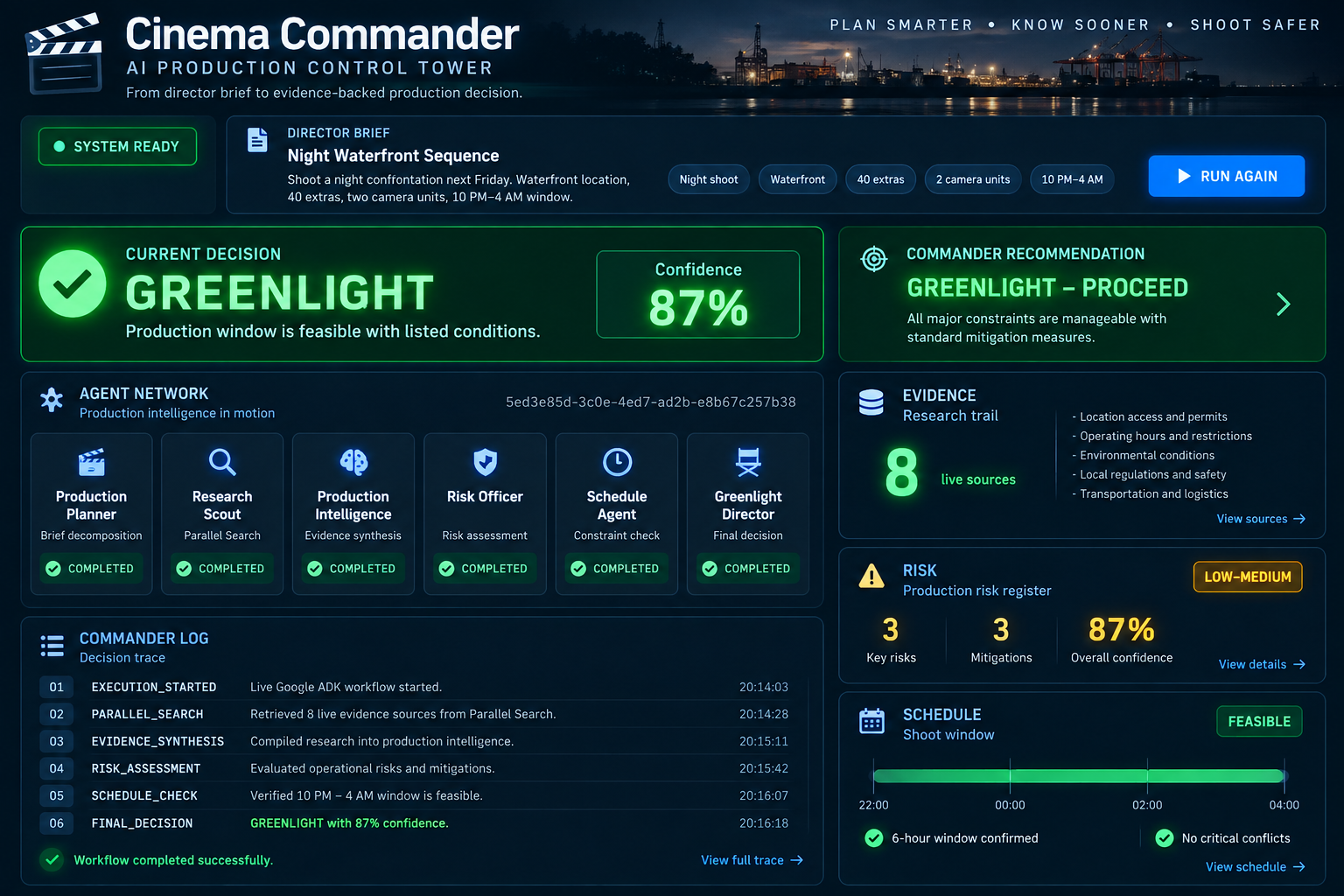
PRODUCTION GREENLIGHT 87% CONFIDENCE • READY TO PROCEED
-
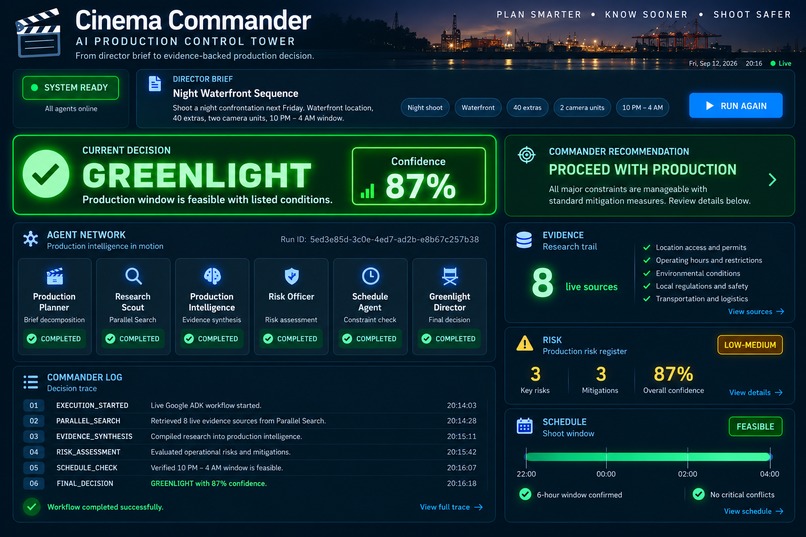
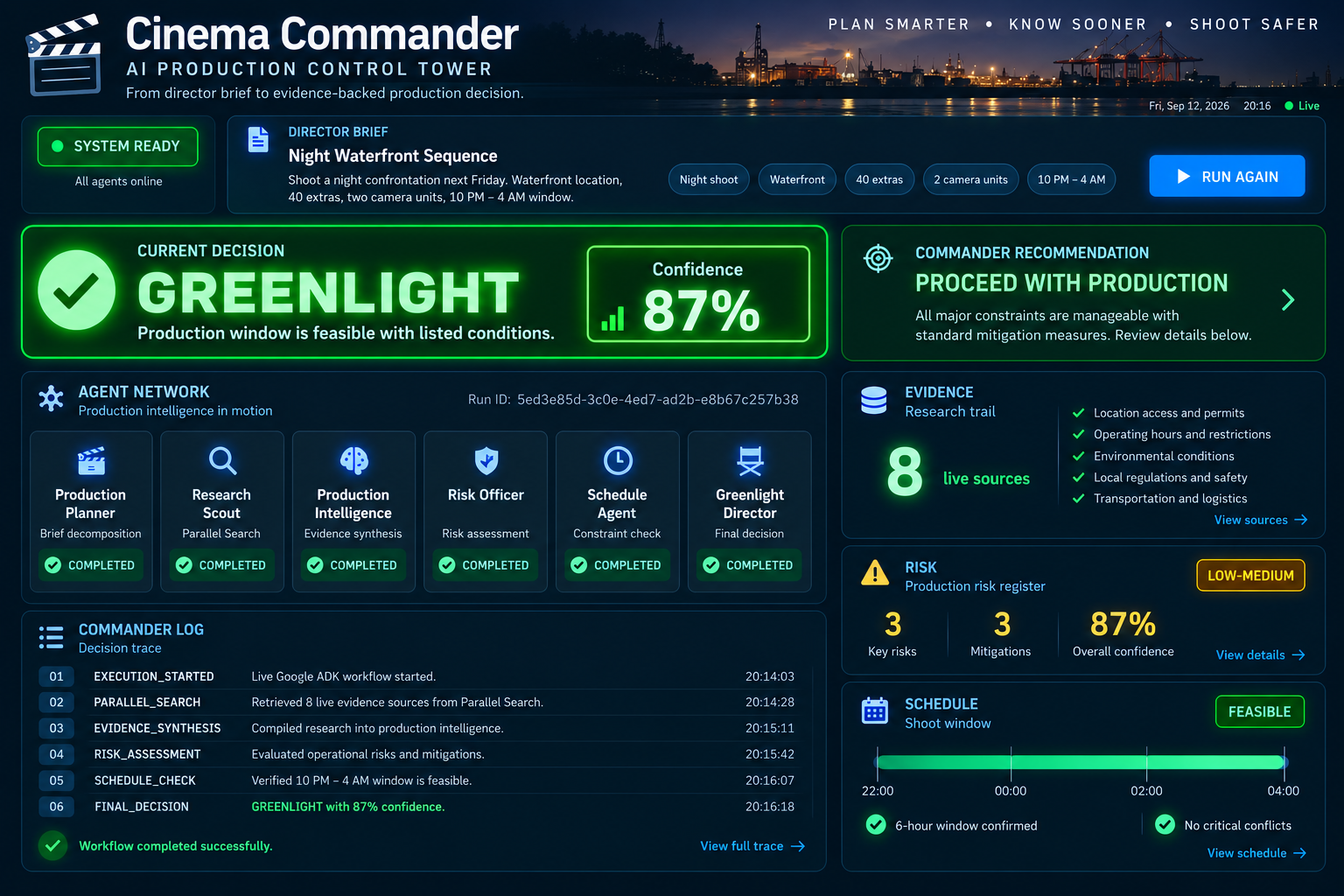
PRODUCTION GREENLIGHT 87% CONFIDENCE • READY TO PROCEED
-
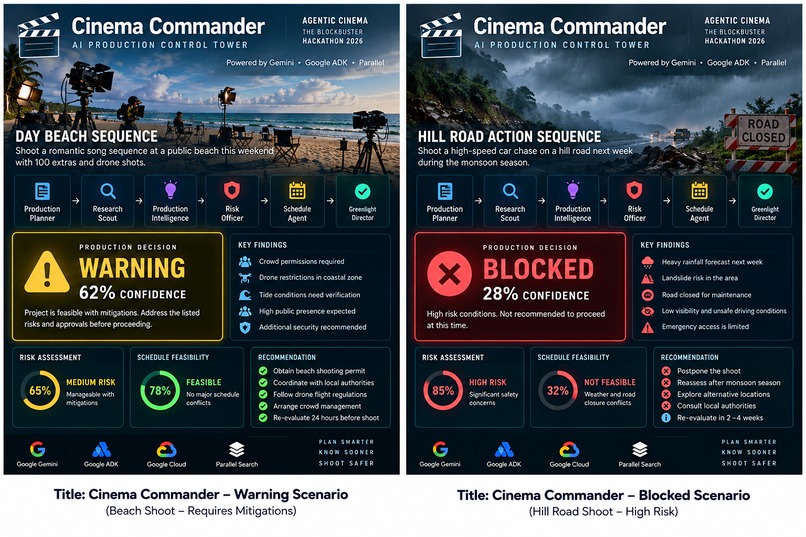
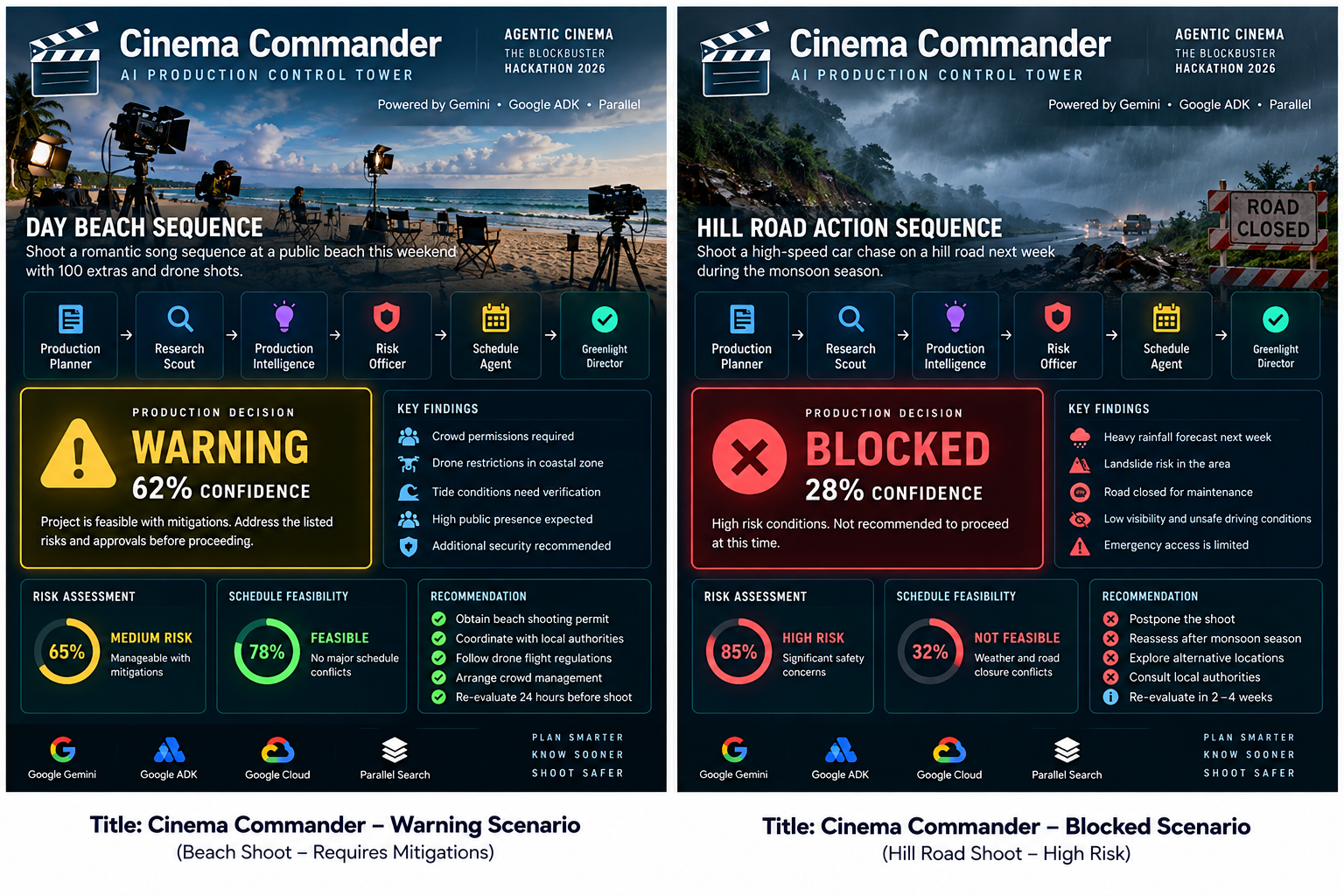
PRODUCTION BLOCKED 28% CONFIDENCE • DO NOT PROCEED
Inspiration
Film production is full of decisions that depend on information outside the screenplay: location access, permits, operating hours, transportation, environmental conditions, scheduling constraints, safety considerations, and last-minute changes.
We were inspired by a simple question:
What if a director could ask an AI production commander, “Can we actually shoot this?” — and receive an evidence-backed answer instead of a generic AI response?
Cinema Commander was created to turn production planning from a collection of disconnected searches, spreadsheets, messages, and assumptions into an intelligent decision workflow.
What it does
Cinema Commander is an AI production control tower for filmmakers and production teams.
A director provides a production brief, such as a night waterfront sequence, and Cinema Commander coordinates a team of specialized AI agents:
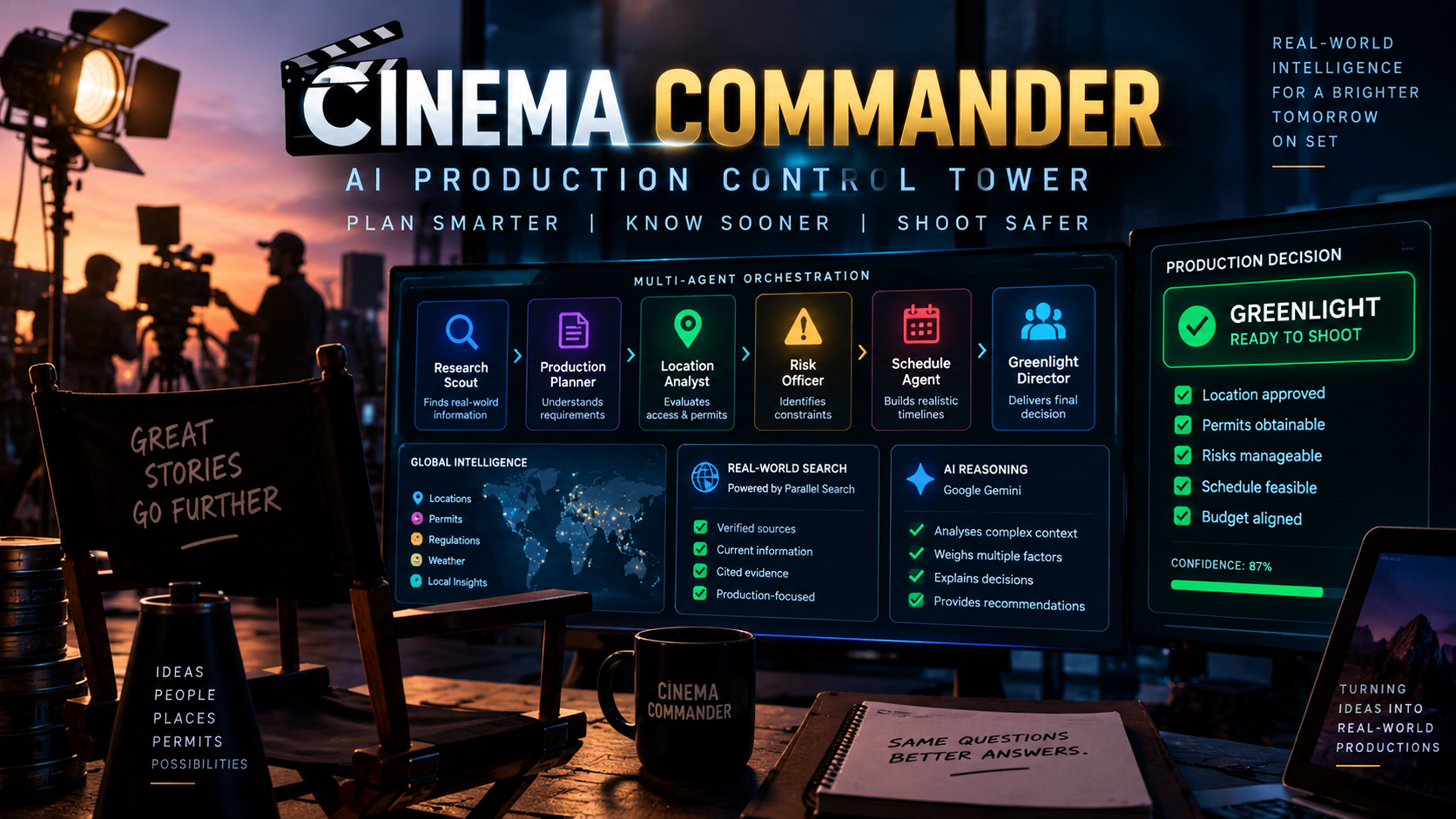
Production Planner — understands the production brief and extracts operational requirements. Research Scout — researches real-world production constraints using Parallel Search. Production Intelligence Agent — converts research results into structured production findings. Risk Officer — identifies operational risks and links them to supporting evidence. Schedule Agent — deterministically evaluates shooting duration, buffers, constraints, and conflicts. Greenlight Director — combines the results and produces an auditable GREENLIGHT, WARNING, or BLOCKED decision. Evidence & Trace Layer — records what happened, what evidence was used, and how the decision was reached. The result is a live production control tower rather than a simple chatbot.
Core decision loop:
Research → Evidence → Intelligence → Risk → Schedule → Decision → Replan
How we built it
Cinema Commander is built as a multi-agent system using Google Gemini and Google ADK, with Parallel Search integrated as a runtime research capability.
The architecture combines:
Google Gemini for reasoning and agent intelligence. Google ADK for multi-agent orchestration and agent execution. Parallel Search API for real-world web research at runtime. FastAPI for the application backend and APIs. Server-Sent Events (SSE) for live execution updates to the control tower. Deterministic production engines for risk, scheduling, and greenlight decisions. Evidence and execution tracing for auditability. HTML/CSS/JavaScript for the director-facing control tower interface.
The architecture deliberately separates AI reasoning from deterministic verification.
AI agents investigate and reason about the production problem, while deterministic engines verify scheduling arithmetic, risk thresholds, conflicts, and decision gates.
This gives Cinema Commander a more reliable foundation than relying on a single generative response.
Challenges we ran into
The biggest challenge was making the system genuinely agentic and operational, rather than creating a chatbot that simply produces a convincing paragraph.
We had to solve several problems:
Coordinating multiple specialized agents without losing the overall production objective. Integrating real external research into the agent workflow instead of mentioning a search tool only superficially. Turning unstructured research into structured production intelligence. Making AI-generated decisions auditable by connecting decisions to evidence and execution events. Separating probabilistic AI reasoning from deterministic production calculations. Creating a live agent experience where the UI reflects actual backend execution rather than simulated animations. Designing a compelling control-tower interface that communicates a complex multi-agent workflow quickly during a three-minute demo.
The most important architectural lesson was that a strong agentic application needs both intelligence and control.
Accomplishments that we're proud of
We are particularly proud that Cinema Commander evolved into a complete decision pipeline rather than stopping at multi-agent orchestration.
The system can:
Coordinate multiple specialized Gemini agents. Execute agents through Google ADK. Perform runtime research through Parallel Search. Transform research into structured production findings. Generate evidence-linked risk assessments. Evaluate schedule feasibility deterministically. Detect conflicts and evidence gaps. Produce GREENLIGHT, WARNING, or BLOCKED decisions. Preserve evidence and execution traces. Stream live agent activity to the control tower. Support production replanning when constraints change.
Most importantly, the system answers a meaningful production question:
“Can we shoot this?”
And instead of returning only an AI-generated opinion, it attempts to show why.
What we learned
We learned that multi-agent systems become much more useful when each agent has a clear responsibility and the overall workflow has explicit control points.
We also learned that:
AI reasoning should not have to perform every job.
Gemini is excellent for understanding briefs, researching problems, interpreting evidence, and reasoning across multiple constraints. Deterministic software is better suited for things such as duration arithmetic, schedule conflicts, thresholds, state transitions, and validation.
We also learned that evidence is critical for production AI. A recommendation becomes significantly more useful when the team can inspect the supporting research and understand how the system arrived at its conclusion.
Finally, we learned that the best agentic UX is not necessarily a chat window. For operational workflows, a control tower can communicate agent activity, evidence, risk, schedule, and decisions much more effectively.
What's next for Cinema Commander
Cinema Commander is designed as the foundation for a much larger production intelligence platform.
Next, we would expand it with:
Location and venue intelligence. Permit and access verification workflows. Weather and environmental intelligence. Cast and crew availability. Transportation and logistics planning. Equipment and resource planning. Budget impact analysis. Safety and crowd coordination. Production-day live monitoring. Automatic replanning when conditions change. Season/episode continuity for episodic productions. Persistent production memory across projects. Deeper Google Cloud Agent Runtime deployment. Additional specialized production agents. Collaboration workflows for directors, producers, ADs, and production managers.
The long-term vision is simple:
Cinema Commander becomes the intelligent operational layer between creative intent and real-world film production.
Instead of asking filmmakers to manually discover every constraint, compare every dependency, and coordinate every operational decision, Cinema Commander can continuously reason about the production and help the team make better decisions earlier.
Built With
- agentic-ai
- ai-agents
- ai-orchestration
- decision-intelligence
- evidence-based-ai
- fastapi
- film-production
- generative-ai
- google-adk
- google-cloud
- google-cloud-ai
- google-gemini
- multi-agent-ai
- parallel-search-api
- production-intelligence
- python
- risk-analysis
- scheduling
- server-sent-events
- web-application


Log in or sign up for Devpost to join the conversation.