Inspiration
Speed is usually shown with faster movement, streaks and motion blur. CHRONOBREAK tries the opposite: the faster the hero moves, the slower everything around it becomes. A clock is the natural stage for that idea. It is a machine whose only job is to measure time.
What it does
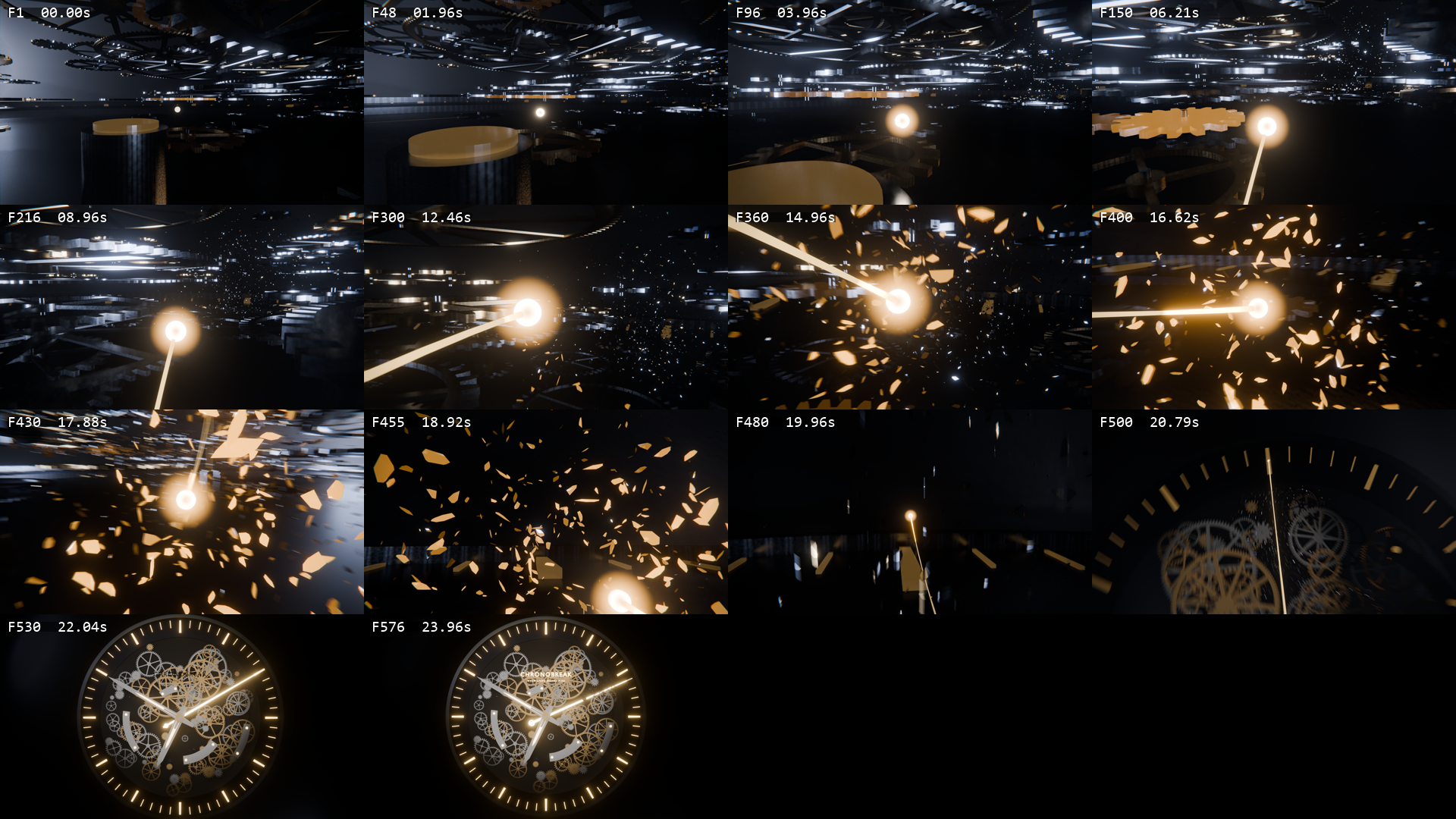
A 24-second, single-take film in five beats:
- Awakening (0–4 s): an amber pulse flickers to life on a jewelled cradle beneath towering skeleton-watch gear trains.
- Acceleration (4–9 s): it climbs a curved path through meshing, rotating gears, trailing a comet streak whose length follows its speed.
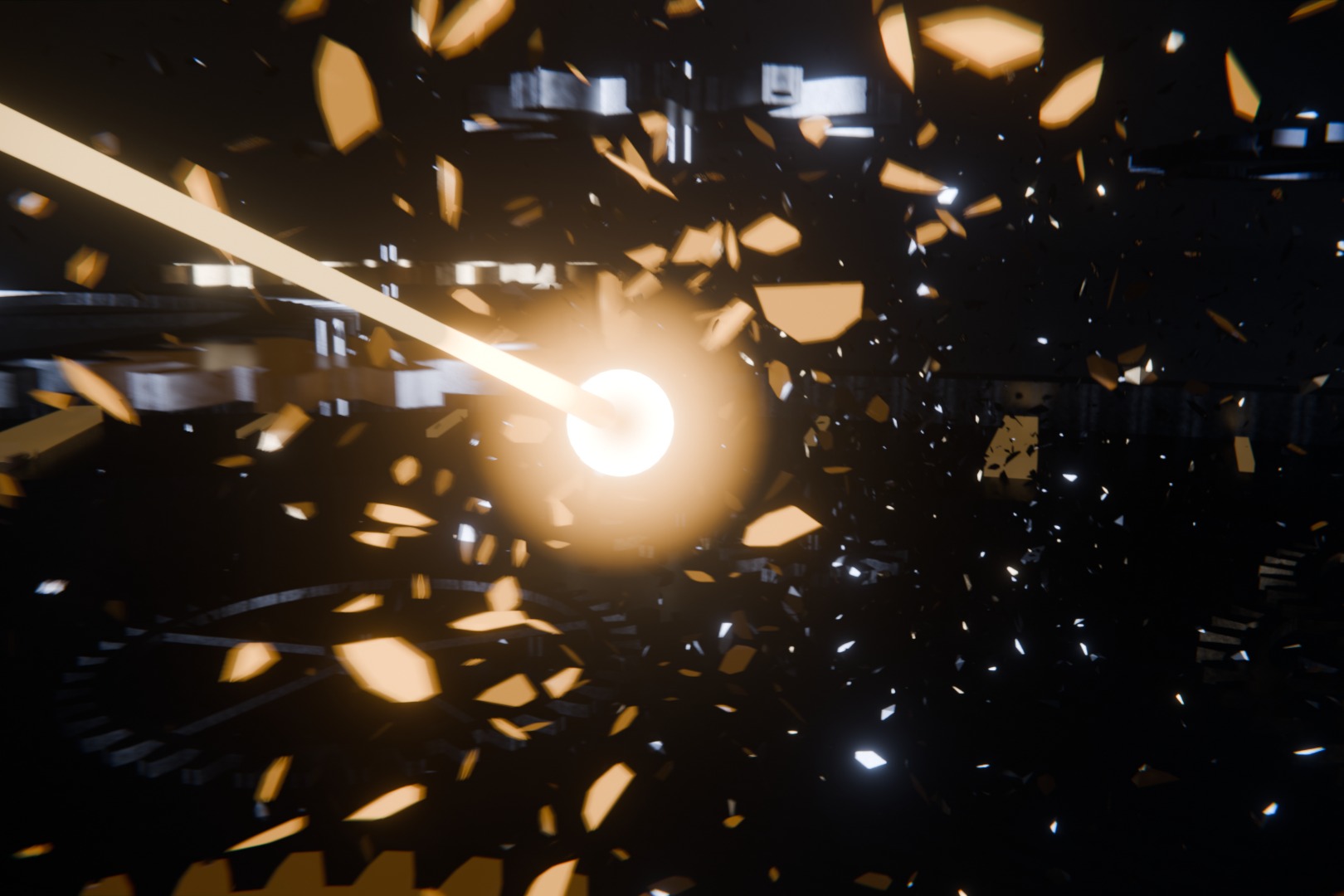
- Distortion (9–15 s): the world's own clock slows to 2.5% while the pulse keeps accelerating. Gears near it stall and fracture into shards.
- Stillness (15–20 s): the pulse crosses a field of frozen fragments. A bullet-time beat holds even the pulse while the camera orbits it, then time snaps back.
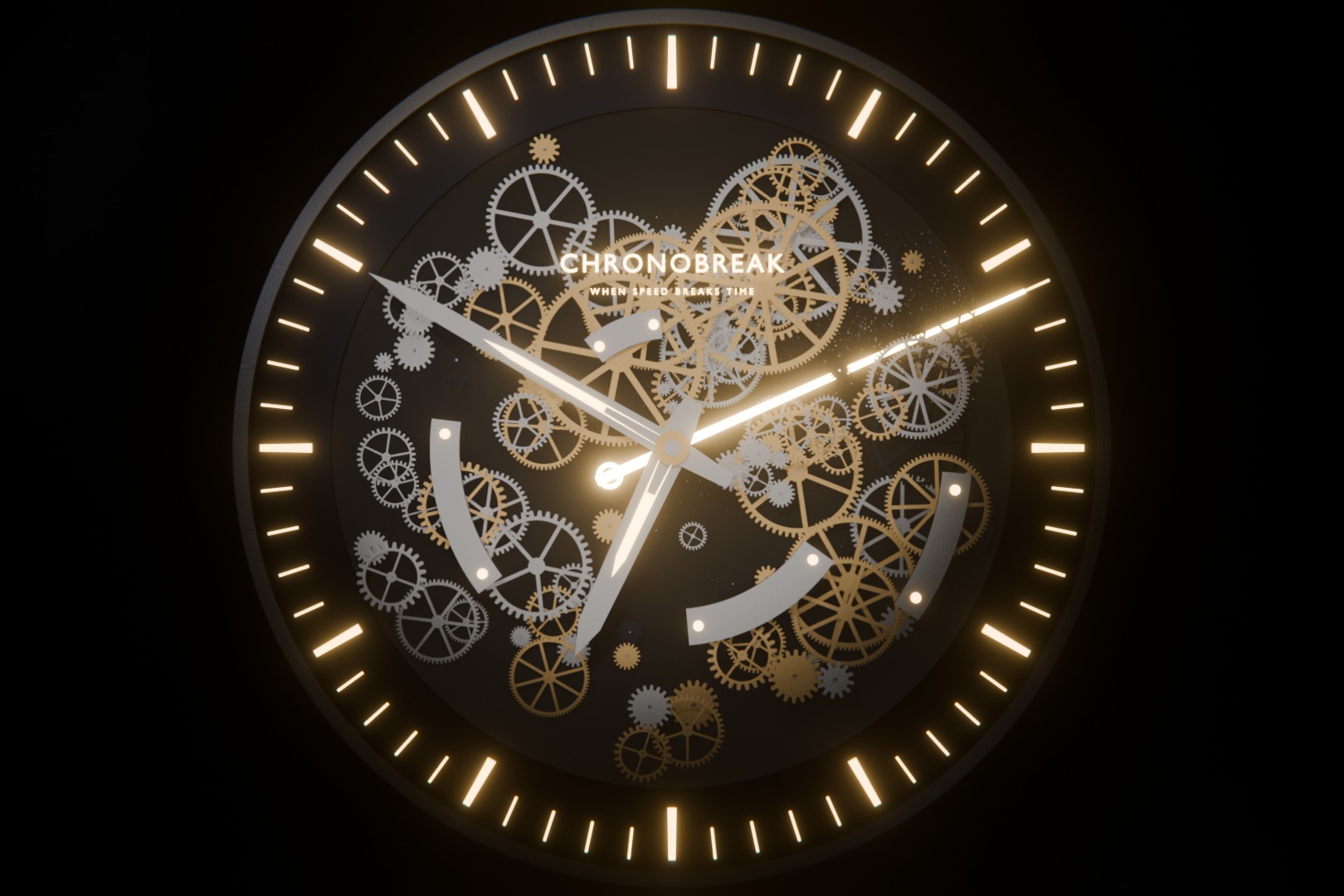
- Reveal (20–24 s): the camera rises 420 units and the pulse's looping 3D flight turns out to be a perfectly straight line, the second hand of a giant clock. It ticks once and the title lights up.
How we built it
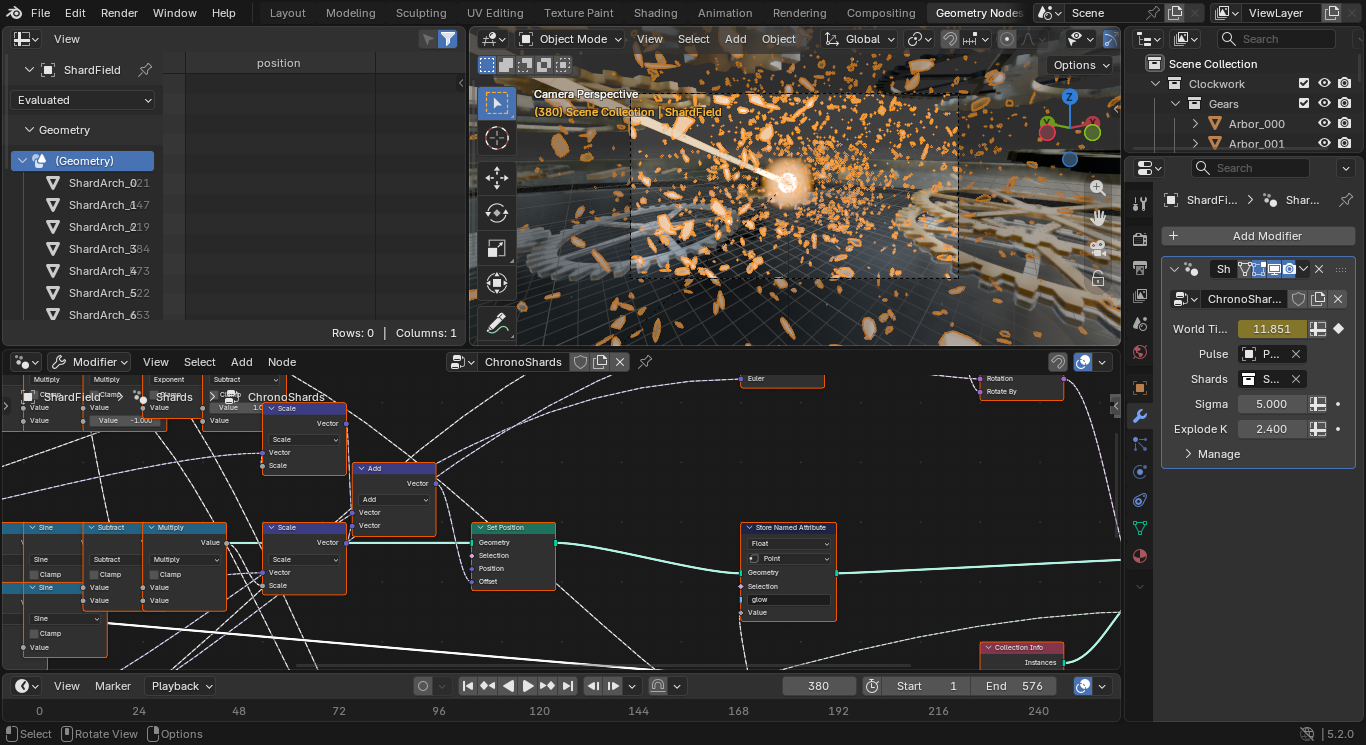
Everything is generated by Blender Python (bpy) + NumPy from two JSON config files. python run.py build rebuilds the full .blend from scratch in about 6 seconds. There are no hand-placed objects, image textures or downloaded assets.
Motion by arc length. The pulse follows a cubic Bézier
$$B(u) = (1-u)^3P_0 + 3(1-u)^2u\,P_1 + 3(1-u)u^2P_2 + u^3P_3$$
reparameterised by arc length with an inverted 8,193-sample table, because equal steps in \(u\) differ in length by more than 20% on this curve. Its speed is \(v(x) = v_0 + a\,x^{p}\) (\(p = 2.2\)). The closed-form integral \(F(x) = v_0x + \frac{a\,x^{p+1}}{p+1}\) is normalised so the pulse arrives at exactly \(t = 20\) s. It accelerates from 0.8 to 23.4 units/s.
Two clocks. Real time, story time and world time are each defined as a rate and integrated on a fixed 240 Hz grid. Gears, shards and the tick read world time, which drops to 0.025. The pulse reads story time. Speed is the gap between them.
Distortion field. A Gaussian field around the pulse
$$D(\mathbf{x},t) = \exp!\left(-\frac{\lVert \mathbf{x} - P(t)\rVert^2}{2\sigma^2}\right)$$
slows nearby gears by \((1 - 0.92\,D)\), decides which gears fracture (14 of 122), and drives amber emission in the metal and the shards.
Procedural clockwork. 10 gear archetypes (12–120 teeth) built from a trapezoidal tooth profile. A seeded rejection solver lays them out as properly meshing trains: centre distance \((N_1+N_2)\,m/2\), ratio \(-N_1/N_2\), and tooth phase solved so teeth meet gaps. It also guarantees clearance from the pulse path, the camera and its sight lines, and the top-down view of the hand.
Geometry Nodes shards. 4,975 shards are points on one mesh carrying 12 seeded attributes. A ChronoShards node group evaluates the fragment motion per point (bounded burst envelope, drift, spin, distortion glow and fracture flash) and instances 8 convex-hull shard shapes. Its only animated input is a single keyed World Time value. This is an art-directed analytic model, not a rigid-body simulation.
The reveal is geometry, not a trick. All four Bézier control points lie in the vertical plane of the second hand. Any point in that plane projects onto the same radial line from the clock axis, so the 3D path becomes a straight hand when seen from above. A unit test checks this to \(10^{-9}\).
Look. Eevee (Blender 5.2): screen-space ray-traced metal reflections, motion blur, keyed depth of field, keyed volumetric haze, AgX colour. Procedural "circular-grained" titanium, brass and blued-steel materials with an obsidian dial. The pulse's own point light is the key light. The compositor adds bloom, chromatic dispersion and a vignette.
Pipeline. QA stills → full 640×360 animatic → 1080p benchmarks (48 vs 24 samples) → final render in crash-safe 40-frame chunks → H.264 encode → verification (FFmpeg probe + full decode, SHA-256, contact sheet, frame-difference scan). 26 automated tests cover the maths, determinism, frame bounds and scene integrity.
Challenges we ran into
- The GPU compositor crashed after 162 frames. The laptop has only integrated Intel graphics, which share system RAM. A long single Blender session hit a null render-pass texture. Fix: render in 40-frame chunks, each in a fresh Blender process, with automatic resume and retries. Every value is a pure function of the frame number, so chunks are bit-identical to a continuous render. A scan of all 575 frame transitions confirmed there are no seams.
- A bug that only existed at final quality. The animatic had volumetrics off. At full settings the huge reveal softbox scattered into the fading haze, veiling the clock in grey with a visible brightness pop. The frame-difference scan caught it. Fix: the light no longer scatters in the volume; 106 frames re-rendered and re-verified.
- Mirrored lights. Area lights appeared as white discs in the glossy dial. Fix: retuned specular contribution and dial roughness.
- Readability in a crowded machine. A centre post blocked the camera, near-lens shards became bokeh blobs, and the haze washed out the image. Fix: camera clearances in the layout solver, culling shards near the lens, and rebalanced emission.
- Render budget. 48 samples cost 36.5 s/frame against 19.8 s for 24 samples, with no visible difference at 100% crop, so the final uses 24.
- Blender 5.2 API changes: new Geometry Nodes modifier input paths, the node-group compositor, and slotted-action F-curves.
Accomplishments that we're proud of
- A clock reveal that is mathematically guaranteed, not faked in compositing.
- 122 real meshing gears that crowd the frame without ever hiding the hero or the hand.
- A complete, reproducible film rendered on a laptop with no dedicated GPU.
What we learned
- Defining motion as integrated rates makes retiming a whole world a one-line change.
- Frame-independent animation is what makes chunked, crash-safe rendering possible.
- Preview passes hide whatever they turn off: always check final-quality frames across the whole sequence, not just a few stills.
Results (measured)
| Duration | 24.0 s (576 frames, 0 decode errors) |
| Format | 1920×1080, 24 fps, H.264 |
| Renderer | Eevee, 24 samples, motion blur, volumetrics, DOF |
| Hardware | Intel i7-1355U laptop, integrated Intel UHD Graphics, 15.6 GB usable RAM |
| Render time | 2 h 16 min summed over 568 logged frames (mean 14.4 s/frame) |
| Scene | 122 procedural gears, 4,975 Geometry Nodes shard instances, 0 image textures |
Asset disclosure
No third-party assets: no downloaded models, textures, HDRIs, add-ons, music or sound. All geometry, materials, animation, lighting and compositing are generated by Python scripts written for this project with the help of an AI coding assistant (Claude) and directed and reviewed by me. The imagery is rendered by Blender, not AI-generated. The title uses Blender's built-in default font.
What's next
Sound design synced to the gear ticks and the fracture moments, a smoother camera move where bullet time ends, and a 4K render on a GPU farm.
