-
-
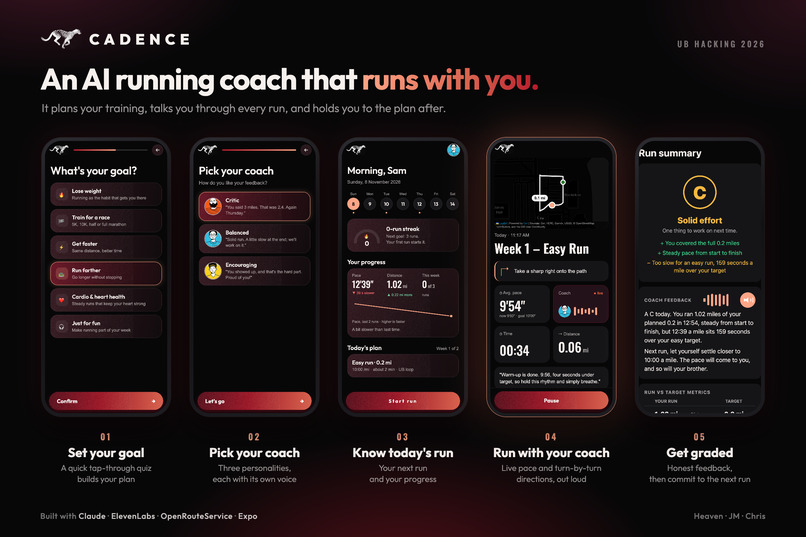
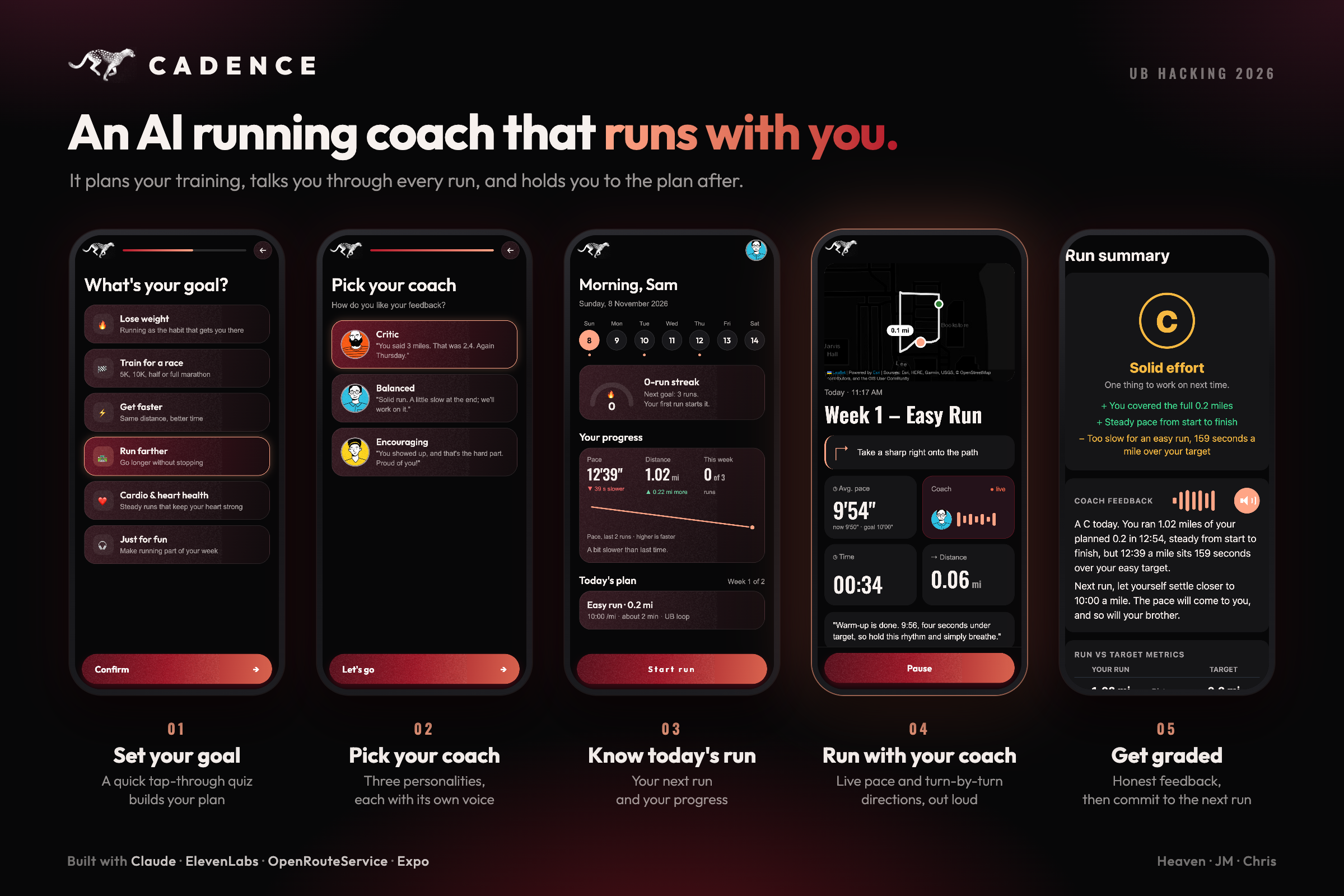
How Cadence works, in five real screens
Inspiration
Most running apps are post-game reports. Strava, Runna and Garmin Connect tell you how the run went after it's over. But the hard part of running isn't reading your stats, it's the middle of the run when you're behind pace and want to walk, or the morning you decide to skip. We wanted a coach that's actually there for that part: before the run, during it, and after it.
What it does
Cadence is a phone app with an AI coach that runs with you.
- Onboarding: a quick tap-through quiz (your goal, how much you run now, why you're doing this) builds a training plan with a date you'll hit your goal by, like "by Dec 7 you'll run 2 miles comfortably."
- Pick your coach: three coaches with very different personalities: a no-excuses drill sergeant, a calm mentor who never raises his voice, and an overjoyed grandpa. Same run, same numbers, completely different energy. Each one has its own voice.
- The run: the app plans a loop of the right distance on real paths from where you start, and the coach talks you through it out loud so you never have to look at your phone. It calls out your pace against the target, mile splits, halfway, and a final push when you're behind ("you're 30 seconds down, speed up... GO GO GO"). It also does turn-by-turn directions like a car GPS, tells you when you're off the route and which way to go, and the run ends by itself when you hit the distance.
- The coach only says what's true: it doesn't just say "great job" on a timer. It only praises you when your pace actually backs it up, and it gives the number ("you pulled back to 12:08, that's on target").
- After the run: a check-in on how you feel, a grade against the plan, the coach's take on the run, and your next run with a Confirm button so you commit to it right then. Miss a run without a real reason and the coach calls you on it. Have a real reason (injury, weather) and the run gets moved instead.
- Home: your next run and your progress (pace and distance vs. your last runs, runs this week).
How we built it
- App: Expo (React Native + TypeScript) with Expo Router, so it runs on iPhone and Android through Expo Go, plus a web preview. Each of us owned one part of the app in its own folder and branch: onboarding and plan (Heaven), the run and the live coach (JM), after the run and home (Chris). We agreed on the data shapes the three parts pass to each other first, so the pull requests fit together.
- The coach brain: a behavior tree in the app works out what the runner is doing every second (pace smoothed over 20 seconds, ahead/on pace/behind, speeding up or fading, mile splits, projected finish) and picks the most important thing to say. Our Node server sends that situation, the evidence and the coach's persona to Claude (the Anthropic API), which writes the line in that coach's voice.
- Voices: ElevenLabs text-to-speech, one voice per coach. Lines we can predict ahead of time (the countdown, milestones, the final push) are prepared early so they play right on time.
- Routes and directions: OpenRouteService round trips give us loops on real walking paths. The server asks for two loops and scores them (real paths, few turns, wide loop, no doubling back, length close to the run) and keeps the better one. Turn instructions come from the same route and are grouped like a GPS ("turn left, then right"). On a real run, your GPS position is snapped onto the route, so turns are called as you reach them. Maps are react-native-maps on the phone and Leaflet in the browser.
- Testing without running a mile every time: a run simulator sends the same data every second that real GPS does, so we could test the coach on a laptop. A "Demo run / Real run" switch picks between the simulator and the phone's GPS.
- Hosting: the server and the web version are on Render, deployed from our main branch.
Challenges we ran into
- Making the coach feel like a running buddy, not a notification. Our first phone test felt empty, then too chatty. We ended up with short buddy lines every 15 to 25 seconds, never the same kind twice in a row, with bigger moments (halfway, falling behind) getting a full sentence.
- GPS is messy. Real runs had jumps and weak fixes, so we filter those out and snap the runner onto the planned route. We also had to work out when someone is off the route, running the wrong way, or took a shortcut to the finish.
- API limits. We burned through the whole day's OpenRouteService quota because each route was making four calls. We cut it to two, cached routes for 30 minutes, and baked a built-in loop around Lake LaSalle on UB North Campus as a backup.
- Phone browsers and sound. Phones only play audio that a tap started, so the coach went silent in the browser version. We route every coach clip through one shared speaker that the first tap unlocks.
- Three people building at once, one of us on Windows without a Mac, on campus Wi-Fi that blocks Expo Go sometimes (tunnel mode saved us).
Accomplishments that we're proud of
- The coach reacts to what you're actually doing, with real numbers, in three personalities you can hear the difference between.
- Turn-by-turn directions in the coach's voice, including "you're off the route, it's to your left."
- Three separate parts built in parallel by three people that plug together into one flow, from the first screen to the next run.
What we learned
- How to design an AI feature around evidence: the model only gets to say what the data supports, which made the coach way more believable than letting it improvise.
- Routing, GPS map matching and audio timing on phones are each harder than they look.
- Agreeing on the data contract first is what let three people build at the same time without stepping on each other.
What's next for Cadence
- Apple Watch heart rate, so the coach can coach effort and not just pace.
- Running with the screen locked (needs a full iPhone build with background location instead of Expo Go).
- Talking back to the coach mid-run, and talking it through after a run ("I might skip the next one").
- Using the AI to adapt the plan when someone keeps falling below it. Right now the plan comes from a fixed template.
- Making your own coach from a character you like.
Built With
- anthropic
- claude
- elevenlabs
- expo.io
- leaflet.js
- node.js
- openrouteservice
- openstreetmap
- react-native
- react-native-maps
- render
- typescript


