-
-
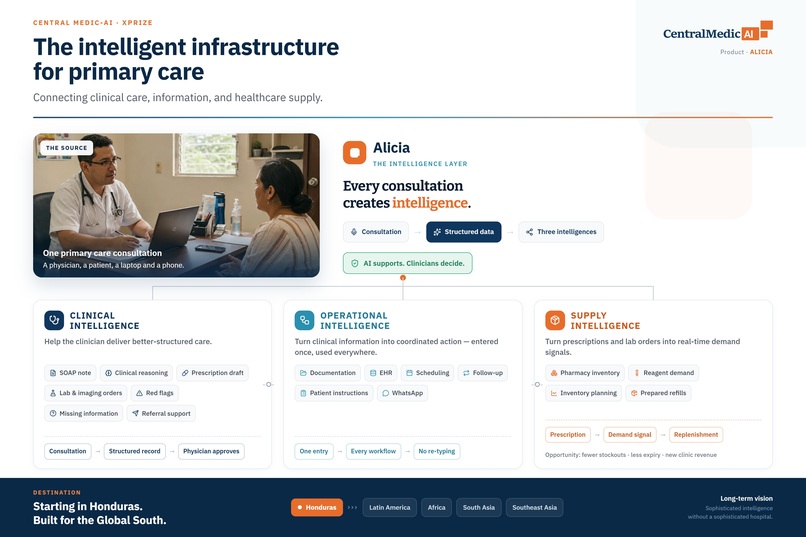
Alicia turns every consultation into clinical, operational, and supply intelligence—building smarter primary care from the source.
-
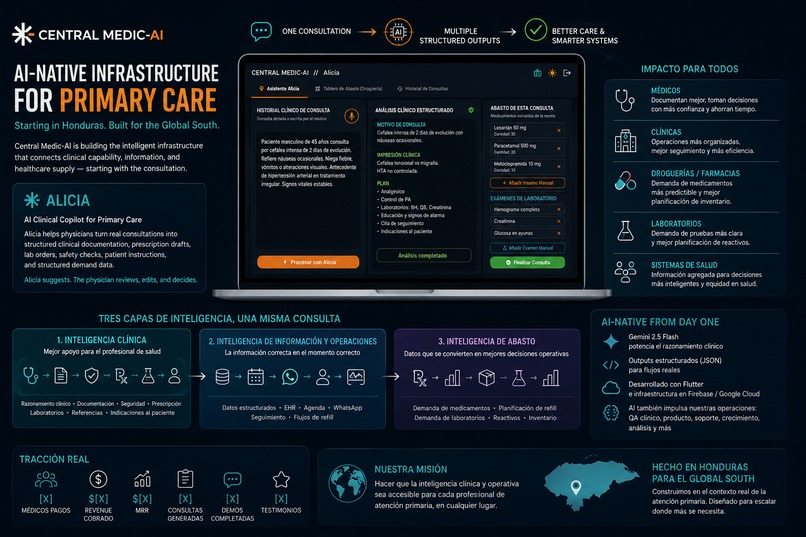
Central Medic AI from Honduras to the Global South
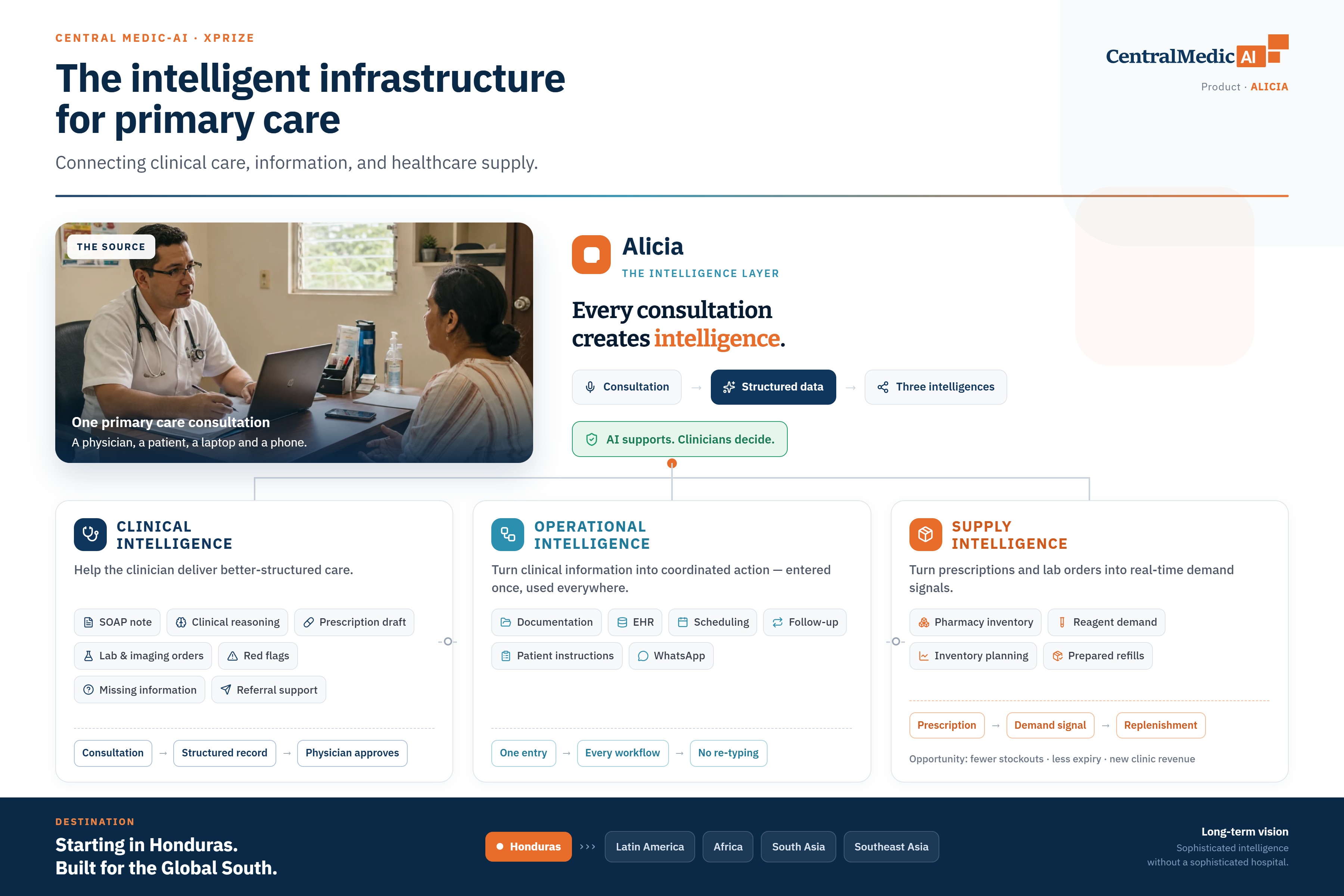
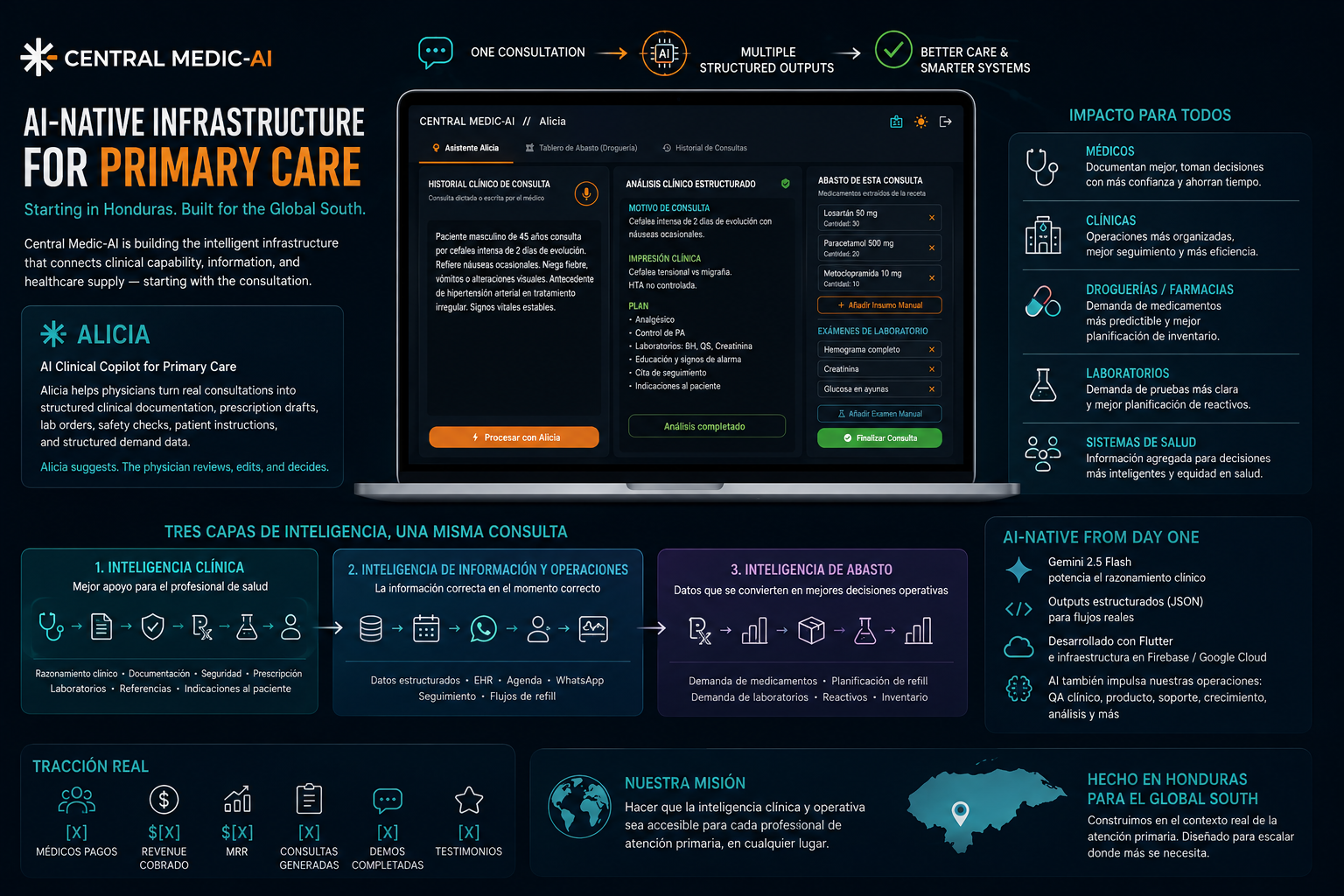
Central Medic-AI is building the intelligent infrastructure for primary care across the Global South — starting in Honduras.
We start with Alicia, an AI clinical copilot that helps primary care physicians turn everyday consultations into structured clinical workflows: documentation, prescription drafts, laboratory and imaging orders, safety checks, patient instructions, and structured medication and laboratory demand data.
Our thesis is simple:
Primary care works better when clinical capability, information, and healthcare supply are connected instead of operating in silos.
Central Medic-AI starts where all three intersect:
the consultation.
Inspiration
Primary care is where most people first interact with a health system.
Yet across much of the Global South, the professionals delivering that care often work without the digital and operational infrastructure available to large health systems.
I know this reality personally.
I am Manuel Espinoza, a physician and public health professional from Honduras. I have spent years working in and around primary care and public health, and I have seen clinicians expected to do everything at once: listen to the patient, examine, reason clinically, document the encounter, write prescriptions, order tests, explain the plan, coordinate referrals, and move on to the next patient.
Often, they do it with paper, WhatsApp, memory, or fragmented systems.
My experience in public health has led me to a simple belief:
Primary care becomes stronger when clinical capability, information, and healthcare supply are connected.
But in many underserved settings, those three systems remain disconnected.
A physician may make a good clinical decision, but documentation remains on paper. A prescription creates medication demand, but the clinic has no system to learn from it. A laboratory order creates demand for tests and reagents, but inventory planning happens separately. A patient may need specialist care, but the referral process can introduce additional delays.
We started Central Medic-AI with a simple question:
What if AI could help connect these pieces, starting with the healthcare professional already sitting in front of the patient?
That question became Alicia.
Our mission is bigger than building another AI assistant.
We want to make intelligent primary care infrastructure accessible across the Global South.
Honduras is where we are starting.
What it does
Alicia is our AI clinical copilot for primary care physicians.
A physician enters or dictates information from a consultation. Alicia helps transform that information into structured clinical outputs, including:
- SOAP clinical documentation
- Suggested diagnoses with levels of certainty
- Prescription drafts for physician review
- Laboratory and imaging suggestions
- Missing critical information
- Clinical warnings and red flags
- Structured medication and laboratory demand data
- Patient-facing instructions prepared for physician review and sharing through WhatsApp
The principle behind the product is simple:
Alicia suggests. The physician reviews, edits, and decides.
Alicia does not replace the physician or specialist.
Instead, we are building a lightweight intelligence layer that helps clinicians structure the work they already do while keeping clinical responsibility with the healthcare professional.
Alicia can also prepare patient-facing instructions for WhatsApp without sending the physician's full clinical note. The physician reviews the message and decides whether to edit, send, or discard it.
This means one consultation can move through a single AI-assisted workflow:
Consultation → Clinical structure → Prescription → Labs → Safety → Patient instructions → Structured demand
That can also matter when access to the next level of care is delayed.
In early real-world use, we have seen Alicia help a primary care physician organize clinical information, consider additional work-up, and prepare a more complete referral while specialist input was still pending.
The patient was still referred.
The physician still made the decisions.
But primary care did not have to stop thinking while it waited.
From prototype to real-world use
The accomplishment we are most proud of is simple:
Central Medic-AI left the prototype stage and entered the real world.
We deployed Alicia, began demonstrating it directly to practicing physicians, onboarded real users, and converted early physicians into paying customers.
As of [08-16-2026]:
| Evidence | Result |
|---|---|
| Paying physicians | [5] |
| Revenue collected | $[30] |
| Monthly recurring revenue | $[0] |
| Real consultations generated | [100] |
| Physician demos completed | [15] |
| Physician testimonials | [7] |
| Medication demand records captured | [145] |
| Laboratory demand records captured | [94] |
These are early numbers.
We believe that is precisely why they matter.
They do not represent projections, survey responses, or hypothetical interest.
They represent clinicians willing to try, critique, use, and pay for a product built in Honduras.
Our goal during this competition has not been to build the largest feature set.
It has been to demonstrate the beginnings of a real, AI-native business.
How we built it
Central Medic-AI was designed as an AI-native business from the beginning.
AI inside the product
Alicia uses Gemini 2.5 Flash through the Gemini API as the core AI model in the production clinical workflow.
Rather than returning only conversational text, Alicia analyzes clinical information and produces structured outputs that can be rendered into different parts of the workflow.
The clinical note, suggested diagnoses, prescription draft, laboratory orders, missing information, safety warnings, and demand data can therefore be handled as distinct components.
This architecture matters beyond documentation.
Once the consultation becomes structured data, that same information can eventually connect to EHR fields, patient communication, scheduling, inventory systems, referrals, and analytics without asking the clinician to recreate the encounter every time.
Our application is built with Flutter and Firebase / Google Cloud infrastructure, allowing physicians to access Alicia through a responsive web application using devices they already have.
AI inside the company
AI is not only a feature of Alicia.
We also use AI throughout the way we build and operate Central Medic-AI, including:
- Clinical QA and test-case development
- Product development and debugging
- Customer discovery analysis
- Physician onboarding
- Growth and sales workflows
- Customer support
- Feedback synthesis
- Business planning
- Evidence organization
This allows a very small team in Honduras to operate with capabilities that previously would have required a much larger organization.
The division of responsibility remains deliberate:
AI accelerates and structures the work. Humans remain accountable for the decisions.
One consultation, three layers of intelligence
Going to market helped us realize that a clinical consultation produces much more than a note.
It creates decisions, documentation, prescriptions, laboratory demand, follow-up requirements, referrals, and future care.
When AI converts that encounter into structured information, the consultation can become the starting point for three connected layers of infrastructure.
1. Clinical Intelligence
Help the healthcare professional make the consultation more structured and actionable.
Clinical reasoning → Documentation → Safety checks → Prescription → Labs → Referral support
This is where Alicia begins today.
2. Information & Operational Intelligence
Turn clinical information into coordinated action around the consultation.
Structured data → EHR → Scheduling → Patient instructions → WhatsApp → Follow-up
Some of this workflow already exists today, including structured documentation and preparation of patient-facing WhatsApp instructions.
Other components, including deeper EHR integration and scheduling, belong to our customer-driven roadmap.
The underlying goal is simple:
Enter the clinical information once. Make it useful everywhere it needs to go.
3. Supply Intelligence
Turn prescriptions and laboratory orders into demand signals.
Prescription → Medication demand → Refill planning → Inventory
Lab order → Test demand → Reagent demand → Inventory
This is particularly relevant to our market.
Many small primary care clinics in Honduras also operate a small pharmacy, dispense medications, provide basic laboratory services, or depend on nearby suppliers. Yet they may lack sophisticated software to understand what medications or laboratory reagents are actually moving.
Central Medic-AI already captures structured prescription and laboratory demand at the source:
the consultation.
Over time, aggregated and non-identifiable demand data could help clinics plan purchasing, reduce unnecessary inventory, anticipate replenishment, and develop additional revenue opportunities around services they already provide.
We have not yet proven these downstream outcomes.
But we are already building the data foundation that makes them possible.
Challenges we ran into
Our biggest challenge was not getting an AI model to generate a clinical note.
It was building something a physician could trust enough to use.
Healthcare is different from building a generic productivity application.
Clinical information may be incomplete. Medications have contraindications. Pediatric dosing requires specific information. Dangerous conditions can initially look routine. And an AI response that sounds confident can still be wrong.
That forced us to think beyond generation and build around clinical guardrails, missing-information checks, red flags, structured outputs, and explicit physician control.
Then we encountered a second challenge:
The market began asking for more than we originally planned.
Once we started demonstrating Alicia to practicing physicians, the conversations changed.
Doctors began asking:
- Can Alicia populate the fields in my existing EHR?
- Can it schedule the patient's next appointment?
- Can it send patient instructions through WhatsApp?
- Can it remind patients about follow-up?
- Could the clinic prepare chronic medication refills in advance?
- Could connected blood pressure monitors or glucometers feed information back to the physician?
Some of that feedback has already influenced the product.
Patient-facing WhatsApp instructions, for example, moved from physician feedback into the live workflow.
After we made Central Medic-AI publicly accessible, something else happened that we did not expect:
Nurses began contacting us.
Some work in frontline settings where physician availability is limited and asked whether Alicia could support their workflows too.
We are not treating every request as a feature to build immediately.
We are treating them as market signals.
They are helping us understand where the infrastructure is missing.
What we learned
Going to market changed how we think about Central Medic-AI.
We started by thinking about documentation. We discovered an infrastructure opportunity.
Our original problem was straightforward: help a physician manage the information generated during a consultation.
But the moment that information became structured, new possibilities appeared.
A prescription is not only a document for the patient.
It is also a demand signal.
A laboratory order is not only a clinical instruction.
It is also a demand signal.
A follow-up recommendation is not only text.
It is also a future workflow.
A referral is not simply a destination.
It is a transfer of structured clinical information between levels of care.
That realization changed our roadmap.
We also learned that building for the Global South should not mean creating a cheaper copy of software designed for large health systems elsewhere.
The starting conditions are different.
Small clinics may have no formal EHR. Administrative support may be limited. WhatsApp may be more important than a patient portal. Clinics may operate their own small pharmacies or laboratories without sophisticated inventory systems. Patients may travel between multiple pharmacies looking for medications. And some frontline facilities operate with limited physician availability.
These are not edge cases here.
They are the design environment.
Honduras is our starting point.
The problem is much larger.
Business viability: start narrow, expand from real demand
Our business model begins deliberately with the simplest relationship:
Help physicians first.
Physicians are our initial users and customers because the consultation is where clinical trust, documentation, prescriptions, laboratory orders, referrals, and follow-up originate.
That gives us a focused entry point with a low-friction subscription product.
Our current founder plan validates a simple proposition:
Will physicians pay directly for an AI copilot that makes their daily clinical workflow easier?
Early paying customers give us an initial signal that the answer can be yes.
But the same workflow creates opportunities to serve additional customers and generate additional value over time:
- Physicians — AI clinical assistance
- Clinics — workflow automation and operational tools
- Small pharmacies and clinic dispensaries — medication demand and refill workflows
- Laboratories — test and reagent demand intelligence
- Healthcare networks — potential aggregated operational intelligence
- Frontline health programs — role-aware support and coordination
We do not need to build all of these businesses today.
Our strategy is to earn the right to expand by first proving physician adoption, usage, trust, retention, and willingness to pay.
Doctors first. Structured demand second. Connected primary care next.
What's next: a customer-driven roadmap
Our roadmap is not a feature wishlist.
It is increasingly being shaped by customer pull.
Each layer builds on the information, trust, and workflow created by the one before it.
Today — Prove the physician workflow
Consultation → Documentation → Prescription → Labs → Safety → Patient Instructions → Structured Demand
Help the physician first.
Earn trust.
Generate usage.
Generate revenue.
Capture structured demand.
This is our current foundation.
Next — Connect the clinic
Structured Data → EHR → Scheduling → Follow-up → Refill Workflows
Physicians are already asking us to connect Alicia's output to the workflows surrounding the consultation.
The goal is simple:
Enter the clinical information once. Make it useful everywhere it needs to go.
This could reduce duplicate documentation and allow the structured consultation to become the operational foundation for what happens after the visit.
Medication and laboratory workflows are particularly interesting because they connect clinical activity with clinic operations.
For chronic patients, predictable medication demand could eventually support easier refill workflows.
For clinics and laboratories, aggregated demand could help inform purchasing and inventory decisions.
These are roadmap opportunities, not outcomes we claim to have proven today.
Later — Expand the infrastructure
Supply Intelligence → Role-Aware Frontline Support → Remote Monitoring → Connected Primary Care
Interest from nurses revealed another potential access problem.
Future versions of Alicia could adapt to different professional roles with appropriately constrained capabilities, stronger protocols, and explicit escalation rules.
The goal is not to use AI to expand someone's professional scope.
It is to provide better support within that scope and connect frontline professionals more effectively to the next level of care.
Physicians have also suggested connecting devices such as blood pressure monitors, glucometers, and pulse oximeters.
Over time, this could allow primary care to extend beyond the consultation itself.
Responsibly aggregated, non-identifiable information could eventually help clinics and healthcare networks understand medication demand, laboratory demand, chronic disease patterns, and operational needs.
These longer-term opportunities remain part of our vision, not our current product claims.
Our destination
Our ambition is not to build every feature at once.
It is to build each layer only when the previous one has earned the right to expand.
We start with physicians because that is where clinical trust begins.
We start with the consultation because that is where clinical decisions, documentation, prescriptions, laboratory demand, referrals, and follow-up converge.
And we start in Honduras because this is a healthcare system we know firsthand.
Our long-term thesis is simple:
Primary care works better when clinical capability, information, and healthcare supply are connected rather than operating in silos.
Central Medic-AI aims to become the AI-native layer that connects them.
We imagine a future where a primary care professional in a small clinic in Honduras — or anywhere across the Global South — can operate with intelligent clinical support, connected workflows, better visibility into supply needs, and stronger coordination with the rest of the health system.
Not because that clinic became a sophisticated hospital.
But because sophisticated intelligence became accessible to that clinic.
Central Medic-AI is building the intelligent infrastructure for primary care across the Global South.
The vision is global. The proof starts in Honduras.
Built With
- dart
- firebase
- firestore
- flutter
- gemini
- google-cloud
- googleai

Log in or sign up for Devpost to join the conversation.