-
-
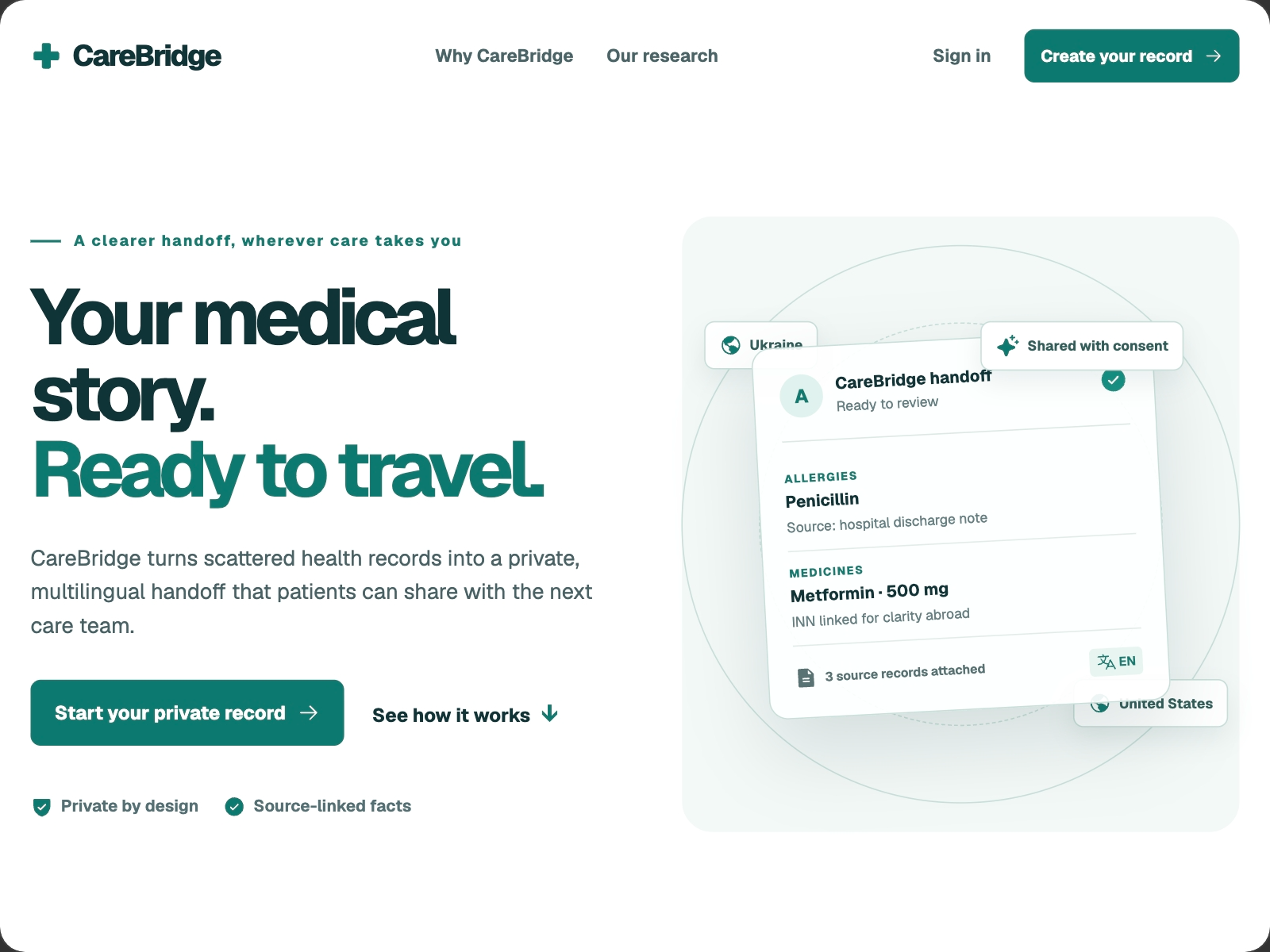
landing
-
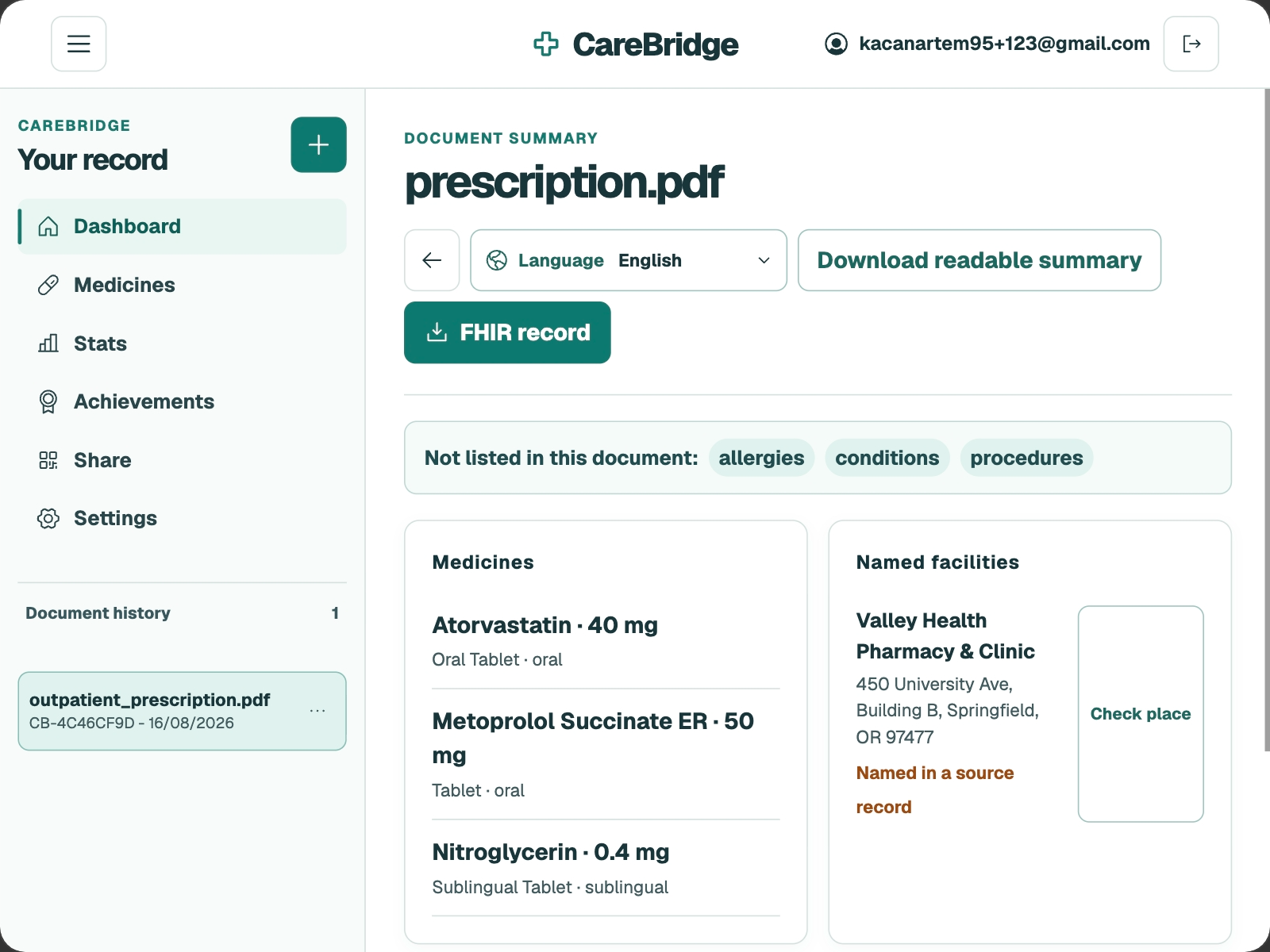
record example
-
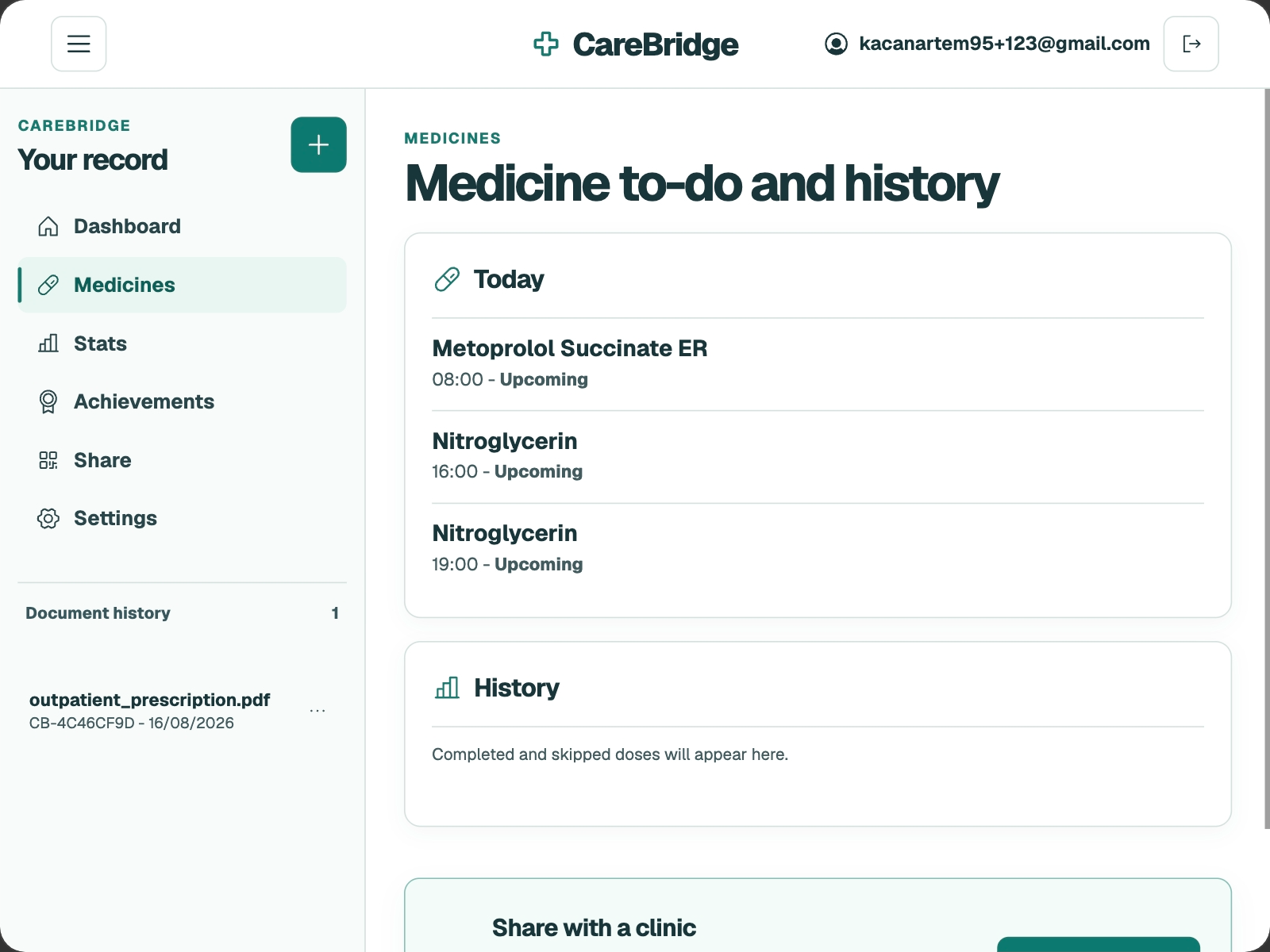
medicine to-do
-
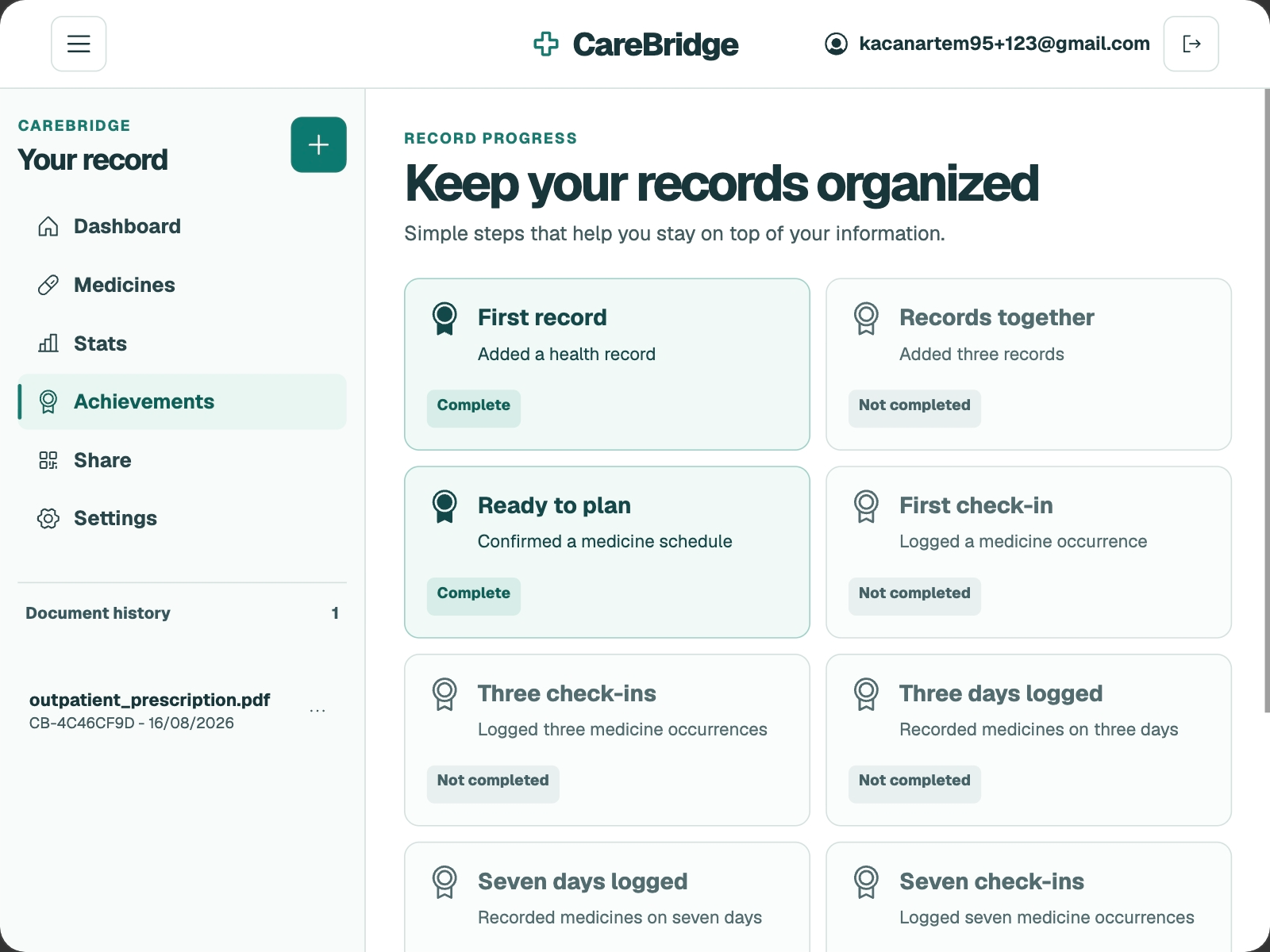
achievements
Inspiration
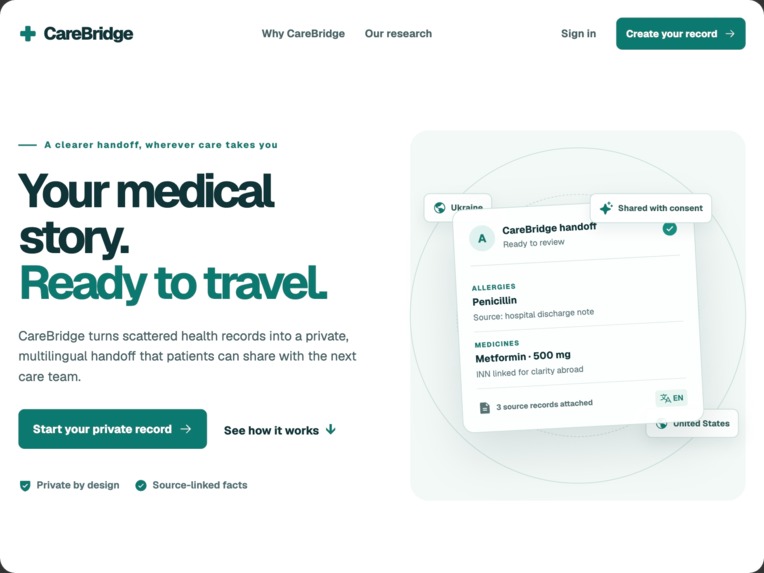
CareBridge was inspired by a simple problem in healthcare: patients often carry medical history in scattered files, screenshots, PDFs, lab reports, prescriptions, and records written in different languages. When they arrive at a clinic, the clinician may have only a few minutes to understand what matters.
A normal AI summary is not enough for this situation. Medical context needs traceability. If a system says a patient has an allergy, takes a medication, or had a procedure, the user should be able to see exactly where that fact came from.
CareBridge is built around that idea: every extracted fact stays connected to its original evidence.
What it does
CareBridge is a full-stack MVP for evidence-linked, multilingual patient handoff.
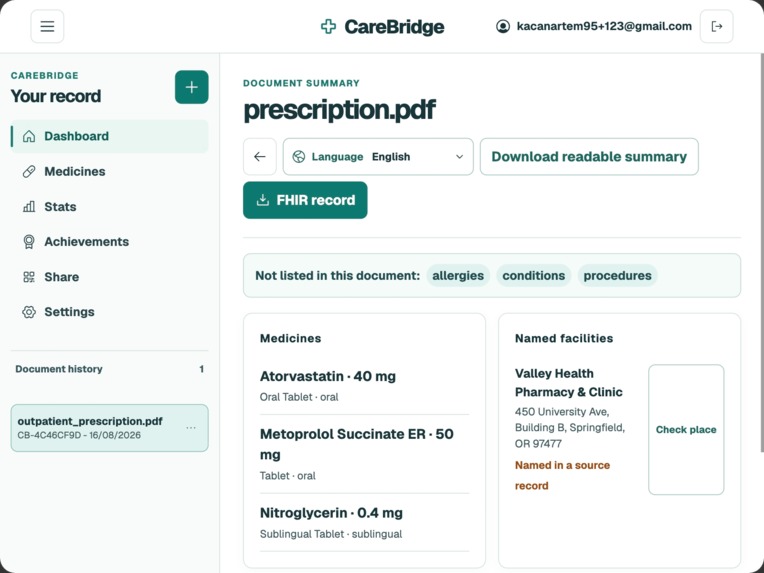
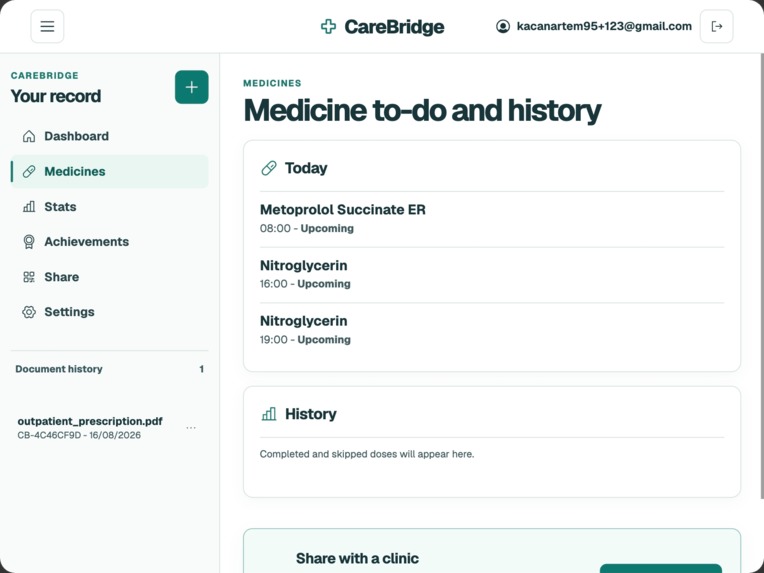
A patient can register, upload private PDF or image medical records, extract explicit facts with AI, review the evidence behind each fact, translate summaries, manage medication schedules, search nearby pharmacies, export a readable handoff, and generate a temporary QR sharing code.
An approved clinic can redeem the patient’s one-use code, view shared patient context, open source records, compare documents, create clinic documents, issue them, and download generated PDFs.
The system organizes information into:
- medications
- allergies
- conditions
- procedures
- facilities
- lab observations
- patient summaries
- clinic-issued documents
CareBridge is intentionally conservative. It does not diagnose, prescribe, calculate dosage, or recommend medication substitutions.
How we built it
CareBridge uses Next.js 16, React 19, TypeScript, Supabase Auth, Supabase Postgres, Row Level Security, Supabase Storage, Gemini, PDF parsing, QR generation, QR scanning, generated PDFs, IndexedDB caching, and external public health and map sources.
The patient uploads a PDF, JPEG, PNG, or WebP record. The app detects exact SHA-256 duplicates before AI processing. For PDFs, embedded text is extracted where available. Gemini then receives the record and returns structured JSON with evidence fields.
For each extracted fact, CareBridge stores or returns:
- source filename
- source location
- original text
- confidence
- verification status
The sharing flow uses a temporary token:
( token_hash = SHA256(token) )
Only the hash is stored server-side. The raw token is shown only to the patient as a QR code or manual code. The code expires after five minutes and is intended to be redeemed once by an approved clinic.
Access control is enforced mainly through Supabase Row Level Security. Patients manage their own records. Clinics can read patient data only after explicit patient sharing creates an access grant.
Challenges we ran into
The hardest challenge was balancing usefulness with safety. It would be easy to build a flashy medical AI assistant that gives confident answers. CareBridge takes a narrower approach: organize facts, preserve evidence, mark uncertainty, and avoid clinical decisions.
Another challenge was the patient-clinic permission model. A simple shared link would be faster to build, but medical data needs stronger boundaries. CareBridge uses temporary sharing codes, clinic approval, access grants, private storage, and database-level policies.
The third challenge was making the demo complete within a hackathon timeline. The project includes patient upload, extraction, evidence review, translation, QR sharing, clinic access, document comparison, and generated PDFs, while still staying clear that it is an MVP and not a production medical device.
What we learned
We learned that healthcare software needs careful product boundaries. The safest useful version of this idea is not a diagnostic chatbot. It is a handoff layer that helps humans review existing evidence faster.
We also learned how important backend authorization is. In this project, the frontend experience matters, but the real trust model comes from Supabase Auth, private storage, Row Level Security, and explicit patient-to-clinic grants.
What’s next
The next steps are production deployment, stronger rate limiting, audit logs, compliance review, clinic onboarding automation, broader test coverage, better document templates, improved FHIR conformance, and validation with clinicians and patients.
CareBridge is currently a prototype/MVP. It is not clinically validated and should not be used as a diagnostic, prescribing, medication-substitution, or emergency medical system.
Built With
- fda
- gemini
- genai
- indexeddb
- medlineplus
- motion
- next.js
- nominatim
- openstreetmap
- overpass
- pdf-lib
- pdf-parse
- postgresql
- qrcode
- react
- sdk
- typescript
- vitest
- zxing

Log in or sign up for Devpost to join the conversation.