CareNori — Find Care. Understand It. Be Heard.
💡 Inspiration
Accessing healthcare should not be more difficult because someone has a disability.
People with mobility, visual, hearing, or communication disabilities often face additional barriers when navigating hospitals, understanding medical documents, finding accessible entrances, or communicating with healthcare professionals.
We wanted to build something that goes beyond a traditional healthcare website.
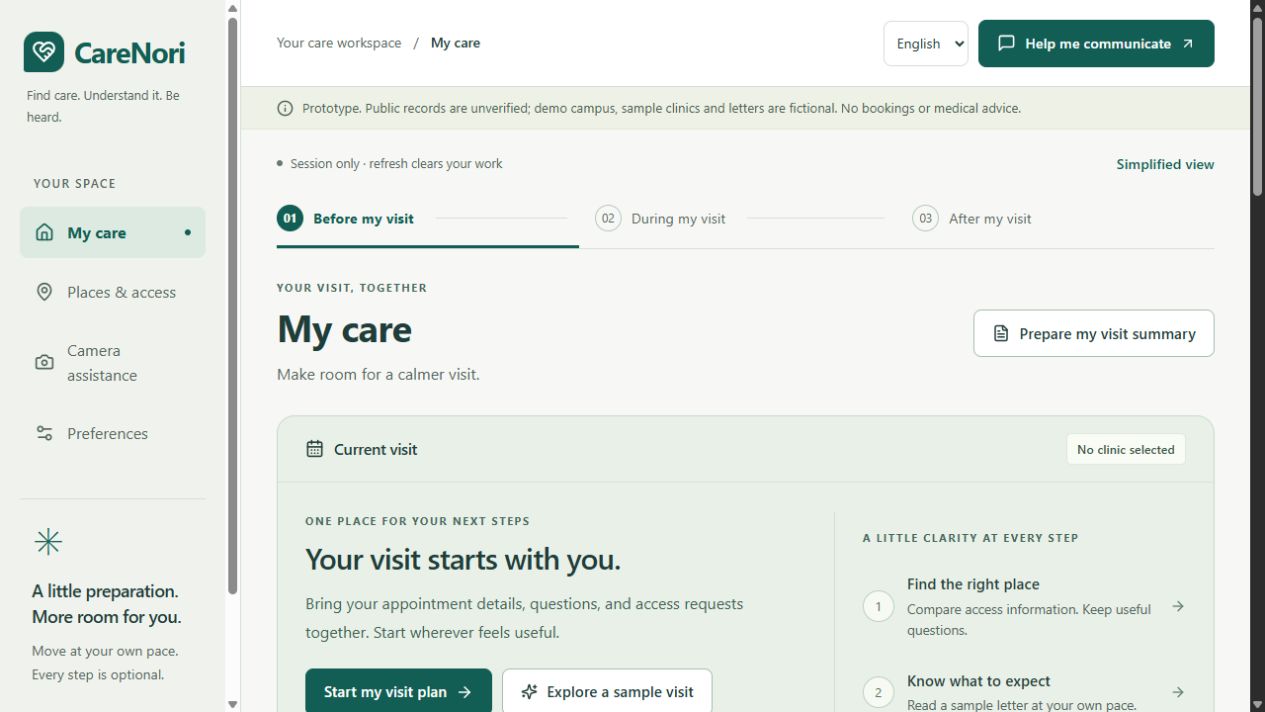
That's why we created CareNori — an AI-powered healthcare accessibility companion designed to help people navigate medical environments with greater independence and confidence.
Our goal is simple: make healthcare more accessible, understandable, and inclusive for everyone.
🚀 What It Does
CareNori combines healthcare navigation, accessibility information, computer vision, and communication assistance into one connected experience.
Its core features include:
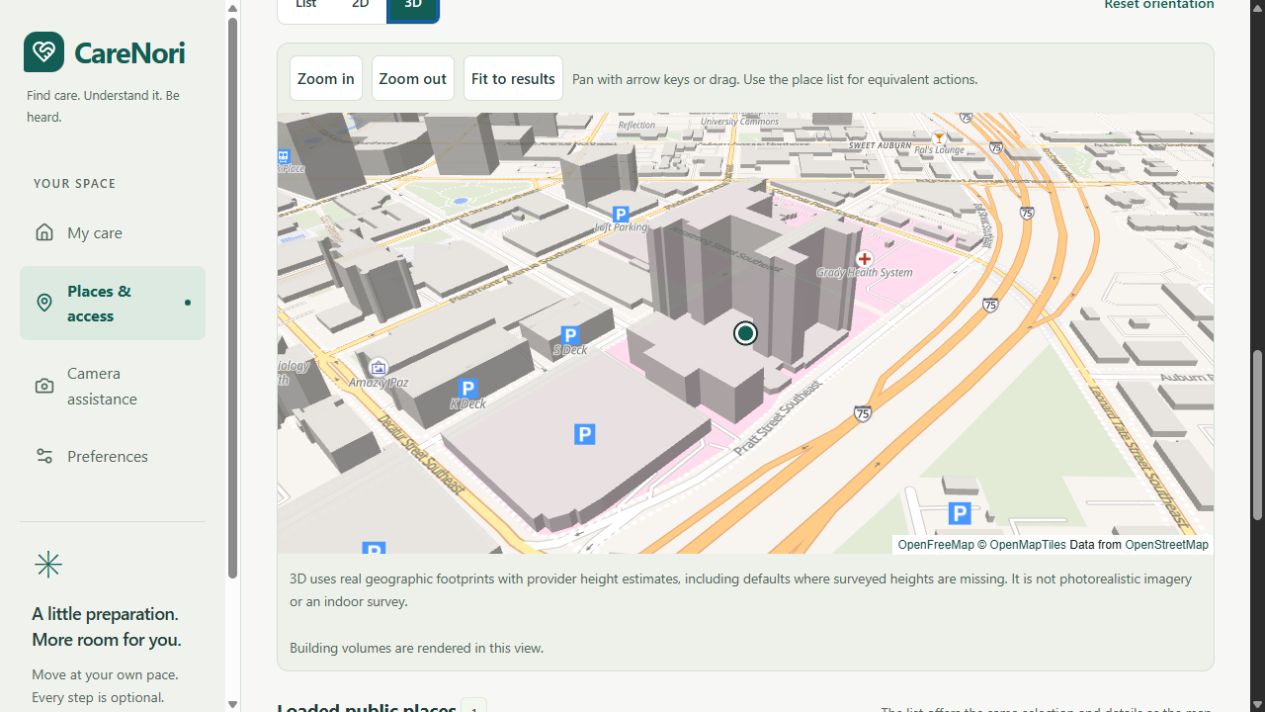
- Accessible Healthcare Navigation: Interactive maps that help users explore healthcare facilities and find information about wheelchair-accessible entrances, ramps, elevators, and other accommodations.
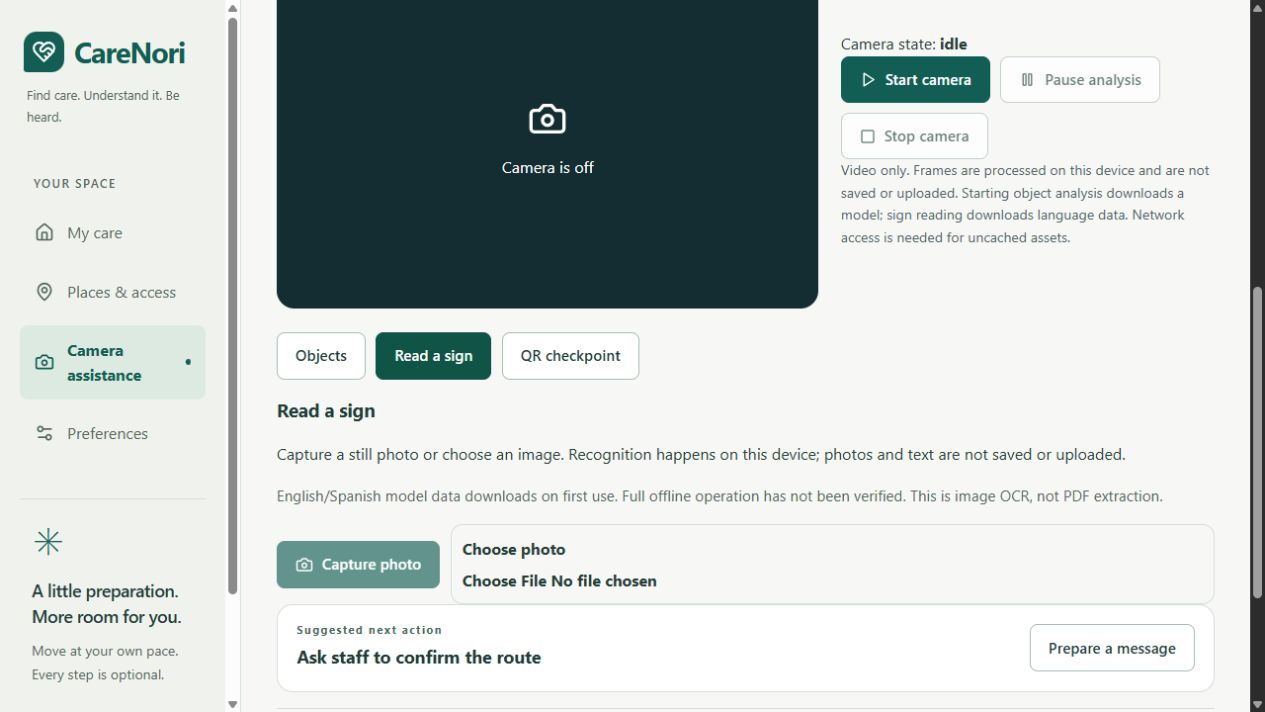
- AI Camera Assistance: Computer vision designed to recognize supported objects, identify people in view, and provide helpful descriptions of the user's surroundings.
- Smart Document Reader: Tools for reading signs and simplifying appointment information.
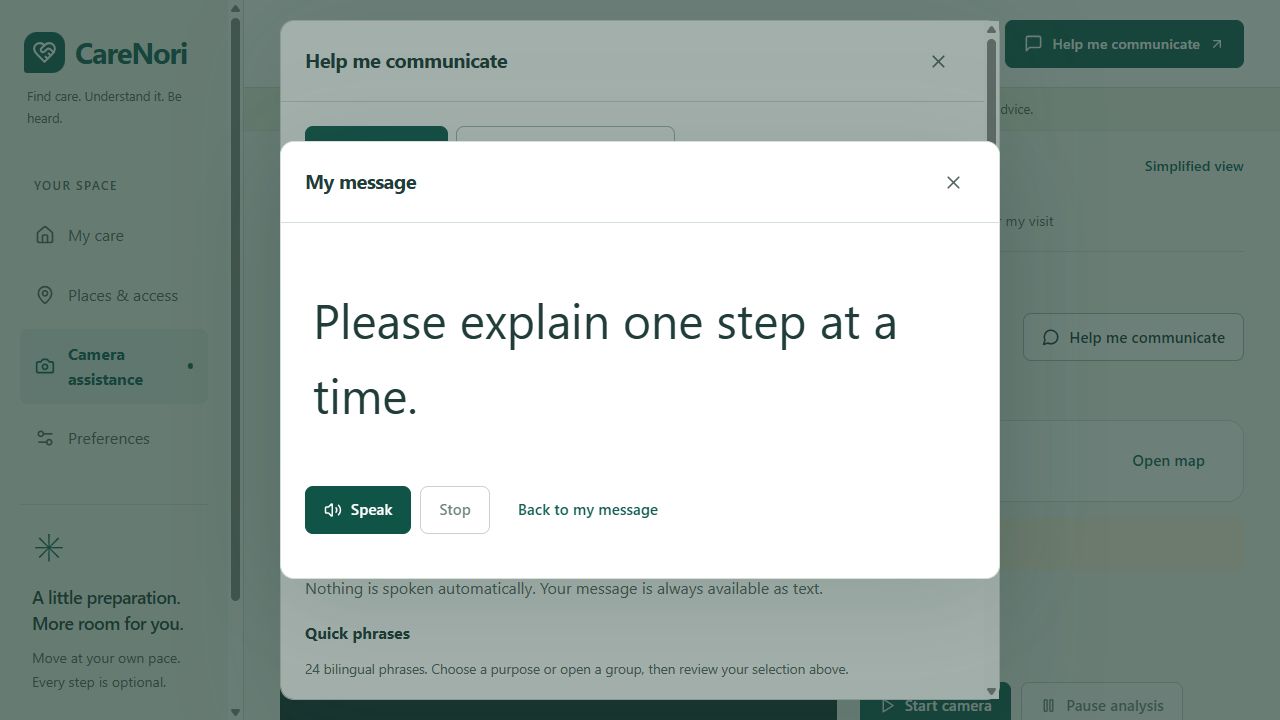
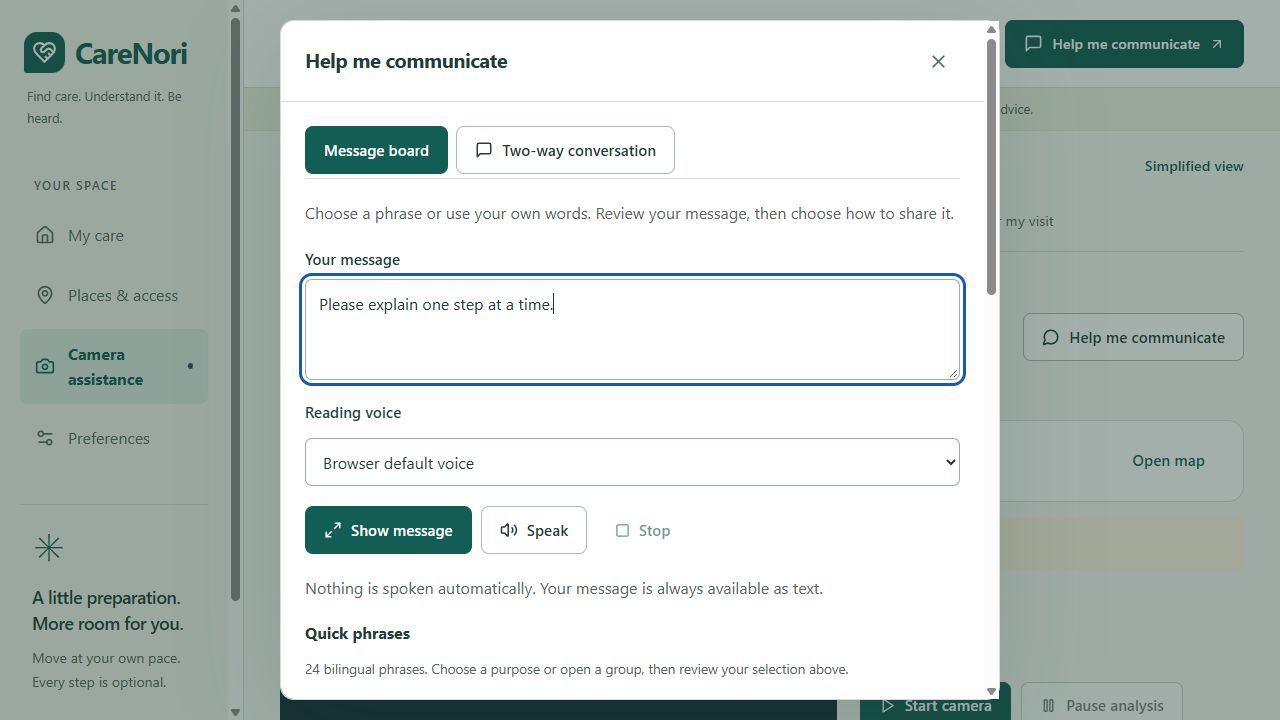
- Communication Assistant: Text-to-speech, customizable messages, and communication shortcuts for people who have difficulty speaking.
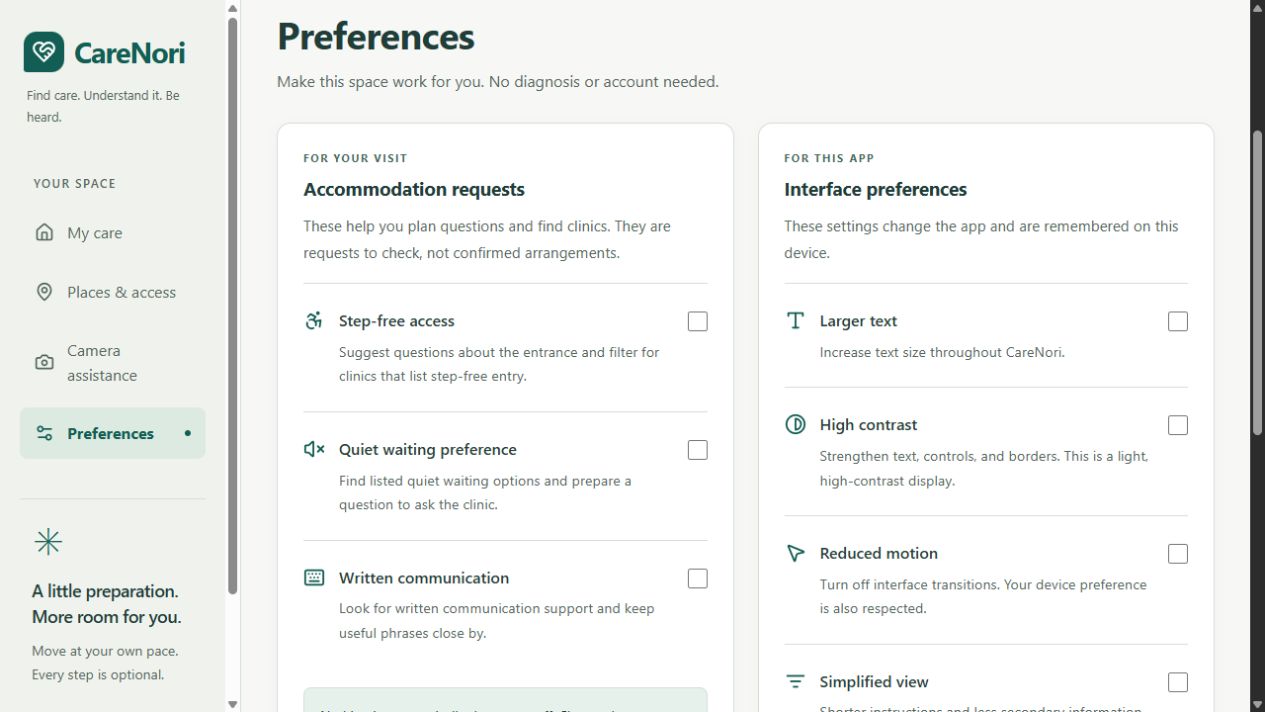
- Personalized Accessibility: Adjustable interfaces and accessibility preferences tailored to individual needs.
- Visit Preparation: A connected workspace for organizing appointment details, important questions, and accessibility requirements.
Rather than switching between multiple applications, users can access these capabilities in one place.
🛠️ How We Built It
We designed CareNori as a modern, browser-based application using technologies that support accessibility, interactive mapping, and artificial intelligence.
Our development approach combines:
- React and TypeScript for the application interface.
- Tailwind CSS for responsive and accessible design.
- MapLibre GL JS and OpenStreetMap for geographic visualization and accessibility-related location information.
- TensorFlow.js for browser-based computer vision.
- Tesseract.js for optical character recognition.
- Web Speech APIs for voice-based communication.
- Structured data for healthcare locations, accessibility features, and user preferences.
We focused on connecting these technologies into a single experience rather than developing isolated tools.
For the hackathon, our approach prioritizes a functional prototype with clearly identified demonstration data and opportunities for future integrations.
🧩 Challenges We Faced
One of our biggest challenges was combining several complex technologies while keeping the application simple and accessible.
Building useful navigation: Traditional maps do not always provide enough information about accessible entrances, elevators, or indoor routes.
Integrating computer vision: Camera-based assistance requires careful attention to model accuracy, device performance, and real-world limitations.
Designing for different disabilities: An interface that works well for one user may create barriers for another. We had to consider different ways of navigating, reading, and communicating.
Working with incomplete data: Accessibility information is not always available or verified. We wanted to avoid presenting uncertain information as fact.
These challenges helped us understand that accessibility requires more than adding features. It requires designing the entire experience around people's needs.
📚 What We Learned
Building CareNori taught us how artificial intelligence, mapping technologies, and accessible interface design can work together to address real-world challenges.
We learned that technology should support independence without creating unnecessary complexity.
We also learned the importance of communicating technical limitations clearly, especially when users may depend on information about physical accessibility.
Most importantly, we discovered that the value of technology is not only what it can do, but how effectively it helps people.
🌎 What's Next for CareNori?
Our long-term vision is to make CareNori a comprehensive healthcare accessibility companion.
Future development could include:
- More detailed accessible indoor navigation.
- Improved computer vision and environmental descriptions.
- Expanded healthcare accessibility datasets.
- Multilingual communication assistance.
- Partnerships with healthcare facilities.
- More personalized accessibility tools.
We envision a future where navigating a hospital, understanding healthcare information, and communicating with medical professionals are easier for everyone.
CareNori isn't about replacing healthcare professionals. It's about removing barriers between people and the care they need.
CareNori — Find Care. Understand It. Be Heard.
Built With
- api
- coco-ssd
- css
- css3
- github
- gl
- html5
- javascript
- maplibre
- mediapipe
- openfreemap
- openstreetmap
- react
- speech
- sqlite
- tailwind
- tensorflow.js
- tesseract.js
- typescript
- vite
- web


Log in or sign up for Devpost to join the conversation.