-
-
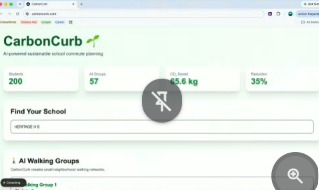
Our live platform
-
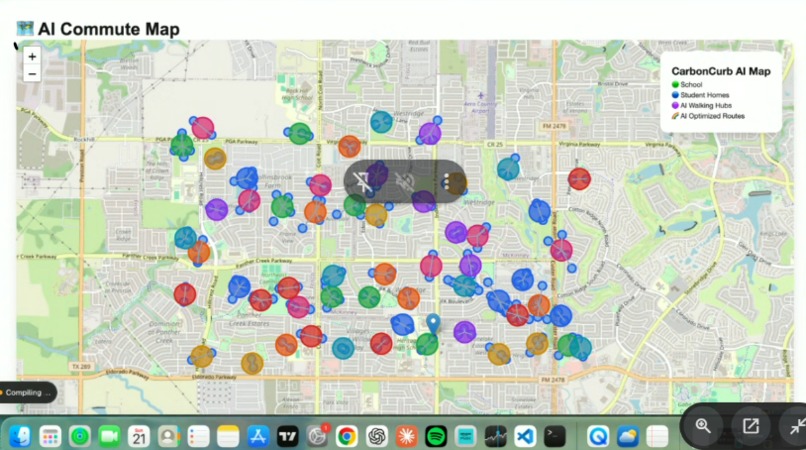
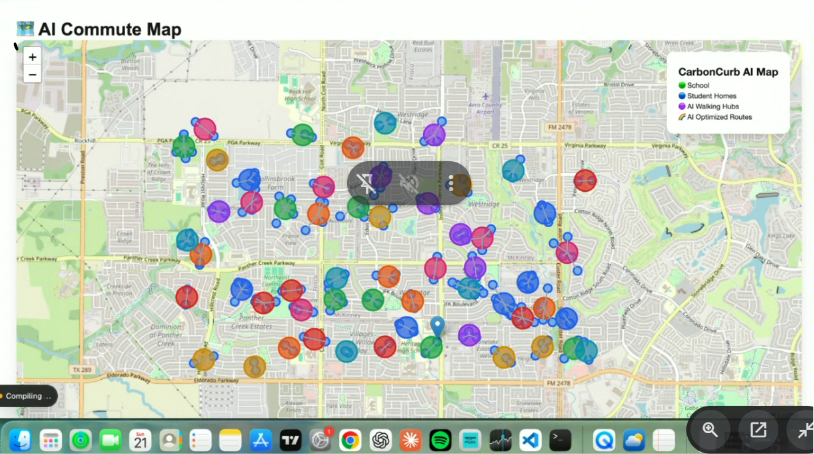
AI clusters students into walking groups and provides safe routes to school.
Inspiration
Morning school drop-offs create massive traffic gridlocks and trap lines of idling cars venting toxic CO_2 right where students breathe. Parents want to coordinate shared walking routes to reduce this impact, but doing the math to organize groups manually for hundreds of families is impossible. Tired of abstract climate talk, we built CarbonCurb to make green commutes local, structured, and doable.
What it does
CarbonCurb is an AI-powered routing tool that automatically clusters neighborhood students into safe, shared walking groups to eliminate school drop-off traffic. To ensure absolute child safety, the platform utilizes a "Human-in-the-Loop" architecture: the spatial AI builds the logistical paths behind the scenes, but all routes are locked by default until a parent explicitly reviews and approves them via their dashboard.
How we built it
We engineered a multi-layered spatial mapping architecture on three core technical pillars: Privacy-First Geolocation: Ingests broad, anonymized neighborhood zip codes instead of precise physical home addresses to guarantee student privacy. Infrastructure Layering: Scrapes public city data to filter routes exclusively along continuous sidewalks, safe pedestrian zones, and active crossing guards. Spatial AI Clustering: Uses custom pathing logic to prioritize pedestrian protection vectors over simply finding the shortest physical distance.
Challenges we ran into
Standard mapping APIs optimize strictly for speed, which frequently directed walking routes onto dangerous arterial roads or shortcuts lacking continuous sidewalks. We had to build custom filters to explicitly override these hazards. Additionally, ensuring complete data security required establishing an unmanipulatable architecture wall between our core spatial backend database and frontend client interfaces.
Accomplishments that we're proud of
We successfully built and deployed a fully functional web prototype that makes complex spatial data accessible and intuitive. We are incredibly proud of designing a seamless balance where parents retain absolute real-world veto power over safety while our AI handles the logistics, meaning every active cluster can effortlessly save around 15 lbs of CO_2 per week.
What we learned
We learned that traditional databases and spreadsheets instantly crash or hit a wall when trying to compute multi-variable neighborhood locations simultaneously. More importantly, we learned that when engineering technology for schools, privacy and human verification cannot be added later, responsible AI guardrails must be baked directly into the initial architecture.
What's next for CarbonCurb
We plan to build a dedicated administrative portal and authentication allowing school officials to dynamically update local construction hazards or crossing guard schedules in real time. From there, our goal is to pilot CarbonCurb at our own high school next semester, transforming an overwhelming global crisis into a measurable local victory.
Built With
- geojson
- github
- mapbox-gl-js
- next.js
- pandas
- python
- react
- scikit-learn
- tailwind-css
- typescript
- vercel


Log in or sign up for Devpost to join the conversation.