Inspiration
Donations are often a major source of support for institutions such as orphanages and shelters. However, these contributions are often less effective than they could be due to a lack of coordination between donors and institutions: some items arrive in excess while others are still needed, and donors who want to give specific items have no easy way to know which institution needs them most. Logistical challenges make this worse. Even when donors know what to give, it is often unclear where to deliver it, when the institution can accept it, or whether there is a collection point nearby. As a result, many good intentions never turn into donations that reach their intended recipients.
We wanted to build a platform that would enable donors and nonprofits to connect effortlessly by matching generosity with actual needs and rewarding concrete actions.
What it does
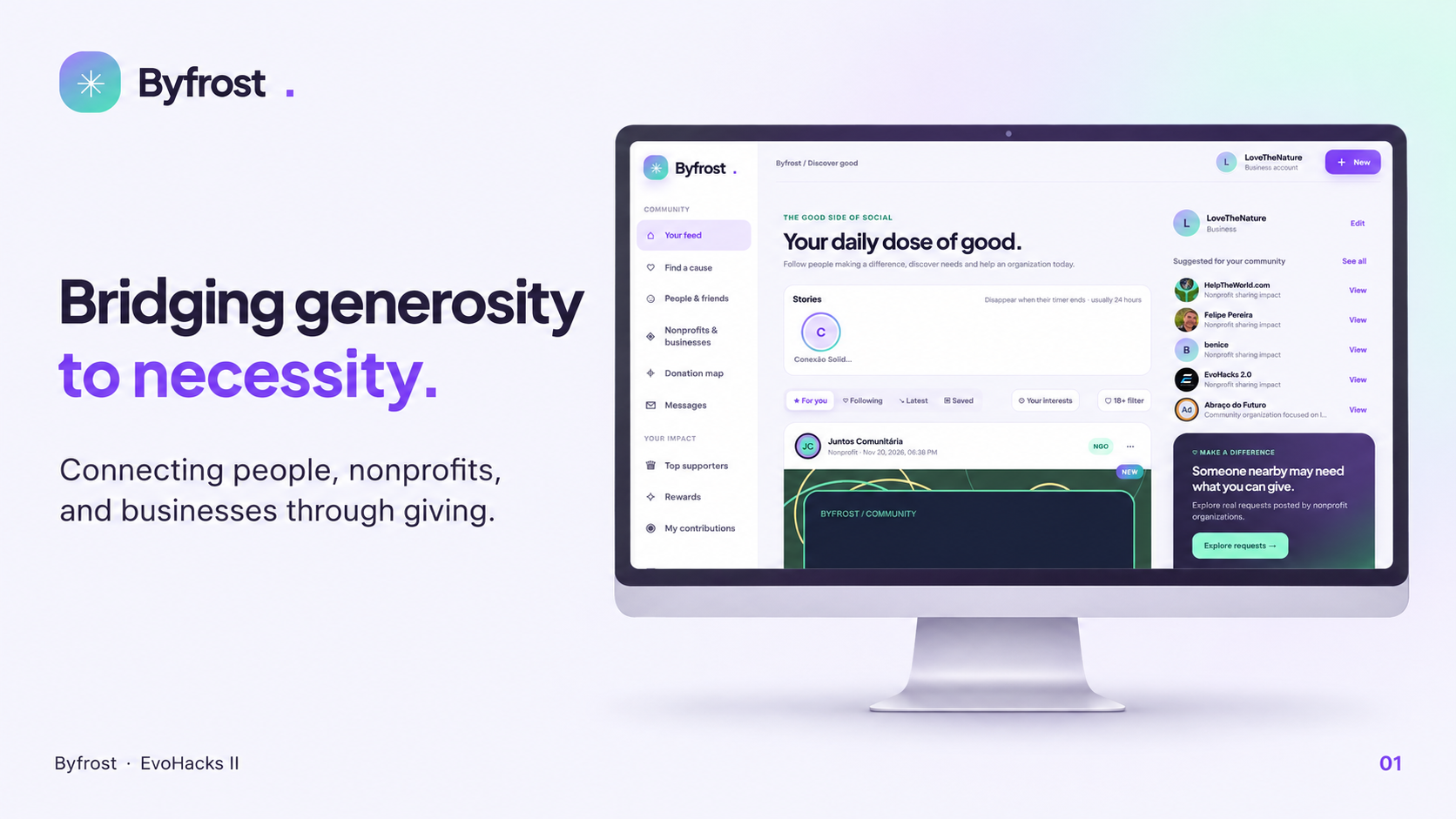
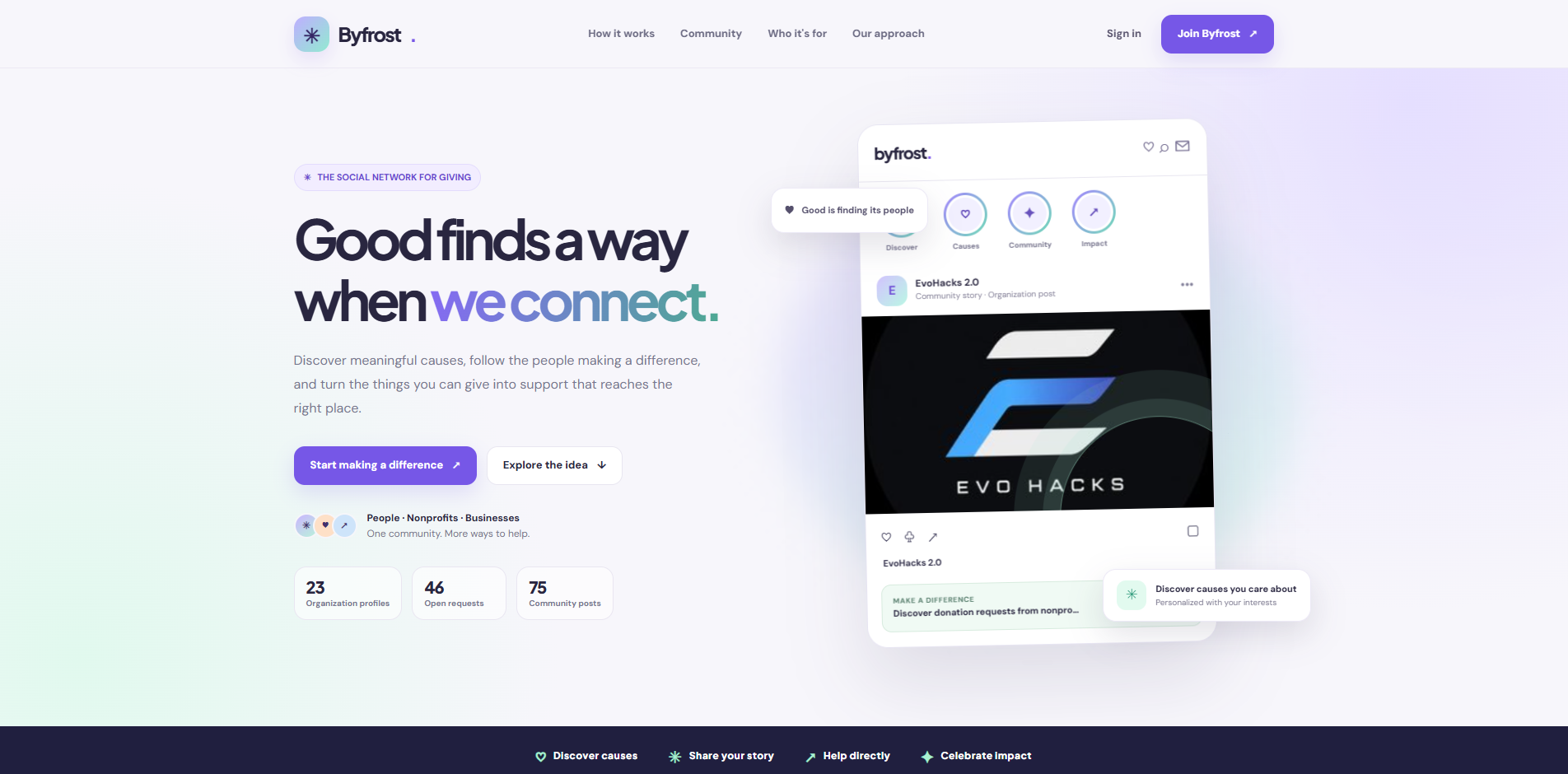
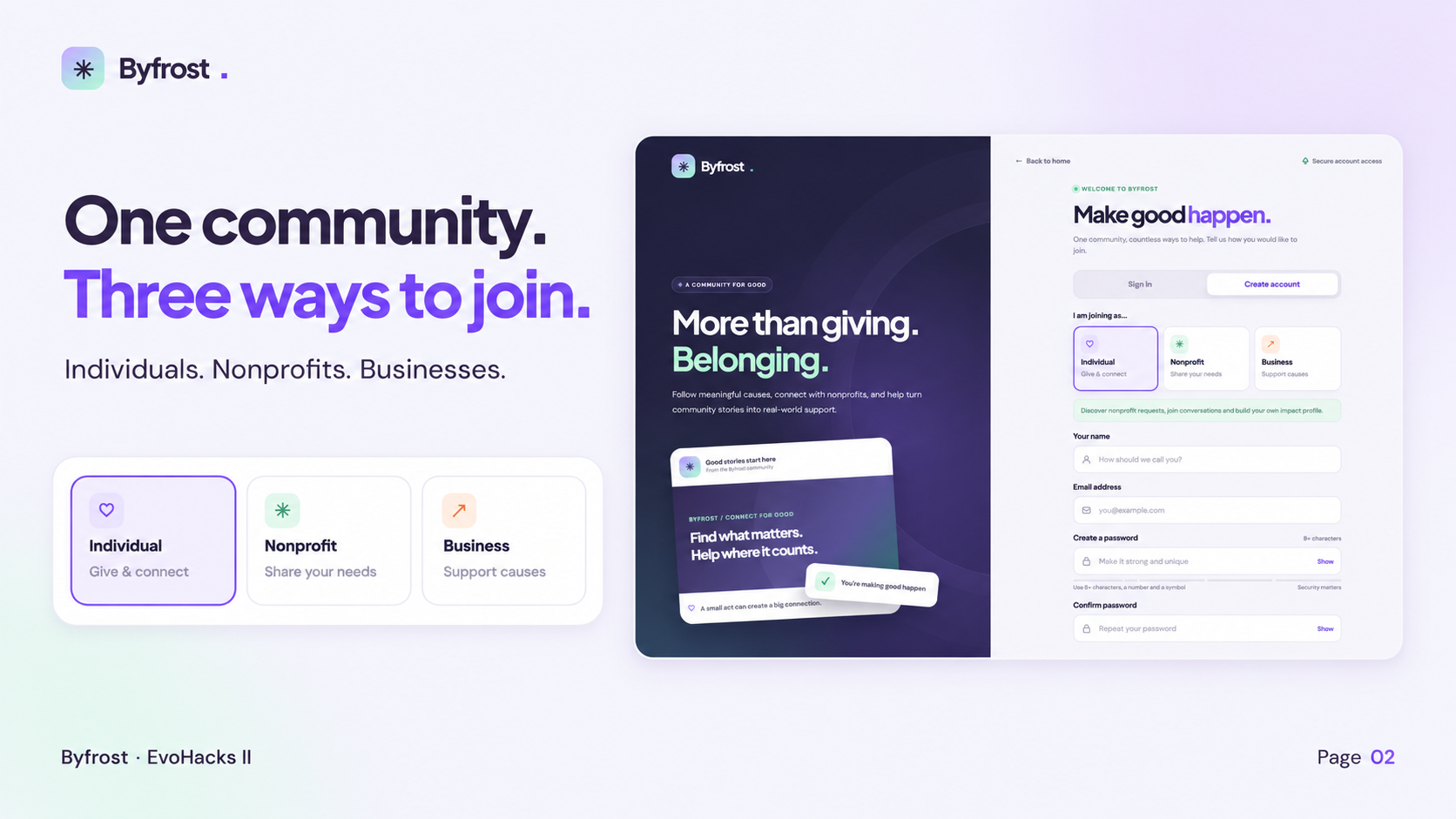
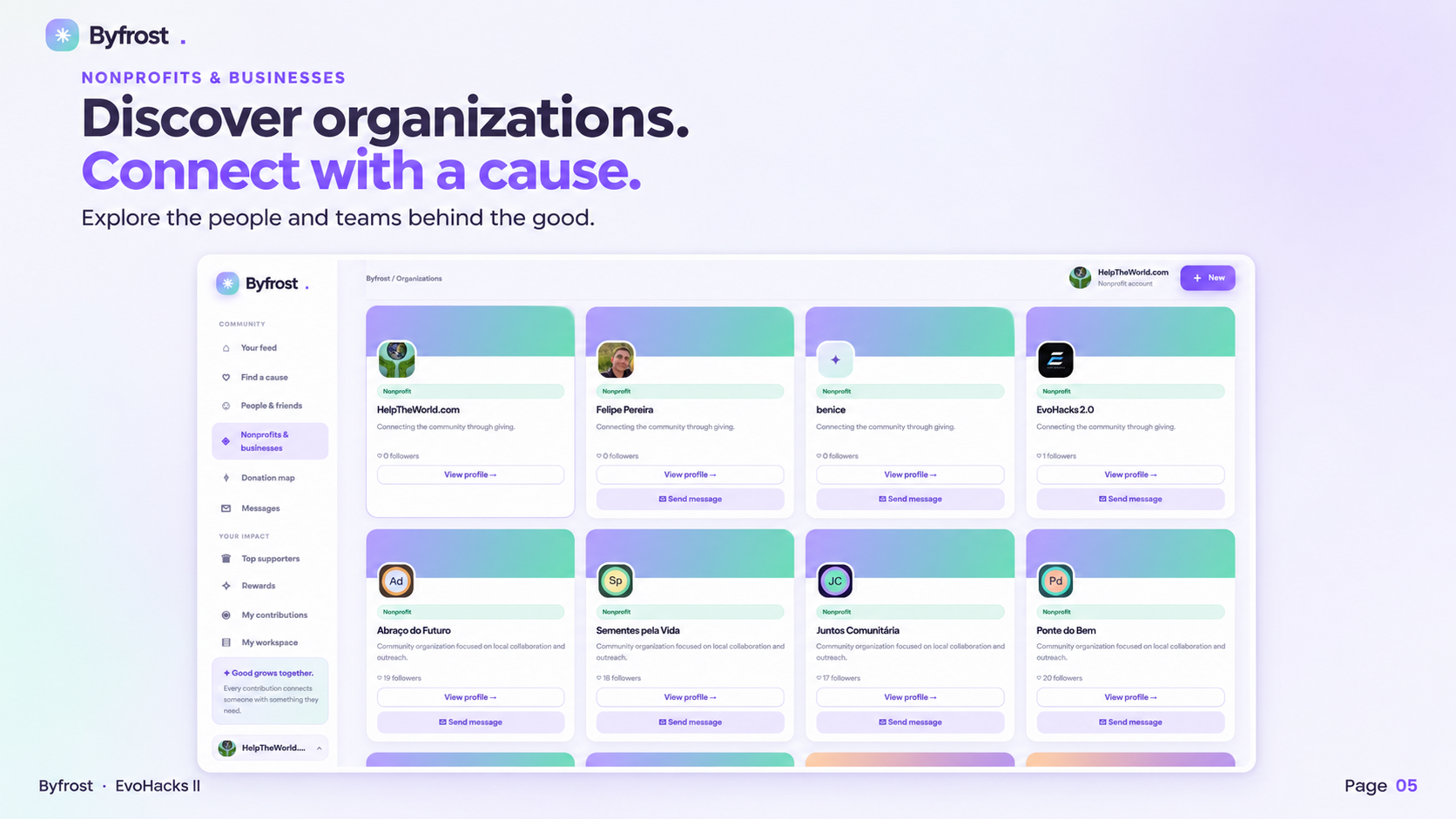
Byfrost is a social platform that connects individuals, nonprofits, and businesses to coordinate donations of physical goods. Organizations publish what they need, and donors share what they can offer.
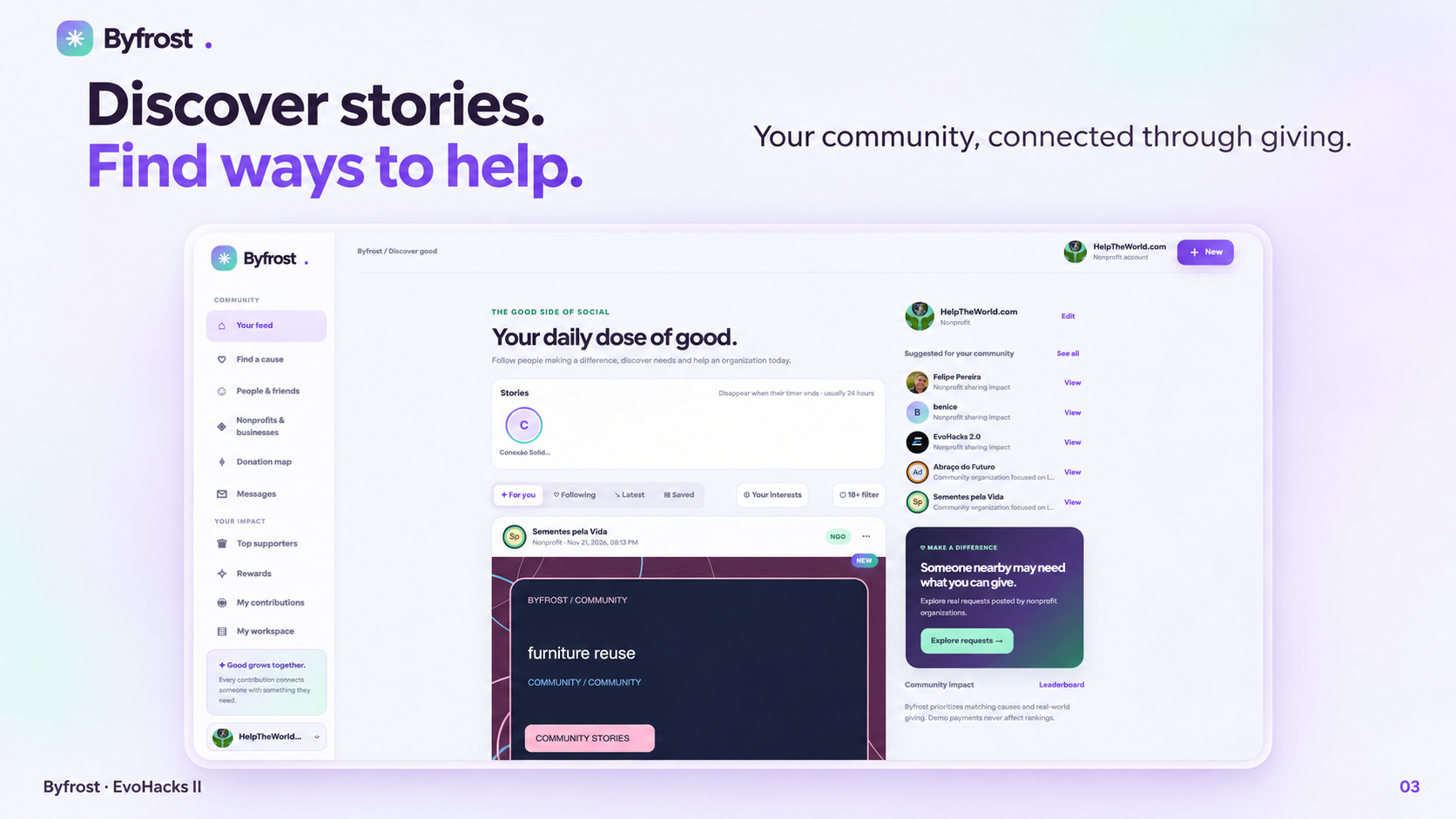
Its AI-powered feed recommends relevant requests and organizations by matching donors’ offers with nearby needs. Through a familiar social media interface, users can share updates, discover campaigns, and connect directly with the people behind them.
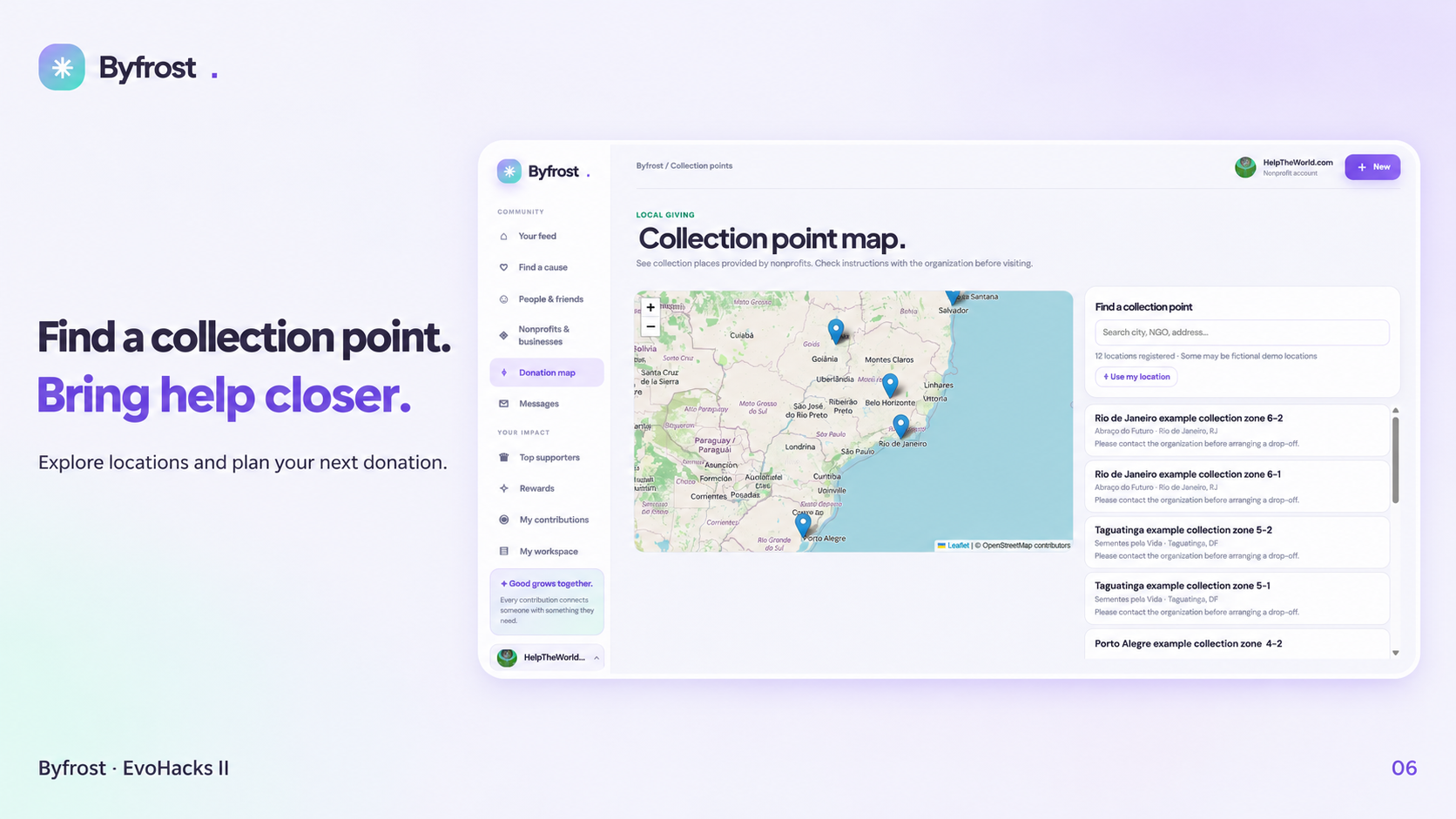
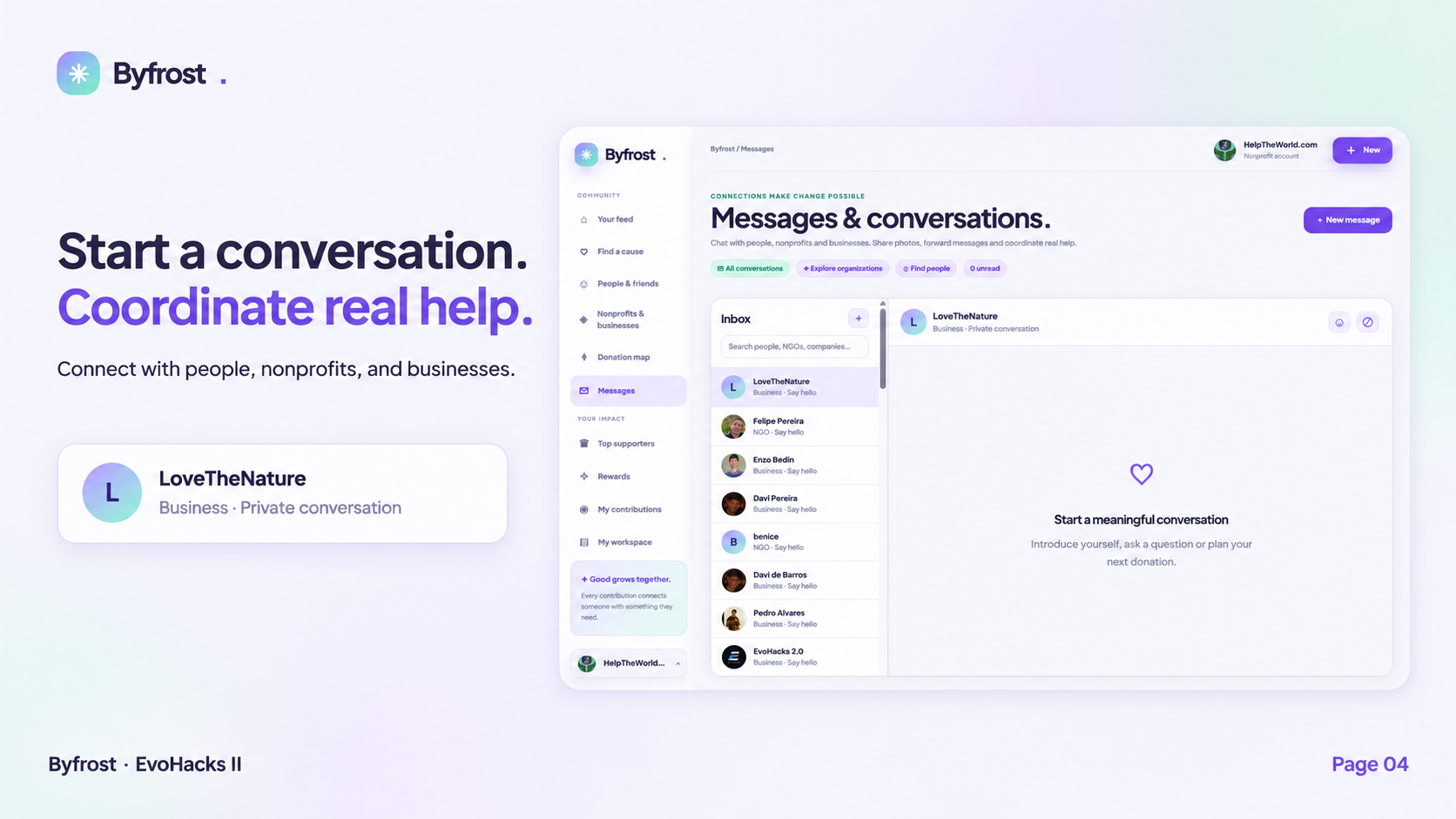
Find a Cause helps donors explore initiatives and understand how to contribute, while the Donation Map shows active drop-off points to help them plan deliveries. Private messaging makes it easier to ask questions and coordinate donations.
To encourage continued participation, Byfrost includes levels, contribution tracking, supporter leaderboards, and rewards. Nonprofits and businesses can also manage requests and recognize their supporters.
By bringing discovery, communication, and coordination together, Byfrost helps turn the intention to give into a concrete contribution.
How we built it
Byfrost was developed using different programming technologies to create a complete, modern, and functional platform.
We used Python and Flask to build the backend, which manages user registration, authentication, posts, messages, and data processing.
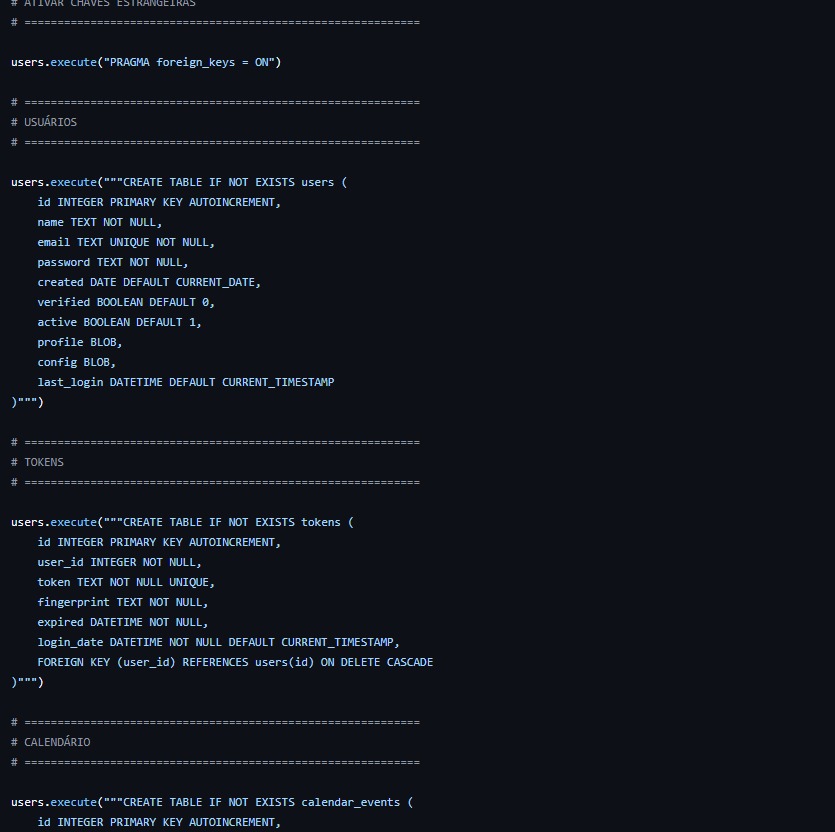
For data storage, we used SQLite, which stores user information, posts, interactions, campaigns, and other important records.
The user interface was developed using HTML, CSS, and JavaScript, allowing us to create modern, interactive, and responsive pages that work on computers and mobile devices.
We also implemented a recommendation system that analyzes users' interests and interactions to organize their feeds without relying on an external artificial intelligence API.
Throughout development, we organized the project into different modules, making it easier to maintain, improve, and expand the platform.
Our focus was to combine technology, accessibility, and social impact into a single solution.
Challenges we ran into
During the development of Byfrost, we faced several technical challenges related to building and integrating a social networking platform.
One of our biggest challenges was integrating multiple features into a single system, ensuring that posts, messages, profiles, campaigns, and donations worked together properly.
Another important challenge was managing photos, videos, and other media files, including different formats, file size limits, storage, and performance.
We also had to focus on user security, implementing password protection, authentication, session management, and data validation.
Developing the recommendation system was another challenge because we needed to find a way to display relevant content while also giving visibility to recent posts and different social causes.
Additionally, as the project evolved, we had to carefully update the database structure without deleting existing user information.
These challenges helped us improve our code organization, platform stability, and understanding of real-world software development.
Accomplishments that we're proud of
We’re proud to have built Byfrost to make giving easier and better coordinated. By connecting donors directly with organizations and helping them identify relevant needs, we aim to turn good intentions into meaningful contributions.
Beyond the platform’s features, we’re proud to have created a project that encourages generosity, strengthens community connections, and supports a culture of helping others.
What we learned
We learned that making donations more effective requires more than encouraging generosity: it requires connecting people with relevant needs and making coordination easier. Building Byfrost helped us understand how integrating familiar features into the platform can help users move from discovering a cause to taking action.
We also learned that recommendation algorithms need to consider practical factors, such as location and compatibility between offered items and requested goods. A useful recommendation should help someone find where their contribution is actually needed.
During the technical development of BYFROST, we learned how to connect different parts of a web application, including the frontend, backend, and database. We also explored how to use AI to match donation offers with the needs of organizations. We learned how to validate information, process user inputs, and automate tasks such as creating donation promises and sending reminders.
More broadly, this project showed us that, even with limited time and resources, we can use technology to turn a problem we care about into a working prototype.
What's next for Byfrost
We plan to continue developing Byfrost beyond EvoHacks 2.0. Our next step is to reach out to local charities and nonprofits, offer the platform for free, and work with them to test it in real donation campaigns. Their feedback will help us improve the platform and understand how well it supports their needs.
We also plan to seek sponsors and investors to support further development and help Byfrost reach more communities.
Built With
- ajax
- artificial-intelligence
- css3
- data-analytics
- flask
- flask-limiter
- html5
- image-processing
- javascript
- jinja
- json
- leaflet.js
- machine-learning
- openstreetmap
- personalized-feed
- pillow
- python
- pythonanywhere
- recommendation-algorithms
- responsive-ui
- rest-api
- scikit-learn
- sqlite
- user-authentication
- werkzeug


