Inspiration
Most of us have walked past a broken water fountain or a dead outlet and done nothing. Not because we didn't care, but because figuring out how to report it takes longer than walking away. And even when you do report something, you never hear whether it got fixed.
While building this, we talked to Amelia McBride, Public Services Associate II at Price Gilbert Library. She told us students have no direct way to report a maintenance problem in the library. Either a student tells a librarian, or a staff member notices it themselves and files a report, which then gets routed to the right department. When we showed her BuzzFix, her reaction was that as long as it is low friction and easy, students will use it. That is the whole idea.
When we looked into the rest of campus, we found the same pattern. At Georgia Tech, how you report maintenance depends on which building you're in. Housing has its own request form. Academic buildings expect you to find the building manager, since students aren't supposed to email I&S customer service directly. The Student Center has a form meant for staff. Three systems, three front doors, none of them obvious. Submitting a request as a student is time-consuming or plain confusing, and once you submit, you are not told when it is resolved.
What it does
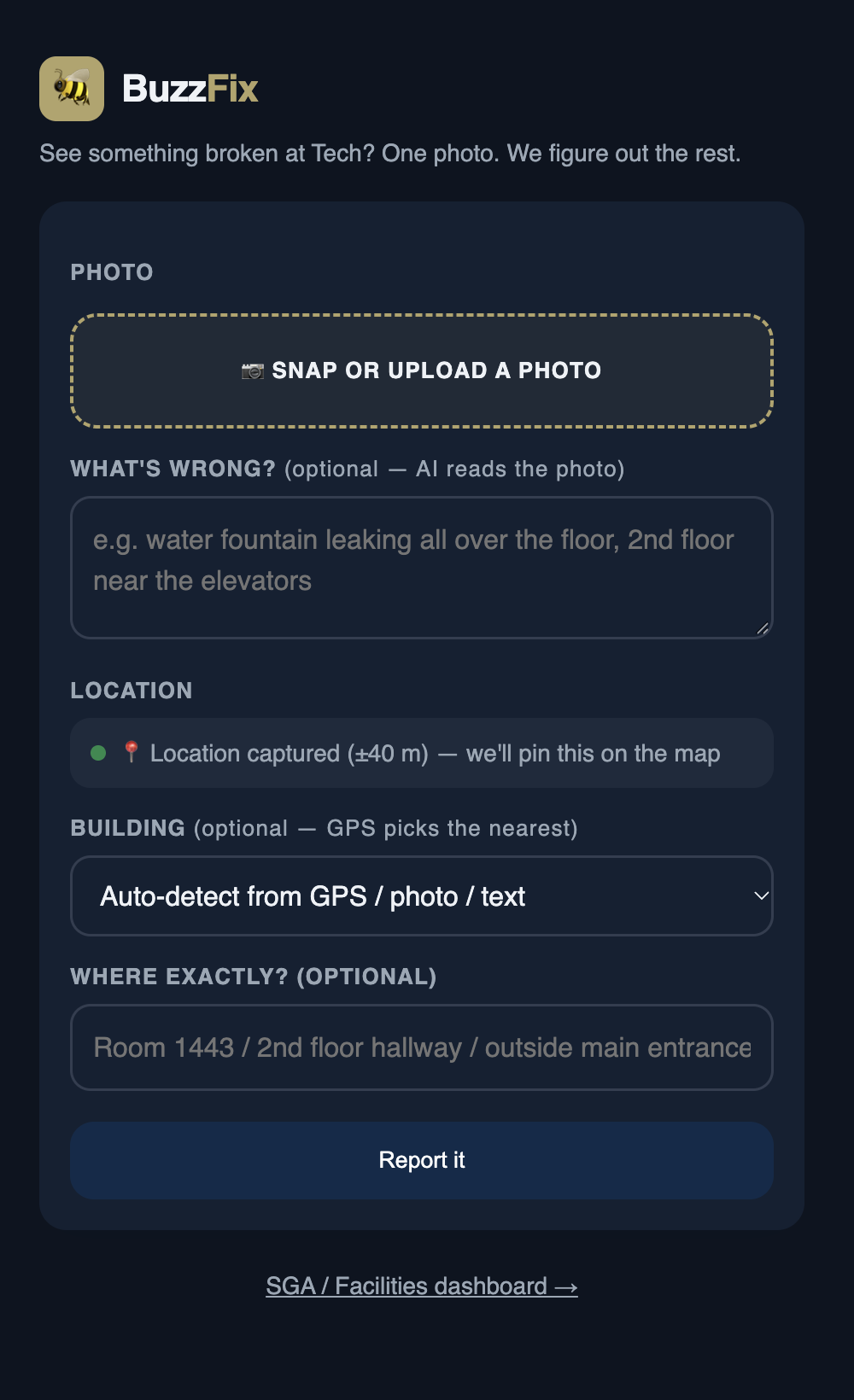
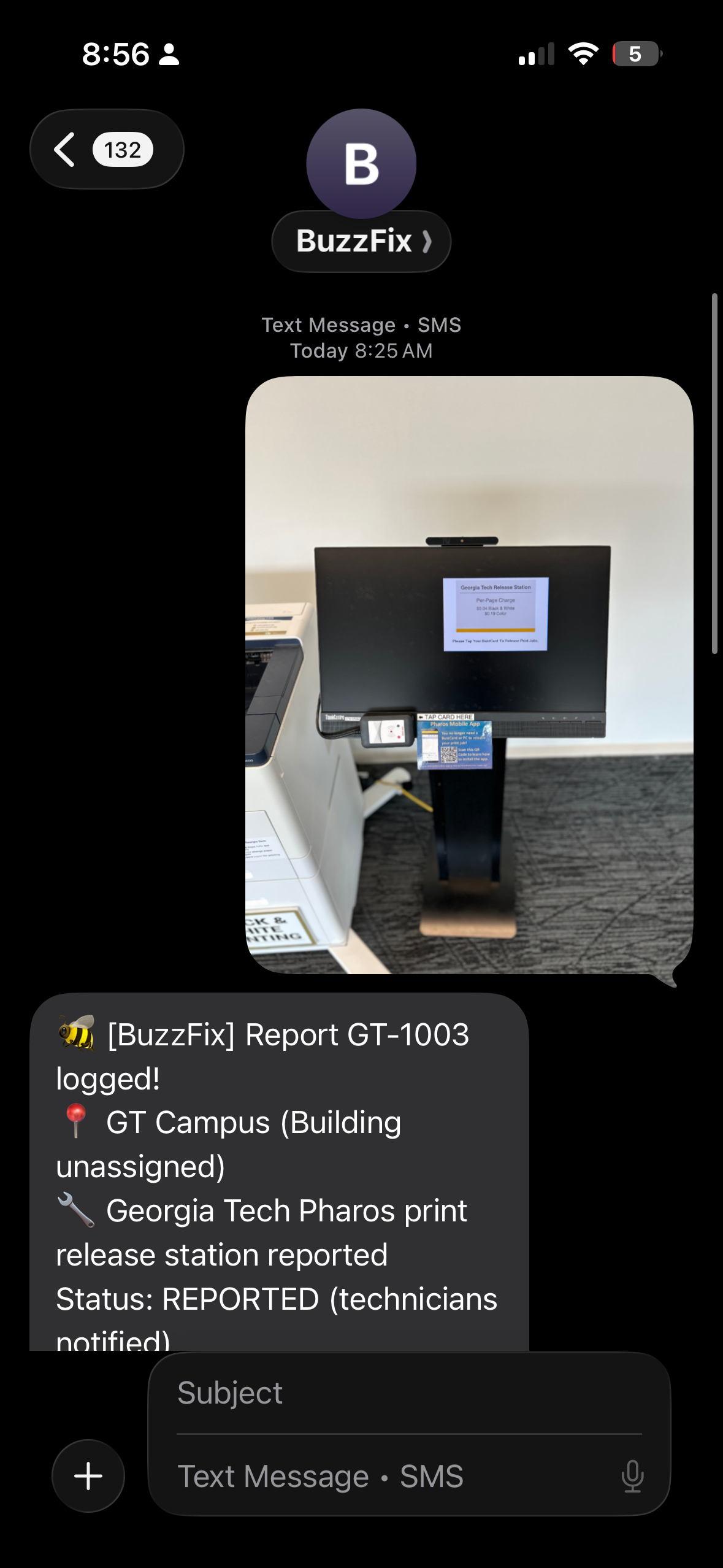
BuzzFix removes the friction from reporting. Instead of searching online for the right form or finding a staff member, a student texts a photo to a number. The people responsible find out where their attention is needed, and the student stays in the loop until it is fixed.
- Gemini reads the photo and your note and figures out the category, urgency, a short title, and a summary a technician can act on.
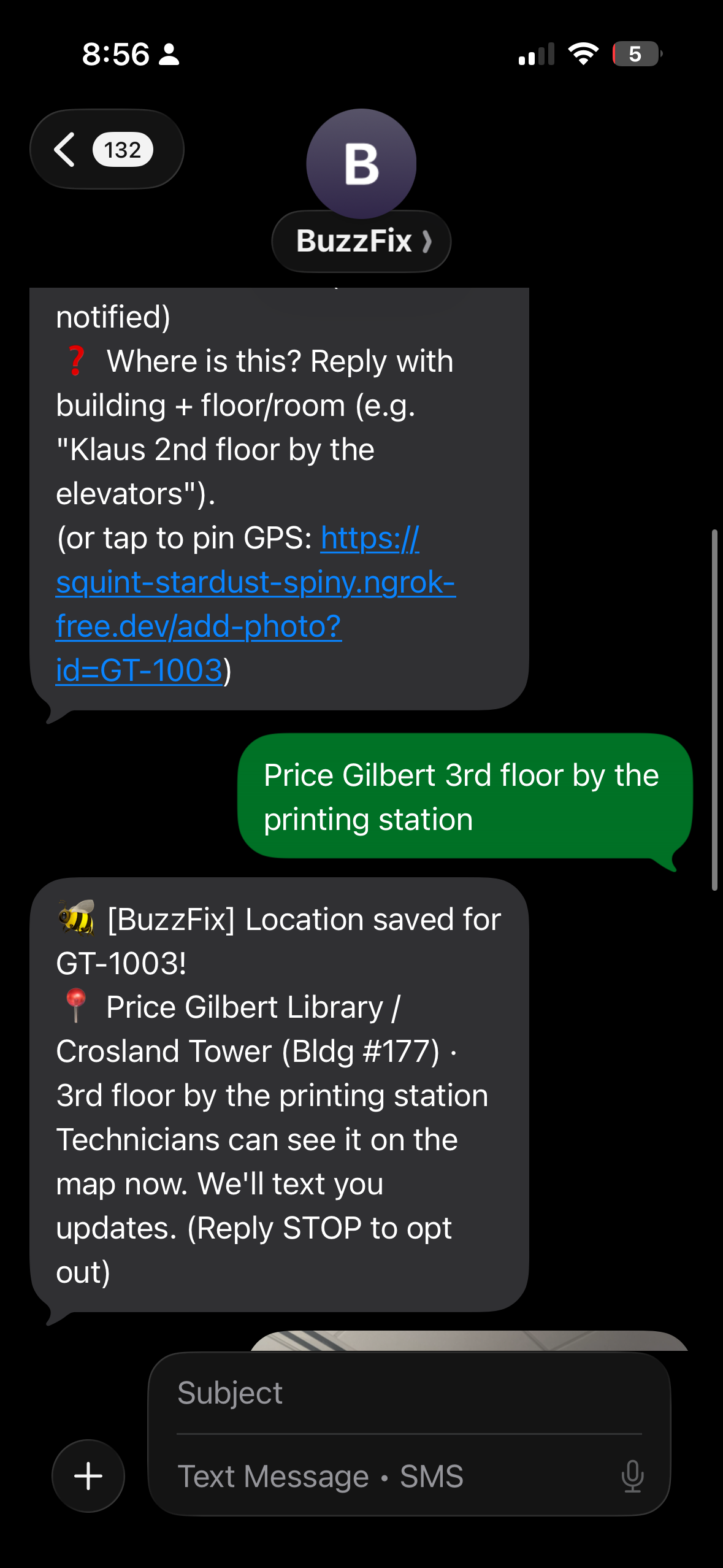
- If it doesn't know where the problem is, it asks. "Where is this? Reply with building and floor/room." Your reply gets parsed and attached. It asks at most twice.
- It routes the report the way GT actually works: dorms to Housing, academic buildings to the building manager and I&S with the building number included, Student Center and outdoor issues to their own queues.
- Emergencies skip the ticket. A burst pipe gets "call 404-385-6000 now," or GTPD after hours, and still gets logged.
- Duplicates merge into upvotes, so the fifth person reporting the same elevator bumps its priority instead of creating noise.
- Reporters get status texts when Facilities updates a ticket on the dashboard.
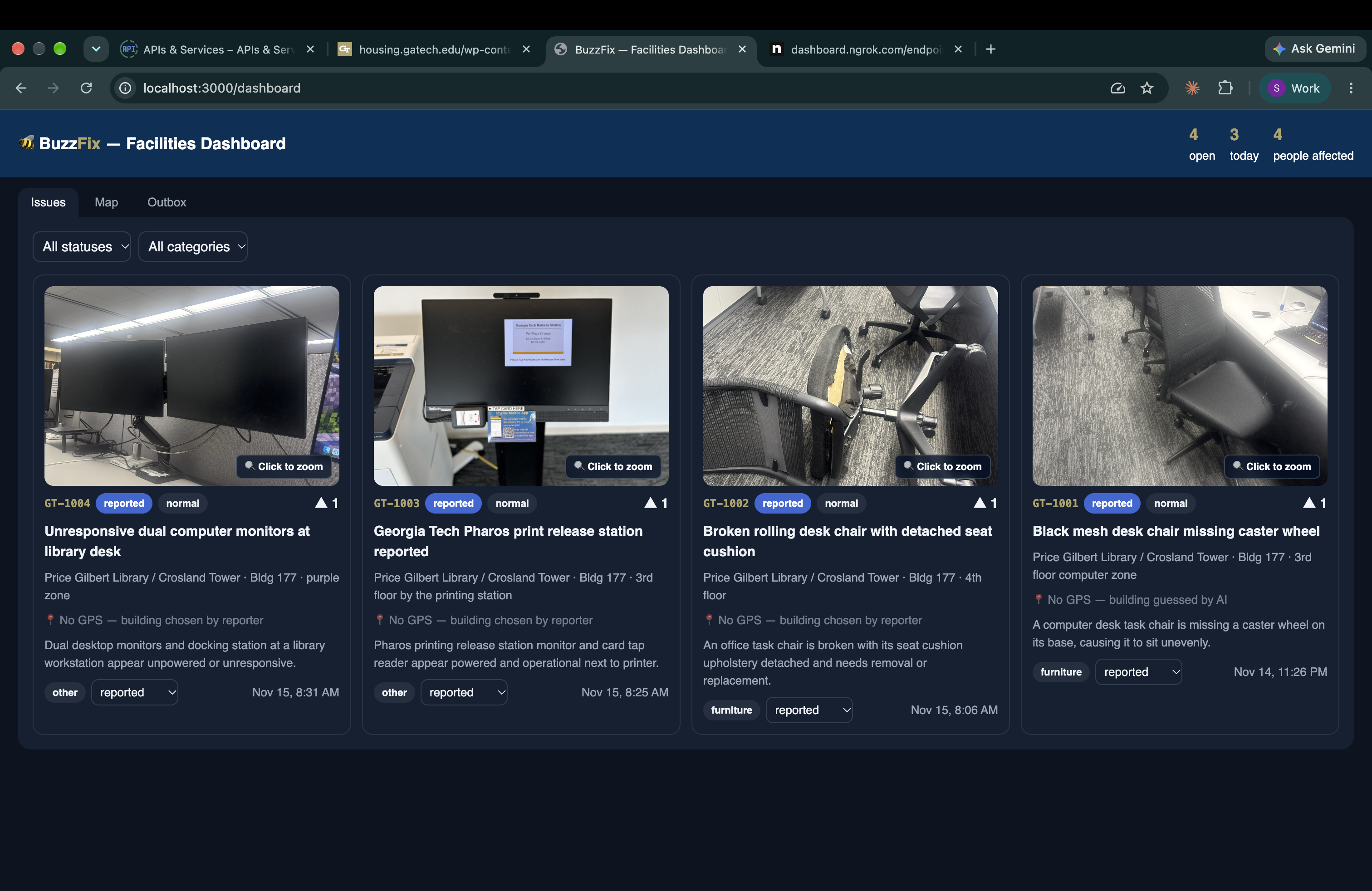
- SGA and Facilities get a live dashboard: issue cards with photos, a campus map with exact GPS pins and street addresses, and an outbox showing the email each report would generate.
How we built it
Node and Express backend. Twilio for SMS and MMS in and out. Gemini on Google Cloud for photo triage and for parsing free-text location replies like "its in klaus by the elevators." A small routing engine encodes GT's real process, including which phone number to call at which time of day. Browser geolocation and WhatsApp location pins are reverse-geocoded through OpenStreetMap. Leaflet for the map. A JSON store for the weekend, built to swap for Firestore. We used Antigravity to parallelize work across the backend, the dashboard, and the SMS flow.
Challenges we ran into
We assumed photo metadata would give us location. It doesn't. Carriers and iMessage strip GPS from MMS photos, and iOS Safari strips it from web uploads too. We checked the actual bytes of our test photos to confirm. That pushed us to the text conversation approach, which turned out better anyway, since GPS can't tell you which floor or room. We also tightened duplicate detection after a test photo got merged into an unrelated ticket, and fixed a building matcher that was sending any report containing the word "reported" to the Red Zone parking deck.
Accomplishments that we're proud of
The whole loop works over real SMS: text a photo, answer one question, watch it appear on the map with the room number, and get a text when it's resolved. The routing mirrors GT's actual process rather than pretending one inbox exists. And it degrades gracefully: with no API keys at all it still classifies, routes, and tracks.
What we learned
The hard part of campus maintenance isn't the software, it's that the reporting process is invisible to students. Lowering the friction to "send a text" changes who reports. We also learned how much of a real product is handling the messy middle: duplicate reports, vague replies, emergencies, and people who never answer the follow-up.
What's next for BuzzFix
A2P registration or a verified toll-free number so any student can text it. A real building manager directory from SGA and live email into Housing and I&S. Firestore and Cloud Run on the GCP credits. Analytics for SGA: response times per building, hotspots, and resolution SLAs. We also want to offer the next best option when something is broken: if the printer you reported is down, BuzzFix can point you to the closest working one. Then other campuses, because every university has this exact problem.
