-
Design Process
Inspiration
Immigration is a current hot-button issue with a heavy influence in American history. Although building a border wall between Mexico and the United States has been proposed as a solution to illegal immigration, the notion comes mostly from misconceptions and negative sentiment surrounding unauthorized immigrants. We wanted to create a solution that would help bridge that gap of misinformation regarding immigration and help others gain a better understanding on the lives of undocumented immigrants and the difficulties of illegal immigration that many people don’t know.
What it does
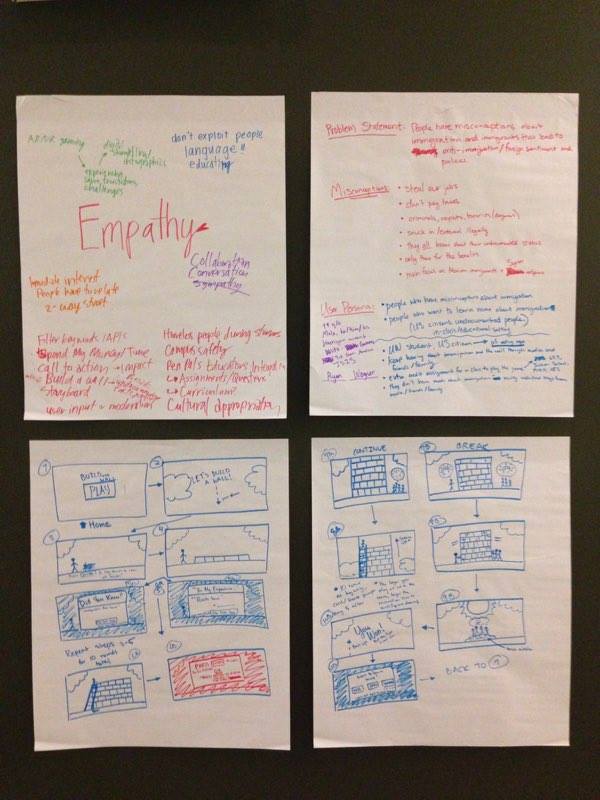
Our solution is a game called “Build a Wall” that is meant to educate its users about immigration through statistics, facts, and testimonials to better understand the problems that many undocumented immigrants face. The game involves the player building a wall: each round, the player can set a row of bricks that will spawn an informational pop-up about illegal immigration. After a certain number of rounds, the player can choose to either break down the wall or continue to build it and choose their own ending.
How we built it
For this project, we used Figma, a prototyping and wireframing app similar to Sketch in order to create a storyboard layout of the game.
Challenges we ran into
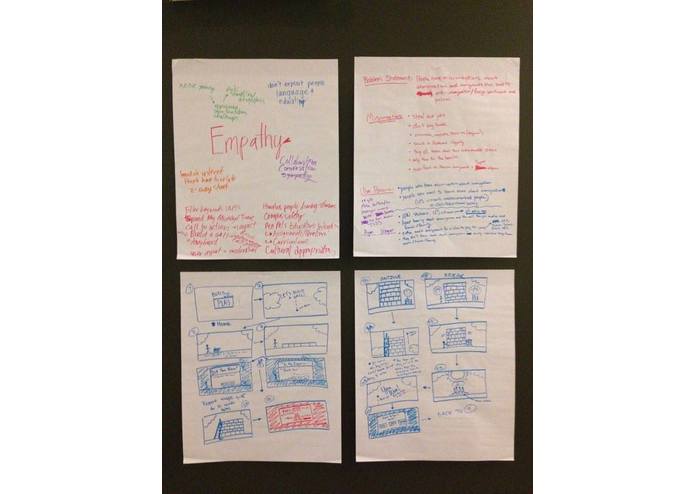
Because our group consisted of people who were better with UX, design, and some front-end web development but not so much back-end dev, the prospect of developing a working prototype game in 24 hours was quite slim. Therefore we decided to play to our strengths and focus especially on the design of the game by using Figma and pen-to-paper techniques to flesh out how the game should look and behave.
Accomplishments that we're proud of
We’re proud of coming up with an interesting, novel idea and working to ideate a decent story and premise. Collaborating and thinking together to try and create a cohesive narrative and layout for the game was a challenge, but when we came up with a great story beat or quirk that fit the nature of the game, it felt like puzzle pieces fitting neatly together in line. Best of all, we worked with our strengths rather than focusing on our weaker points for a great project.
What we learned
We learned that even with our limitations, a hackathon is definitely a place where people can come together to network, meet new people, and learn new things to better improve the coding and designing experience. Challenges are welcomed, and overcoming those challenges is a feeling like no other. We also learned much through research on illegal immigration that we didn’t know before.
What's next for Build A Wall
Bettering our back-end development or collaborating with others who are more experienced in game design could be a great way to physically actualize our game into a reality. We’d also like to consider additional end-game features for the future, like implementing data visualization to show how other users responded and performed in the game as a whole.
Built With
- adobe-illustrator
- figma


Log in or sign up for Devpost to join the conversation.