Inspiration
As electrical engineering students, we were stepping into a field that was almost completely unfamiliar to us. We had very limited knowledge of coffee store site selection, commercial value, market analysis, or product-oriented software design. At the beginning, this project felt less like a normal technical assignment and more like entering an entirely new discipline.
That unfamiliarity became our motivation. We wanted to see whether engineering thinking could be applied to a real business problem. Since we did not understand how retail brands choose store locations, we had to begin by studying successful business cases and analyzing the logic behind their expansion and site-selection strategies. This became the starting point of BrewSpot.
What it does
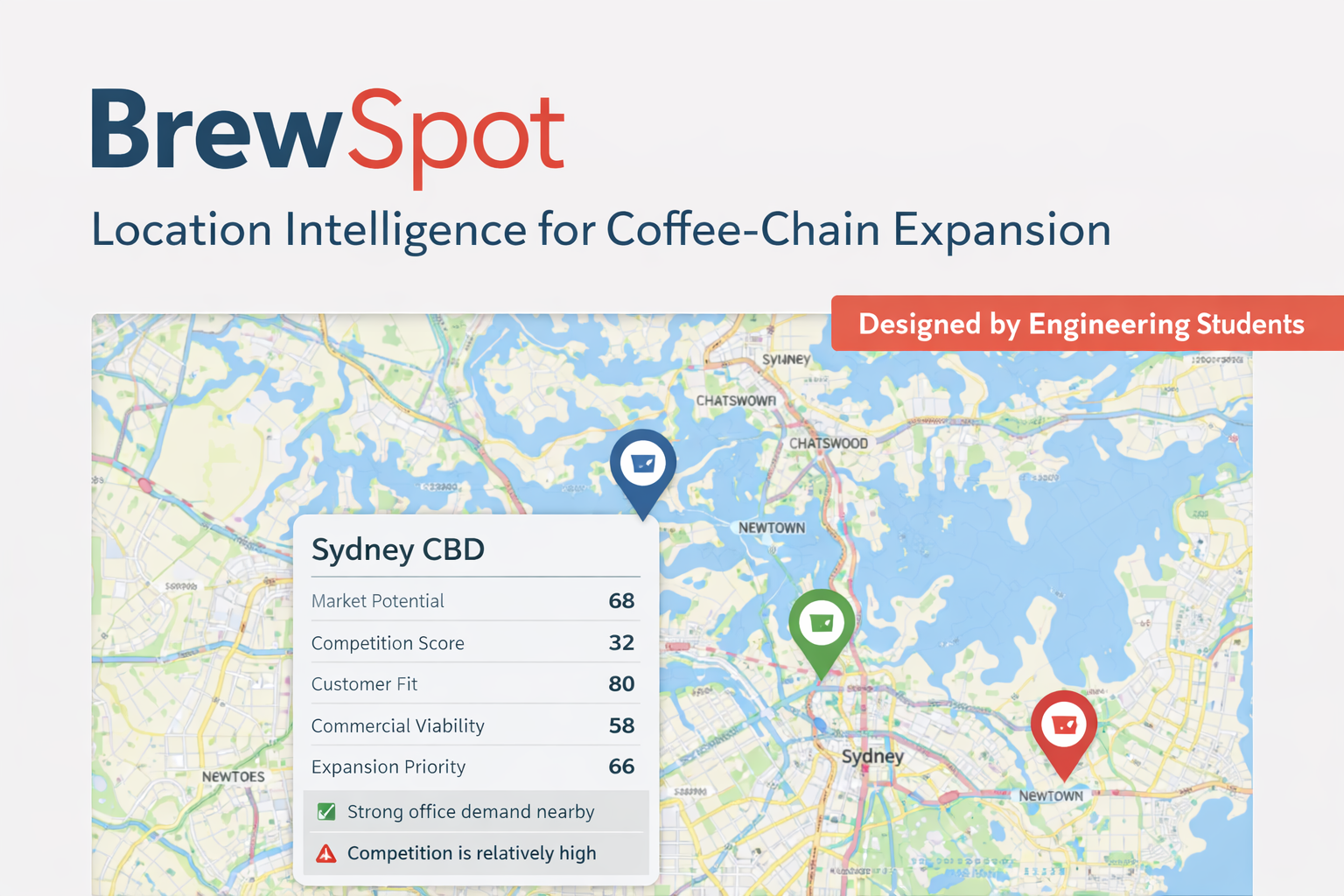
BrewSpot is a location intelligence tool for coffee-chain expansion. It helps users evaluate whether a location is suitable for opening a new store by analyzing factors such as business district type, nearby demand signals, competition density, customer catchment, and commercial viability.
Instead of simply showing places on a map, BrewSpot turns place data into decision support. It helps answer questions like:
- Is there enough demand in this area?
- Is the competition too strong?
- What kind of customers are likely to be here?
- Is this location worth prioritizing for expansion?
How we built it
Because we did not come from a business background, we first researched successful real-world retail and coffee-chain cases to understand how site selection works in practice. We looked at patterns such as proximity to offices, transport hubs, mixed-use districts, and areas with repeat demand.
After that, we translated those commercial ideas into a technical structure. We designed BrewSpot around several explainable scoring dimensions, including market potential, competition and catchment, and commercial viability. We then built a lightweight prototype that uses place data and location-based features to rank and explain potential store sites.
Our approach was to keep the system interpretable. Rather than building a black-box model, we wanted the product to clearly show why a site was recommended.
Challenges we ran into
The biggest challenge was that we started from almost no background knowledge in this domain. As electrical engineering students, we were unfamiliar with commercial site selection, business evaluation, customer segmentation, and product design. That meant we had to learn many concepts from scratch while also trying to build a working prototype.
Another challenge was data realism. In an ideal system, we would include complete information on rent, foot traffic, demographics, and store-level performance. But with limited time and limited access to data, we had to decide what to approximate, what to simplify, and what to leave as future work.
We also found that building a product is different from doing technical analysis. It was not enough to have an idea or a scoring method — we also had to think about user needs, interaction flow, and how to present results in a useful and convincing way.
Accomplishments that we're proud of
We are proud that we were able to take a problem from a field we barely understood at the start and turn it into a structured, presentable project. We moved beyond our usual engineering topics and built something that connects technical reasoning with commercial decision-making.
We are also proud that BrewSpot is not just an abstract concept. We turned it into a clear product idea with a defined user, a scoring framework, and a practical use case. Most importantly, we built it in a way that is explainable, so the recommendation is not just a number, but something a user can understand and act on.
What we learned
We learned that a good store location is not simply the busiest one. It depends on a balance of demand, accessibility, customer fit, competition, and cost.
We also learned how important it is to bridge technical thinking and business thinking. Data alone is not enough — it needs to be translated into decisions. This project taught us how to approach an unfamiliar problem, research the domain, extract useful patterns, and then design a system around those insights.
On a broader level, we learned how to work across disciplines. As engineering students, this experience pushed us to think beyond pure technical implementation and consider market logic, product value, and real-world usability.
What's next for BrewSpot
The next step for BrewSpot is to make it more realistic and more data-rich. In the future, we would like to add stronger commercial layers such as historical rent data, real foot-traffic information, demographic profiles, and more detailed competitor analysis.
We also want to improve the product itself by making the interface more interactive, allowing users to compare multiple districts, and generating more detailed recommendations for different retail formats.
In the long term, BrewSpot could grow from a prototype into a broader location intelligence platform that supports smarter expansion decisions not only for coffee chains, but for other retail businesses as well.
Built With
- nominatim
- openstreetmap
- overpass-api
- python
- requests
- streamlit

Log in or sign up for Devpost to join the conversation.