
Inspiration
Memes. They’re ubiquitous. Social media is flooded with them—some are good, some are bad, and some are downright hilarious. But more often than not, meme culture is described as cringe. Yet memes play a pivotal role in how society, especially Gen Z and Millennials, interact with one another.
Once every while, we stumble upon this “perfect meme”; we send it to friends, hoping they’ll approve of our humour. This isn’t a unique experience, though, as “74% [of youth] send memes to make people smile or laugh—and 53% send them to react to something.” Even if memes may be considered questionable, or perhaps, dark, we still share them—which is the exact inspiration behind our project.
What it does
There’s a slew of mental health apps for mindfulness, teletherapy, or “emotional companions.”
In this oversaturated selection, it can get redundant. How much journaling can you do? How many times can you track down when you felt sad?
Through a multidisciplinary approach, BREAK OUT! combines psychology, talk therapy, peer support, and internet culture all in one.
Mental health is critical to our well-being, and removing that stigma starts with actually talking about it.
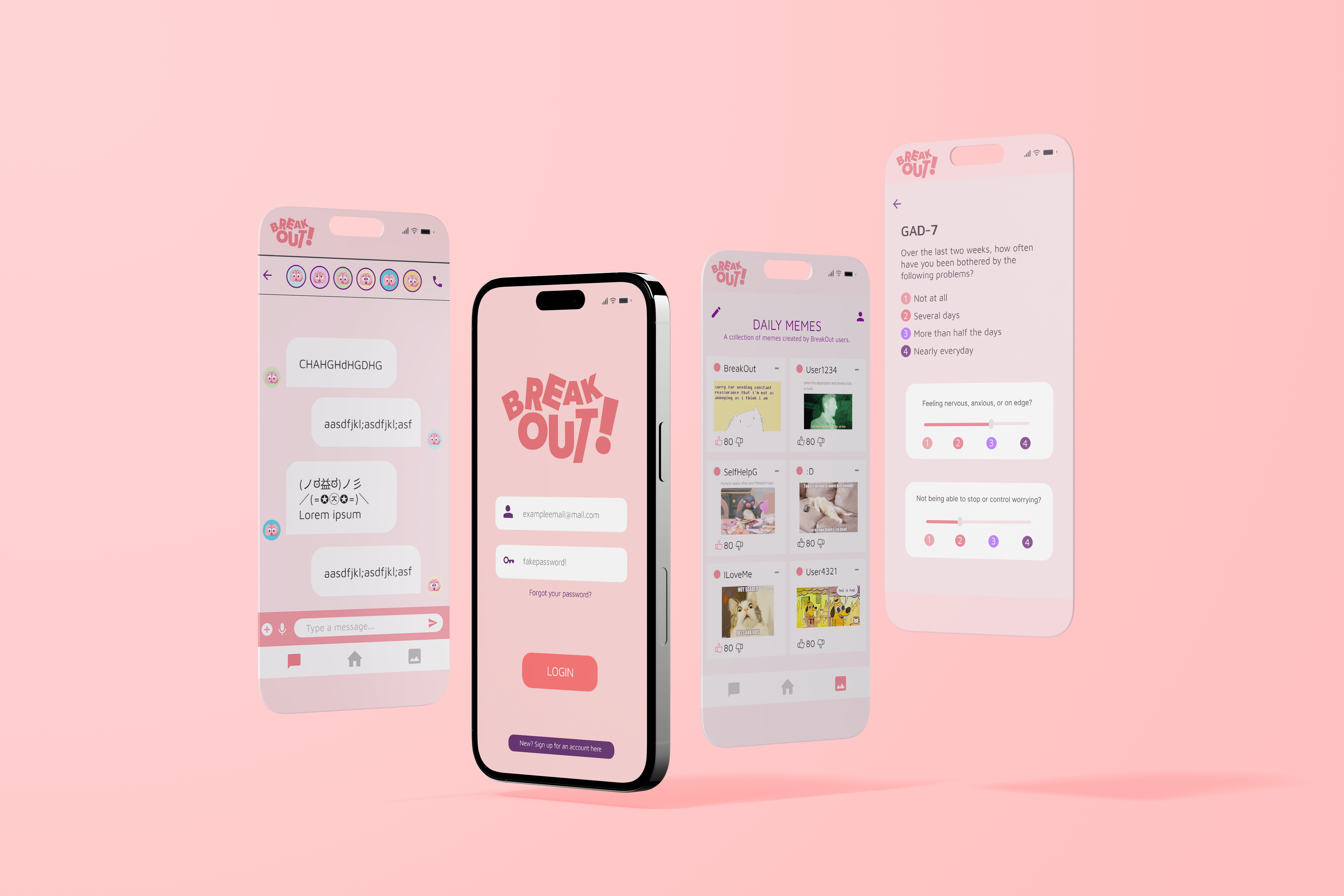
BREAK OUT! utilizes the Patient Health Questionnaire (PHQ-9) and Generalized Anxiety Disorder Assessment (GAD-7)—which assess depression and anxiety, respectively—to differentiate whether users are experiencing a mental health struggle or a mental illness. There is a quantifiable threshold to making this distinction. Although these evaluations are short, totalling 16 questions, psychiatrists note that “the PHQ-9 is a reliable and valid measure of depression severity.”
After getting diagnosed, users have two options: join a breakout room with five other individuals, or speak to a mental health professional.
The breakout rooms are generated using the results from the questionnaire. A balance of individuals with mental health struggles and paired with individuals who may not have mental health struggles. In addition, users can choose an avatar that shows their current mood or feelings, so that those in the conversation can converse with the proper sensitivity.
Then, this is where BREAK OUT! connects itself to internet culture. BREAK OUT! aims to utilize the power of memes and humour for the benefit of its users’ mental health. In fact, a study notes that “internet memes related to depression may be beneficial for individuals experiencing consistent symptoms.” Through BREAK OUT!’s intuitive interface, users can view, share, like, and comment on mental health-related memes. They also have the ability to create and publish their own memes through BREAK OUT!’s meme editor.
At the end of a user’s session, BREAK OUT! offers its users reliable mental health resources such as Wellness Together Canada and Kids Help Phone.
Every two weeks, BREAK OUT! Users will be prompted to re-take the GAD-7 and PHQ-9 questionnaires as an opportunity for self-reflection and to see how they’ve progressed.
To break out of a cycle that makes us feel stuck.
How we built it
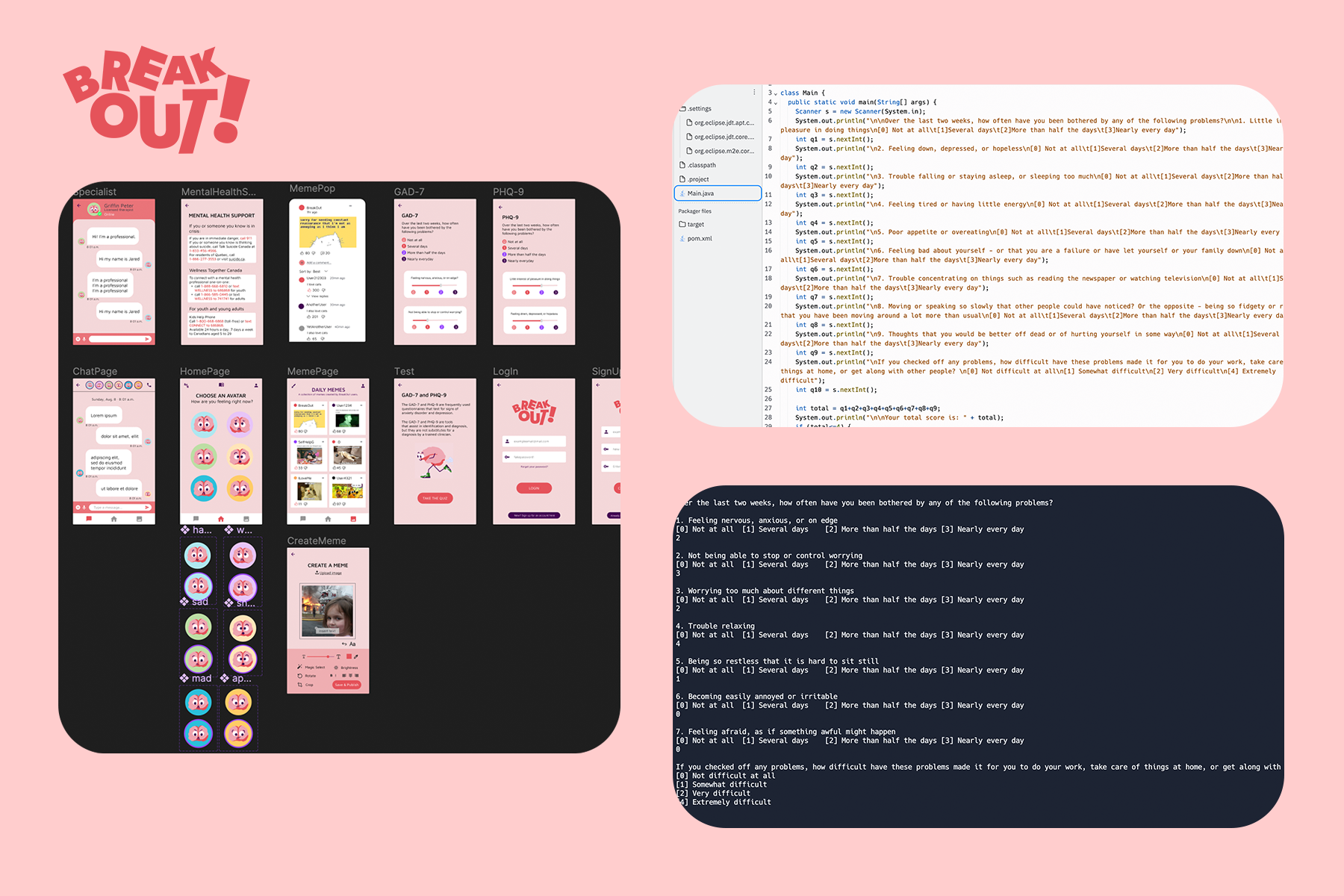
We built our program using Replit, Figma, html, css, java, Adobe Illustrator, and Adobe Photoshop.
Challenges we ran into
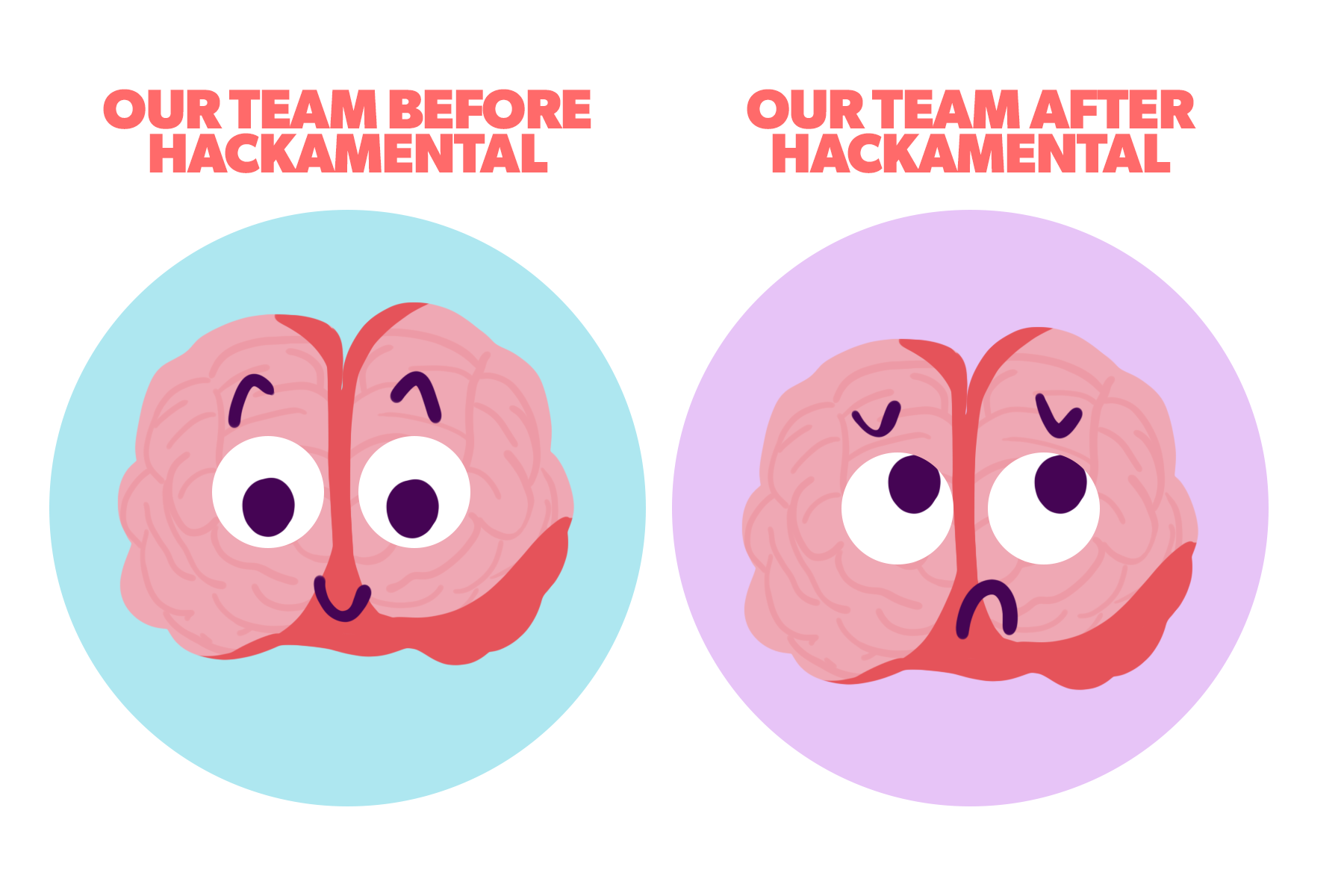
Our team is still relatively new to hackathons, nor do any of us carry any expertise in coding. Since using Figma last year, we have definitely grown. We ran into challenges with limited time and compatibility/limitations issues with Figma with other programs.
Accomplishments that we're proud of
The original idea, the aesthetics and design of our app, producing a good project by the end despite being all inexperienced devs, and coming up with a unique brand.
What we learned
Our skills within Figma have improved greatly through the process of this hackathon, as have our understanding of mental health as a whole. We were also able to learn some basic Java for making the GAD-7 and PHQ-9 questionnaires.
What's next for BREAK OUT!
BREAK OUT! aims to go from the prototype stage with a demo to a fully functional app with built-in surveys, meme pages, meme making function, and chat rooms.
Citations
“3 Stats That Show What Memes Mean to Gen Z & Millennials.” YPulse, 19 Nov. 2019
Built With
- adobe-illustrator
- figma
- java
- love
- photoshop
- replit


Log in or sign up for Devpost to join the conversation.