-
-
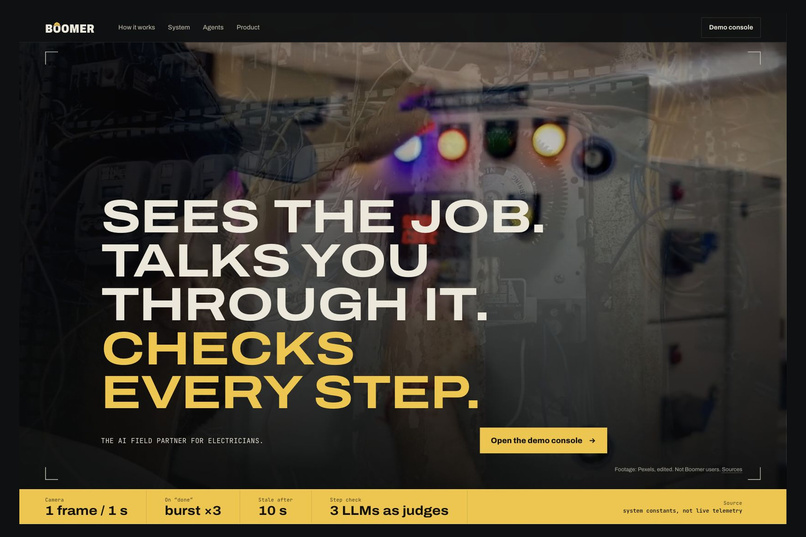
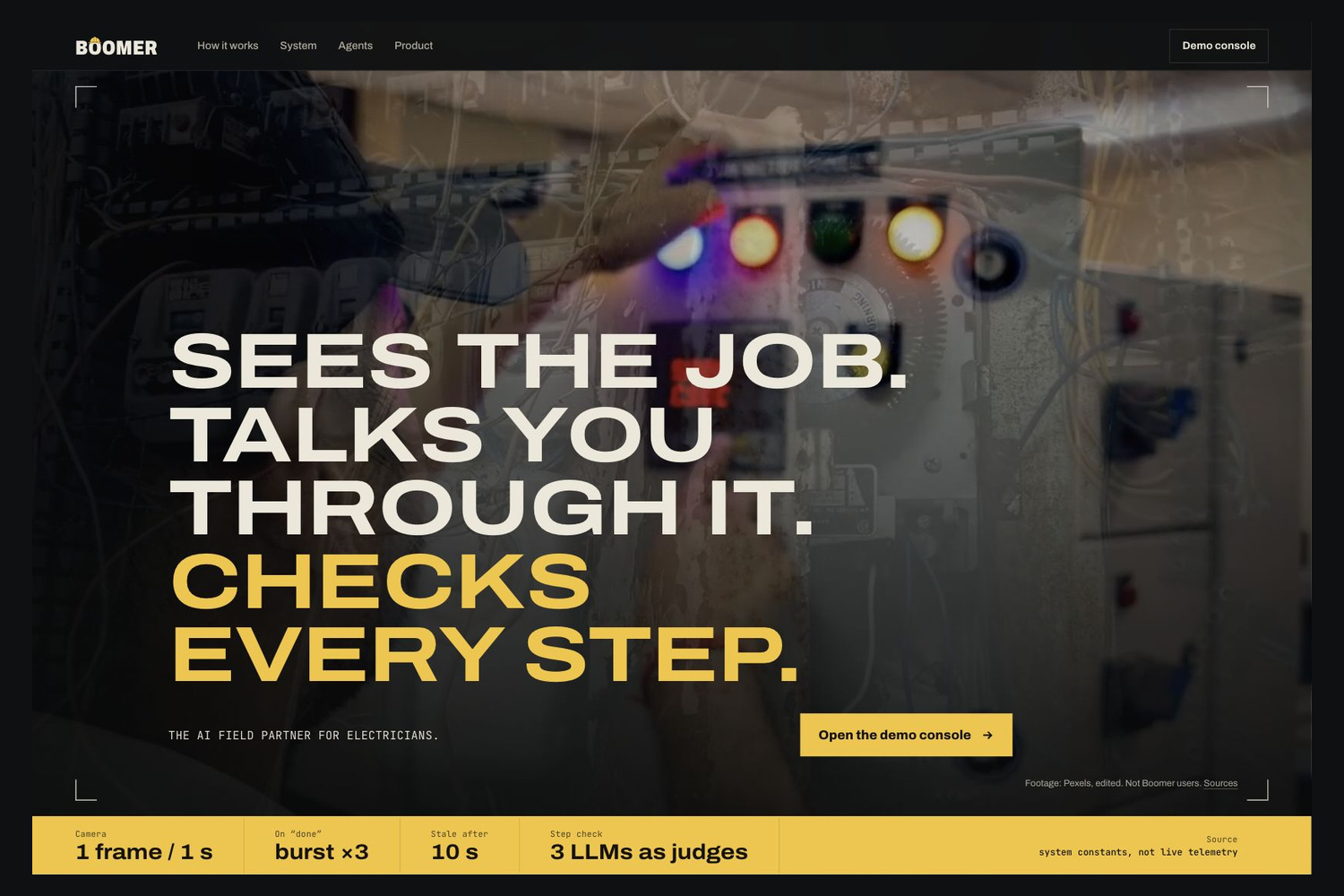
Meet Boomer: voice and camera guidance for electricians. Actual homepage; licensed editorial background footage.
-
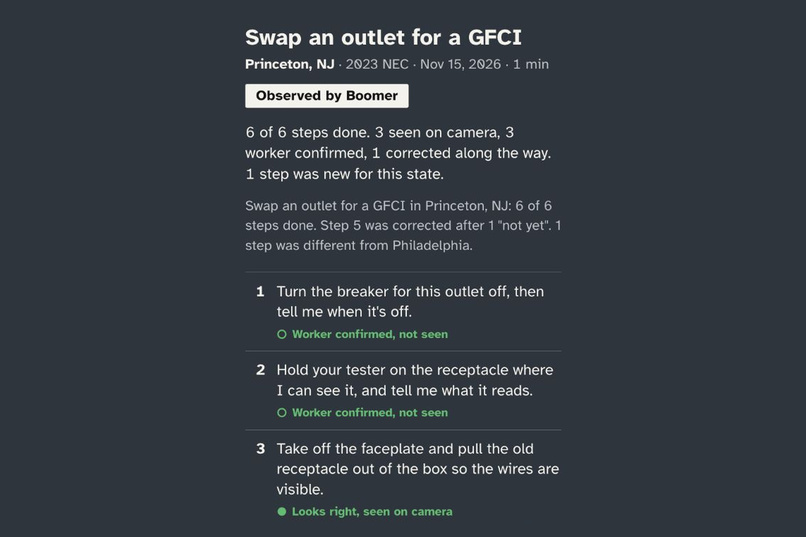
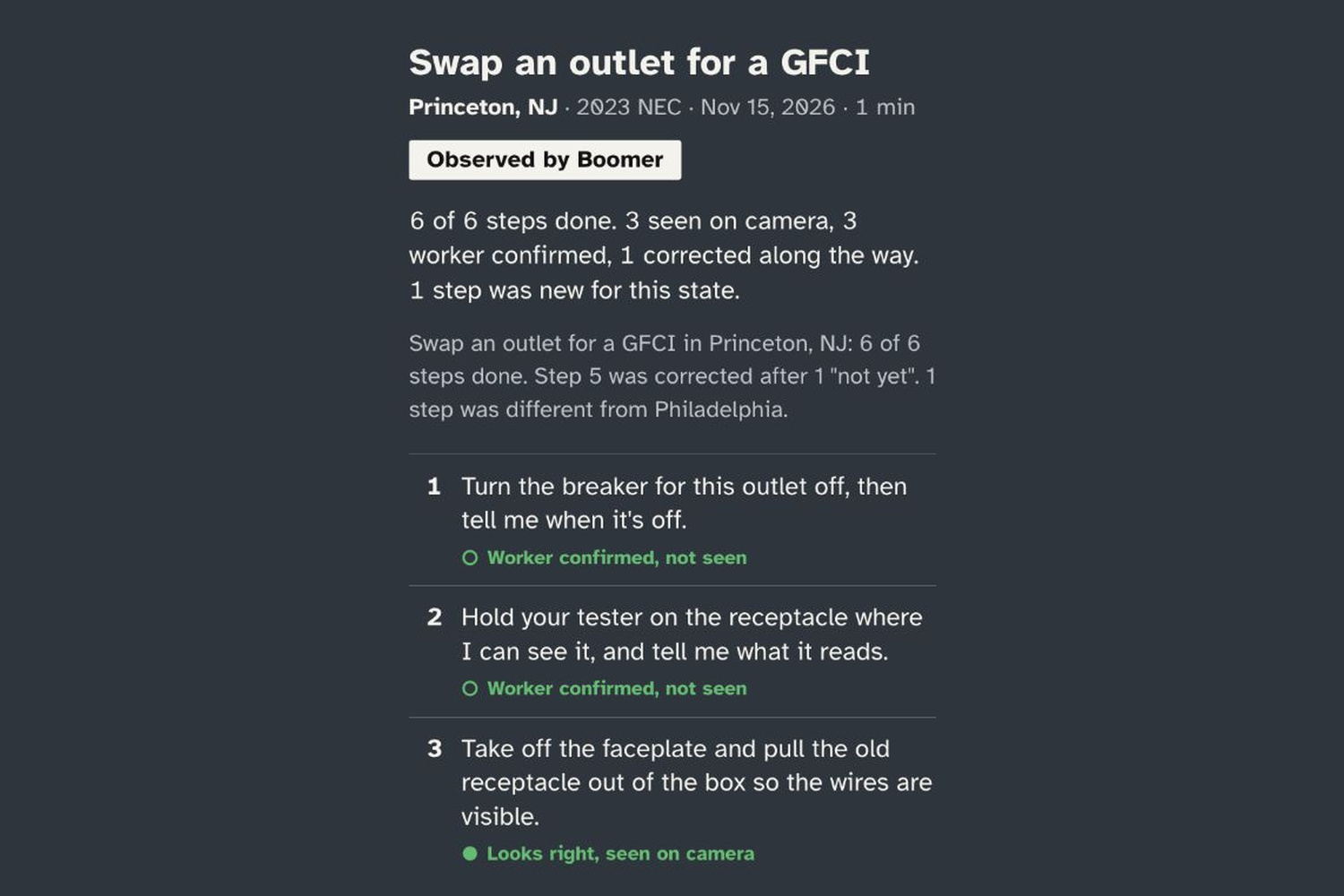
A completed job retains steps, observations, spoken confirmations and corrections. Actual record screen; scripted demo data.
-
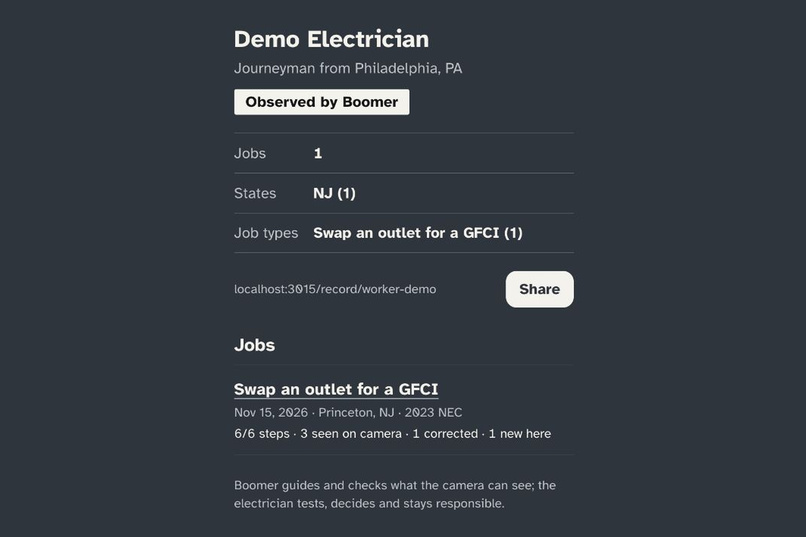
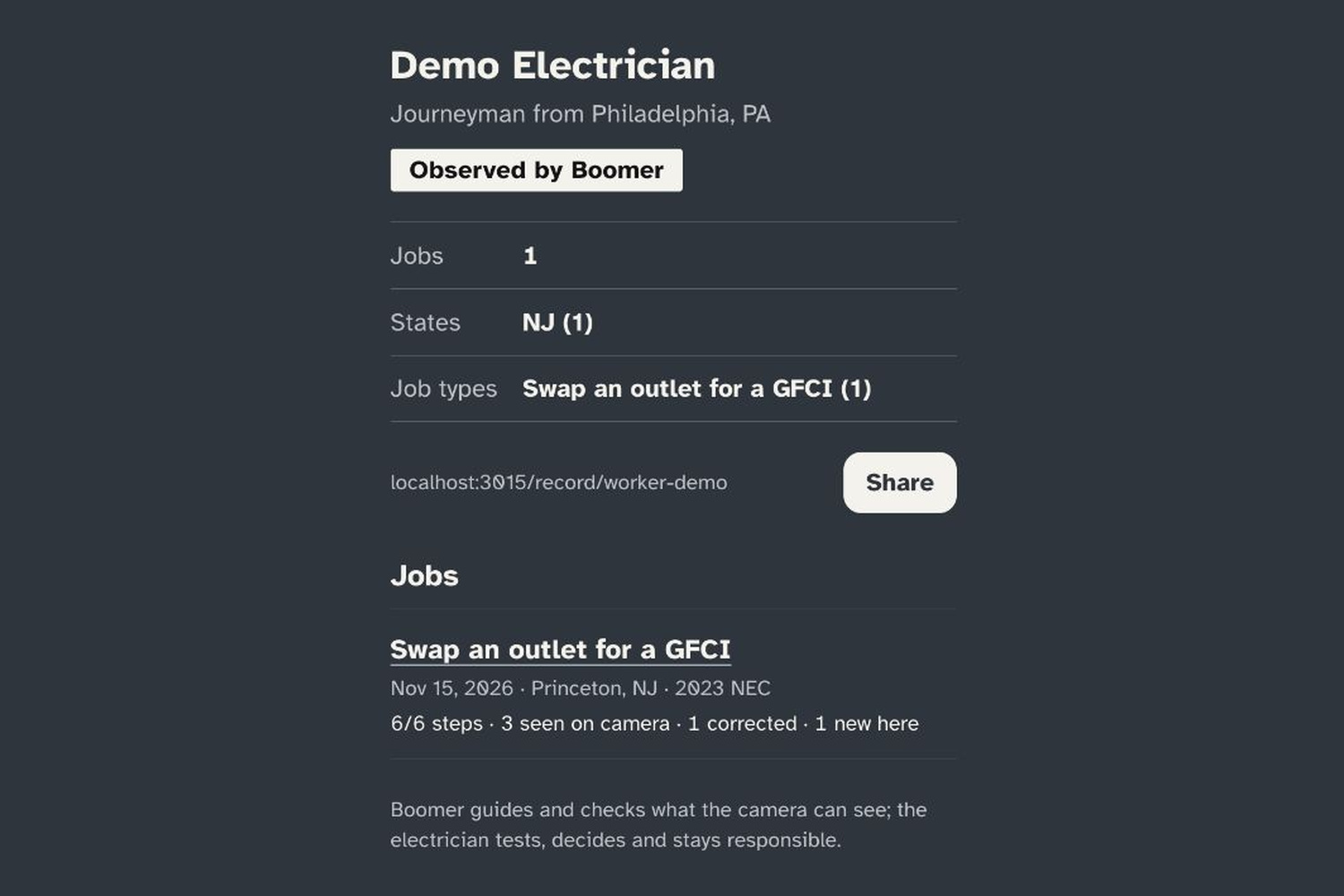
A shareable history of jobs and locations follows the worker. Actual portable record screen; demo data shown.
-
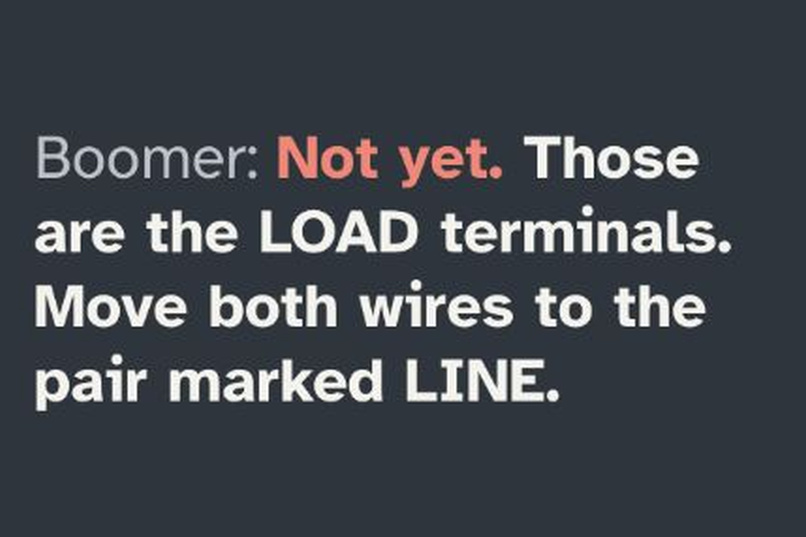
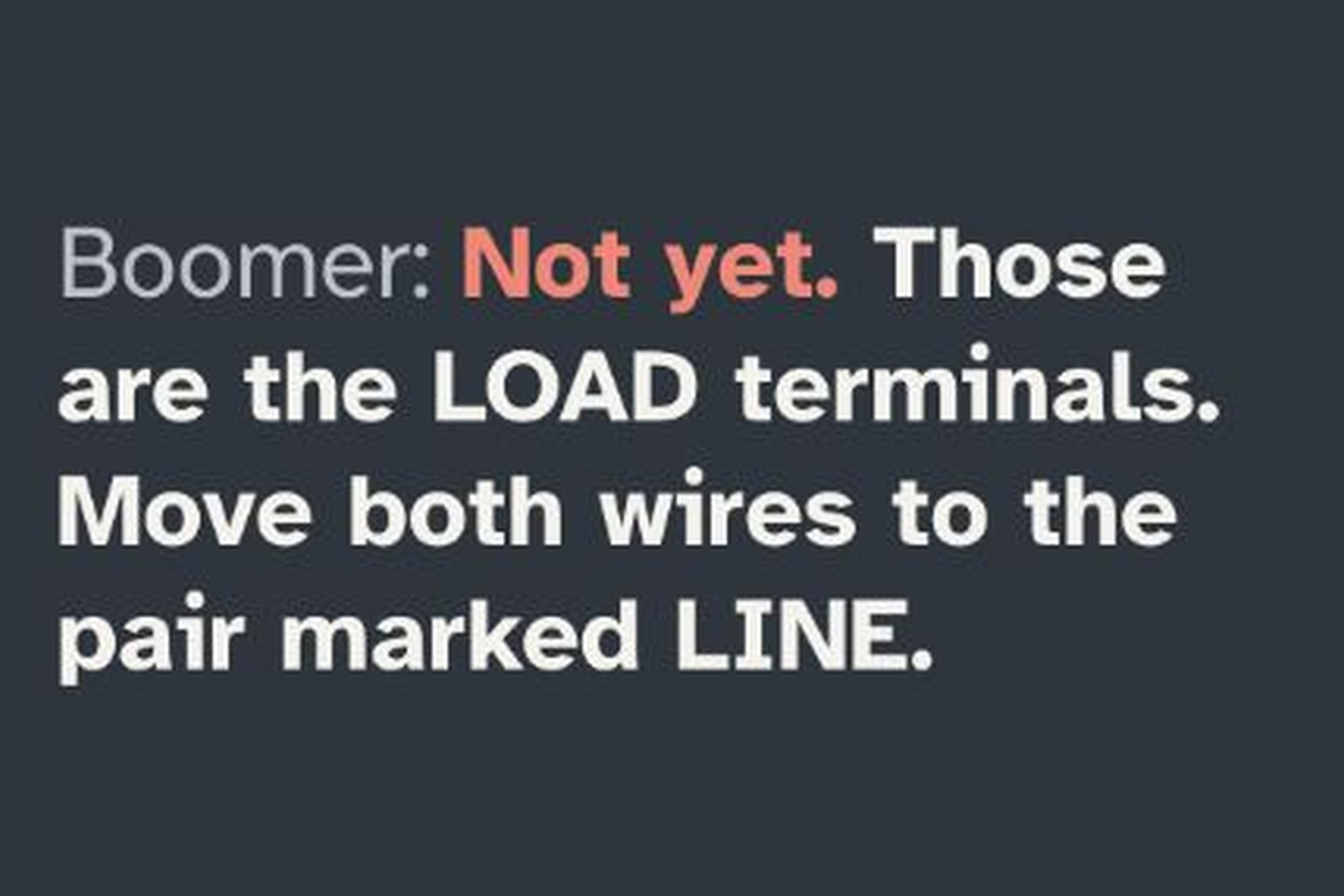
The job monitor demonstrates the LOAD-versus-LINE correction flow. Scripted demo state shown.
-
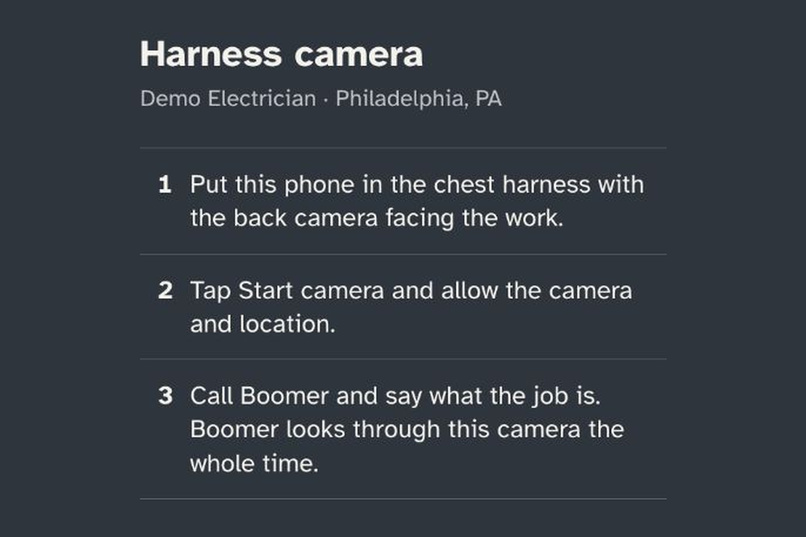
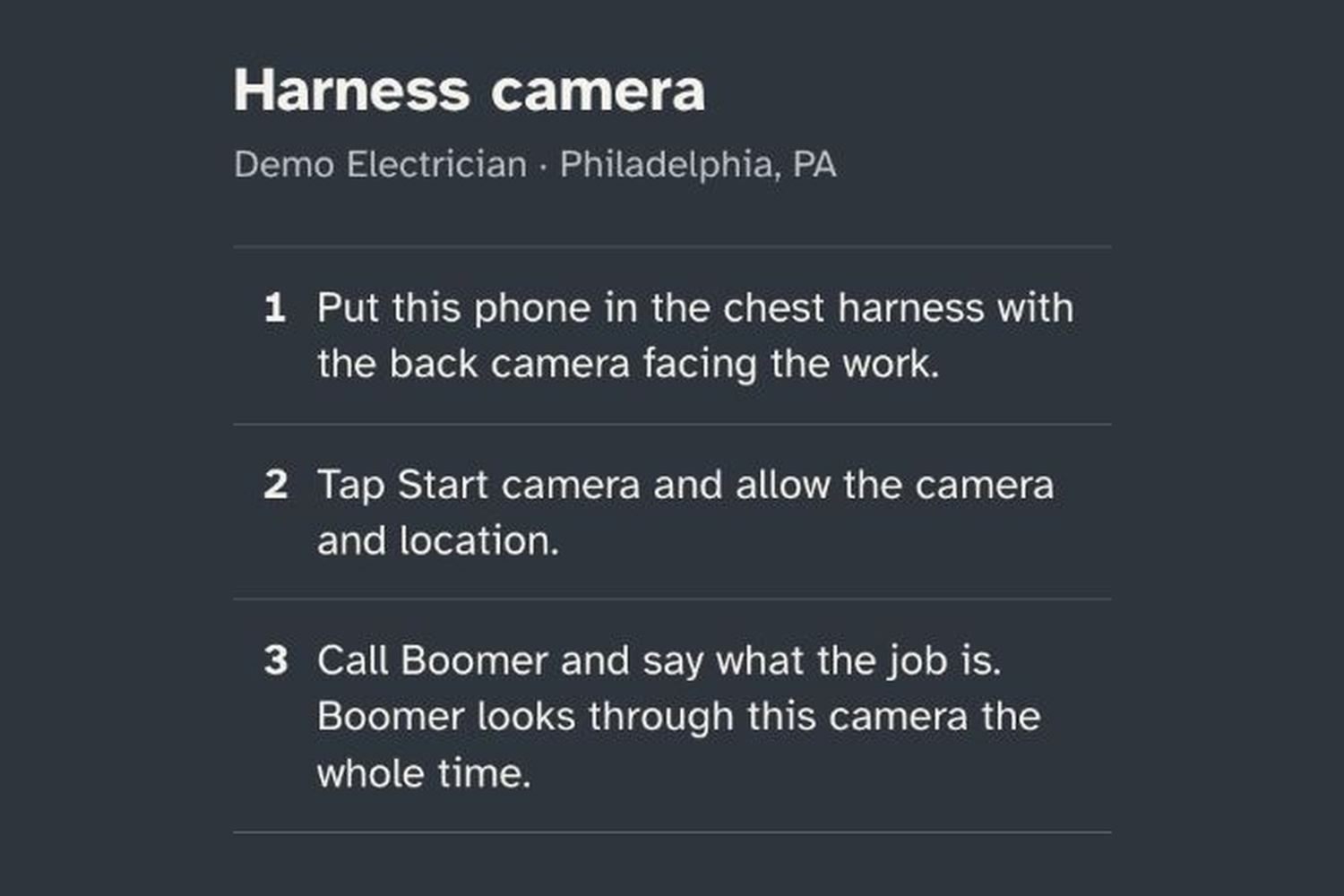
Mount the phone, open the harness camera and call Boomer for hands-free guidance. Actual setup screen; demo profile.
-
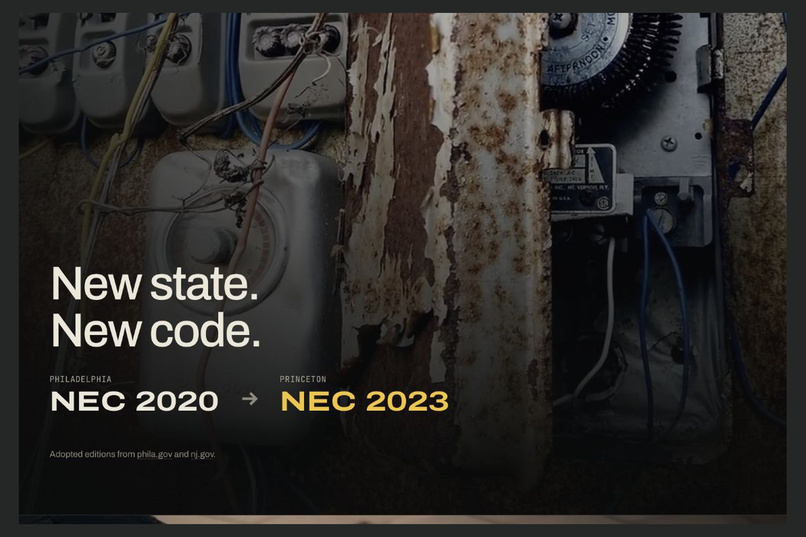
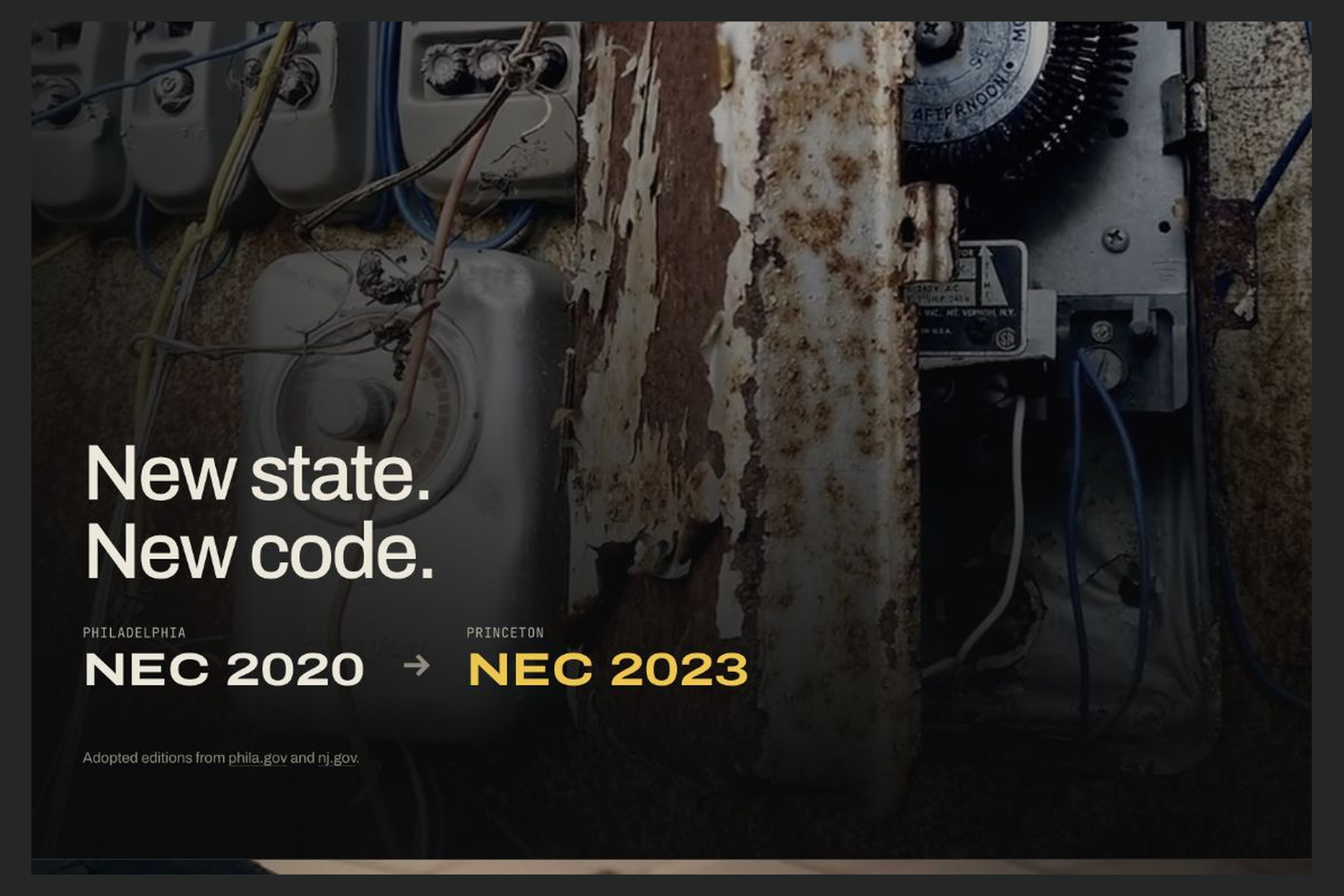
Home and job jurisdictions side by side, with linked adoption references. Website overview; editorial stock background.
-
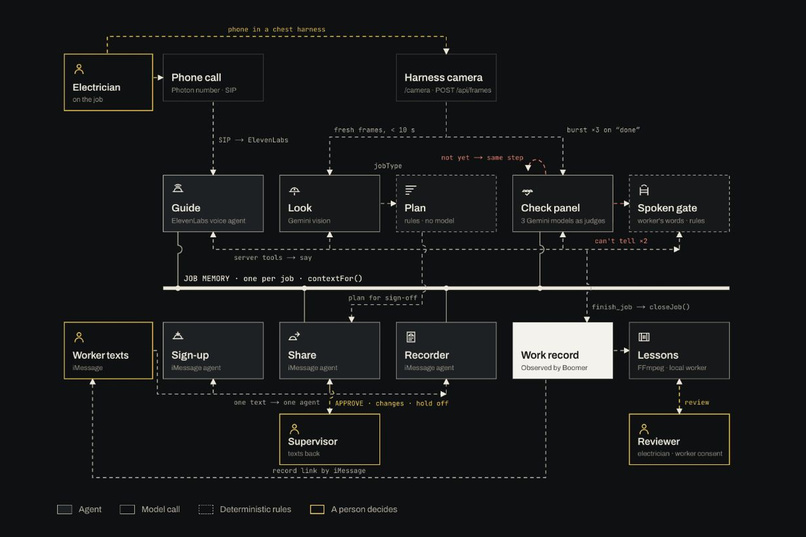
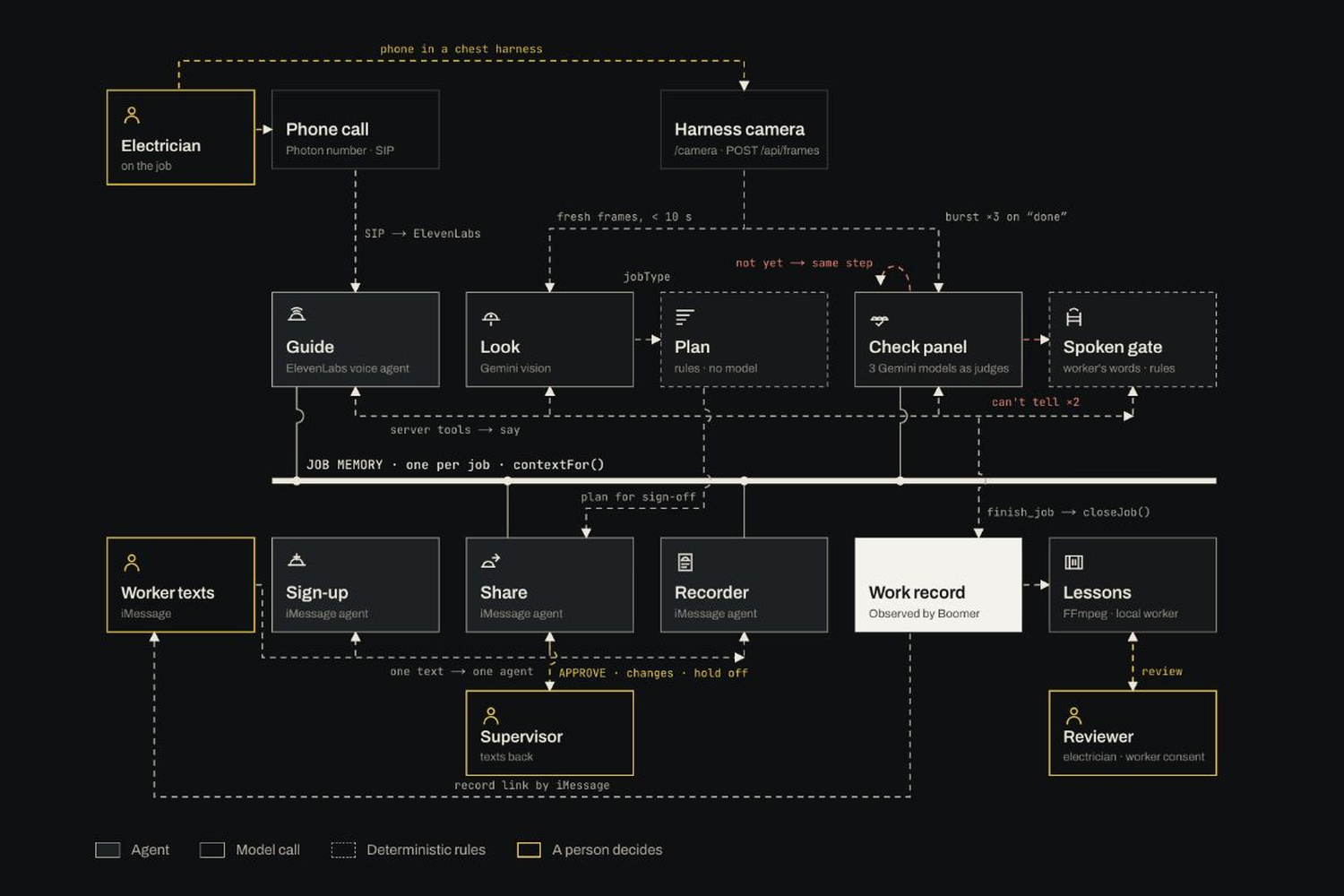
Voice, camera checks, supervisor texts and work records connect through shared job memory. Architecture from our website.
Inspiration
While AI writes our emails, books our flights, and generates our code, blue collar workers are still missing that same level of support on the job.
Electricians face challenges that most office workers never have to think about. Their hands are occupied, they're constantly moving between job sites, and the requirements they're expected to follow can change from one municipality to the next. Even a ten-minute drive can mean different permitting procedures, inspection requirements, or local regulations.
And when an apprentice encounters something unfamiliar, there isn't always an experienced electrician standing beside them to help.
We wanted to understand these problems firsthand. Before writing a single line of code, we interviewed six electricians across New Jersey, Virginia, Nebraska, and Massachusetts, ranging from apprentices to seasoned veterans. One of those interviews happened in person.
Two problems kept coming up.
An experienced electrician from Nebraska described how difficult it can be to keep up with changing electrical codes and requirements between jurisdictions. Years of experience don't necessarily mean knowing every rule that applies to the next job site.
A junior electrician explained the challenges of working without someone available to check his work, explain an unfamiliar step, or catch a mistake.
Those conversations shaped what we decided to build. We introduced location-aware guidance to help electricians understand local requirements, computer vision to provide feedback on their work, and autonomous supervisor coordination to make getting help easier.
That's how Boomer, the AI copilot for electricians, came to life.
The name has two meanings. In the electrical trades, a "boomer" is a traveling lineman who moves from one job to the next. There's also the familiar "OK boomer" meme, which dismisses advice from older generations. We wanted to give that phrase a new meaning by making decades of hands-on knowledge more accessible to electricians, from first-year apprentices to experienced professionals.
That's also where our domain, okayboomer.us, comes from.
Forward Deployed Challenge (Peri): built with working electricians
We talked to electricians first. During HackPrinceton, before we wrote any code, we interviewed six of them, one in person: Arjun Patel, a master electrician at Loudoun Electrical in Virginia; Rahul Sharma, a journeyman at Cifelli Electrical Inc. in New Jersey; Jack Anderson, a master electrician at TruVolt Electrical Consulting in Nebraska; Rohan Mehta, an apprentice at Dago Electric in Virginia; Ryan Schmidt, a journeyman at Victory Electrical in Massachusetts; and Kevin Morales, a journeyman at JM Electrical Solutions in Boston. Most of what we built came out of those conversations. (Watch the video to see these interviews!)
The electricians earlier in their careers mostly talked about getting help. When they run into something they haven't seen before, the person to ask is a senior electrician, and that person is usually on another job and may not get back to them for hours. Until then they're stuck.
"[I]t's honestly really frustrating knowing that ... my senior and the people who are supposed to help me aren't really there for me." — Rahul Sharma, journeyman, Cifelli Electrical Inc.
The experienced ones had a different problem. Jack Anderson moved from Arkansas to Nebraska as a master electrician and still had to work through license requirements and local regulations that didn't match years of prior experience. Each move means starting that over.
"When I moved from Arkansas to Nebraska, the license requirements changed and the local regulations are different ... so it isn't really super transferable." — Jack Anderson, master electrician, TruVolt Electrical Consulting
Boomer is our answer to both. It checks each step of the work through a phone camera, texts the job plan to the supervisor and reads the reply back to the electrician on the call, and uses GPS to look up the code edition, permit office, and inspection rules for wherever the job is. A supervisor only has to answer one text.
We also wanted these businesses to be able to use it right away. There's no app to install: the electrician calls a phone number and opens a web page, the supervisor replies in iMessage, and all of it is running now at okayboomer.us. Any of the six could try it on their next job.
What it does
Boomer helps electricians throughout an entire job, from understanding the task and navigating local requirements to coordinating supervisor approval, checking their work, and documenting the results.
The entire experience is designed around something electricians already carry: their phones.
1. Onboard through iMessage
Electricians can get started by texting Boomer. Our onboarding agent collects their name, home state, and experience level through a natural conversation and saves that information for future jobs.
2. Strap on your phone and call Boomer
The electrician mounts their phone in a chest harness, opens Boomer's camera page, and calls our real phone number, (814) 301-4979, powered by Photon 2.0.
Boomer sees what the camera sees, identifies the electrical task, and prepares a step-by-step plan using manufacturer instructions.
It also uses GPS to identify the job-site jurisdiction and retrieve relevant electrical-code editions, permitting information, inspection requirements, and licensing notes.
When a verified requirement differs from the electrician's home jurisdiction, Boomer highlights the difference and provides its official source.
3. Coordinate supervisor approval automatically
Before work begins, Boomer sends the proposed plan to the electrician's supervisor through Photon iMessage.
The supervisor can approve the plan, request changes, or reject it. Boomer's approval agent processes the response, updates the job's shared memory, and communicates any feedback directly through the electrician's ongoing voice call.
The electrician can stay focused on the job while Boomer handles the back-and-forth communication.
4. Guide and check the work in real time
Once the plan is approved, Boomer walks the electrician through each step using voice.
Workers can say "repeat," "why," "go back," or "check" without touching their phones.
For visually verifiable steps, three specialized Gemini models independently examine the latest camera frames to determine whether the work appears correct.
In our live demonstration, the electrician intentionally connects wires to the wrong terminals on a GFCI receptacle. Boomer recognizes that they're connected to LOAD instead of LINE, explains the problem, and asks for a correction. After the electrician fixes the connection, Boomer checks the new camera frames before proceeding.
For steps that a camera cannot reliably verify, such as confirming that a circuit is de-energized, Boomer requires explicit confirmation from the electrician. Electrical testing and safety decisions remain the worker's responsibility.
5. Create portable work records
After the job, Boomer generates a work record documenting the completed steps, camera observations, corrections, timestamps, and jurisdiction information.
The electrician receives this record through an interactive Photon mini app inside iMessage.
They can review their work, share the record with a supervisor, or forward it to a future employer. These records document what Boomer observed and do not constitute professional certification.
6. Remember the job across calls and texts
Boomer's six specialized agents share one persistent job memory.
If a phone call drops, the electrician can call back and resume at the same step. They can also text Boomer afterward to ask about a previous step, and the recorder agent answers using the actual job history.
This shared memory keeps the voice conversation, camera observations, supervisor approvals, and completed records synchronized throughout the job.
7. Turn recorded jobs into training lessons
We built a training-video pipeline that combines original recordings and timestamped transcripts with clip editing, captions, freeze frames, and annotations. A hosted FFmpeg worker prepares and renders lessons, with electrician review and worker permission required before publication. The pipeline preserves corrections and distinguishes spoken confirmations from camera observations, so future workers can learn from the job history.
How we built it
We designed Boomer as a coordinated system connecting voice, computer vision, autonomous messaging, location intelligence, and persistent job memory.
Our main engineering principle was to keep job progression and approval logic in the backend while allowing AI agents to handle conversations, visual interpretation, and communication.
Photon: Six agents, shared memory, and autonomous communication
Photon is central to Boomer's architecture.
We integrated Photon 2.0 with ElevenLabs Conversational AI over SIP to create a live phone number electricians can call.
The voice guide has ten backend tools for retrieving job context, inspecting camera frames, delivering instructions, explaining steps, managing supervisor approvals, and completing jobs.
We also integrated Photon 1.0 and iMessage to power four messaging agents:
- Signup agent: Onboards workers and creates their profiles through natural text conversations.
- Supervisor approval agent: Sends job plans, processes approval decisions, and relays supervisor feedback.
- Recorder agent: Answers questions using observations and events stored in the job history.
- Sharing agent: Sends job sheets and completed records to the contacts requested by the worker.
A separate step-checking agent handles visual verification.
Together, these six agents operate on the same job memory, allowing information to move between phone calls, camera checks, and text conversations.
For example, when a supervisor approves a plan through iMessage, the approval agent updates the shared job state. The voice guide, which has been waiting for approval, can then read the supervisor's response and continue the electrician's instructions.
The shared memory also carries what Boomer learns about each worker. Using Bayesian knowledge tracing, every result from the step-checking agent updates a per-skill estimate of how well the worker knows that skill. The voice guide reads those estimates on the next step and the next call, giving full instructions and reasons for skills the worker is still learning and short prompts for skills they have shown they know.
We also developed interactive Photon mini apps for live job sheets and completed work records. Their visual design is inspired by electrical panel schedules, with individual steps and result codes such as SEEN, SAID, and FIXED. The live job sheet updates as work progresses.
The messaging backend uses signed webhooks, a shared routing system, and duplicate-event handling to keep the different agents synchronized.
Google Gemini: Three-model computer vision verification
We use the Google Gemini API throughout Boomer, with its most important role being real-time visual verification.
We developed a system where three specialized Gemini models evaluate each visually verifiable step in parallel:
- Inspector: Determines whether the requested step appears complete.
- Wiring checker: Focuses on the wires, terminals, and physical connections in the image.
- Photo skeptic: Evaluates whether the camera frame provides sufficient visual evidence for a reliable judgment.
Each model receives the relevant step instructions and recent camera frames, then returns a structured result describing what it observed.
We implemented custom voting and error-handling logic to combine their responses. Model failures and inconclusive judgments are handled separately from valid decisions. A majority of valid responses determines the result, while unresolved disagreements prompt the electrician to provide a better view.
The system can also return a result early once the remaining votes can no longer change the outcome.
Every judgment and its reasoning are saved to the job memory.
Gemini also supports several other parts of the application, including identifying jobs from camera images, extracting worker information during onboarding, answering texts grounded in job history, and summarizing completed work.
Location-aware electrical guidance
Boomer uses GPS and reverse geocoding to identify the municipality where an electrician is working.
Our backend connects that location to researched information about electrical-code editions, permitting authorities, inspection procedures, and licensing requirements, with links to official sources.
For our prototype, we researched jurisdiction-specific information for Princeton, New Jersey, and Philadelphia, Pennsylvania.
Boomer only flags a requirement as different when the underlying comparison has been verified. This helps electricians account for location-specific requirements without assuming that every nearby municipality uses a different electrical code.
Application infrastructure
We built the frontend and backend with Next.js, React, and TypeScript, using Supabase for persistent data and Vercel for deployment.
The chest-mounted phone runs a browser-based camera interface that uploads fresh frames to the backend.
Images are resized for efficient processing, and the system captures additional frames when the worker requests a check. We also reject camera frames older than ten seconds so Boomer doesn't evaluate outdated visual information.
Our backend manages job progression, approval status, visual checks, agent memory, and record generation.
Custom 3D-printed hardware
We designed and 3D-printed five types of electrical components for our physical demonstration using Python, trimesh, and manifold3d.
These include a GFCI receptacle, an older outlet, a wall box, a faceplate, and terminal pieces, modeled around realistic US electrical device dimensions.
The props allow us to demonstrate Boomer's computer vision and mistake detection using physical components while keeping everything completely unpowered.
Our domain: okayboomer.us
We launched our website and application at www.okayboomer.us.
The name combines the electrical-trade meaning of "boomer" with the recognizable "OK boomer" expression. We liked the idea of turning a phrase associated with dismissing experience into one associated with making experience accessible.
The .us extension also fits our focus on American electricians and jurisdiction-specific electrical requirements.
Our domain uses the GoDaddy Registry .us namespace and serves as the home of our live project.
Challenges we ran into
Getting autonomous iMessage communication working
One of our biggest challenges was coordinating conversations between electricians, supervisors, and multiple agents.
Initially, supervisor replies reached our backend, but Boomer didn't respond. We discovered that some asynchronous message handlers were still running after Vercel had returned an HTTP response, which caused the remaining operations to terminate.
We restructured the webhook flow to await the necessary operations and corrected outdated webhook endpoints.
Photon's shared iMessage lines also introduced restrictions around initiating conversations. We implemented routing and delivery fallbacks to work within these limitations.
Getting three Gemini models to agree
Our initial vision panel frequently returned inconclusive results.
We discovered that model errors and quota failures were affecting the final vote because unsuccessful calls were being treated similarly to negative judgments.
We redesigned the voting logic to distinguish valid visual decisions from errors and abstentions, while still requesting better images when the available evidence was insufficient.
Preventing the AI from guessing
During early testing, Boomer occasionally tried to identify an electrical job before receiving a camera frame.
We added explicit checks for missing and stale images so the system reports when it cannot see the work rather than making assumptions about something it hasn't observed.
Running the camera alongside a phone call
Maintaining a live camera feed while the electrician was on a voice call required careful tuning.
We optimized frame frequency, image resolution, freshness checks, and additional captures when the worker requests verification.
Keeping multiple agents synchronized
We also encountered cases where actions were unintentionally repeated. For example, a supervisor could receive the same plan twice if the voice agent revisited the job context while waiting for approval.
We adjusted the job state logic to prevent duplicate approval requests and ensure all agents operate from the same record.
These challenges gave us valuable experience building systems where multiple AI components and external services need to work together reliably.
Accomplishments that we're proud of
Our biggest accomplishment is getting Boomer to work as a connected, end-to-end experience through a real phone call.
An electrician can mount their phone, call Boomer, have it identify a task, coordinate supervisor approval through iMessage, and receive hands-free guidance with visual feedback.
Watching a teammate approve a live job plan through iMessage and seeing the voice agent automatically continue the call was one of our favorite moments from the hackathon.
We're especially proud of the following:
- Six coordinated agents sharing job memory across voice, computer vision, and iMessage.
- A three-model Gemini vision system that can identify a visible wiring mistake, explain the correction, and evaluate the updated work.
- A working Photon voice agent accessible through a real phone number.
- Autonomous supervisor approval workflows that connect iMessage responses to an ongoing voice conversation.
- Interactive Photon mini apps for live job sheets and portable records.
- Custom-designed and 3D-printed electrical props that make our physical demonstration possible.
- A live product at okayboomer.us, built during HackPrinceton.
- Six interviews with electricians across four states, conducted before development.
We're particularly proud that the features we prioritized came directly from the problems electricians described to us.
What we learned
Talking to real users shaped our strongest features.
Our conversations with electricians showed us how important hands-free operation, local requirements, supervisor involvement, and immediate feedback are during physical work. These insights influenced the product before we started development.
Reliable AI requires more than capable models.
Building Boomer taught us how much engineering goes into managing shared state, coordinating agents, handling asynchronous webhooks, and maintaining reliable communication between different services.
AI needs to recognize uncertainty.
Our initial vision-checking failures reinforced the importance of distinguishing actual visual evidence from assumptions. When the camera can't provide enough information, Boomer needs to acknowledge that limitation and request another view.
Deterministic backend logic makes agent systems more dependable.
Keeping job progression, approval states, and required safety confirmations in backend logic made the application easier to test and debug.
Physical work requires a different kind of interface.
Designing for electricians meant accounting for occupied hands, noisy environments, camera positioning, and workers who can't constantly look at a screen. That influenced nearly every part of the experience.
Most importantly, building Boomer showed us how much opportunity exists to make AI genuinely useful for people whose work happens away from a desk.
What's next for Boomer
Our HackPrinceton prototype demonstrates Boomer through a GFCI receptacle replacement, but our goal is to support electricians across a much wider range of work.
Expand our library of electrical jobs. We want to support additional procedures, with each workflow reviewed by experienced electricians before being introduced into the system.
Support more jurisdictions. We're planning to expand our collection of verified electrical-code references, permitting information, inspection procedures, and licensing requirements across more municipalities and states.
Expand the training library. We want to grow a collection of reviewed job recordings that show important components, explain steps, and preserve mistakes alongside their corrections, helping newer electricians learn from experienced professionals.
Improve autonomous coordination. Dedicated Photon messaging lines would allow Boomer to initiate supervisor conversations directly and support contractors managing multiple active jobs.
Pilot with electrical contractors. We want to bring Boomer to real electrical businesses, starting with the electricians who helped us understand the problem.
As the platform grows, we want every completed job to contribute to a larger collection of practical knowledge and portable records that electricians can build upon throughout their careers.
Our long-term goal is to make reliable guidance, location-specific knowledge, and accumulated experience accessible wherever electricians are working.


