-
-
Description_home
-
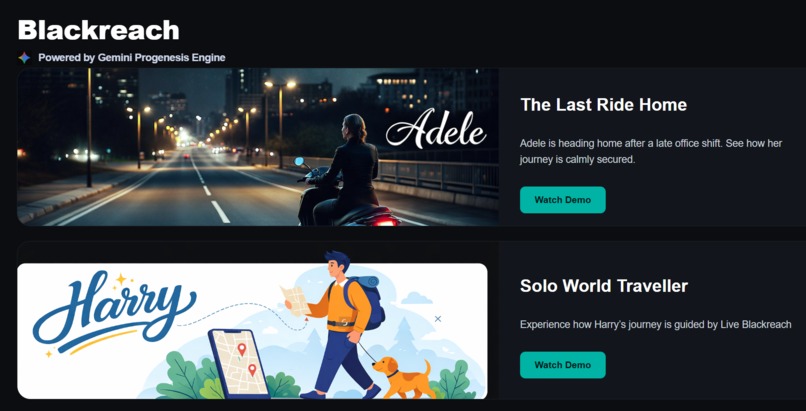
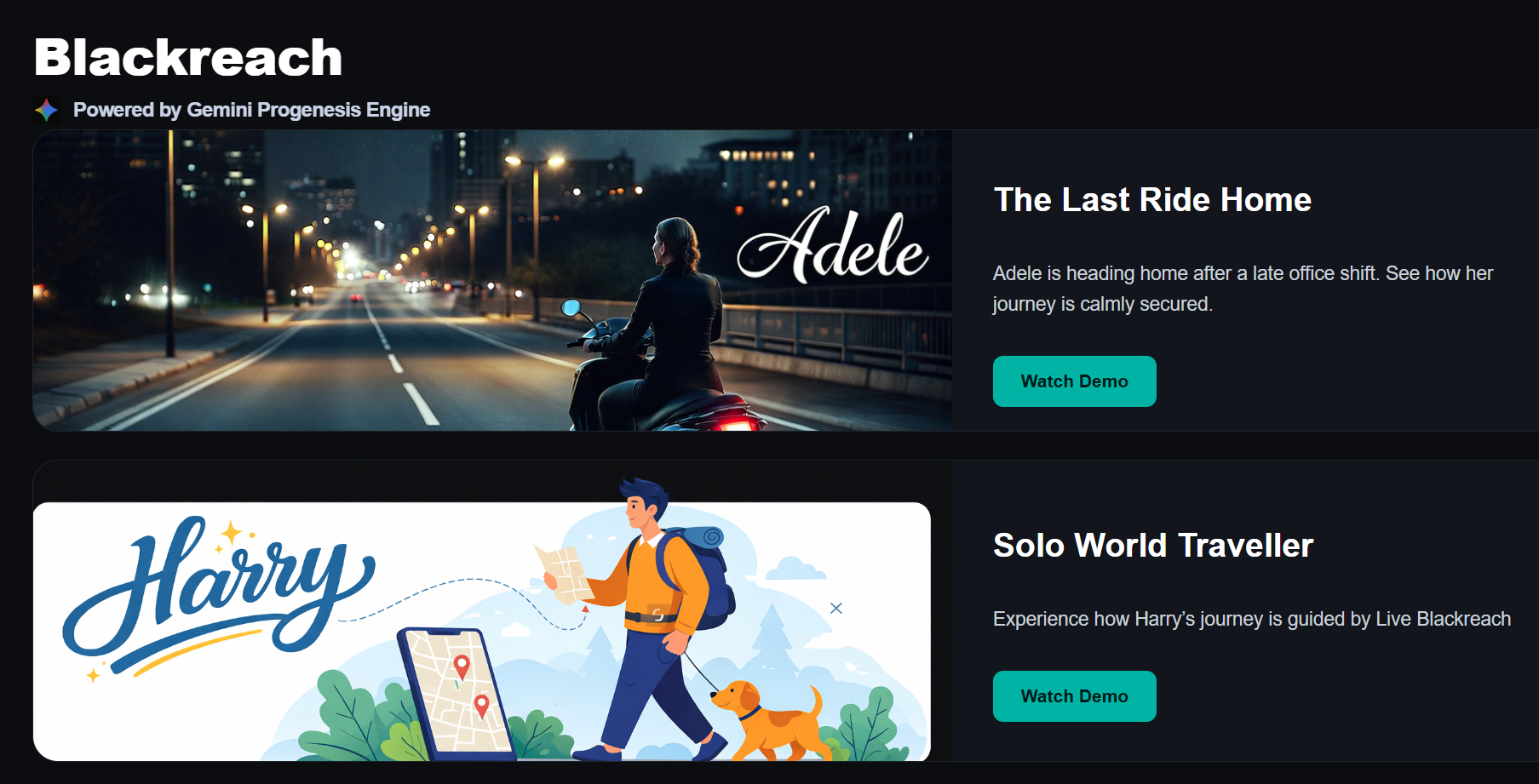
home page
-
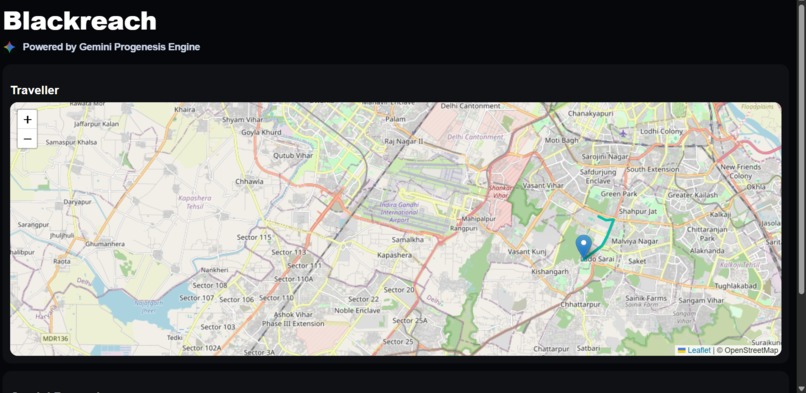
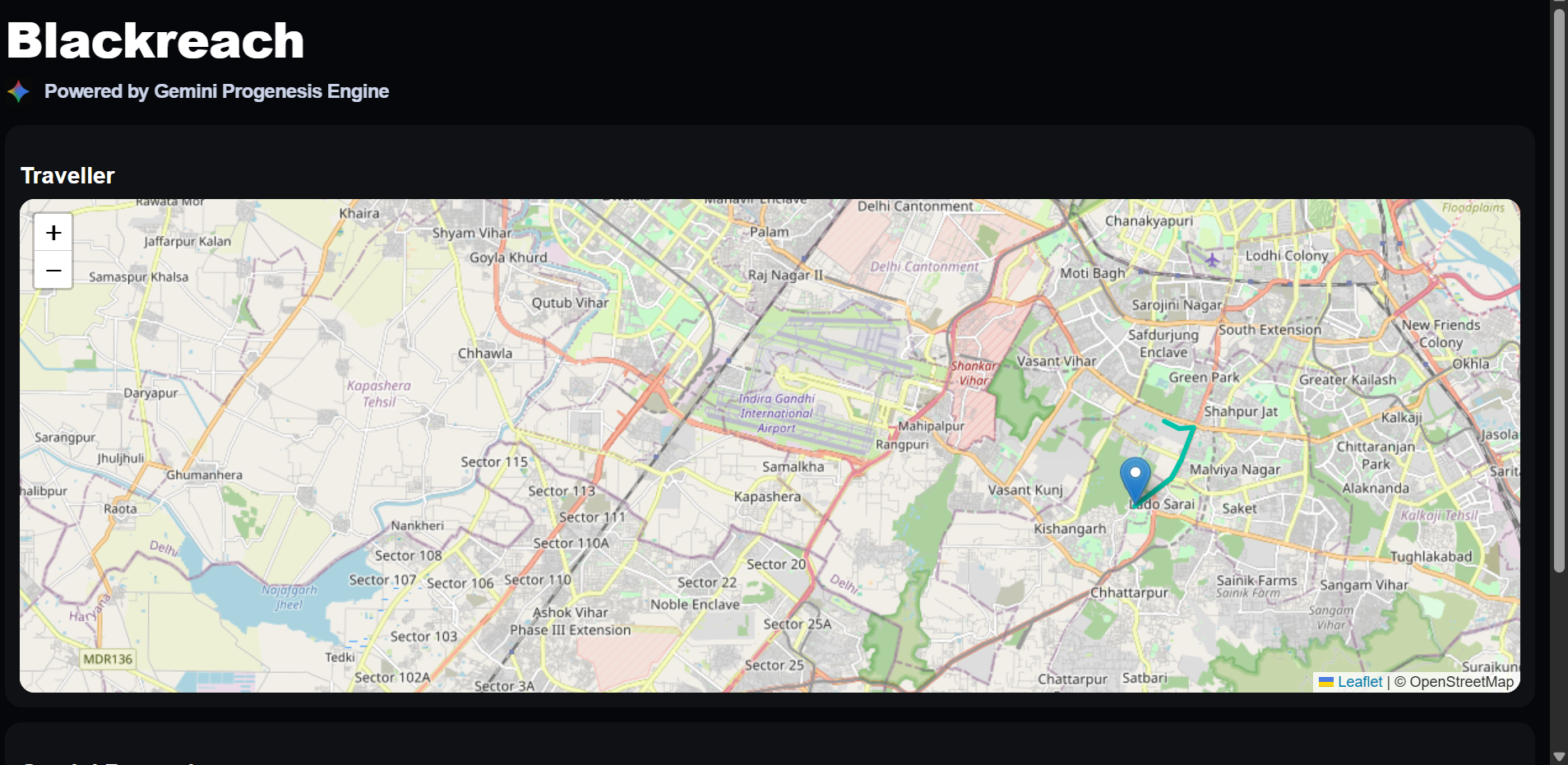
live tracking
-
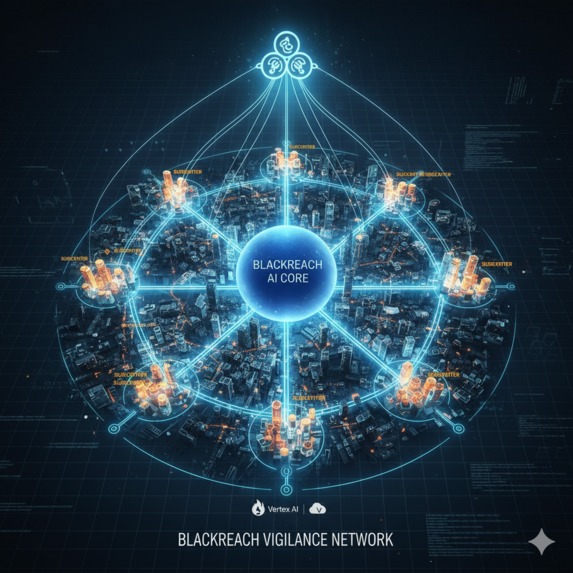
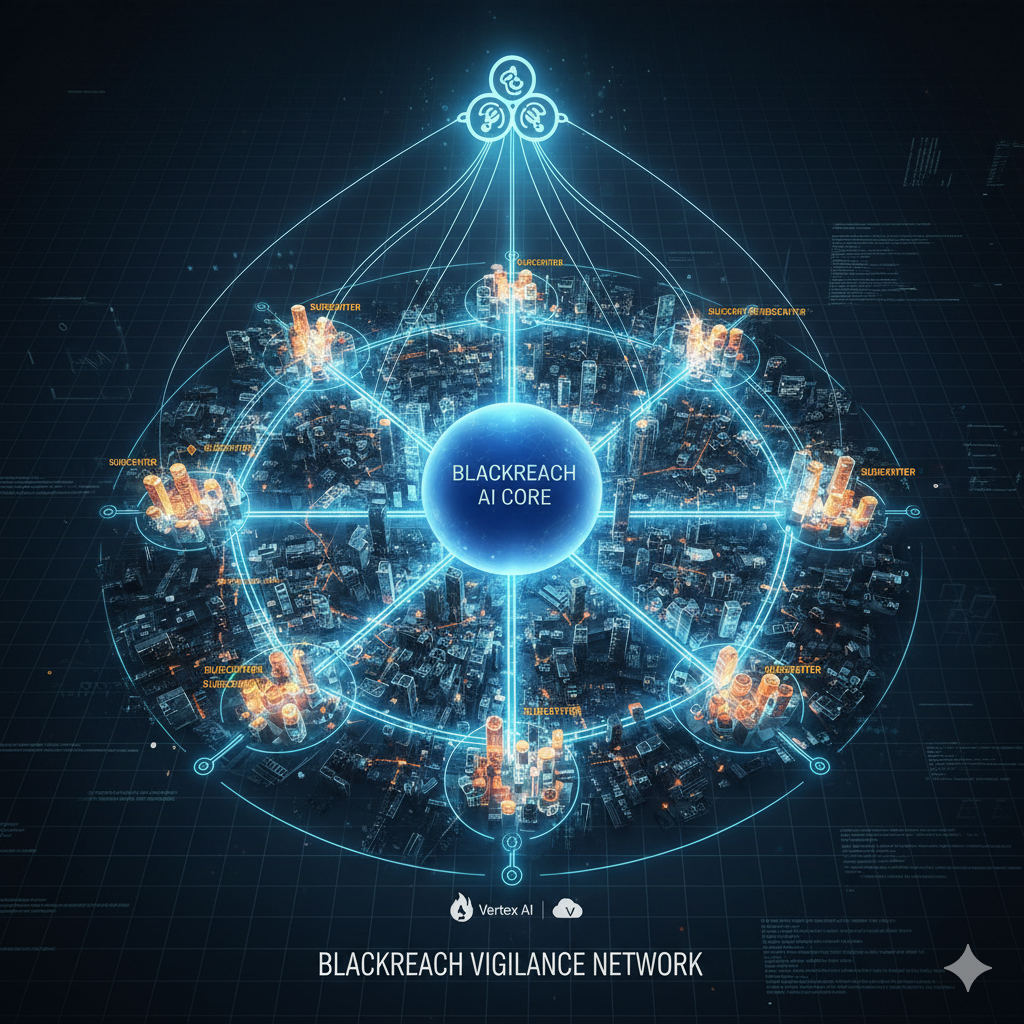
Center and subcenter distributed network
Inspiration: The Human Paradox
Modern cities are more connected than ever, yet the scarcity of human attention has made everyday journeys more vulnerable for those we care about most.
Whether it’s an elderly parent seeking independence or a child navigating busy urban spaces, safety should not depend on constant supervision or network privilege, it should be built into the journey itself.
Blackreach was inspired by the idea of replacing passive GPS dots with active reasoning: a system that watches, understands, and protects when human eyes cannot in their selected journey.
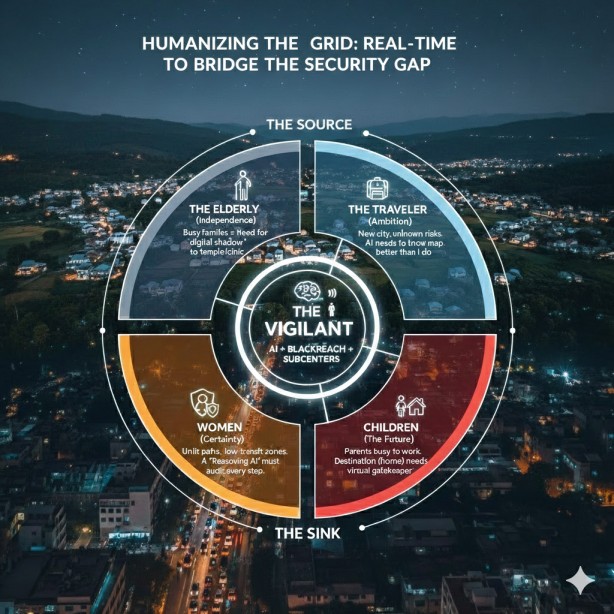
What it does: The Blackreach Experience
Blackreach is a journey-aware safety companion designed to provide a digital shadow that respects human independence while ensuring absolute protection.
Blackreach is designed around real journey patterns and safety gaps observed across everyday journeys at every level of travel.
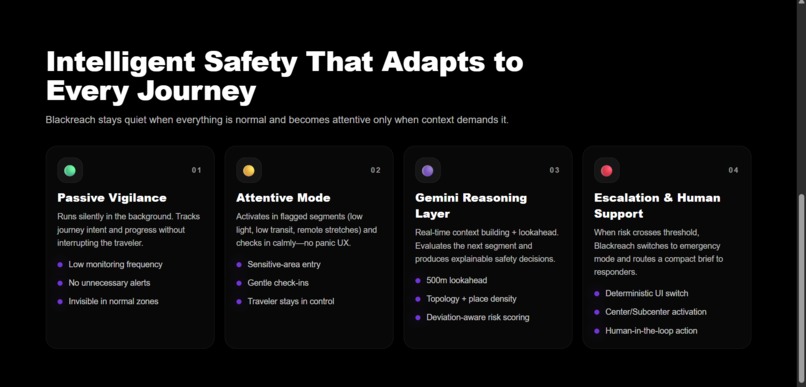
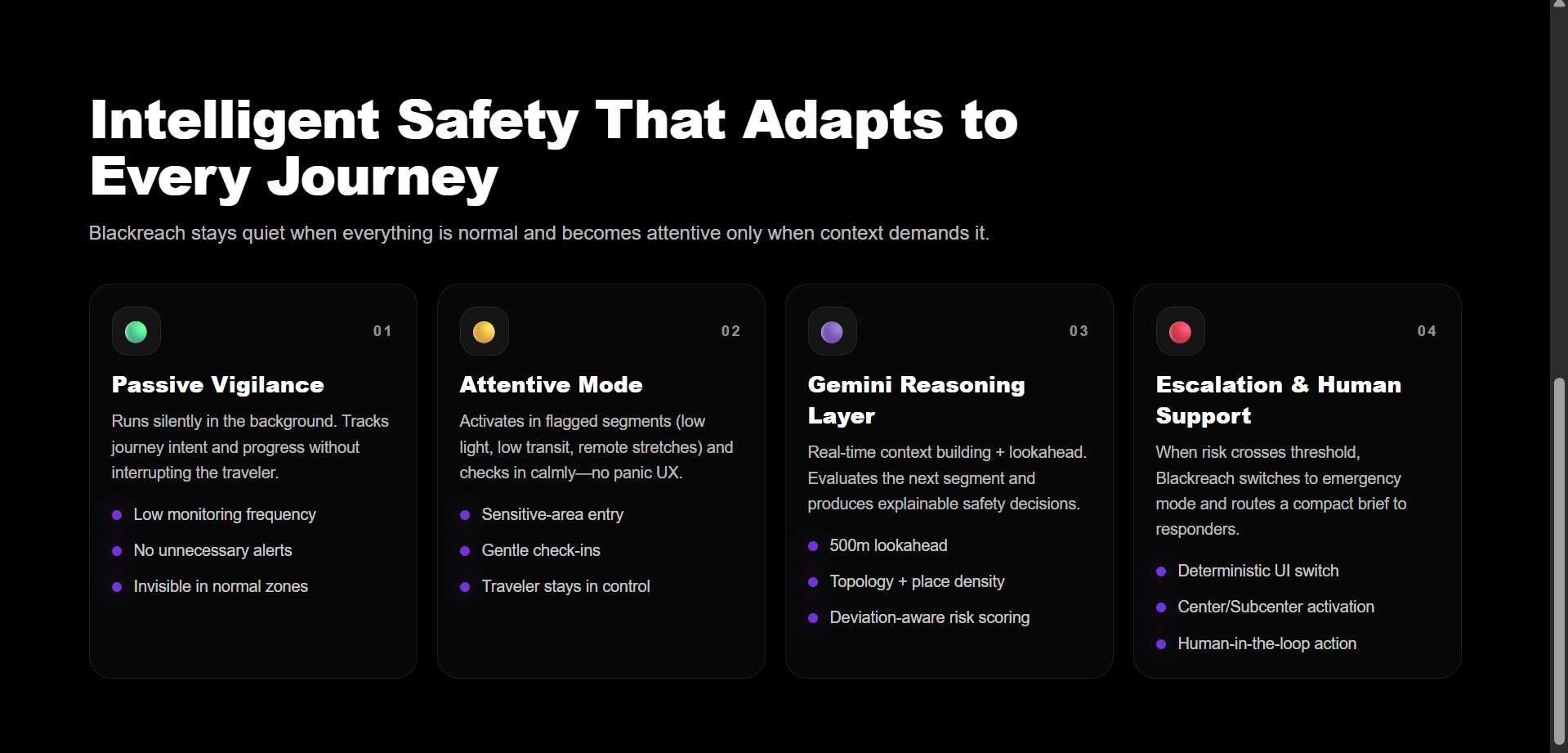
1. Passive Vigilance (The Quiet Observer)
Instead of a stressful, passive GPS dot, Blackreach follows the journey in real time. The system remains invisible when everything is normal, allowing the traveler to focus on life, not their phone. It quietly monitors progress and context, engaging only when the journey meaningfully changes.
2. Attentive Mode (The Sensitive Guardian)
When the journey enters a flagged or sensitive area, such as low light zones, low transit regions, or remote stretches, Blackreach becomes attentive. It checks in calmly and reassuringly, offering a simple way for the traveler to signal discomfort without overwhelming them with controls or alerts.
3. Support Escalation (The Active Shield)
If the traveler triggers an emergency, or if live Gemini reasoning determines that risk has crossed a critical threshold, Blackreach instantly shifts from observer to active support. It coordinates human assistance and nearby support resources while guiding the traveler with clear, calming instructions.
4. Reasoning in the Background (Clarity for the Human)
The traveler only sees what matters most: calmness, reassurance, and clarity. All high-complexity work, including real time journey reasoning, contextual risk analysis, and decision making powered by live Gemini 3.0 intelligence, happens silently in the background.
How we built it
Blackreach was built as a background safety system, not a foreground distraction.
Our guiding principle was simple:
the traveler should feel calm, while the system does the hard thinking silently.
Instead of constant alerts or panic-driven triggers, we focused on context, timing, and restraint.
The system was engineered around four practical principles.
1. Intent-Aware Journey Reasoning
Traditional safety apps treat all GPS movement the same. We intentionally did not.
Problem
Raw coordinates lack meaning. A pause near a café is normal; the same pause near an unlit road at night is not.
Approach
Each journey is modeled with an explicit intent baseline (route, time, environment type).
Live movement is continuously compared against this baseline instead of reacting blindly to location changes.
Implementation
- Journey plans are precomputed with route structure and labeled areas
- Environmental context is inferred using map topology and nearby infrastructure
- Deviations are treated as concerns, not emergencies, enabling early intervention without panic
This allows the system to surface risk before something goes wrong.
2. Layered Decision Architecture (AI + Human)
We deliberately separated data processing, reasoning, and action.
Edge Layer (User Device)
Handles GPS sampling, UI feedback, and user actions with minimal latency.
Reasoning Layer (Gemini Engine)
Operates as a background analyst. It performs short-range lookahead reasoning to assess upcoming segments (isolation, lighting, activity density) and determines whether escalation is required.
Human Oversight Layer (Subcenters)
Physical intervention is always a human decision. The system forwards compact, explainable briefs instead of raw data.
This hierarchy ensures reliability:
AI filters noise. Humans handle judgment.
3. Temporal Vigilance, Not Constant Surveillance
Security failures are often about timing, not distance.
What we optimized for
- When to pay attention
- When to stay quiet
- How to escalate without panic
The system maintains a rolling safety window based on speed, route segment, and time of day.
Monitoring intensity adapts automatically:
- Low frequency in normal zones
- Higher fidelity only when risk indicators rise
This avoids unnecessary tracking while remaining responsive when it matters.
4. Localized Response and Data Control
We avoided centralized “one-brain” control by design.
Localized Subcenters
Alerts are routed to the nearest operational region with precise contextual summaries.
Controlled Data Surface
Only summarized reasoning artifacts are shared. Raw movement history and personal data remain isolated.
This minimizes blast radius, improves response relevance, and preserves user trust.
Challenges we ran into
One of the biggest challenges was managing too many states across multiple systems without breaking the user experience.
Blackreach coordinates several moving parts at once:
- Journey state and live tracking
- Security zone activation
- Emergency escalation
- Background AI reasoning
- Center/Subcenter escalation and UI sync
Keeping these states consistent — especially during fast transitions like entering the zone or triggering emergency — required strict phase design and careful separation between “data updates” and “UI transitions”.
Multi-source real-time context building (Road + Places + OSM + Lookahead)
Another major challenge was building reliable live reasoning context from multiple sources:
- Road topology and connectivity signals (OSM)
- Nearby places density and environment cues (Places API)
- A fixed 500m lookahead window to reason about the next segment before the user reaches it
This had to run without spamming the backend or producing noisy alerts, so we designed it as single-shot lookahead reasoning combined with phase-based triggers.
Video reasoning pipeline (LiveEye) with FPS-based analysis (Vertex AI)
The hardest part we are actively integrating is LiveEye video reasoning.
We are adding a help/LiveEye video flow using Vertex AI, where the system:
- Captures or selects a video clip as the user signal
- Runs analysis at an FPS profile (e.g., 15/24/30 FPS) depending on risk
- Sends structured video reasoning output to Gemini-3.0
- Uses Gemini’s decision (“yes / trigger emergency”) to activate the center/subcenter escalation path
The challenge here is not just “running video AI” — it’s making it auditable and safe:
- Avoiding multi-prompt overload while still providing enough context
- Ensuring consistent decisions across different FPS profiles
- Keeping latency low enough that the response still feels immediate
- Synchronizing the final decision with human escalation (center activation)
Activation + synchronization (User ↔ Center/Subcenter)
Finally, activation and syncing across traveler UI, center, and subcenter was non-trivial. Even when the reasoning says “trigger emergency,” the system must:
- update UI deterministically
- keep logs and context consistent
- escalate with a compact brief that humans can act on immediately
Balancing technical complexity while keeping the interface calm and understandable was one of the hardest — and most rewarding — parts of building Blackreach.
Accomplishments that we're proud of
- 🧠 Built a calm-by-design safety system that works silently in the background without overwhelming the user
- 🗺️ Implemented intent-aware journey reasoning, going beyond raw GPS tracking
- 🔍 Designed 500m lookahead risk analysis using road topology, places data, and environmental context
- 👁️ Created the LiveEye concept, combining video signals with AI-based decision support
- 🚨 Achieved end-to-end emergency escalation, from user signal → AI reasoning → center/subcenter activation
- 🤝 Kept humans in the loop, ensuring AI supports judgment instead of replacing it
- 🧩 Managed complex state transitions across tracking, zones, AI reasoning, and emergency flows
What we learned
- 🧭 Context matters more than location — intent and environment are critical for safety decisions
- ⏱️ Timing is as important as distance in risk detection and intervention
- 🧠 AI works best as a background analyst, not a foreground decision-maker
- 🧑🤝🧑 Human oversight is essential for trust and real-world safety systems
- ⚖️ Less UI can mean more safety — calm interfaces reduce panic
- 🔄 Clear state machines beat ad-hoc logic when systems grow complex
- 🔐 Trust is built by limiting data exposure, not collecting more data
What's next for Blackreach
Our next focus is to take Gemini’s reasoning capability to a deeper, more predictive level.
We plan to integrate long-term historical context — including past journey patterns, localized crime data, and environmental risk signals — so the system can reason not just about where the traveler is, but what typically happens there over time.
We will also expand live context by integrating real-time Google Maps signals and transitioning the traveler experience into a 3D-aware interface, allowing routes, zones, and risk areas to be understood more intuitively.
Most importantly, the traveler will not always be placed into active tracking or security mode.
In future versions, Gemini will reason silently in the background by default, activating tracking, security zones, or emergency workflows only when it is truly necessary.
This shifts Blackreach from a reactive safety tool into a predictive, intent-aware companion — one that intervenes only when it matters, and stays invisible when it doesn’t.
Built With
- fastapi
- firebase
- google-gemini-2.5
- google-gemini-3.0
- google-maps-platform
- javascript
- node.js
- openstreetmap
- overpass-api
- react
- vertex-ai


Log in or sign up for Devpost to join the conversation.