-
-
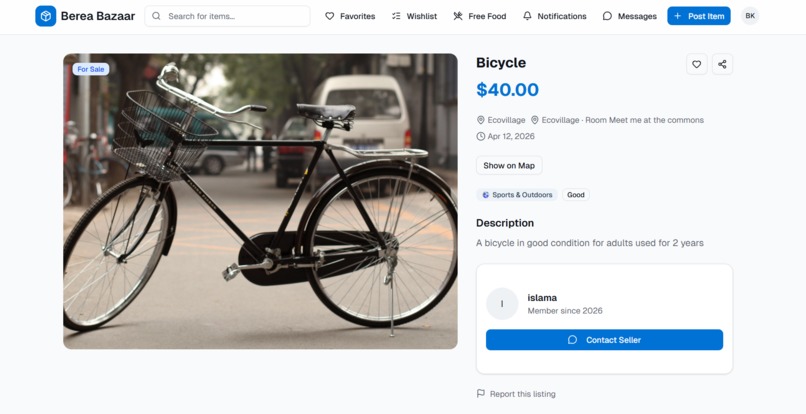
Photo of an item listing
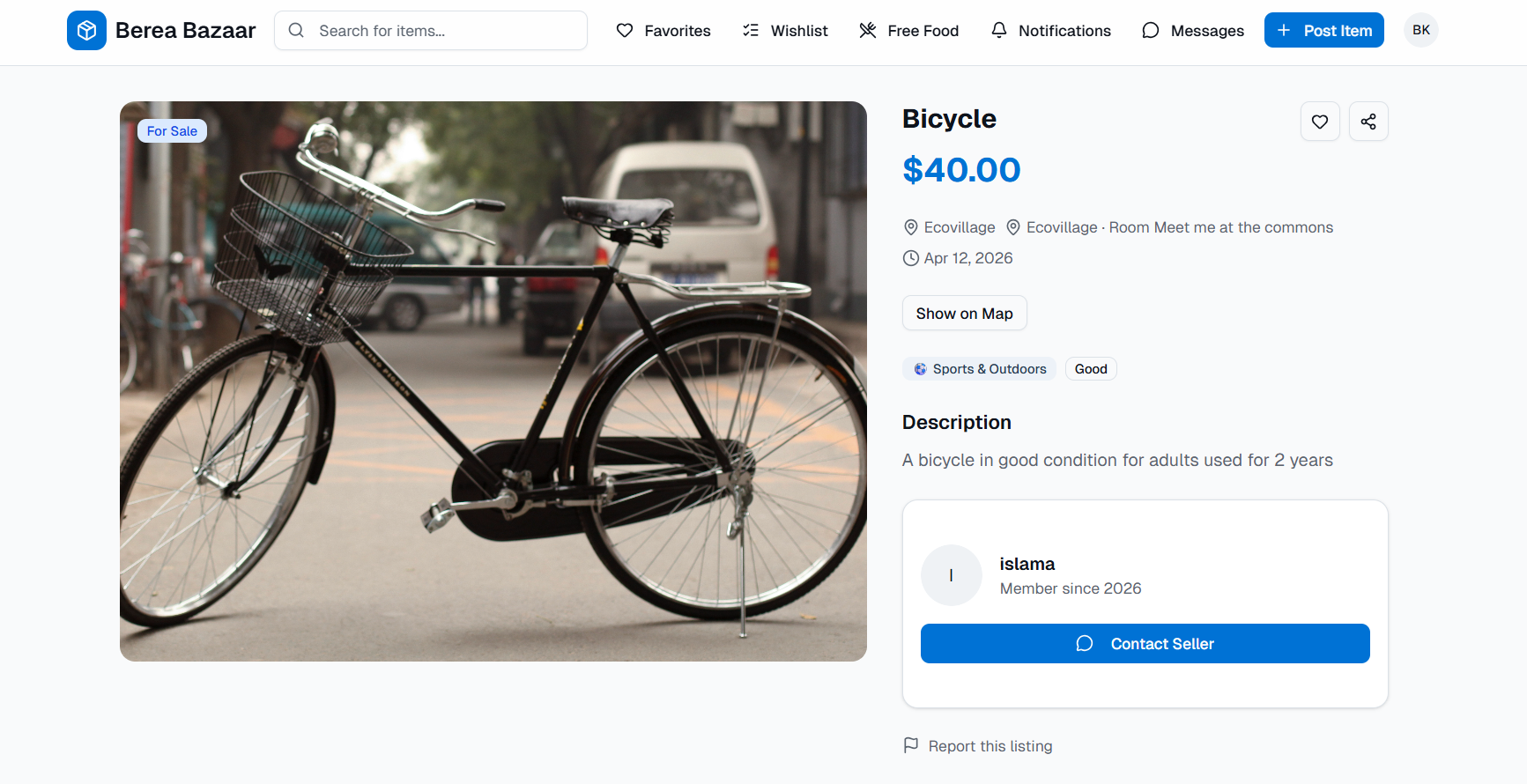
Inspiration
At Berea College, this project grew out of our own day to day experiences as students. We have packed up our rooms at the end of the semester and realized how many useful things we could not take with us. At the same time, we have also struggled to find basic items without spending money. These were not rare situations. They were happening around us every semester, to us and to people we knew.
What made this stand out was how close these two realities existed to each other. In the same dorms and within the same campus, people were leaving behind clothes, food, and supplies, while others were actively looking for those exact things. The issue was not a lack of resources. It was a lack of connection.
Berea is a place that emphasizes community and mutual support, but we noticed that there was no simple, consistent way for students to exchange what they had with what others needed. That gap felt immediate and personal. Berea Bazar started as a way to make sharing easier, faster, and more natural within a community that already values taking care of one another.
What it does
Berea Bazar is a closed, campus centered platform designed to enable safe and efficient exchange of goods and resources within the Berea College community. It is built specifically to keep resources circulating within campus rather than being wasted or discarded.
A defining aspect of the platform is its verified access system. Only users with a valid berea.edu email can register, and every account must go through email verification before gaining access. This ensures that the entire network remains restricted to the Berea community, which increases trust, safety, and accountability across all interactions.
The platform includes a wide range of integrated features that work together to support everyday student needs:
Core Marketplace System
Users can post items for free, sale, or rent. Each listing includes a title, category, condition, description, and pickup location. Listings appear instantly in a centralized feed that updates in real time.
Search and Discovery
A search and filter system allows users to quickly find specific items based on category, availability, or keywords. This reduces friction when looking for necessities such as clothing, textbooks, or dorm supplies.
Direct Messaging
Each listing includes an in app messaging system that allows users to communicate directly. A starter message template helps initiate conversations quickly, reducing hesitation and making coordination easier.
Favorites and Wishlist
Users can save listings to a favorites section for later viewing. The wishlist feature allows users to list items they need and receive notifications when those items are posted.
Free Food Feed
A dedicated feed highlights free food available on campus in real time. This includes surplus meals, leftover event food, and time sensitive giveaways that would otherwise go to waste.
Notification System
Users receive instant alerts when relevant items are posted, when wishlist matches appear, or when there is activity on saved listings. This keeps engagement active without requiring constant app usage.
Campus Map Integration
The Berea campus map visualizes all listings as interactive pins. Users can tap any pin to view details and message the poster directly. This makes pickup coordination more intuitive and spatially aware.
How we built it
We developed Berea Bazar with a focus on speed, clarity, and usability. Our goal was to create a working system that reflects real student behavior rather than an overly complex product.
We started by defining the full user flow, from signing up with a berea.edu email to browsing listings and completing exchanges. This helped us prioritize essential features and avoid unnecessary complexity.
We then built a secure authentication system that restricts access to verified Berea users. Email verification was implemented to ensure that every account is valid and tied to the campus community.
On the backend, we structured a database to handle users, listings, messages, and notifications. On the frontend, we designed a clean and minimal interface that prioritizes speed and ease of use.
We also integrated key interactive systems including real time messaging, wishlist tracking, notification delivery, and map based visualization. Each component was built to work together as part of a unified platform rather than separate tools.
Challenges we ran into
One of the biggest challenges we faced was debugging, which often took hours at a time. A lot of the code we used came from v0, and while it helped us build quickly, it also introduced inconsistencies and edge cases that required extensive troubleshooting to make everything work properly together.
Another major challenge was integrating and adapting generated code into a fully functional and cohesive application. We had to carefully refactor and debug multiple components so they would work seamlessly as one system instead of separate parts.
We also spent a significant amount of time thinking about new features and how to make Berea Bazar feel unique rather than like a generic marketplace app. This meant constantly iterating on ideas, refining functionality, and deciding which features actually added value for students at Berea College versus which ones would add unnecessary complexity.
Finally, deployment was a major hurdle. The application ran flawlessly on localhost, but getting it into a deployed environment took hours of troubleshooting. We ran into configuration issues, environment mismatches, and build problems that did not appear during local development. Making the app behave consistently outside of our local setup required repeated testing, debugging, and adjustments until everything worked as expected in production.
Accomplishments that we're proud of
One of our biggest accomplishments was successfully getting the application to run smoothly after extensive debugging and integration work. Even though we faced significant issues with generated code and deployment, we were able to refine the system into a stable and functional product that works reliably.
We are also proud that we successfully integrated an accurate and interactive map of Berea College’s campus. This feature adds real value to the platform by making it easier for students to locate items, coordinate meetups, and visually understand where resources are distributed across campus.
Another major accomplishment is that we built something that people would actually find useful in their daily lives. Berea Bazar is not just a concept or prototype, but a working tool that directly addresses real problems students face, including waste, affordability, and lack of connection between supply and demand.
Finally, we are proud that we pushed through technical setbacks, especially during deployment, and still delivered a working product that reflects both our original vision and the needs of the Berea community.
What we learned
We learned new ways to think about problem solving by shifting from feature driven development to need driven development. Instead of building what was technically interesting, we learned to prioritize what actually reflects real behavior and demand within a specific community like Berea College.
Working within the context of Berea College helped us understand how important it is to design with a real environment in mind rather than an abstract user base. Because we are part of this campus, we were able to directly observe how students behave, what they struggle with, and where gaps in communication and resource sharing actually exist. This made us more intentional about every feature we included.
We also improved how we approach coding by becoming more mindful of structure, reusability, and debugging. Working with external code and tools like v0 forced us to pay closer attention to how systems are built and how small inconsistencies can create larger issues later in development.
What's next for Berea Bazaar
The next step for Berea Bazar is to continue refining the platform into a stable and polished product based on real feedback from the Berea College community. A major focus will be improving reliability across key systems such as listings, messaging, notifications, and the campus map so that the experience feels seamless in everyday use.
We also want to improve how the platform responds to actual student demand by observing what people naturally use most and adjusting features accordingly. This includes simplifying flows that feel unnecessary and strengthening the parts of the app that students rely on most frequently.
Another priority is making the campus map more powerful and precise, so it becomes a central tool for discovering and coordinating exchanges across campus. We also plan to improve filtering and search so users can find what they need faster with less effort.
In terms of growth, we are interested in expanding the system within Berea College first by increasing adoption and making it a consistent part of student life. Only after that would we consider scaling the concept to other campuses while preserving the same community centered and verification based structure.
Built With
- claude
- css
- next.js
- openstreetmap
- postgresql
- react
- supabase
- typescript
- v0
- vercel

Log in or sign up for Devpost to join the conversation.