Inspiration
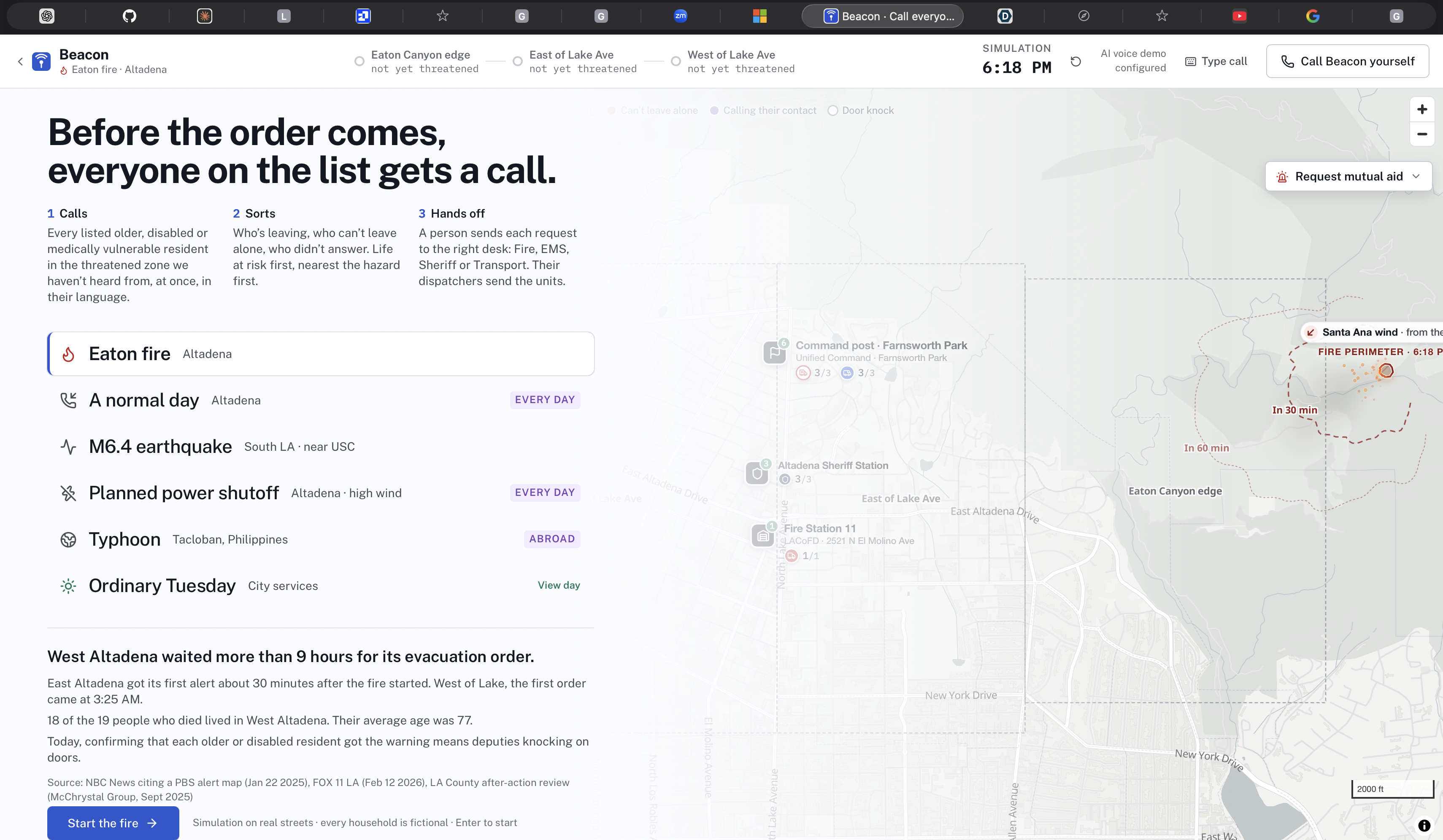
We started from the prompt: an overnight supervisor facing a flood of unverifiable calls with too few people. As we built, we realized the real gap isn't the people calling, it's the people who can't. On the night of the Eaton fire in Altadena (January 2025), evacuation messages for West Altadena went out at 3:25 AM, hours after the rest of Altadena, and the people who died had an average age of 77. After the 2023 Maui fire, the "unaccounted for" list swung from over 1,000 names to 388 in two weeks. Every call center listens to who's calling. We wanted Beacon to also notice who isn't.
What it does
Beacon replays a real disaster turn by turn, and a person makes every call.
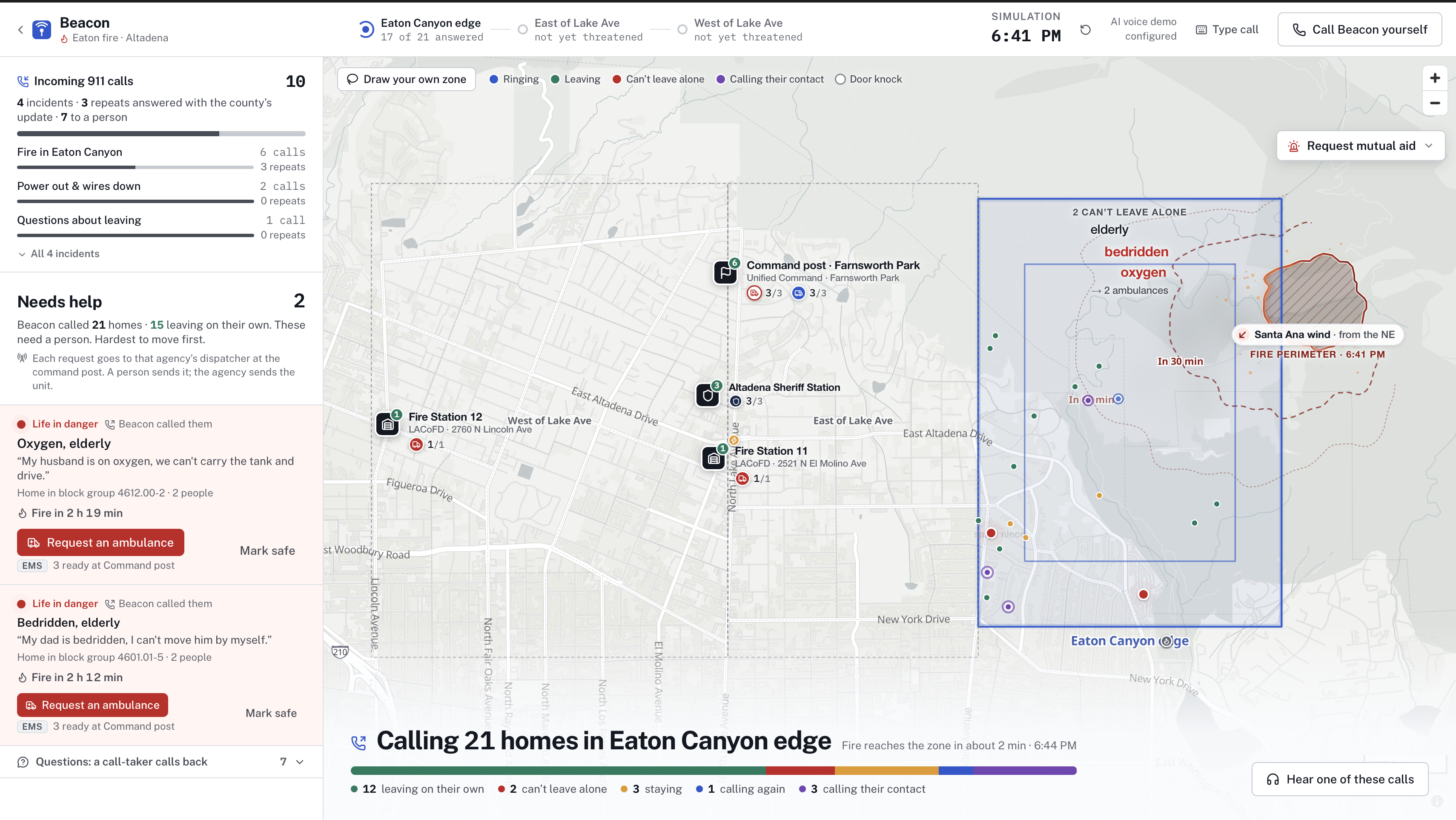
- The 911 flood: reports pop up on the map (stuck, embers, breathing). Beacon groups them by incident, answers repeats with the county's update, and sends only life-threatening or new information to a person.
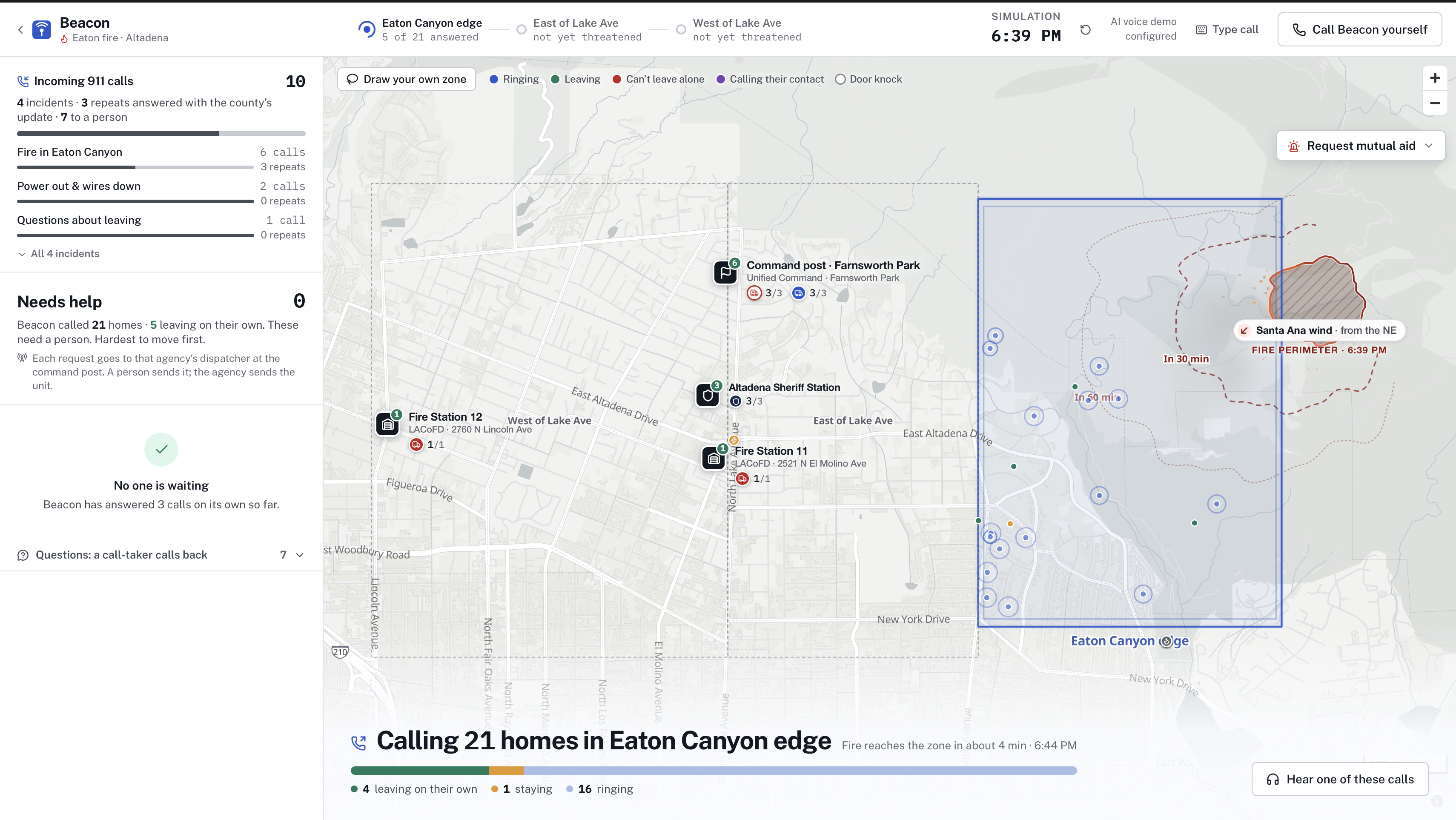
- Who hasn't been heard from: as the fire advances, Beacon warns which zone it reaches next. One click calls every home in that zone that hasn't called or answered the alert, in their own language.
- What people say, at a glance: answers rise off the houses into a word cloud. Dangerous words (bedridden, oxygen, no car) are red and biggest; click one and those homes light up.
- Silence never counts as safe: no answer means a retry, then the emergency contact, then a deputy at the door.
- A person decides, the real agencies act: the supervisor sends each request to the desk that does that job (Fire for a rescue, EMS for oxygen, the Sheriff for a door knock, Transport for no car), and units leave real stations on real streets.
- The report: the real night versus this run, plus a hand-off file of everyone who still needs a person, routed to each agency.
- Live call: a real Retell voice call joins the same triage.
How we built it
A Python backend and a map dashboard using real OpenStreetMap streets, OSRM driving routes and 2020 Census blocks, with the real locations from the Eaton fire in Altadena (LACoFD Stations 11 and 12, the Altadena Sheriff Station, the Farnsworth Park command post). A Retell voice agent handles live calls and the zone call-outs. The fire shape is illustrative; every household, answer and crew is fictional.
Challenges we ran into
Keeping the AI honest: it never promises help, never gives evacuation or medical advice, never confirms a fire, and treats an unclear answer about danger as possible danger. Making "unknown" mean "not yet heard from," never "missing." And agreeing as a team on one demo out of several strong ideas.
Accomplishments that we're proud of
A spoken call goes from a resident's voice to a sorted, mapped queue item in seconds. The screen shows the people nobody has heard from, not just the ones calling.
What we learned
The hard part of a crisis isn't answering the phone, it's knowing who you haven't reached. Simple, honest rules beat a clever AI making decisions it shouldn't.
What's next for Beacon: AI Watcher
- A pilot with a county emergency office, using data it already owns: Census counts, its own alert replies, its own shelter sign-ins.
- Dual-use: the Navy's NFAAS already musters sailors, civilian staff and families after disasters (30,000+ after Hurricanes Harvey and Irma). Neighborhoods have nothing like it, and the same engine serves both.
- Twist 1 (federal funding): counties buy preparedness tools with federal grants; for Beacon as a startup, DHS S&T's startup program (SVIP), then SBIR. Beacon's after-action report is the evidence a county attaches to a grant application.
- Twist 2 (global): the same night happens during a typhoon in the Philippines. Beacon calls in the resident's language and can fall back to SMS ("1 safe, 2 help") when voice networks jam.
- Every day: before a planned power shutoff, utilities must confirm their medical customers got the warning. Same loop.
Streets and Census blocks are real; the fire shape is illustrative; every household, call and responder is fictional.
Built With
- javascript
- openstreetmap
- osrm
- python
- retell-ai

Log in or sign up for Devpost to join the conversation.