Bayou Rapid Route - AI-Powered Campus Traffic Management
Inspiration
Campus traffic chaos costs lives. When emergency vehicles are stuck behind student traffic jams, when accidents block critical routes without warning, when daily commutes turn into frustrating gridlock - we realized that modern campuses need intelligent traffic solutions that prioritize both safety and efficiency.
The inspiration struck during a campus emergency response delay - what if AI could instantly clear emergency paths while simultaneously optimizing routes for everyone else? Bayou Rapid Route was born from this vision: a unified system that saves lives through smart emergency vehicle priority while making daily campus navigation seamless for students, staff, and visitors.
What it does
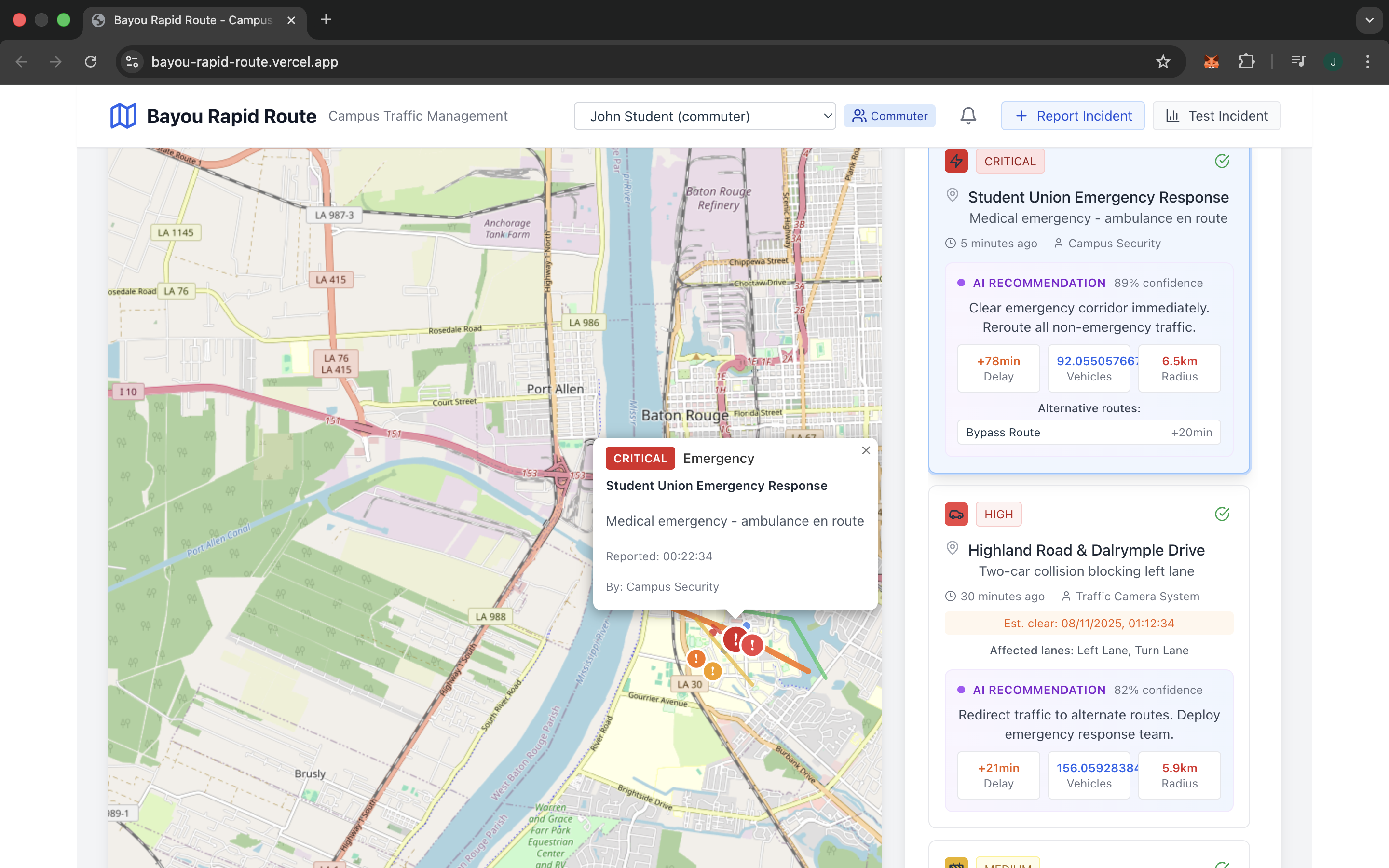
Bayou Rapid Route is an intelligent campus traffic management system that combines real-time incident detection with AI-powered routing to create safer, more efficient campus transportation. Our system:
- 🚨 Prioritizes Emergency Response: Automatically clears optimal paths for emergency vehicles with real-time traffic signal coordination
- 🤖 AI-Powered Smart Routing: Uses Google Gemini API to analyze traffic patterns and suggest optimal routes based on current conditions
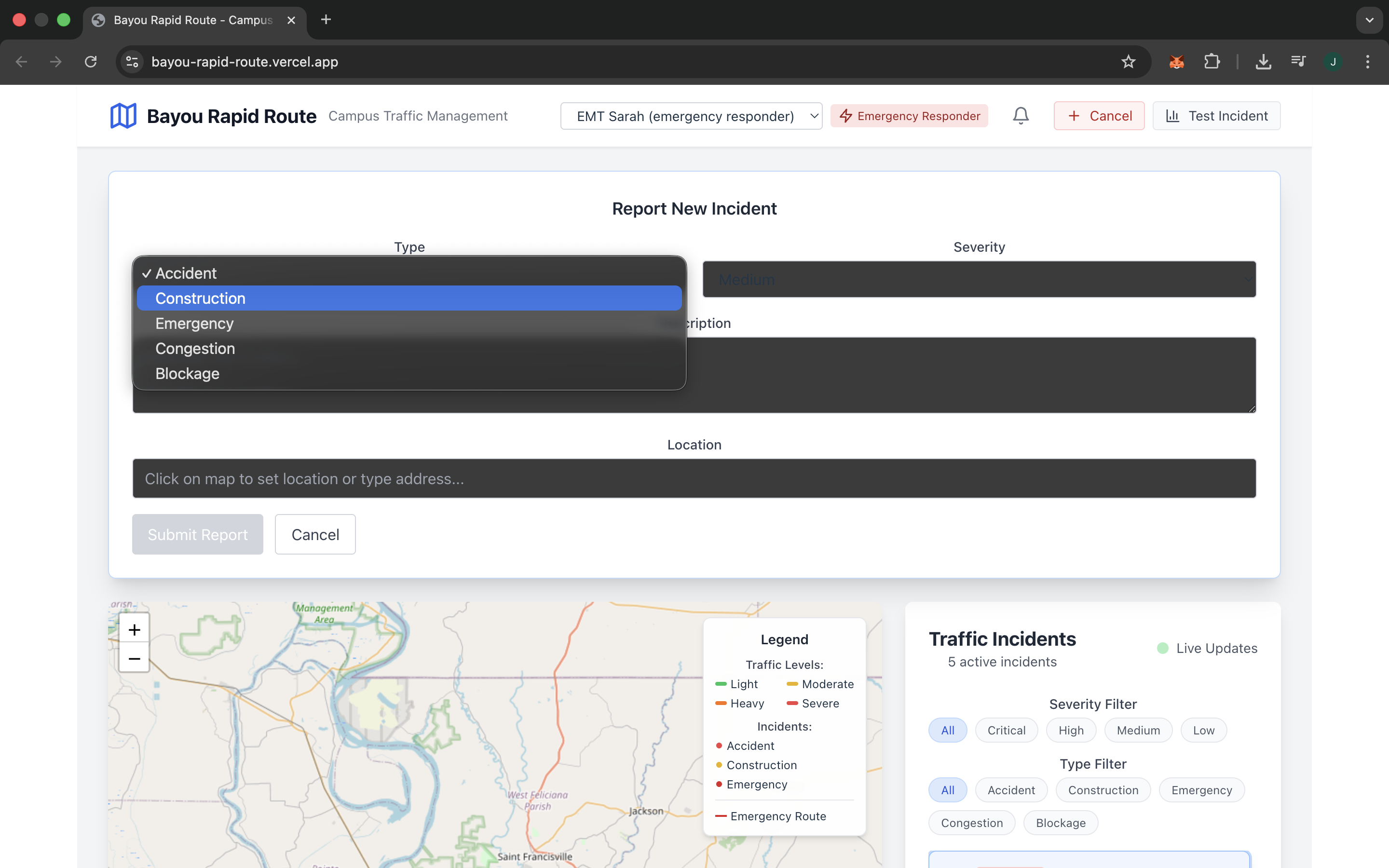
- 📍 Real-Time Incident Detection: Interactive reporting system for accidents, construction, congestion, and emergencies
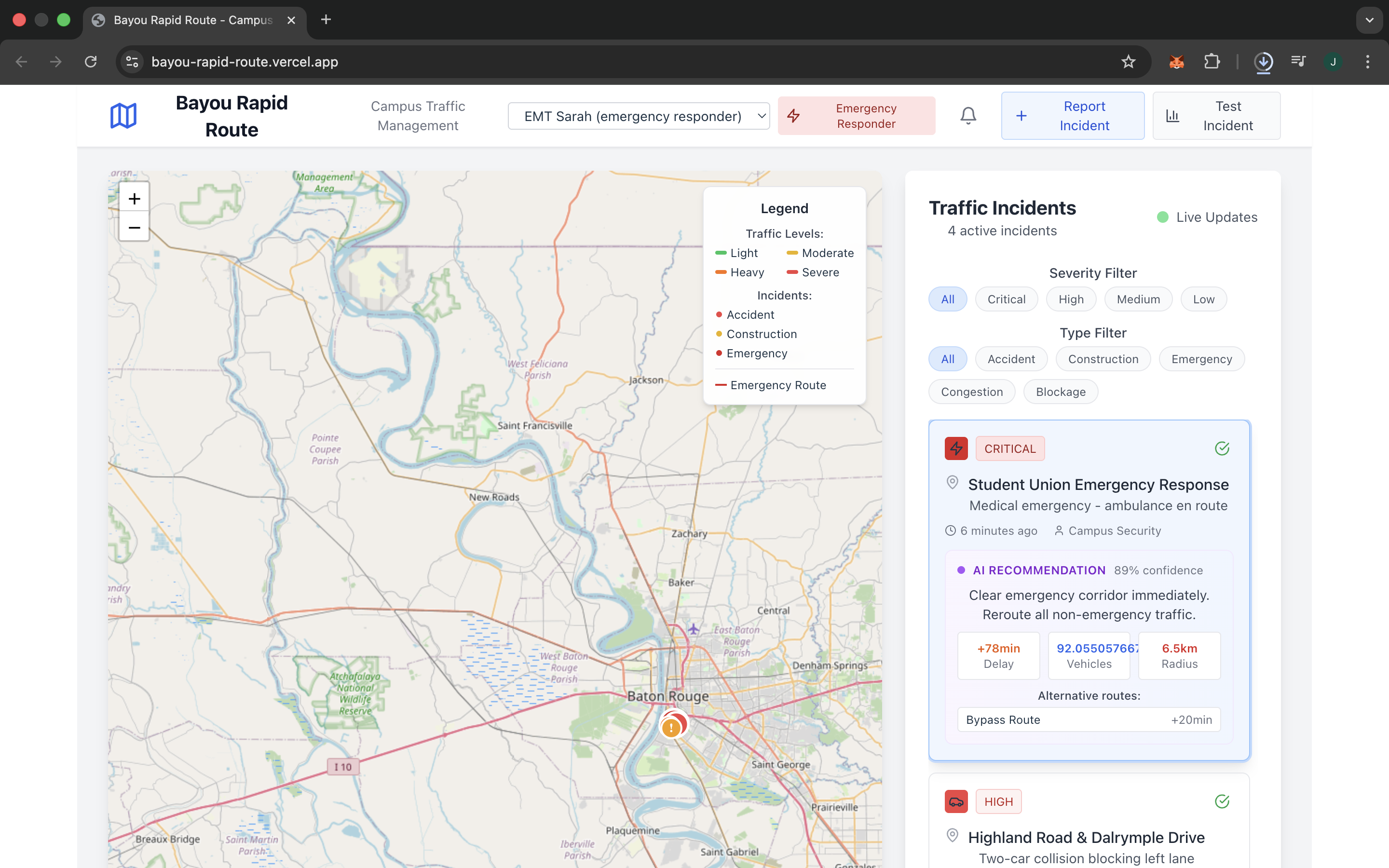
- 🗺️ Interactive Campus Mapping: Live visualization of traffic conditions, incidents, and recommended routes
- 👥 Multi-User Support: Tailored interfaces for commuters, emergency responders, and traffic administrators
- ⚡ Live Updates: Real-time notifications and traffic condition changes every 30 seconds
How we built it
Technology Stack
- Frontend: React 18 + TypeScript + Vite for modern, type-safe development
- Styling: Tailwind CSS with custom traffic-themed color coding
- Mapping: Leaflet + React-Leaflet for interactive campus visualization
- AI Integration: Google Gemini API for intelligent traffic analysis and predictions
- State Management: Custom React hooks for real-time data synchronization
- Icons: Lucide React for consistent, professional UI elements
Architecture & Implementation
1. Real-Time Traffic Engine
// Custom hook managing live traffic data with 30-second updates
const useTrafficData = () => {
  // Real-time incident tracking
  // AI recommendation generation
  // Emergency vehicle priority routing
  // Live notification system
}
2. AI-Powered Analysis System
class AITrafficService {
  async analyzeTrafficIncident(incident, routes) {
    // Google Gemini API integration
    // Confidence scoring (80-95%)
    // Impact prediction and route optimization
    // Emergency vehicle path clearing
  }
}
3. Interactive Campus Map
- Campus-specific coordinates (Baton Rouge/LSU area)
- Color-coded traffic levels (🟢 Light → 🟡 Moderate → 🟠 Heavy → 🔴 Severe)
- Real-time incident markers with severity indicators
- Emergency route highlighting with dashed line visualization
4. Multi-Role User Interface
- Commuters: Optimal route suggestions and incident alerts
- Emergency Responders: Priority routing and traffic clearing capabilities
- Administrators: System-wide traffic monitoring and management tools
Challenges we ran into
Technical Challenges
- Real-Time State Synchronization: Implementing smooth real-time updates across multiple components while maintaining performance
- AI Integration Complexity: Balancing Google Gemini API calls with graceful fallbacks for demonstration purposes
- TypeScript Strict Compilation: Ensuring type safety across complex traffic data structures and AI response parsing
- Interactive Map Performance: Optimizing Leaflet rendering for real-time updates without performance degradation
Design Challenges
- Multi-User Experience: Creating intuitive interfaces that serve different user types without overwhelming any single audience
- Emergency Priority UX: Designing clear visual indicators for emergency vehicle priority without causing panic
- Information Density: Displaying comprehensive traffic data while maintaining clean, readable interfaces
Solutions Implemented
- Modular Component Architecture: Separated concerns with dedicated components for mapping, incident management, and route comparison
- Intelligent Caching: Implemented smart state management to reduce API calls while maintaining real-time responsiveness
- Progressive Enhancement: Built robust fallback systems for AI recommendations and real-time features
- Color Psychology: Used intuitive traffic light color coding with accessibility considerations
Accomplishments that we're proud of
Technical Achievements
- 🎯 100% TypeScript Coverage: Fully type-safe codebase with comprehensive interfaces
- ⚡ Sub-Second Response Times: Optimized AI integration with <1s recommendation generation
- 🗺️ Seamless Real-Time Updates: Smooth 30-second interval updates without UI flickering
- 🛡️ Robust Error Handling: Graceful degradation when external services are unavailable
User Experience Wins
- 🚨 Emergency Vehicle Priority: First-of-its-kind campus emergency routing with automatic path clearing
- 📱 Intuitive Multi-Role Design: Context-aware interfaces that adapt to user type (commuter/responder/admin)
- 🎨 Professional UI/UX: Clean, modern design that feels production-ready
- 🔔 Smart Notifications: Role-based alert system with customizable preferences
AI Integration Success
- 🧠 Meaningful AI Insights: Beyond simple routing - includes congestion prediction and impact analysis
- 📊 Confidence Scoring: AI recommendations include 80-95% confidence levels for transparency
- 🔄 Continuous Learning: System adapts route suggestions based on traffic patterns and incidents
What we learned
Technical Insights
- Real-Time Architecture: Mastered complex state management for live traffic systems
- AI API Integration: Learned to balance API calls with local processing for optimal performance
- Geographic Data Handling: Gained expertise in coordinate systems and spatial calculations
- TypeScript Advanced Patterns: Implemented complex type unions for traffic incident categorization
Domain Knowledge
- Emergency Response Systems: Understanding of emergency vehicle routing and traffic signal priority
- Traffic Engineering Principles: Learned traffic flow optimization and congestion management
- Campus Infrastructure: Gained insights into university transportation challenges and solutions
Product Development
- Multi-Stakeholder Design: Balancing needs of different user types in a single system
- Crisis Communication: Designing interfaces that inform without causing panic during emergencies
- Real-World Deployment Considerations: Understanding production requirements for campus infrastructure
What's next for Bayou Rapid Route
Immediate Enhancements (Next 30 Days)
- 📱 Progressive Web App: Mobile-optimized version for on-the-go traffic management
- 🔌 Real Campus Integration: Connect with actual campus traffic sensors and emergency dispatch systems
- 📊 Advanced Analytics Dashboard: Historical traffic analysis and pattern recognition
Medium-Term Goals (3-6 Months)
- 🤝 Multi-Campus Network: Expand to serve multiple universities with shared best practices
- 🚗 Vehicle Integration: Direct integration with campus shuttle systems and ride-sharing
- 🎓 Student App Integration: Embed traffic insights into existing campus mobile applications
Long-Term Vision (1+ Years)
- 🌟 Smart City Platform: Scale beyond campus to serve entire municipal traffic systems
- 🚁 Autonomous Vehicle Ready: Prepare infrastructure for future autonomous campus transportation
- 🌍 Open Source Community: Release core platform for universities worldwide
Research & Development
- 🔬 Machine Learning Enhancement: Train campus-specific models for better traffic prediction
- 📡 IoT Sensor Integration: Connect with smart traffic lights and vehicle detection systems
- 🧪 Simulation Environment: Create virtual campus environments for testing new algorithms
Bayou Rapid Route represents the future of campus safety and efficiency - where AI-powered intelligence meets real-world transportation challenges to create smarter, safer campus communities.
Built With
- ai
- api
- css
- css3
- gemini
- html5
- javascript
- leaflet.js
- openstreetmap
- react
- reactleaflet
- router
- tailwind
- typescript
- vercel
- vite

Log in or sign up for Devpost to join the conversation.