Barnraise — "About the project", ready to paste
Markdown, as Devpost renders it. Everything below is checked against the repo or against a real run; nothing that cannot be supported is in here.
Inspiration
Cooperation between neighboring community organizations has always existed. It just never left a trace.
Every AI tool in this sector automates the inside of one organization: its donors, its volunteers, its grant deadlines. That is useful, and it is also where the ceiling is, because the thing those organizations most need from each other happens in the gaps between them.
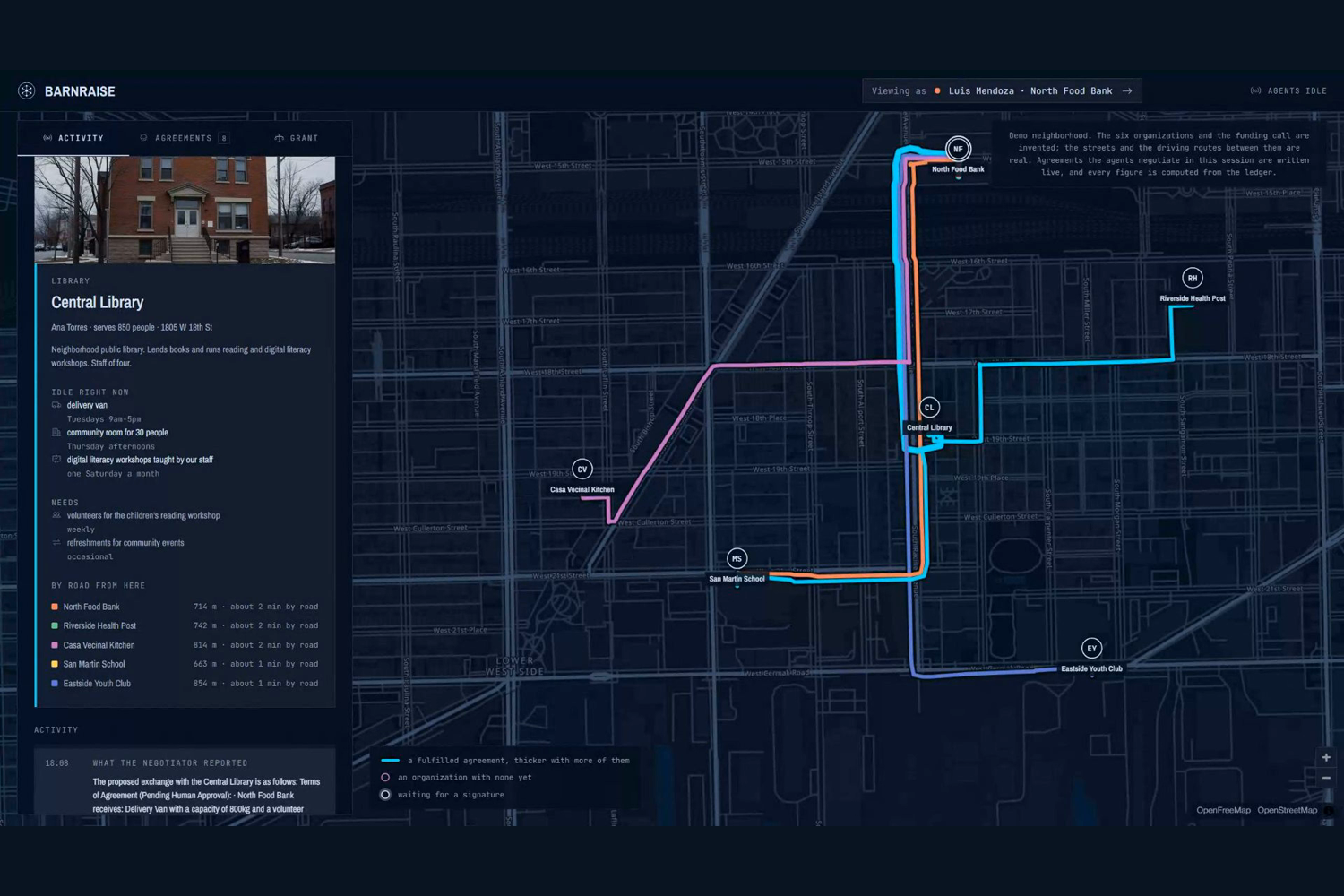
A library two streets from a food bank has a delivery van that sits idle on Tuesdays. The food bank needs one that day. Neither can see what the other has, so the van sits still. That is not a data problem inside either organization. It is a problem between them, and no amount of automating either side alone will find it.
Meanwhile funders ask, explicitly, to see that you work with food banks, schools and clinics rather than operating in a silo. They ask for documented collaboration. Nobody built the infrastructure that produces it.
What it does
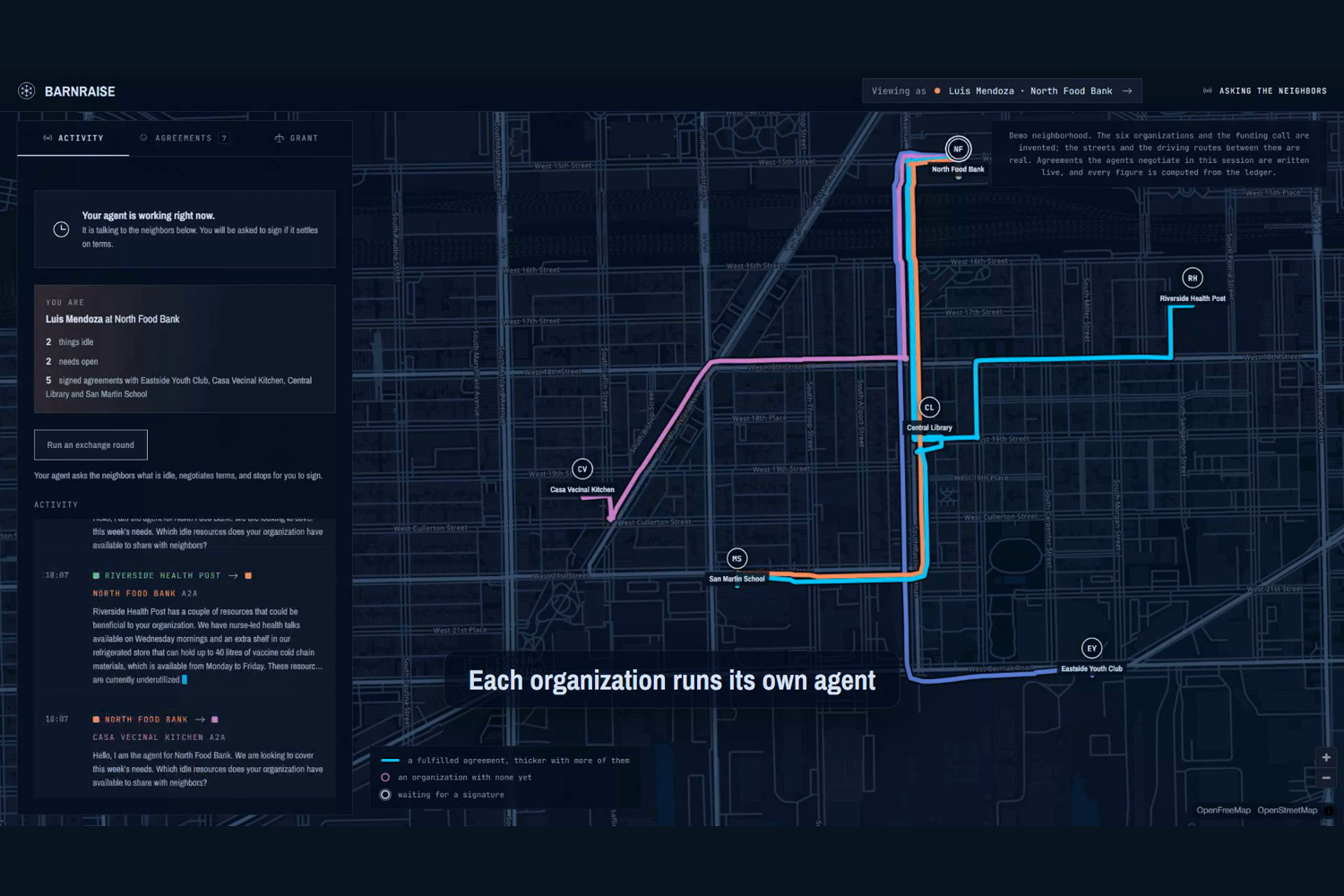
Barnraise gives every organization its own agent over its own private data. The agents reach each other over A2A, the agent-to-agent protocol, across process boundaries, and negotiate concrete exchanges: this resource, that day, these conditions.
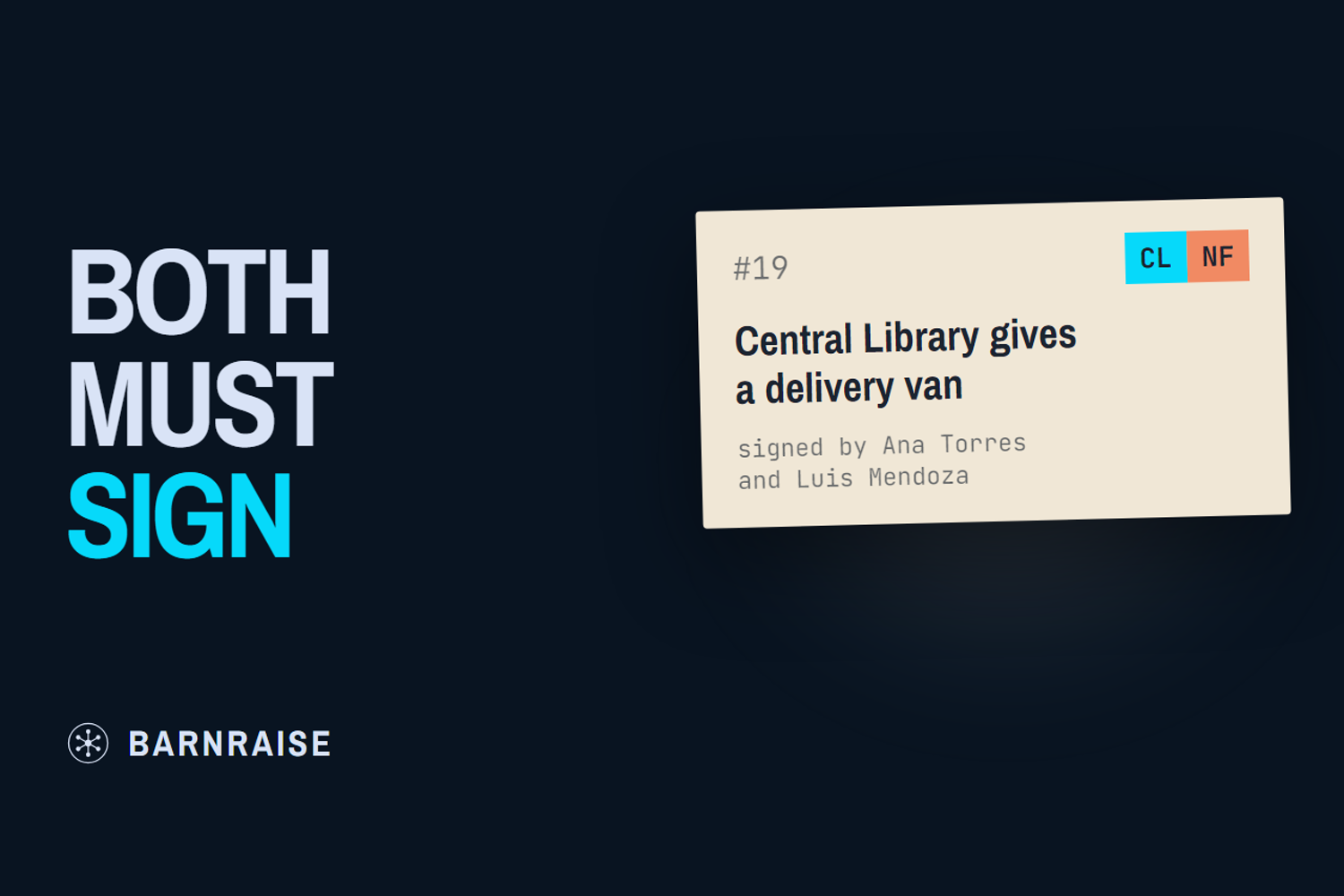
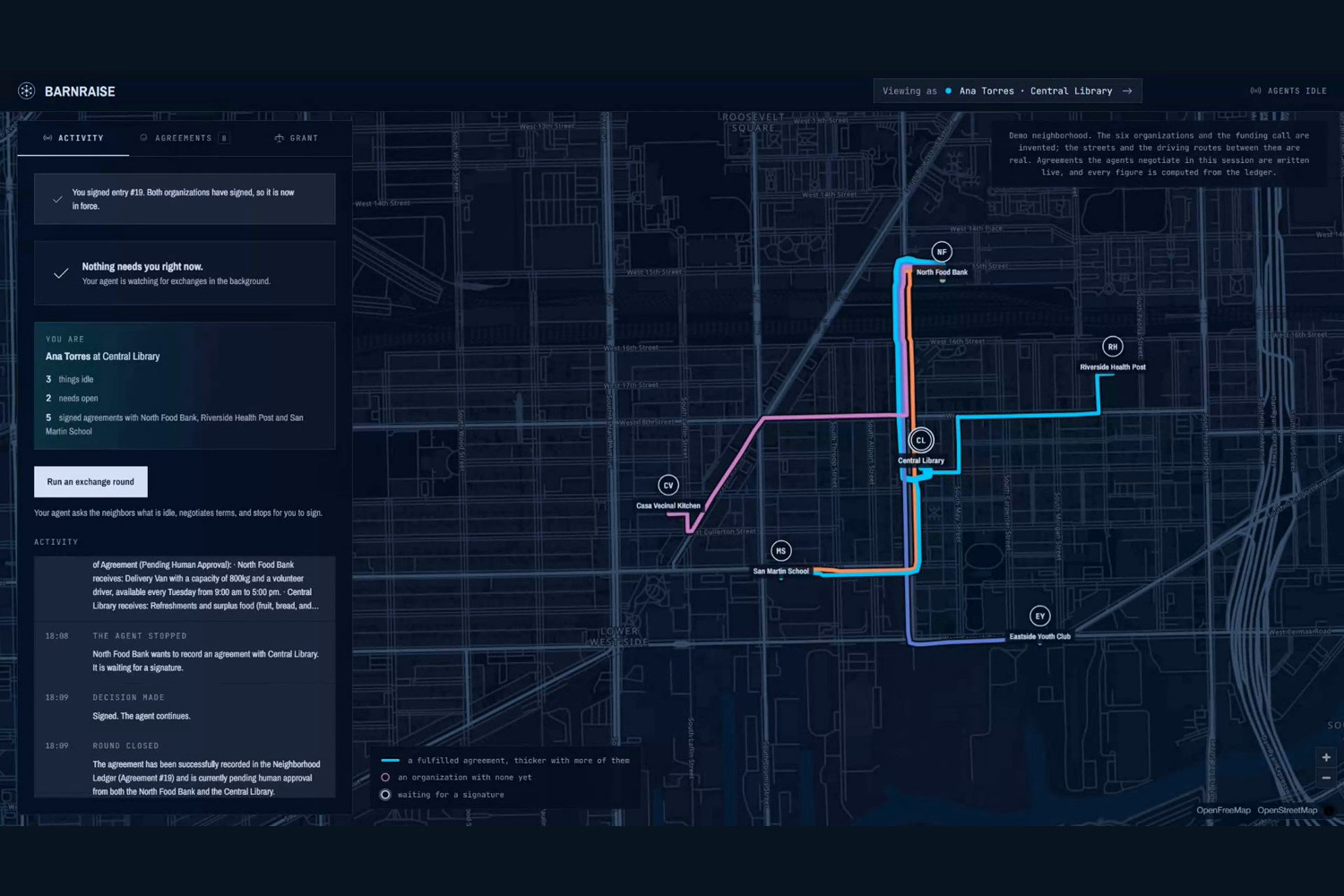
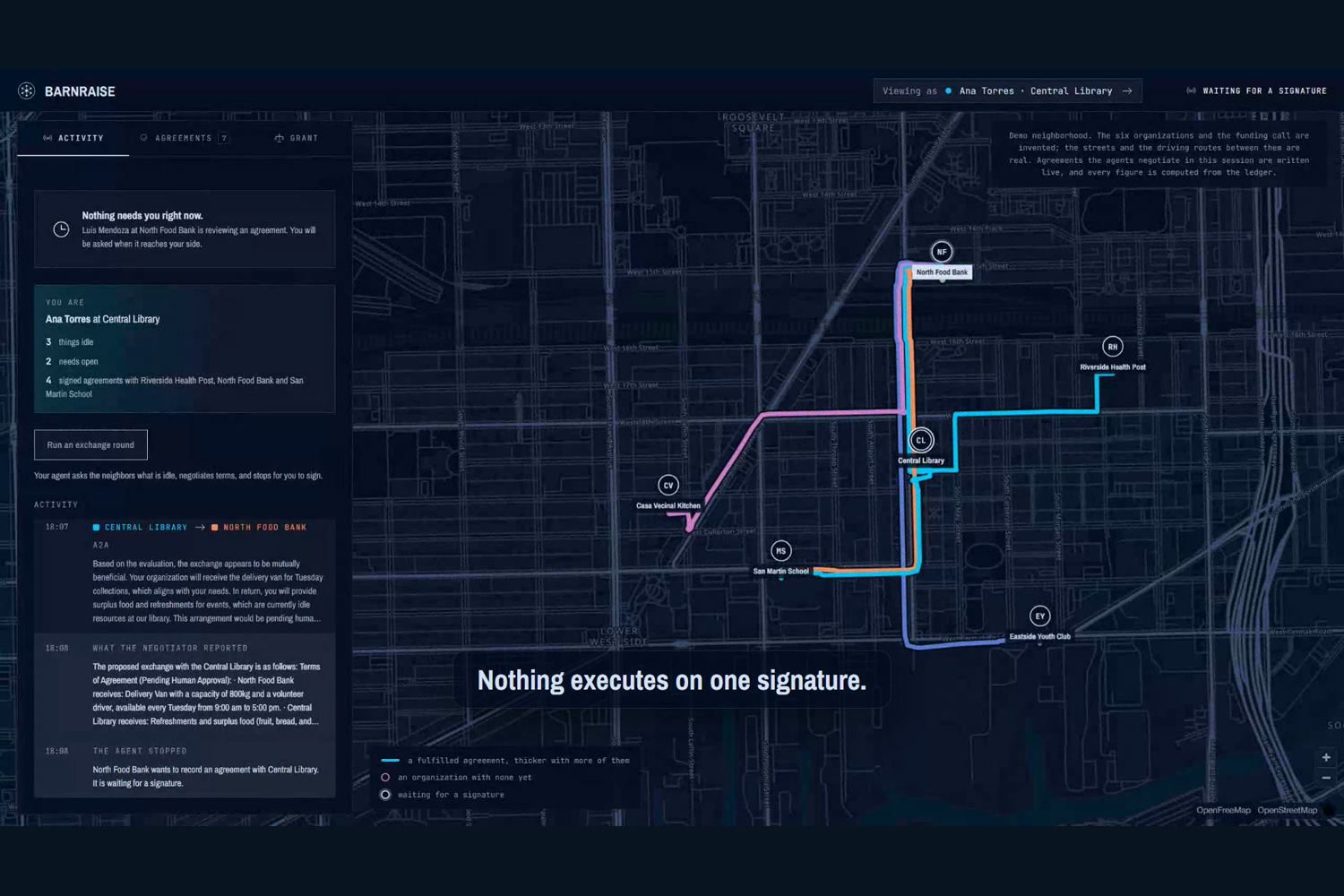
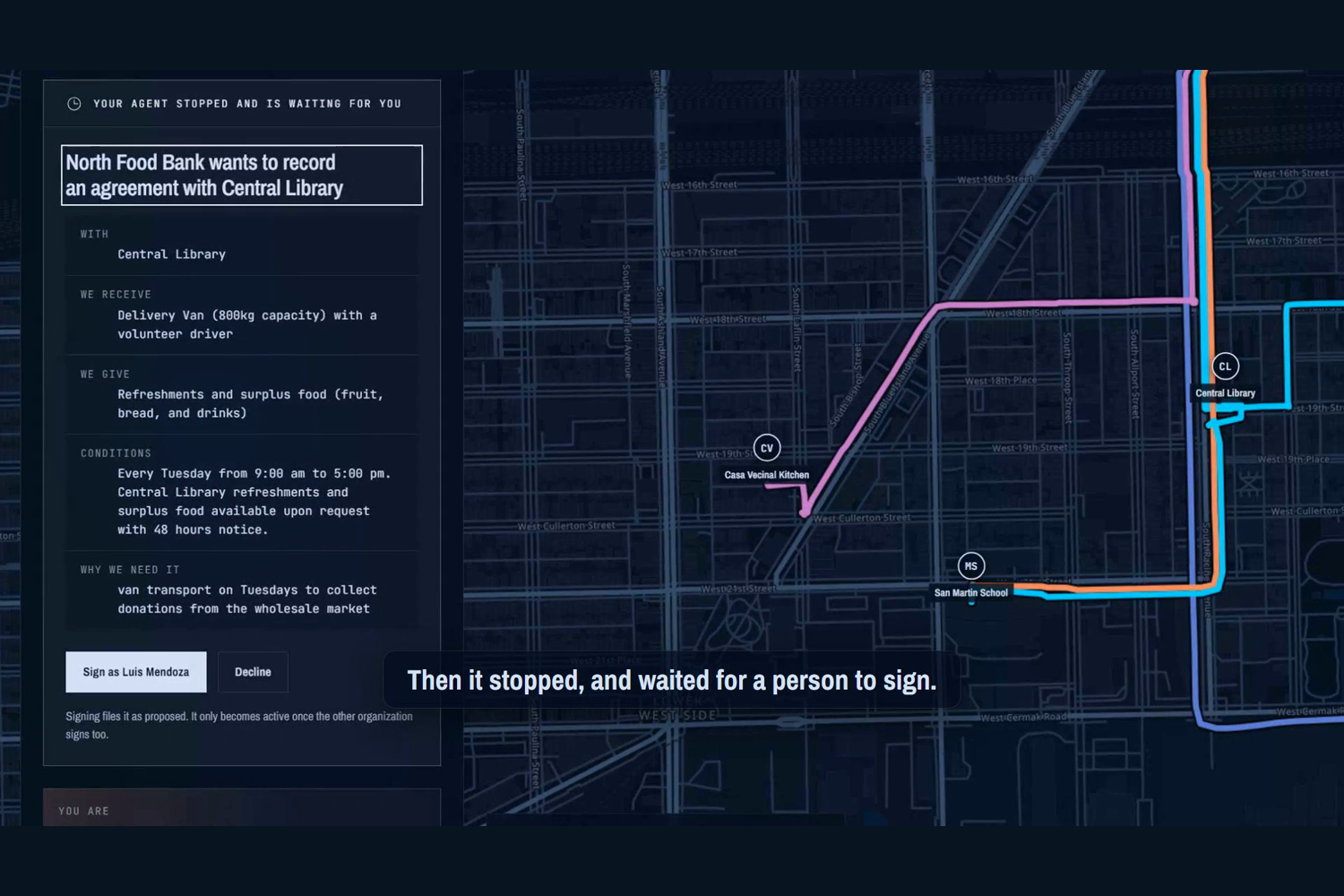
Then they stop. Nothing is written until a human on each side signs.
Every closed agreement lands in a shared ledger, and that ledger is the asset. When a funding call appears, the coalition agent cross-references it against the neighborhood's combined capabilities and can show documented prior collaboration rather than assert it.
Two layers, one cycle. Daily cooperation produces evidence; the evidence makes a coalition credible; the coalition brings money that funds more cooperation.
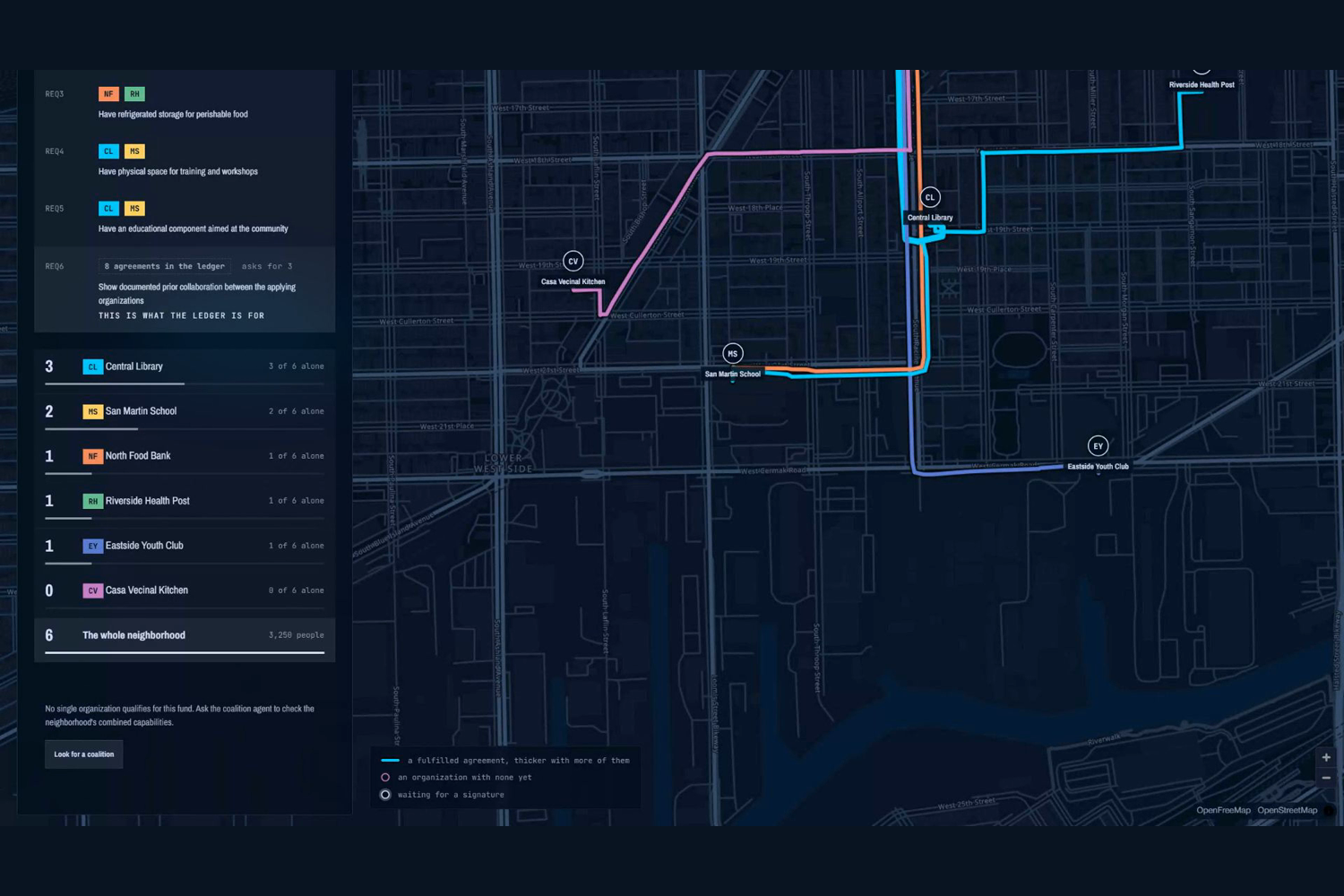
In the demo neighborhood: alone, the strongest organization covers three of the fund's six requirements and the kitchen covers none. None of the six reaches the thousand people the fund asks for. Together they cover all six and reach 3,250. The requirement nobody can fake is the last one, documented prior collaboration: it asks for three agreements, and the ledger holds eight.
How we built it
One process per organization, and that is the whole point.
The obvious build is one agent with six profiles in a list. It works, it is a tenth of the code, and it quietly destroys the claim. If all six profiles live in one process, "the library cannot see the food bank's inventory" is a promise about how carefully the prompt was written.
So Barnraise runs six A2A servers, ports 9001 to 9006, one per organization, each publishing its own agent card. Whichever organization opens a round acts as the client for it; the other five answer from their own servers.
from strands.multiagent.a2a import A2AServer

profile = OrgProfile.from_json(ROOT / perfil_path)

def factory(context_id: str):
    return build_org_agent(profile)

A2AServer(agent_factory=factory, port=port).serve()
Data isolation by construction. Every tool is a closure over exactly one profile, and the tools take no arguments:
def build_resource_tools(profile: OrgProfile) -> list:
    @tool
    def list_idle_resources() -> str:
        """List my organization's idle resources, the ones we could share with neighbors."""
        ...          # `profile` is captured by the closure, never passed in
    return [list_idle_resources]
There is no organization id to pass, so there is no call an agent can make, or be talked into making, that returns a neighbor's data. The guarantee is visible in three lines of a file rather than in a paragraph of a system prompt.
The human gate is a real block. Strands' interrupt brings the run back with
stop_reason == "interrupt" instead of a result. The round is on a worker thread
waiting on a threading.Event; the browser gets the paused tool call over SSE;
when the director signs, the API sets the event and the thread resumes where it
stopped. Nothing is polled and nothing is faked with a timer.
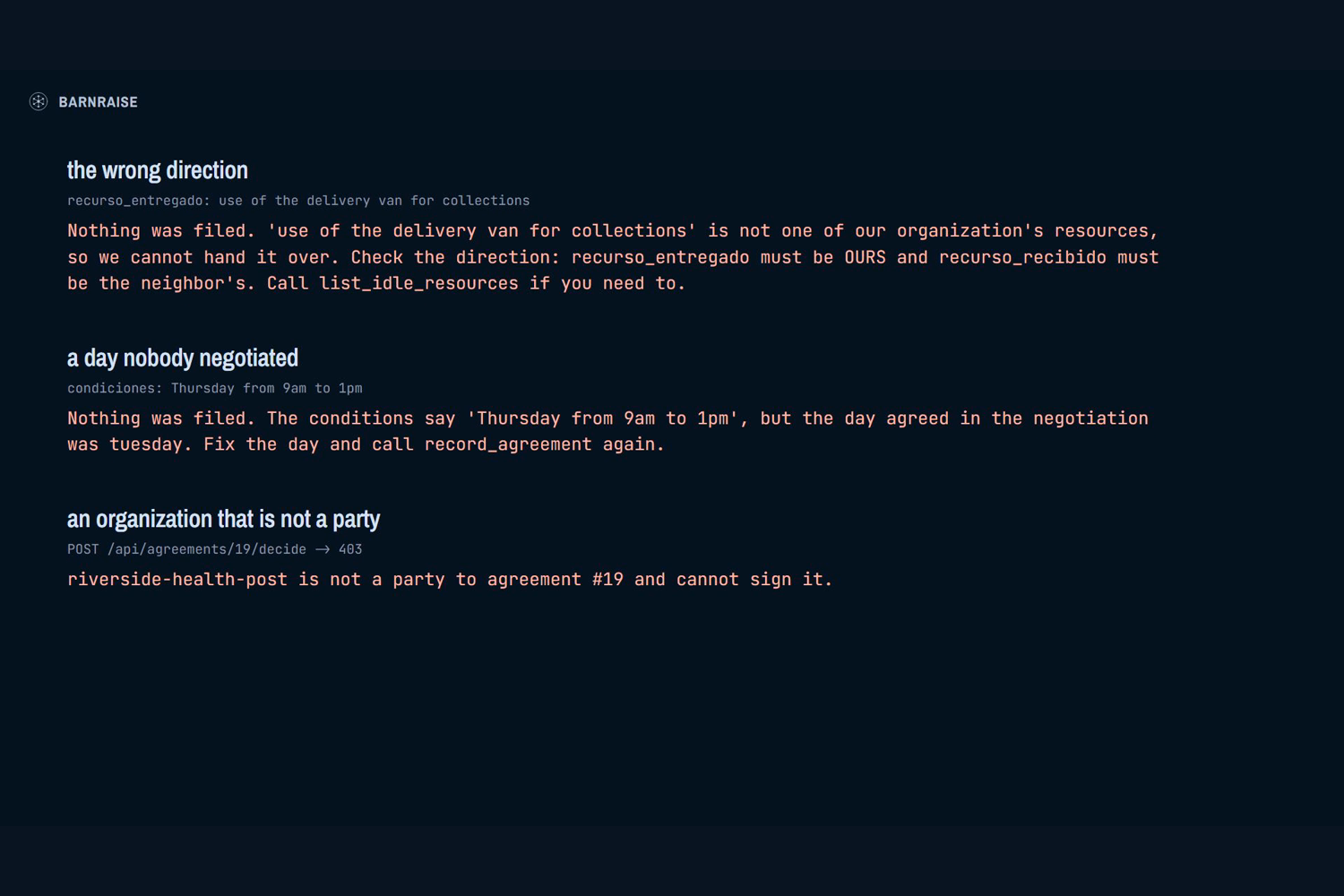
Deterministic guards at the tool boundary. What reaches the ledger is checked by ordinary Python before anything is written: the direction of the exchange against that organization's own inventory, the day that was actually negotiated, whether the counterparty is a real organization id, and whether the same trade is already live between the two parties.
Model-agnostic behind one environment variable. Amazon Bedrock, Google AI Studio and a local Ollama. Bedrock is the Strands default; the local path needs no key at all, so the whole neighborhood can be cloned and run offline.
The console is FastAPI with SSE, and MapLibre over OpenStreetMap with real driving routes from OSRM, so the distances on screen are real: 714 m from the library to the food bank, by road.
Challenges we ran into
The interesting failures were the ones no test caught.
An agent that is told "no" asks again. The resume loop was
while stop_reason == "interrupt". A director declines; the agent receives "no",
decides the task is still unfinished, and calls the same tool again; the loop puts
the refused decision straight back in front of them. Forever. Worse, the app
stayed marked busy, so every later round returned a 409 until the process was
restarted.
Every test we had answered approve. The refusal path was the one never exercised end to end, and it was also the path the entire product exists to protect. It is bounded now, a decline is terminal, and the test is a stub agent whose only behavior is to never stop asking.
The ledger accepted the same trade over and over. Six copies of one van-for-food exchange had accumulated. Nothing went wrong in any single round; the agent simply did not know the deal already existed. A book that records one trade six times documents an agent looping, not a neighborhood collaborating, and to a funder those look nothing alike.
The console asserted a signature that did not exist. The banner about anything waiting on you read "Ana Torres at Central Library has signed. It becomes active when you do" — unconditionally, without checking. On an agreement nobody had signed, it told a director their counterpart was already waiting on them. A product whose whole claim is that both signatures are real cannot invent one in a banner. It reads the ledger now.
A heading that contradicted its own body. The activity feed titled the negotiating agent's free text "Terms closed". That text is a model's prose and can say anything, and in one round it said the counterparty "has expressed a need to further refine the exchange" under a heading asserting the opposite. It is now "What the negotiator reported", and what actually settles the terms is the next event, which is deterministic.
Accomplishments that we're proud of
The product refuses things, and it can show you.
The demo spends twenty seconds on what it will not do, and those refusals are not screenshots taken once and kept. A script lifts the tool closure out of the source, calls it with two sets of bad arguments, and posts a signature from a non-party to a running server to get a real 403. Change the guards and the film changes. It cannot go on saying something that used to be true.
A funder reading this ledger is reading rows a model could not have written on its own: every one passed a deterministic check and carries two human signatures.
What we learned
Building agents that talk to each other is the easy half. The hard half is making what they produce trustworthy enough that someone outside would rely on it, and almost all of that work turns out to be checks, refusals and evidence rather than capability.
Two specifics we would carry to the next build. Write the decline path first — everyone builds the approve path because that is the demo, and the refusal path is where the guarantee lives. And decide early whether your isolation is a promise or a property; everything else follows from that one call.
What's next for Barnraise
Authentication is the piece a real deployment needs and this prototype does not have: the signing organization is a field in the request, so the checks constrain the interface rather than an arbitrary caller. After that, letting an organization publish its agent card to neighbors it has not met.
What this project does not claim
- Not that only one coalition qualifies. Four trios do, and the number moves as the ledger grows.
- Not that the ledger built itself. Four of the eight rows are seeded history, and the video says so out loud.
- Not that an agent physically cannot read a neighbor's data. What is guaranteed is that no tool exists that returns it.
- Not that the signatures are authenticated. They are not, and the README says so.
- Not that the demo runs on Bedrock. The provider is one environment variable and all three are documented, but no run on Bedrock has been recorded.
- Not that the organizations are real. The streets and the driving routes are; the organizations are invented, and the notice saying so is on screen throughout the video.
Built With
- a2a
- amazon-bedrock
- amazon-web-services
- fastapi
- ffmepg
- google-gemini
- javascript
- maplibre
- ollama
- openstreetmap
- osrm
- playwright
- python
- remotion
- server-sent-events
- sqlite
- strands-agents

Log in or sign up for Devpost to join the conversation.