Backup Sentinel
Inspiration
Backup Sentinel was born from a real-world problem I experienced while managing SQL Server backups for multiple clients.
Everything appeared to be working correctly. Backup jobs completed successfully, ZIP archives were created, and transfers finished without errors. However, during a recovery test I discovered that one of the archives did not contain the SQL Server backup (.BAK) file. The backup looked healthy, but it was impossible to restore.
That experience made me realize that successful backups are not the same as recoverable backups.
I created Backup Sentinel to help administrators detect these situations before they become real data loss incidents.
What it does
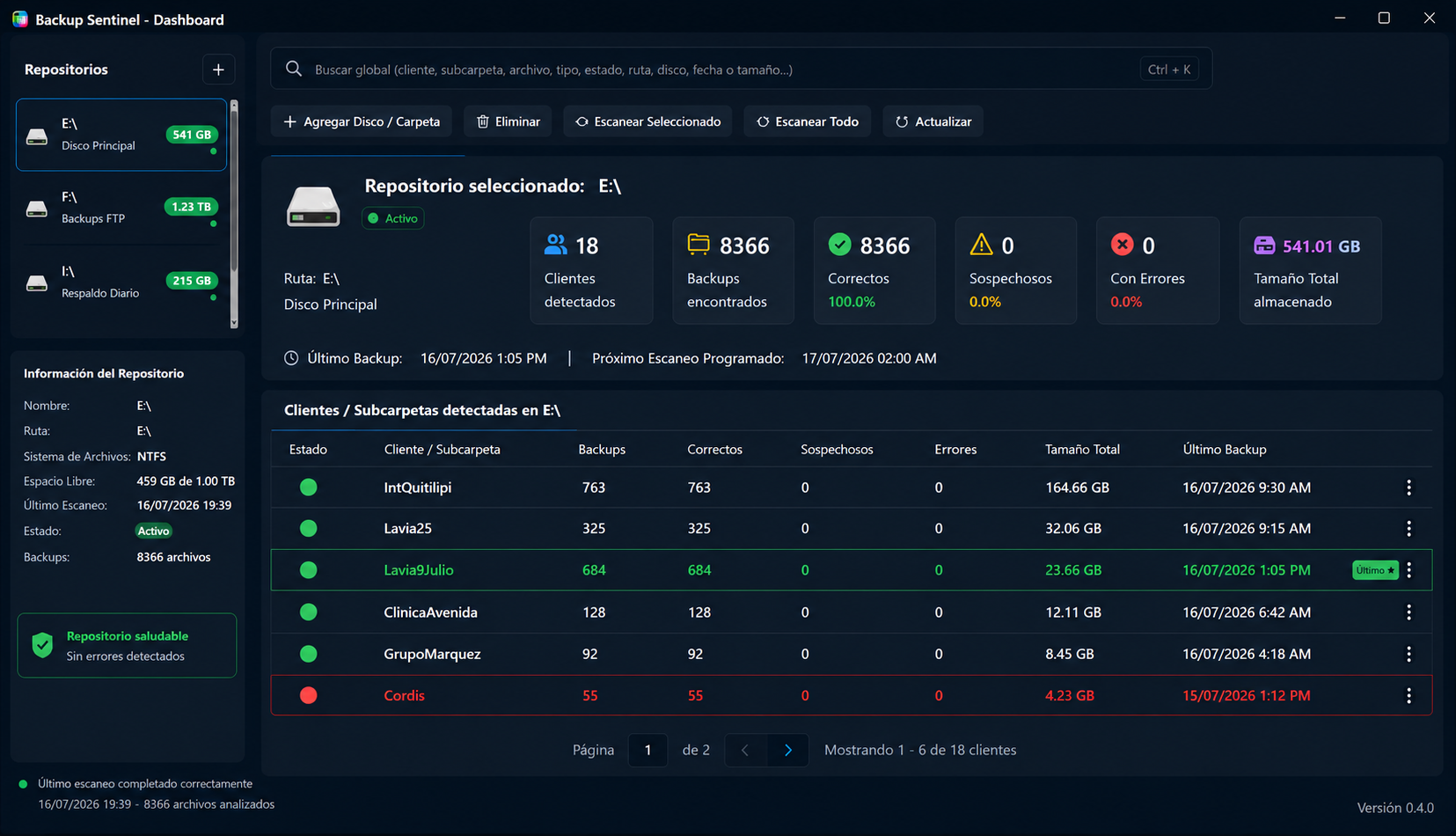
Backup Sentinel is a desktop application that validates existing backups.
Rather than creating or restoring backups, it analyzes backup packages and verifies that critical recovery components are actually present.
The application:
- Validates ZIP archive integrity.
- Detects SQL Server backup files (.BAK).
- Inspects backup metadata and logs.
- Identifies missing or suspicious content.
- Presents clear validation results.
- Operates entirely in read-only mode.
Backup Sentinel never modifies backup files. Its purpose is to provide confidence that a backup contains the information required for a successful recovery.
How I built it
Backup Sentinel was built using modern Microsoft technologies:
- C#
- .NET 8
- WPF
- MVVM
- SQLite
- Git
- GitHub
The application follows a modular Clean Architecture that separates the user interface, validation engine and persistence layer, making it easy to extend with new validation modules.
AI-assisted development tools helped accelerate implementation while keeping the architecture and product vision consistent.
Challenges
One of the biggest challenges was defining what a "valid backup" actually means.
Simply checking whether a ZIP file exists is not enough. A backup can appear successful while missing the most important file required for recovery.
Another challenge was presenting technical validation results in a way that system administrators can understand immediately without navigating complex logs.
Accomplishments
The project successfully transformed a real operational problem into a functional MVP.
Current capabilities include:
- ZIP validation
- SQL backup detection
- Backup inspection
- Recoverability indicators
- Historical validation
- Professional desktop interface
What I learned
Building Backup Sentinel reinforced an important lesson: backup success should never be measured by file existence alone.
The project also provided valuable experience designing scalable desktop software using Clean Architecture and AI-assisted development workflows.
What's next
Future versions will include:
- AI-assisted anomaly detection
- Historical backup comparison
- Email notifications
- REST API
- Web dashboard
- Mobile companion application
- Support for additional database engines
The long-term vision is to become a comprehensive backup validation platform that helps organizations identify backup problems before recovery becomes necessary.
Backup Sentinel doesn't create backups. It validates them before disaster strikes.


Log in or sign up for Devpost to join the conversation.