-
-
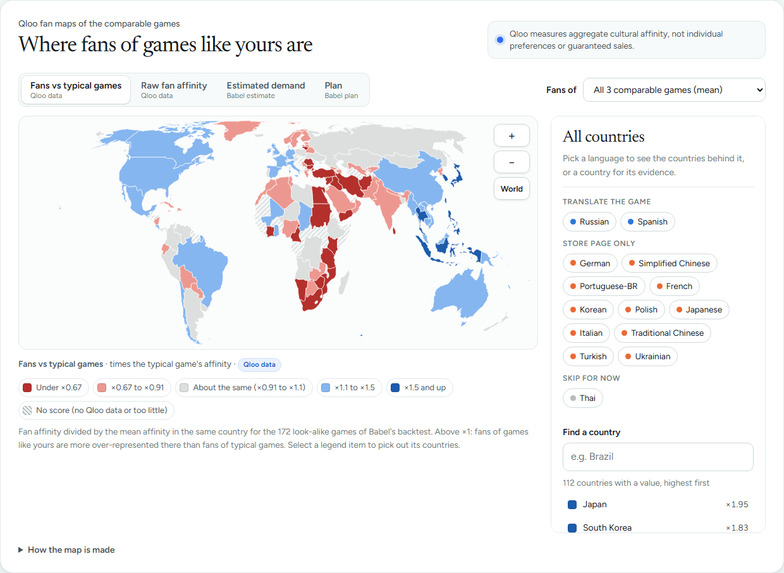
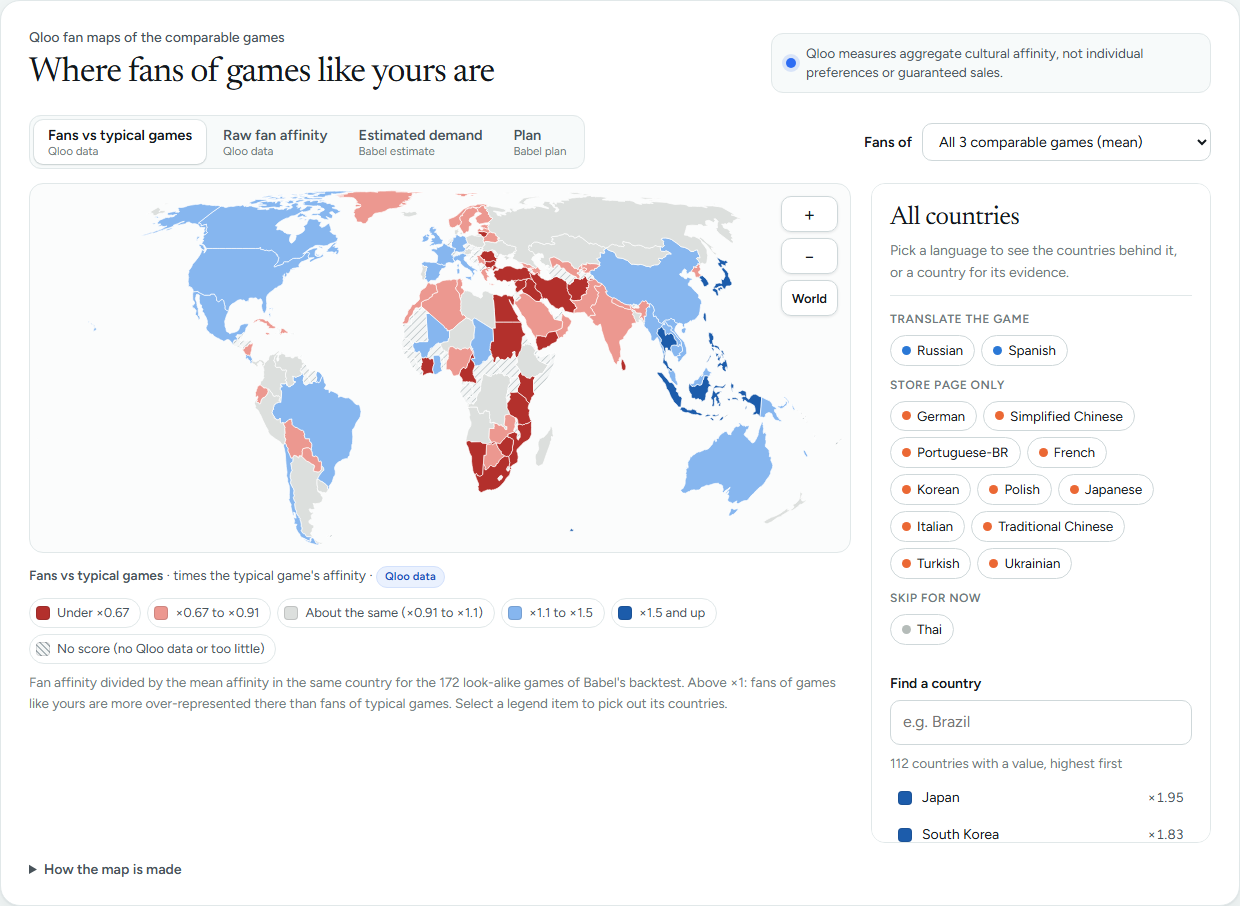
where the fans are (the hero image)
-
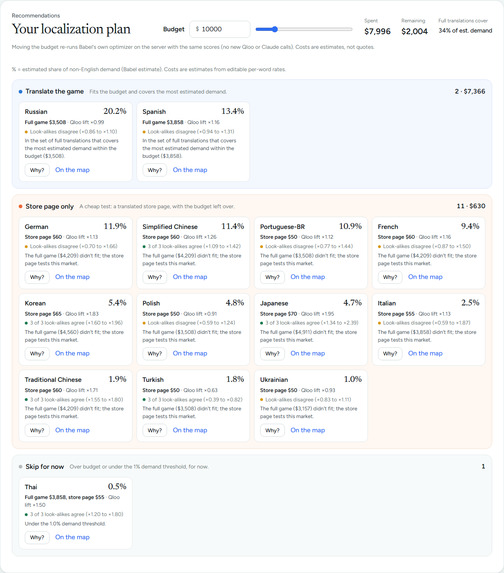
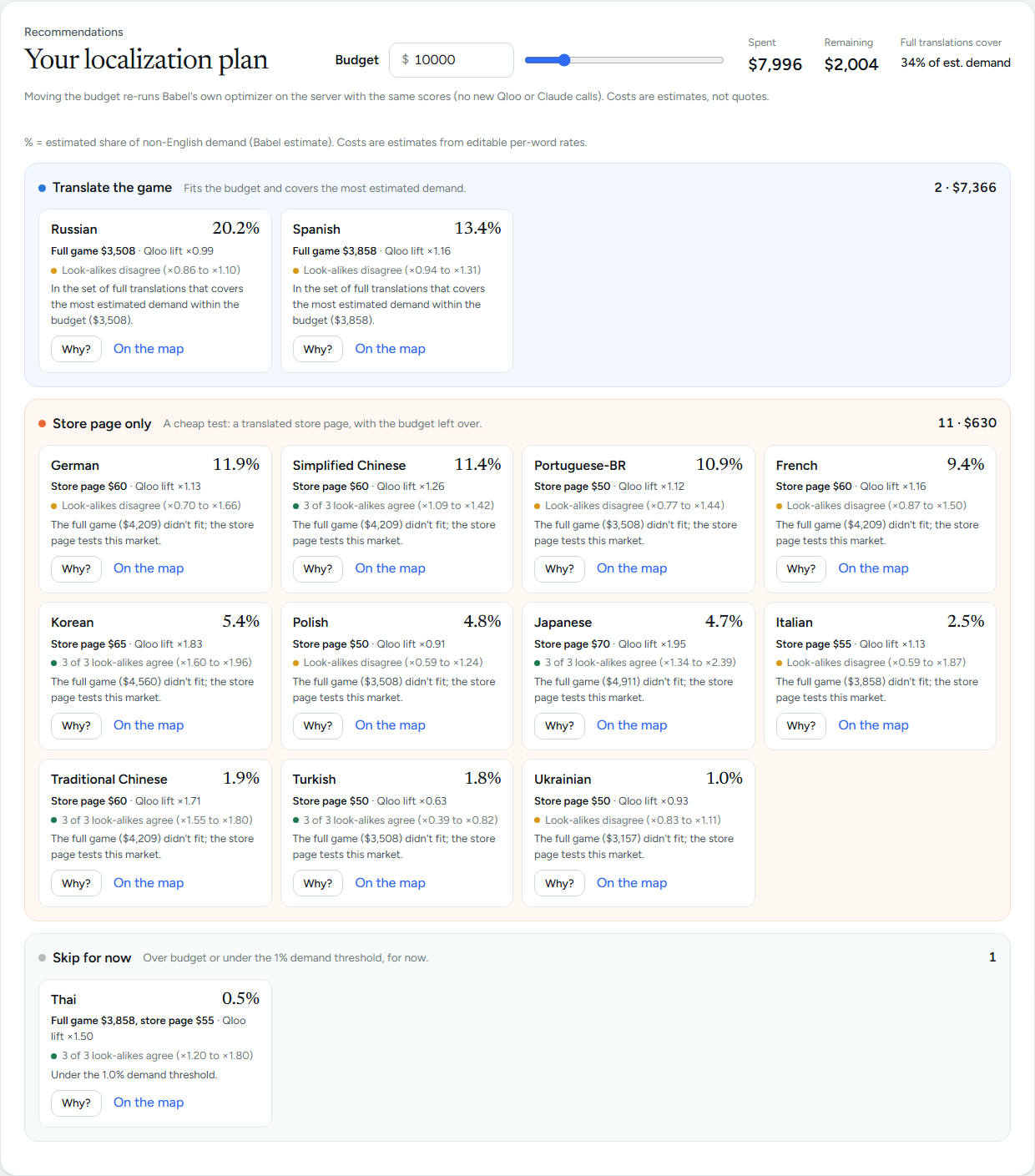
the plan and the budget slider
-
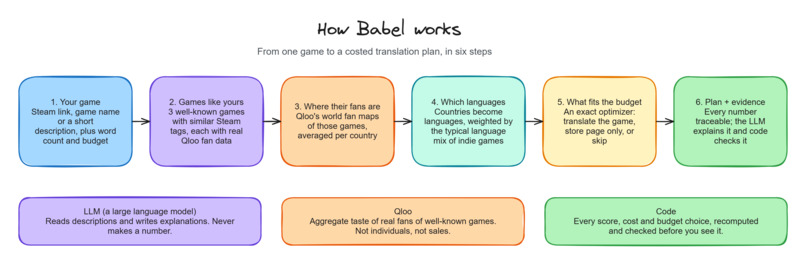
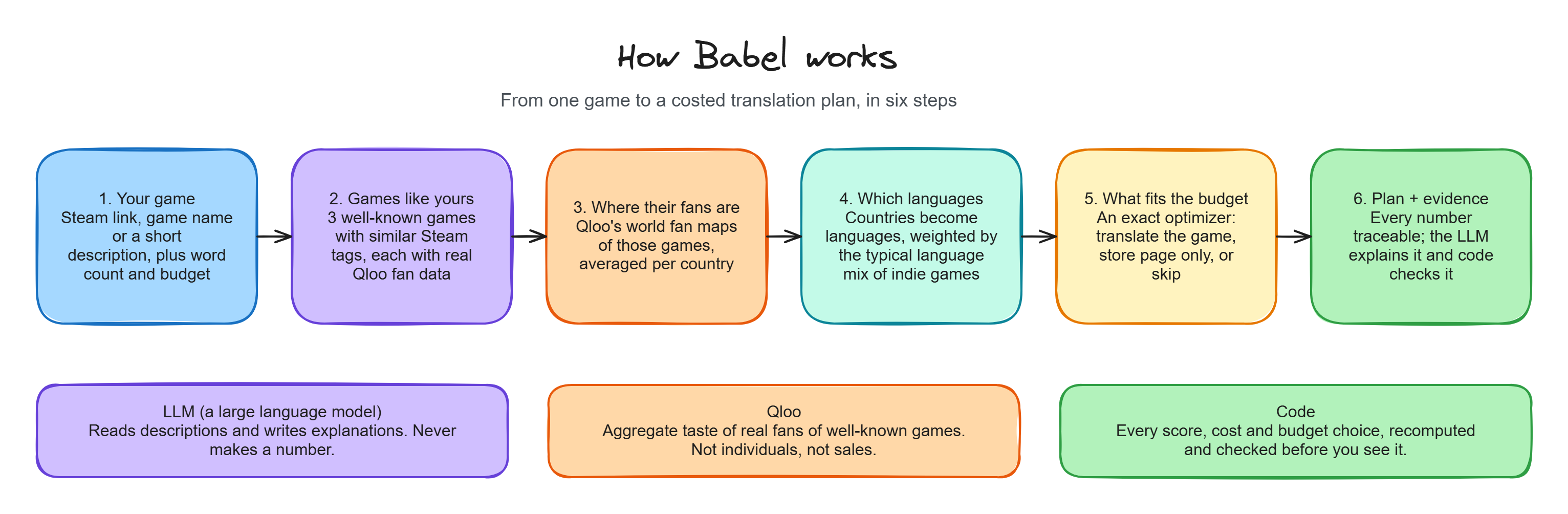
how Babel works
-
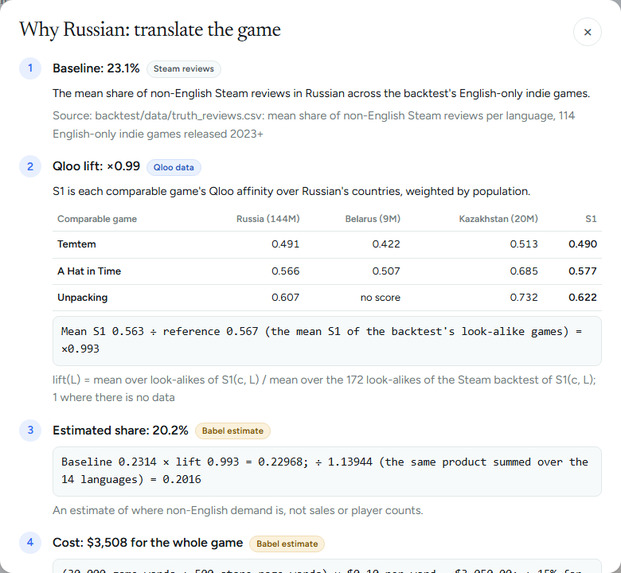
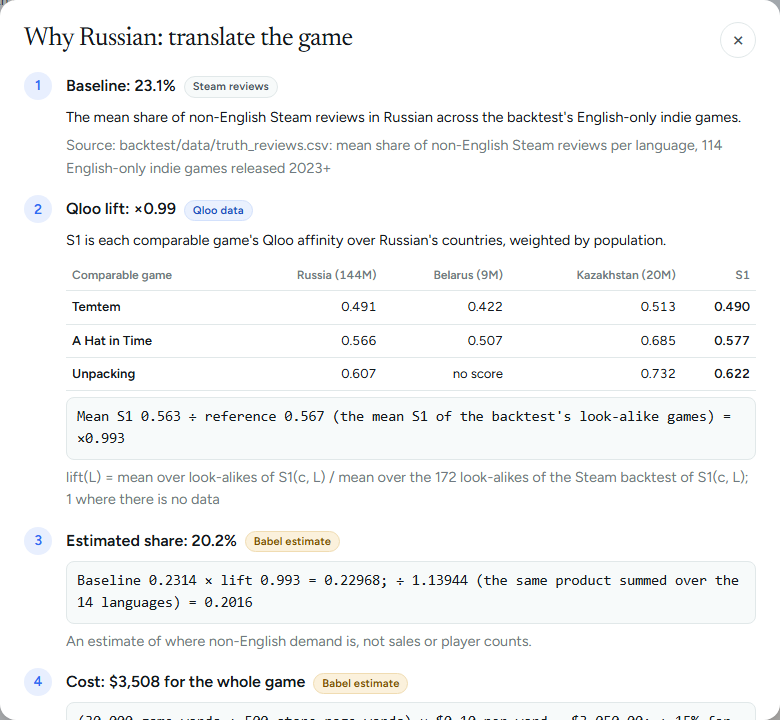
"Why?" for one language
-
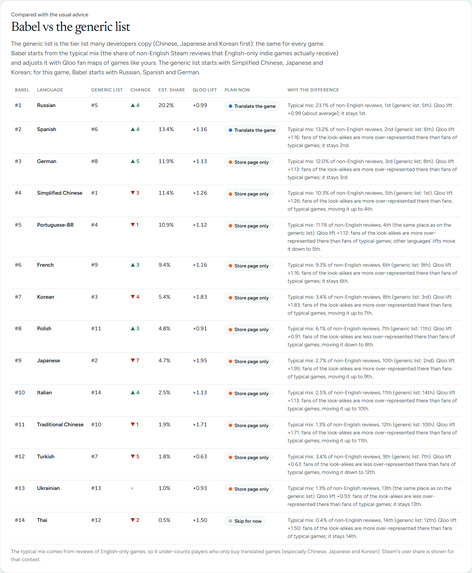
Babel vs the usual list
-
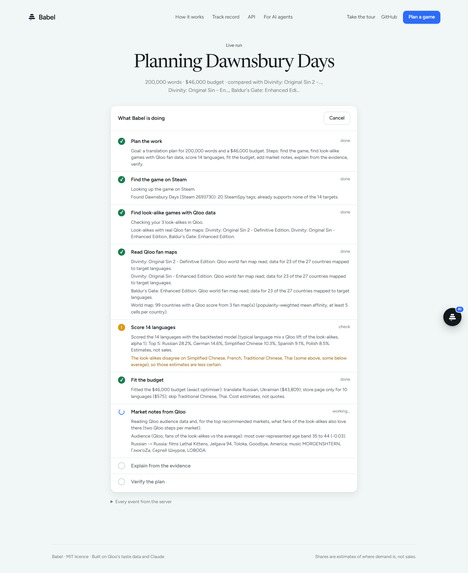
the agent's live trace
-
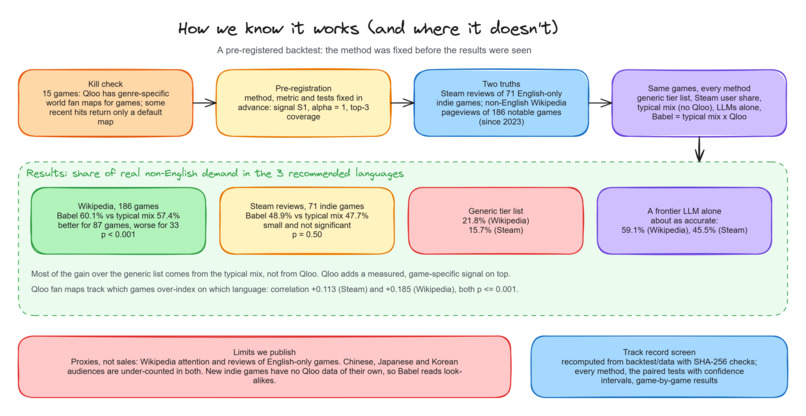
the backtest
-
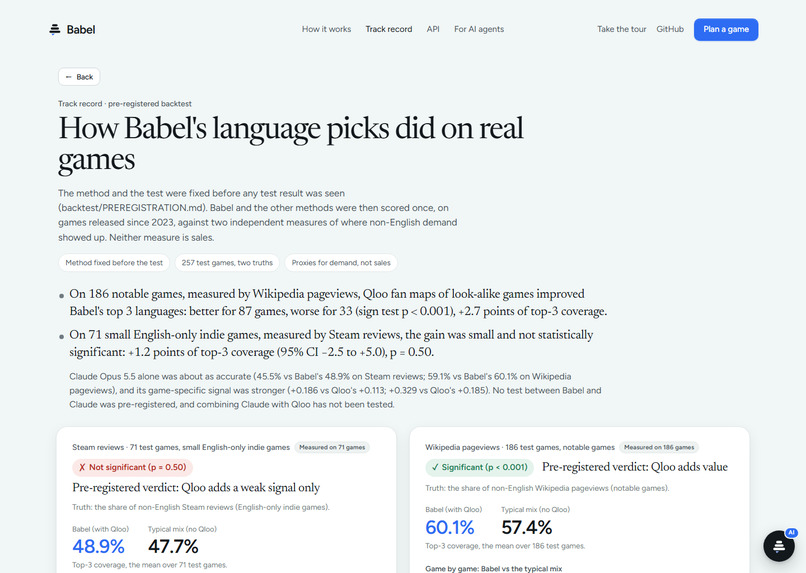
Track record screen
-
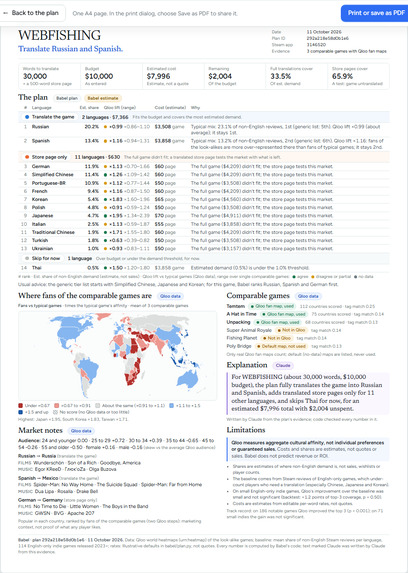
the printable report
-
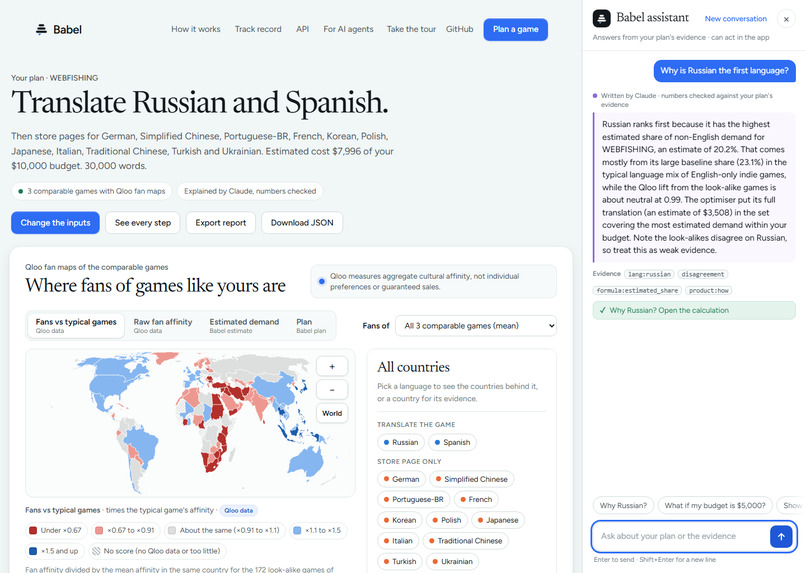
the assistant
-
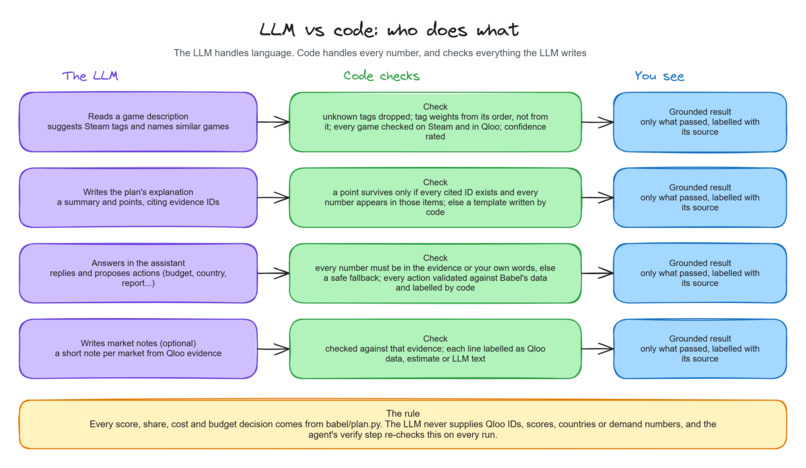
what the LLM does and what code checks
-
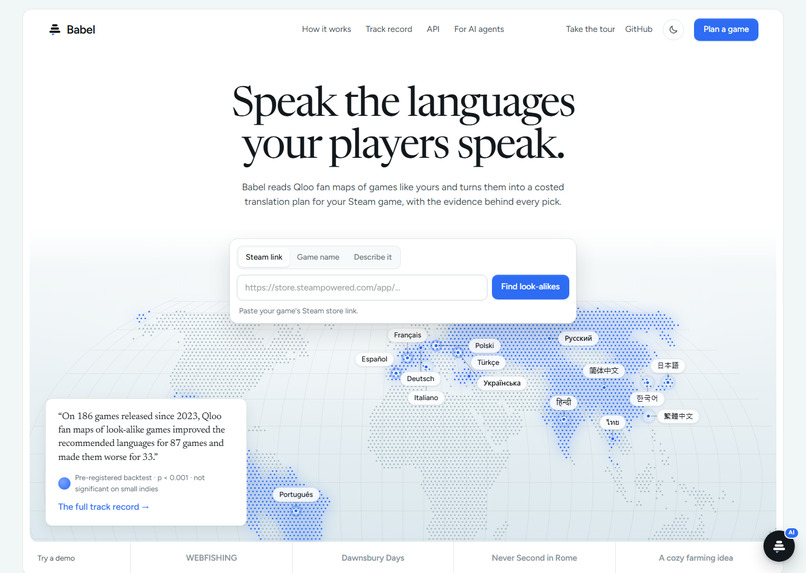
the Start screen
Inspiration
The comments were in Portuguese, Russian and Spanish. The game was only in English.
It was past midnight and I was doing what everyone does: scrolling Instagram. A travel reel from a night market in Bangkok. A food reel of someone in Brazil trying Indian street food for the first time. Then a 20-second clip from a small indie game, made by one person.
I opened the comments, and most of them weren't in English.
"Tradução PT-BR por favor 🙏"
"Добавьте русский язык"
"¿Lo van a traducir al español?"
Three languages under one small game, all asking for the same thing: their own.
What stuck with me was how the feed had got me there. Thai street food, then a Brazilian food reaction, then an indie game, and every jump made sense. The algorithm knew my taste better than I could have described it. Taste has a map, and it doesn't stop at borders.
The problem wasn't new to me. I work in Telugu cinema, where "which languages do we dub this film into?" is a question with a budget attached. My first idea for this hackathon was about dubbing films, and Qloo's data ruled it out in a day. That late-night scroll is what pointed me at games.
The next morning I looked at it from the developer's side and searched for which languages to translate an indie game into. Every answer gave me the same list: Simplified Chinese, Japanese and Korean first. Then Portuguese, Russian, Spanish. It's in blog posts, Discord threads and publisher decks, and it's the same list whether you made a cozy farming game or a war strategy game.
That didn't match the comments I'd read the night before. And this decision costs real money. Say you have $10,000 for localization. For a 30,000-word game, one language costs roughly three to five thousand dollars. So you get two languages. Maybe three. Pick the wrong ones, and that money doesn't come back.
So I checked. I scanned 4,000 Steam games to find 114 English-only indie games released since 2023 with at least 500 reviews, and counted every review by language.
Even with no translation at all, about one review in five wasn't in English. And the biggest group wasn't Chinese or Japanese. It was Russian: 21.7% of the non-English reviews. Japanese, number two on the famous list, was 2.6%. The comment section had been closer than the list.
(One honest caveat, and we'll come back to it: an English-only game loses the players who can't read English, and that hits Chinese, Japanese and Korean hardest. But the gap was too big to ignore.)
Instagram knew where my taste would go next. Qloo maps that kind of taste for the whole world, country by country. That gave me the question behind Babel: can taste data tell an indie developer where their players are likely to be, before the game even launches?
What it does
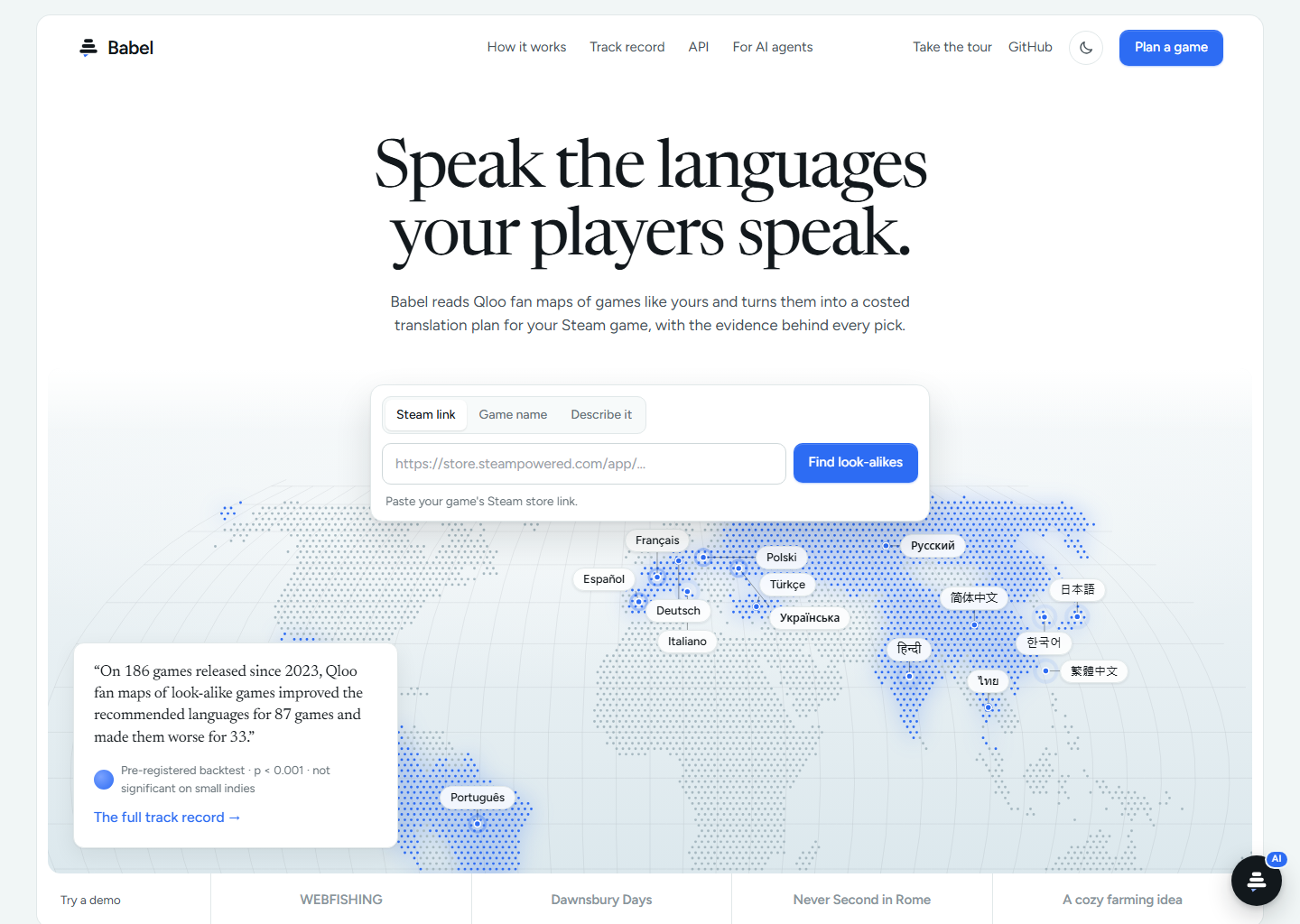
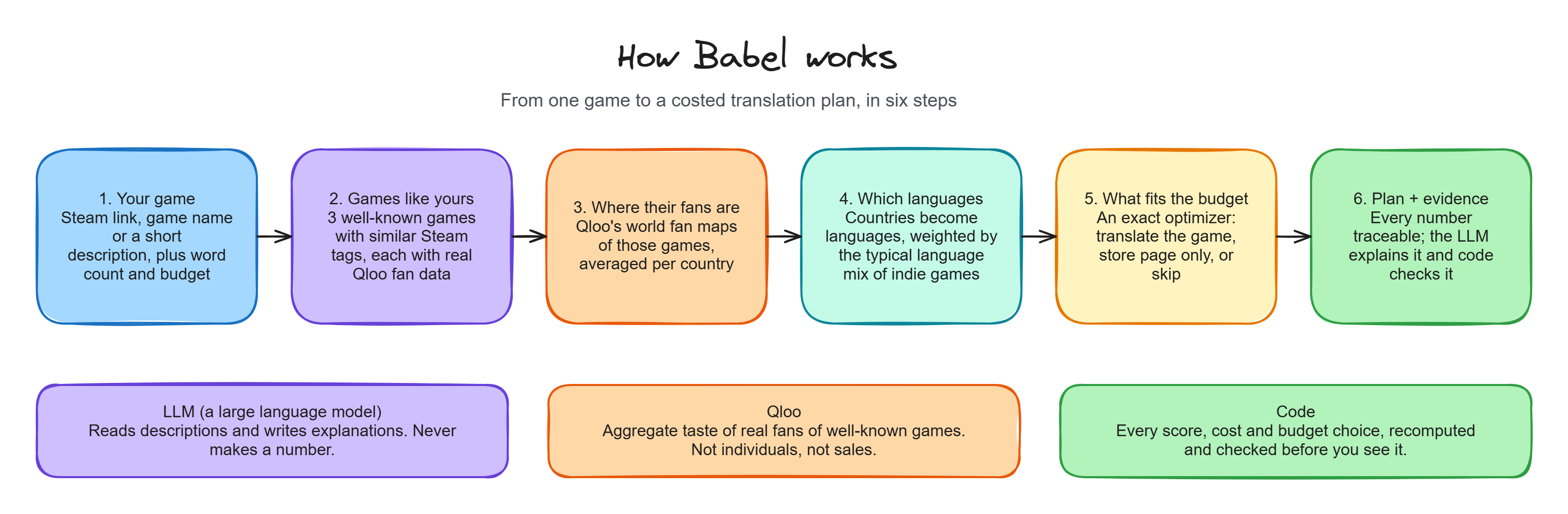
You tell Babel about your game: a Steam link, a name, or just a paragraph if there's no store page yet. Add your word count and your budget.
Babel comes back with a plan, in plain words:
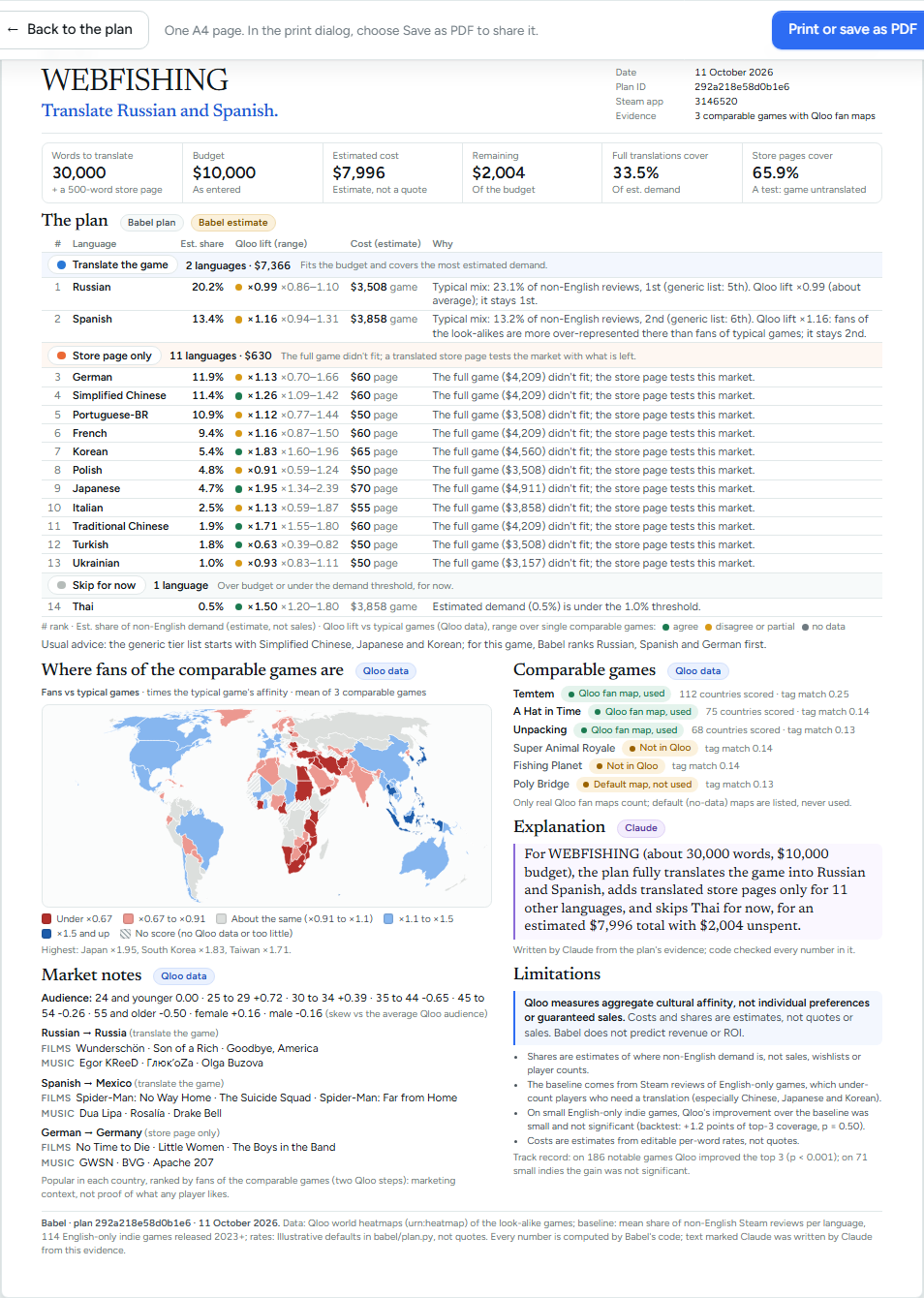
- Translate the whole game into these languages.
- Translate only the store page for these. It's a cheap way to test a market.
- Skip for now for the rest.
Every language comes with an estimated share of your likely non-English players, an estimated cost, and a Why? button that walks through every step behind it.
Try the WEBFISHING demo: 30,000 words, $10,000. Babel says translate the game into Russian and Spanish, put up store pages in 11 more languages, and skip Thai for now. That's $7,996 of your $10,000. (Costs are estimates, not quotes.)
Around the plan you get:
- a world map of where fans of games like yours are, compared with usual
- a budget slider that re-fits the plan instantly
- who those fans are (age and gender skew), and what films and music are popular with them in each top market
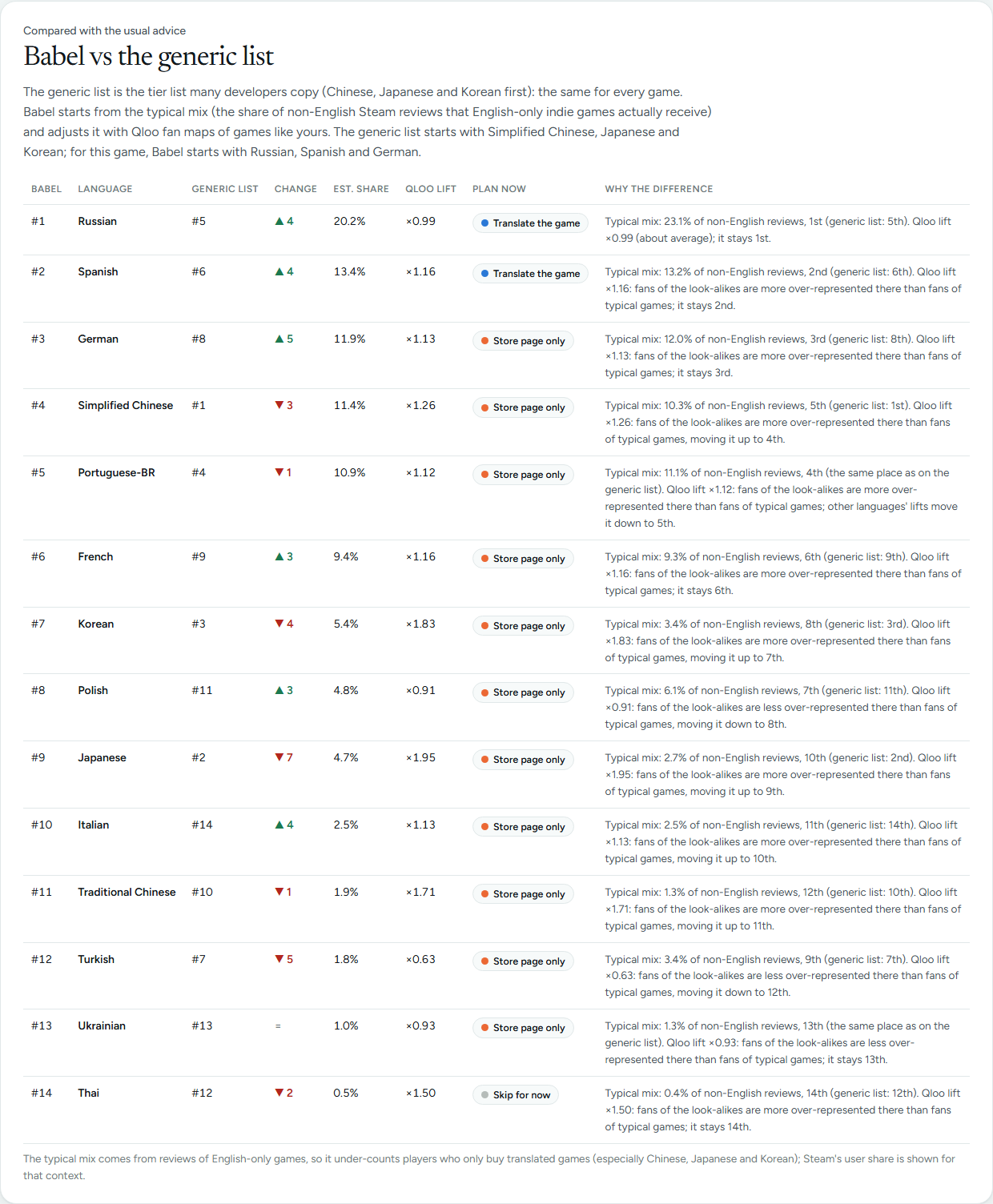
- a side-by-side with the copy-pasted list, with the reason for every difference
- a one-page report you can print or save as a PDF
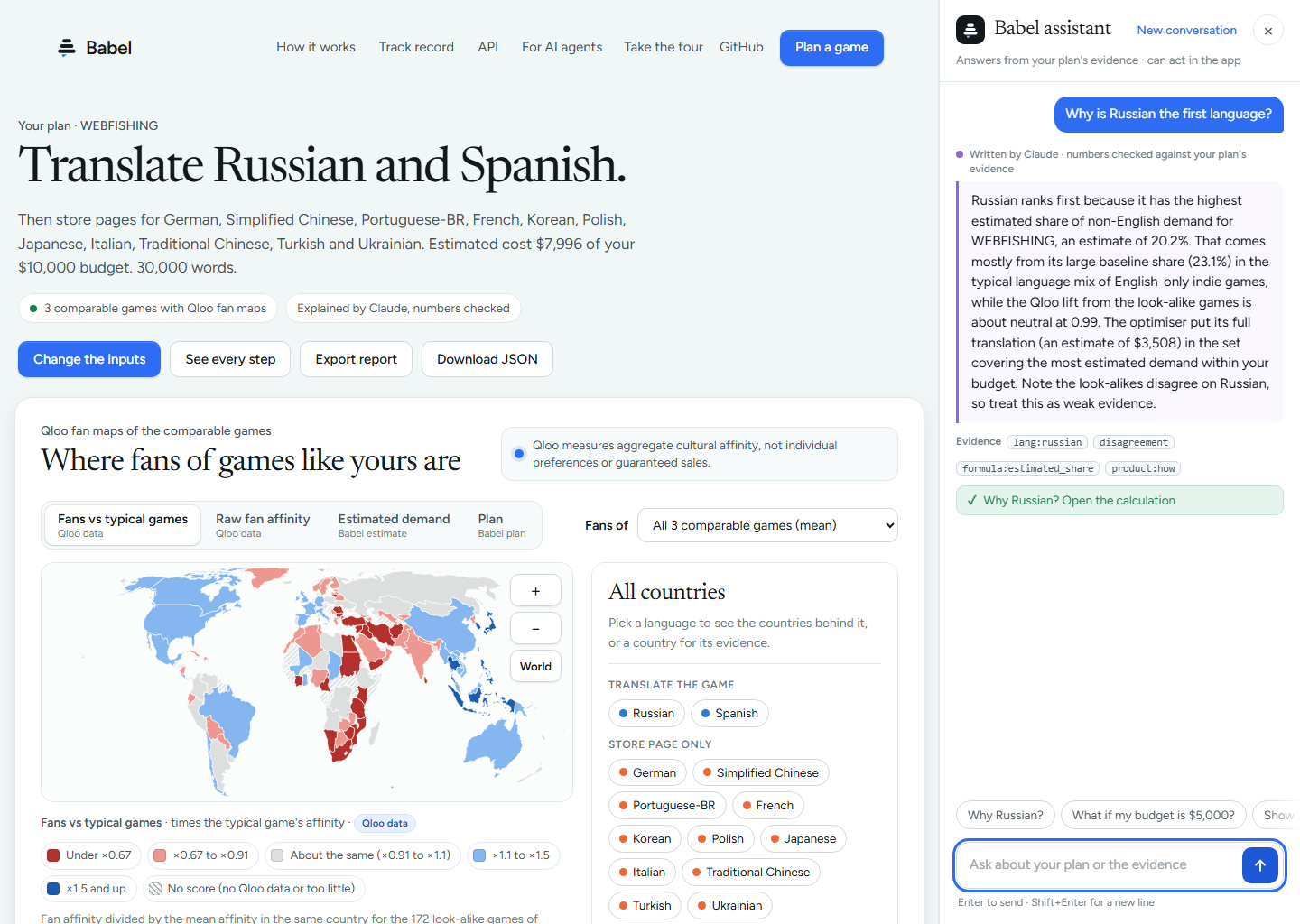
- an assistant that answers questions about your plan and can drive the app for you
And because this is an agent hackathon: Babel is also an MCP tool. Another AI agent can ask it for a language plan and get the same answer the web app shows.
How we built it
Why it needs Qloo
Here's the problem we hit on day one. A game that isn't out yet has no fans, so Qloo has no data on it. We looked up 75 new indie games that Qloo knows about. All 75 came back with Qloo's default "no data" map.
But fans of games like yours already exist. And Qloo knows where they are, country by country, across the whole world.
So Babel picks three well-known games that share your Steam tags and reads their Qloo fan maps. For each language it asks one question: are fans of games like this more or less common where this language is spoken than usual? The answer becomes a Qloo adjustment on top of the typical language mix of English-only indie games.
That adjustment is the only part of the score that's about your game. Take it out, and look what happens to our four demo games at $10,000:
| Demo game | Without Qloo | With Qloo |
|---|---|---|
| WEBFISHING (cozy multiplayer fishing) | Russian + Spanish | Russian + Spanish |
| Dawnsbury Days (tactical RPG) | Russian + Spanish | Russian + German |
| Never Second in Rome (historical turn-based RPG) | Russian + Spanish | Russian + German |
| A cozy farming idea (just a description) | Russian + Spanish | Russian + Simplified Chinese |
Without Qloo, every game gets the same answer again. It's a better-researched version of the list we set out to replace, but it's still one list. With Qloo, the plan follows the fans.
Even when the top two stay the same, Qloo moves the rest. For WEBFISHING, it lifts Japanese from 2.7% to 4.7% and Korean from 3.4% to 5.4%, and cuts Turkish from 3.4% to 1.8%. Open "Why?" on any language and you'll see exactly how much of that came from Qloo.
Qloo gives us two more things nothing else in Babel can: who the fans are (Qloo's demographics for the look-alike games) and what's popular with them in each market (Qloo insights for films and music, re-ranked by these fans). Without Qloo there's no map, no audience and no "why".
Look-alikes, and the fake-data trap
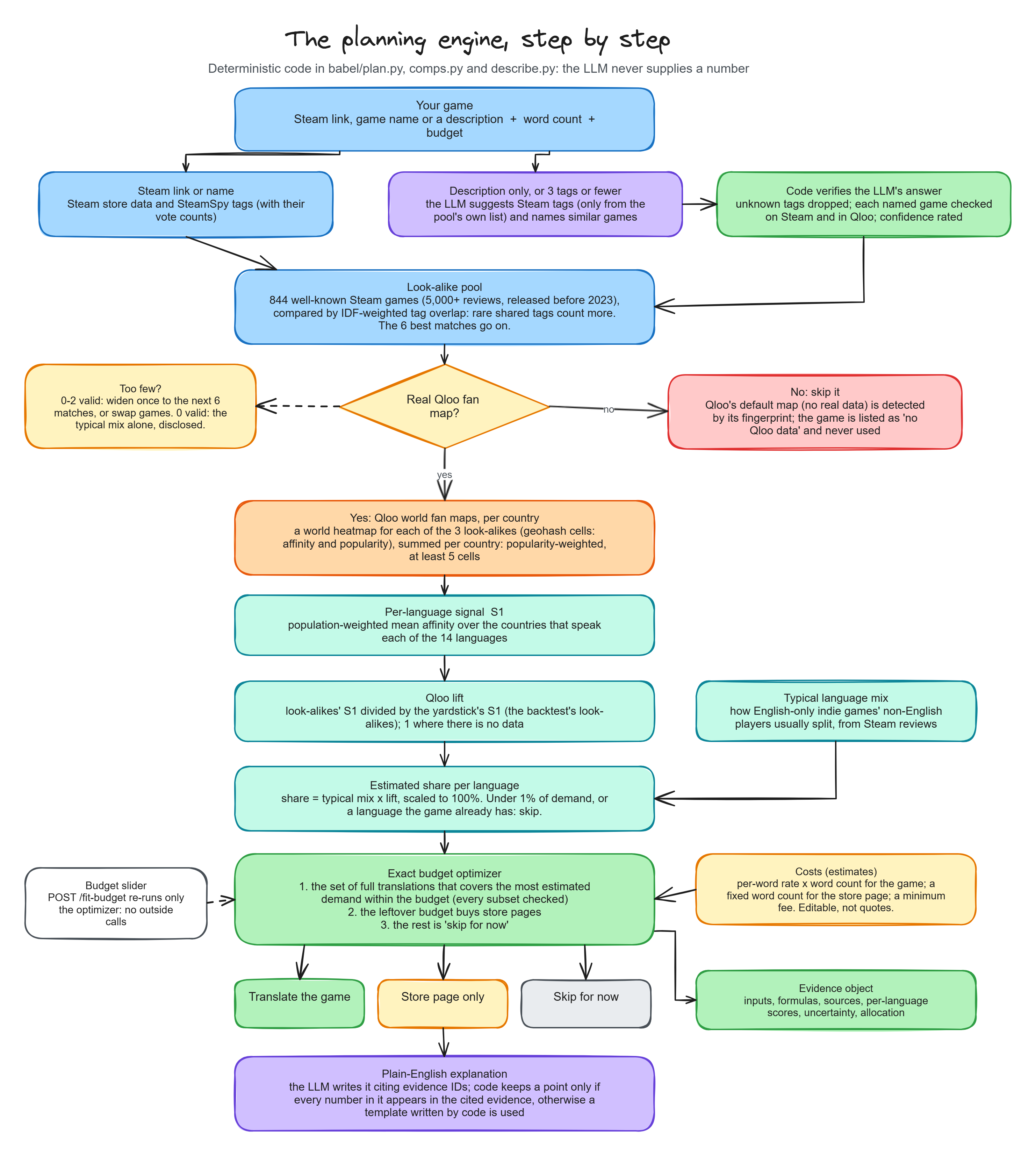
Babel keeps a pool of 844 well-known Steam games released before 2023. It ranks them by shared Steam tags, with rare tags counting more, and tries the top six until three have real Qloo data.
When Qloo has no data on a game, it doesn't return an error. It returns the same generic map every time. We fingerprint that map and never use it. You can watch the agent do this in the WEBFISHING demo: Poly Bridge comes back with the default map and gets skipped, and two other candidates aren't in Qloo at all.
The planning engine
From there, it's all deterministic code:
- Qloo world heatmaps for each look-alike, in cells about 156 km wide, summed per country and weighted by popularity. (Plain averages put tiny islands on top, so a country needs at least 5 cells.)
- Countries become languages, weighted by population.
- A lift per language: how much more or less common these fans are there than for a yardstick of other games.
- The lift adjusts the typical mix:
$$\text{share}(L) \propto \text{typical mix}(L) \times \text{lift}(L)$$
- An exact budget optimizer checks every combination of full translations and keeps the one that covers the most estimated demand. Whatever's left buys store pages.
How Babel works as an agent
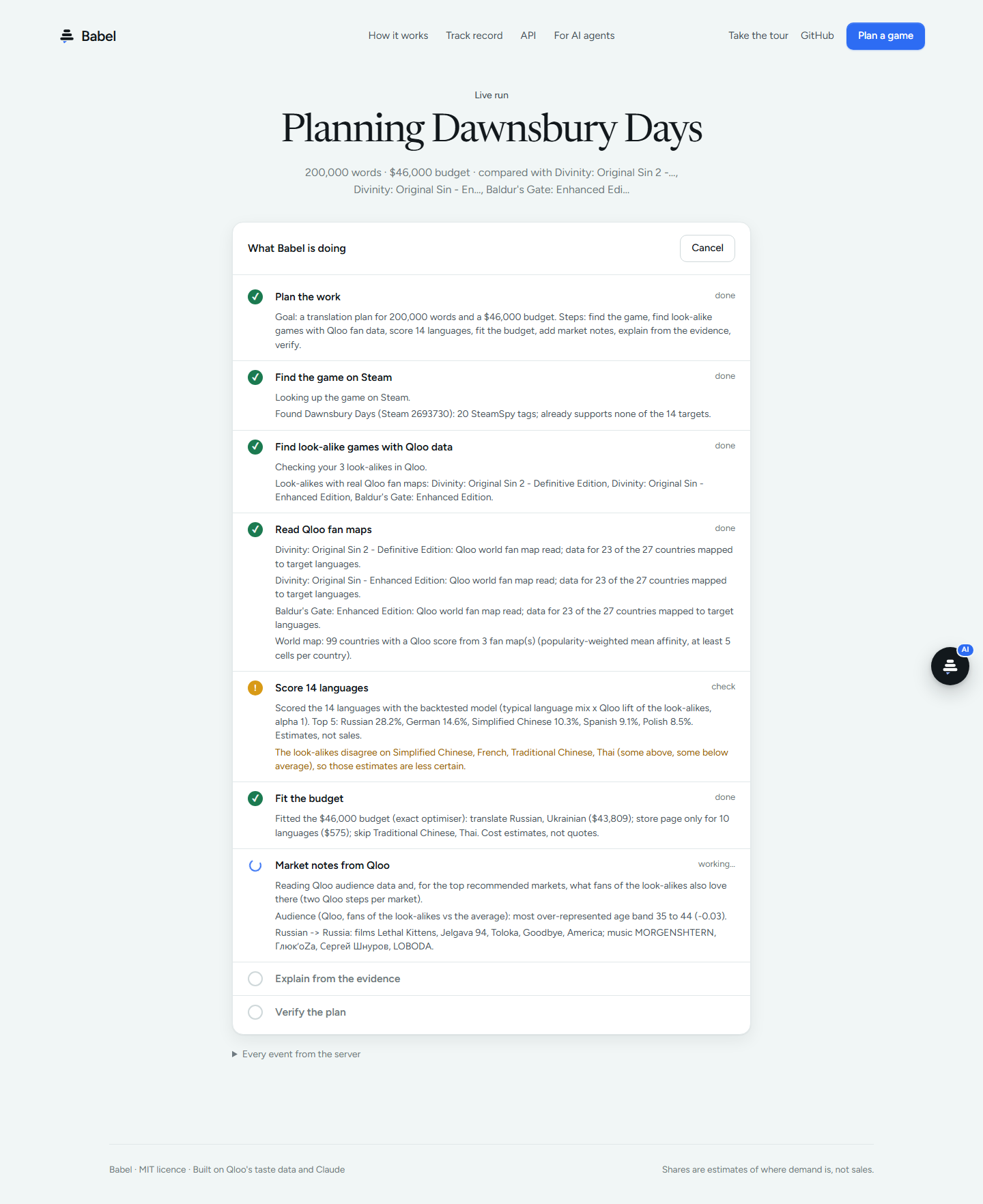
Babel is an agent with one goal: the best language plan your budget can buy. You give it the goal; it works out the rest, and you watch it happen as a live trace on screen.
- It plans. It lays out the steps for your game: find it, find look-alikes, read their Qloo fan maps, score the 14 languages, fit the budget, add market notes, explain, verify.
- It acts, with tools. It calls Steam (your game and its tags), Qloo (finding each look-alike, its world fan map, its audience and what its fans love in each market), Claude (reading a description, writing the explanation), and its own planning engine.
- It reflects on what comes back, and recovers. A look-alike that Qloo has no real data for is caught by its fingerprint and dropped; too few look-alikes and it widens the search; sparse Steam tags and it reads the store description instead; a failed request is reported, never papered over. You see each of these decisions in the trace.
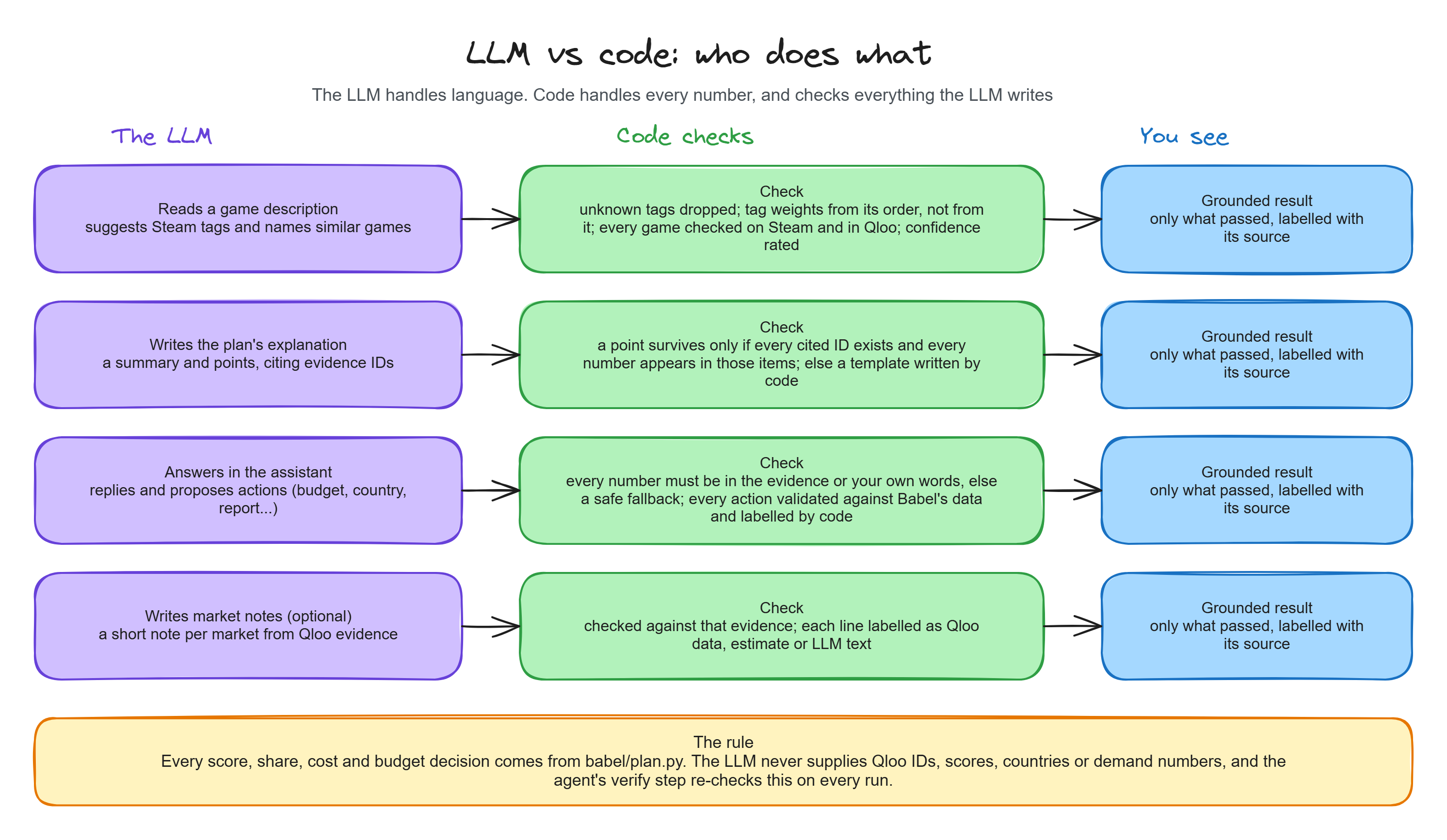
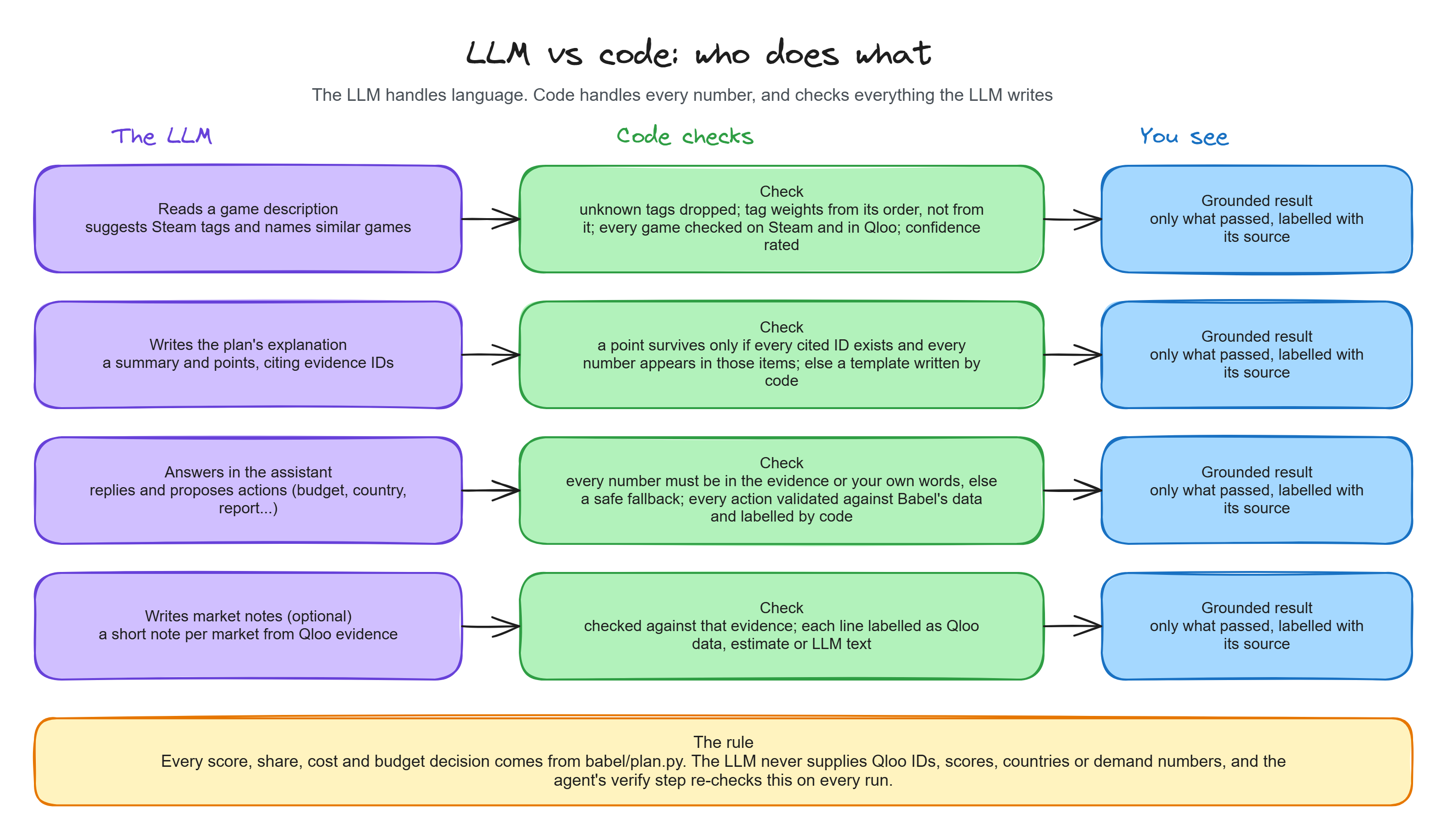
- It verifies before it answers. It re-checks the finished plan, and every number in Claude's explanation must appear in the evidence it cites, or that sentence is replaced.
It also works the other way round: other agents can use Babel as a tool. The MCP tool babel_language_plan runs the same agent and returns the same plan, and the in-app assistant answers questions about your plan and performs actions in the app (re-fit the budget, show a country, open a "Why?"), each one checked against Babel's own data.
Where the LLM fits, and where it doesn't
The LLM reads a description and suggests tags (only tags from our pool) and similar games, and it writes the plain-English explanation. That's it. It never produces a score, a country or a cost. Code checks every game it names against Steam and Qloo. Every number in its text has to appear in the evidence it cites, or code writes that sentence instead.
Stack
Python 3.12 and FastAPI, with Server-Sent Events for the live trace. The frontend is plain HTML, CSS and JavaScript with D3 for the map: no build step, and no API keys in the browser. Every outside call goes through one throttled, cached HTTP layer, so the demo buttons run from cache. 473 automated tests, including real-browser tests. Deployed on Railway.
Challenges we ran into
- The idea almost died on day one. New games are invisible to Qloo. Before writing any product code we ran a kill check: 15 games across 5 genres. Fans of same-genre games lined up by country at 0.50, against 0.08 across genres. That was enough to build the look-alike idea on.
- Qloo's silent default map. Three of the 15 recent hits in that kill check (Lethal Company, Content Warning, Manor Lords) shared one identical map. Averaging those in would have quietly corrupted every plan, so we fingerprint and drop them.
- A bug that returned nothing, quietly. Qloo caps results at 50 per call and our batches were 100, so one signal came back empty without an error. We fixed it before the final run and logged it as a dated amendment.
- Our own data had a flaw. Halfway through, we found that 68 of the 186 Wikipedia test games had no Steam tags, so they'd all been given the same three look-alikes. We left the pre-registered result exactly as it was, reported the flaw, and fixed the planner: look-alikes now have to share at least one tag with your game.
- Keeping the LLM honest. Getting an LLM to explain a plan is easy. Making sure it never invents a number took a checker that matches every figure in its text against the evidence.
Accomplishments that we're proud of
We tested it before we trusted it.
Our first try, on 43 games, was a wash. Qloo changed the top pick on 8 games: 3 got better, 5 got worse. The signal was there (Qloo tracked which games lean toward which language, p = 0.002), but the plan wasn't better.
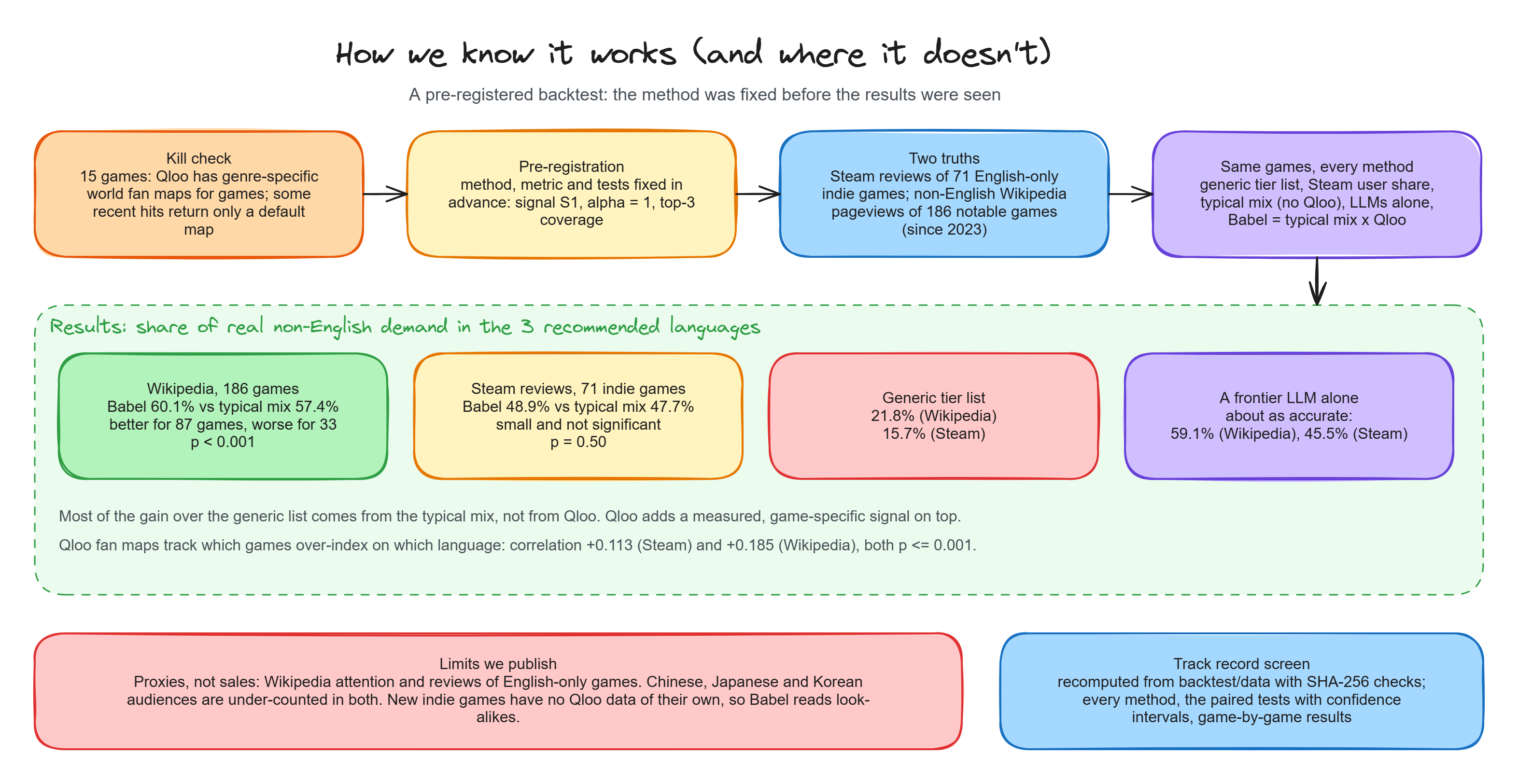
So we stopped tuning. We wrote the test down first: the method, the measure and the pass mark, on 9 October, before any fresh results existed (pre-registration). Then we ran it once, on 257 real games, with two independent measures of where a game's non-English audience really is.
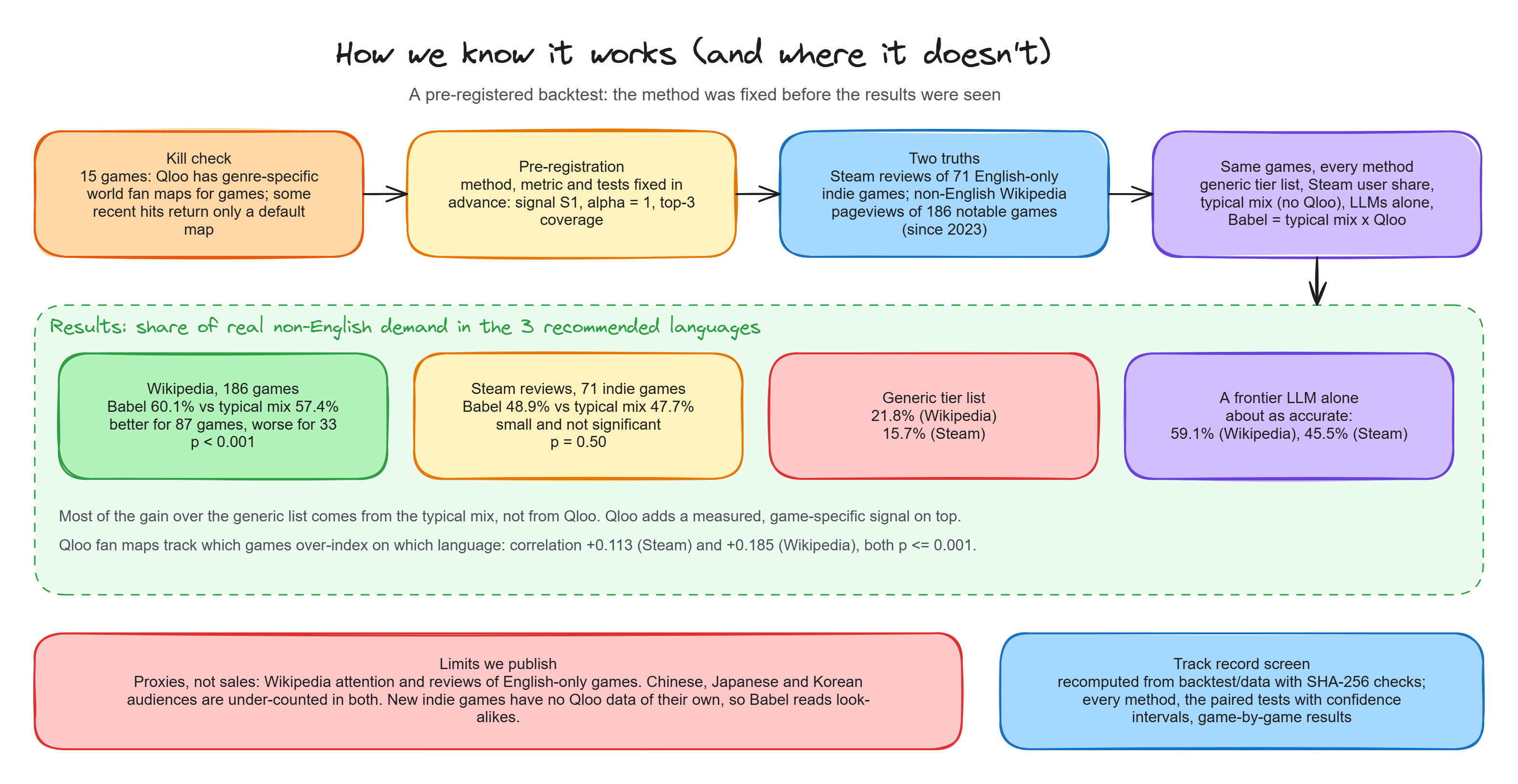
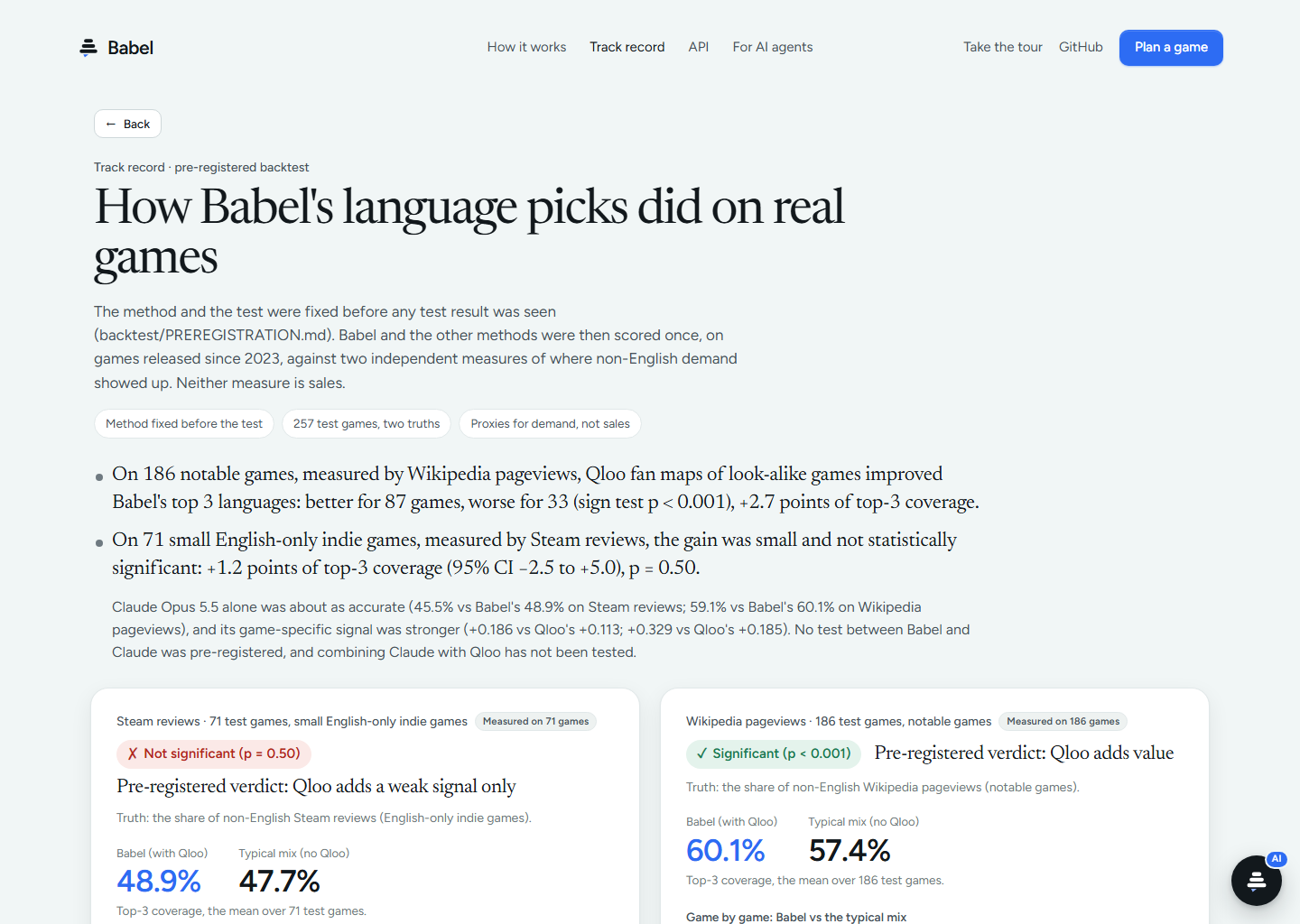
- 186 notable games released since 2023, measured by Wikipedia pageviews in 13 languages: Qloo fan maps of look-alike games improved Babel's top 3 languages. The pick was better for 87 games and worse for 33 (p < 0.001), +2.7 points of coverage.
- 71 small English-only indie games, measured by Steam reviews: the gain was small and not significant (+1.2 points, p = 0.50). Qloo's signal still tracked which games lean toward which language (p = 0.001).
- In context: Babel's top 3 captured 60% of these games' non-English Wikipedia attention, against 22% for the copy-pasted list. Most of that gap comes from using real language data at all, not from Qloo, and this measure under-counts Chinese, Japanese and Korean readers.
- Qloo on its own scored about 26%. Taste data works best as an adjustment, not as an oracle.
- A frontier LLM on its own was about as accurate. So we let the LLM read and explain, and use Qloo for evidence you can inspect on a map.
All of this lives in the app's Track record screen, recomputed from the frozen data files every time.
We're also proud that:
- Every number on screen comes from code, and "Why?" traces it back step by step.
- It works for a game that doesn't exist yet. Describe it in a paragraph and you get a plan.
- Another agent can call it over MCP and get the same plan the web app shows.
What we learned
- Taste data is strongest as an adjustment on top of a solid baseline, not as an oracle. Ranking by Qloo alone did poorly; multiplying it into the typical mix is what worked.
- The honest version of a result is more useful than the impressive one. Writing down what we'd claim before seeing the numbers changed how we built the whole product.
- When money is involved, people want the reason more than the answer. The "Why?" button ended up at the centre of the app.
What's next for Babel
Babel is for solo developers and small studios on Steam, deciding where their first few thousand dollars of localization should go. Two other groups could use it too: small publishers planning translations for a whole slate of games each year, and translation agencies, who could hand a Babel report to a studio as the start of a quote.
Next:
- Regional variants: Latin American vs European Spanish, Brazilian vs European Portuguese
- Real translator quotes instead of example per-word rates
- Testing an LLM + Qloo combination, which we haven't evaluated yet
- Re-running the backtest as new games launch and Qloo's data grows
A big thank-you to Qloo, for the API and for running this hackathon. Babel only knows where the fans are because of your data.
Built With
- anthropic-api
- css3
- d3.js
- docker
- fastapi
- html5
- javascript
- mcp
- openstreetmap
- pytest
- python
- qloo
- railway
- server-sent-events
- steam
- steamspy
- wikidata
- wikipedia


Log in or sign up for Devpost to join the conversation.