-
Project Demo
Inspiration
The inspiration for AutoAlert came from a real-life incident. While travelling to college, I saw an ambulance stuck in heavy traffic with a critical patient inside. There was no clear way for the ambulance to move, and I felt helpless watching the situation. As an engineering student, instead of only feeling bad about it, I started asking myself: “Can technology help detect emergencies and get help faster?”
That question became the starting point for AutoAlert.
What it does
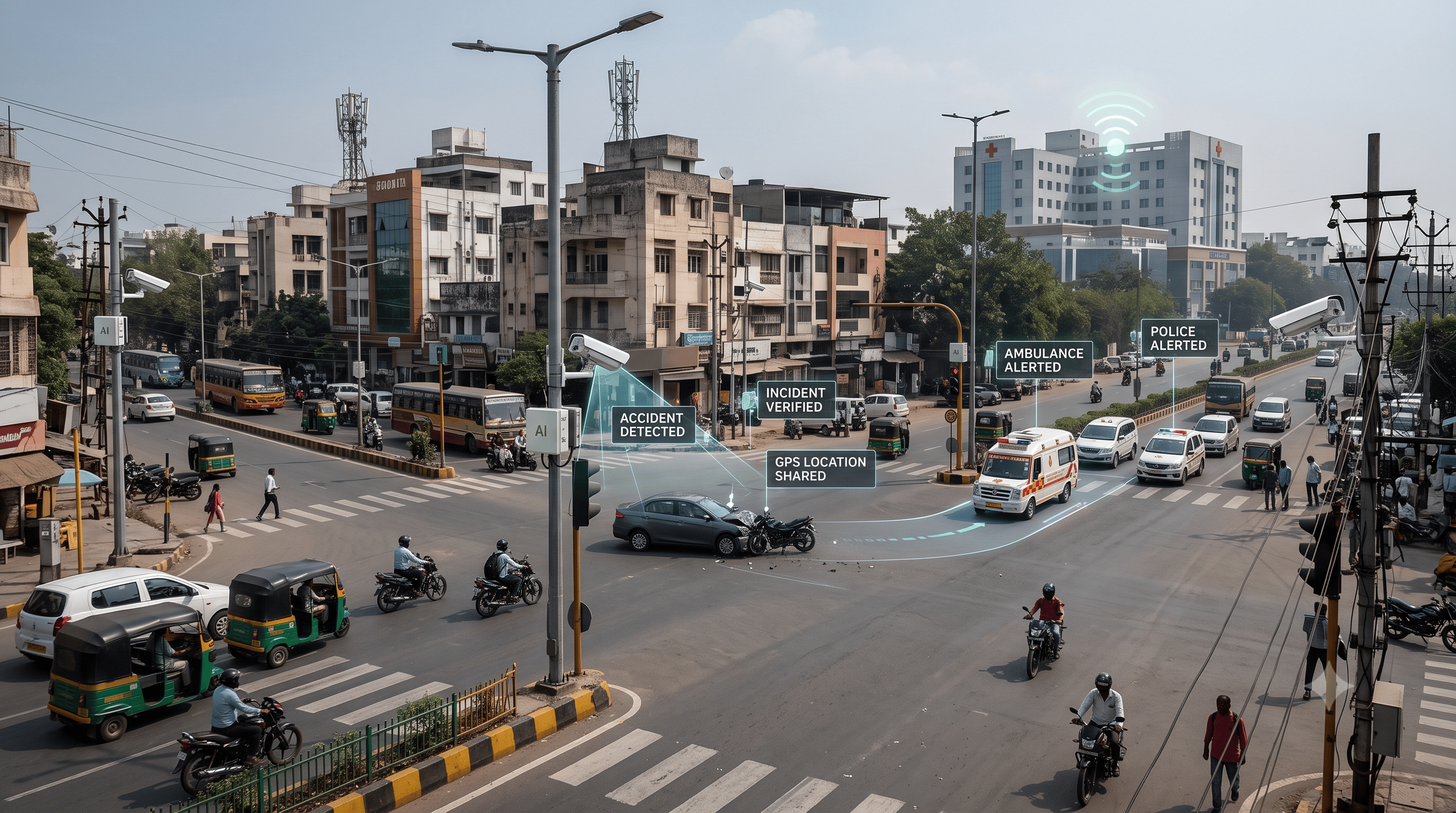
AutoAlert transforms existing CCTV cameras into intelligent emergency-response systems. An AI Box connected to a CCTV camera continuously analyzes its feed and detects events such as vehicle crashes, people lying motionless, blood, smoke, or fire.
After verifying an incident, the system can automatically alert the nearest ambulance and police, share the camera's GPS location, and upload a video clip of the incident for responders.
How we built it
Our concept is designed around existing CCTV infrastructure, so cities do not need to replace their current cameras.
We designed a small, weatherproof AI Box that sits beside an existing CCTV camera. It contains a mini computer for AI processing, SIM module for calls/SMS, GPS for location, microphone for crash sounds, storage for incident footage, and battery backup.
The basic workflow is:
CCTV → AI Detection → Verification → GPS Location → Emergency Alert → Response
We also envisioned Gemini as the contextual intelligence layer to help analyze suspected incidents and understand what is happening in the scene.
Challenges we ran into
The biggest challenge was balancing speed, accuracy, cost, and scalability.
A false alarm could unnecessarily involve emergency services, while missing a real accident could have serious consequences. We therefore included an incident-verification step before triggering an emergency alert.
Another challenge was making the system practical for cities. Instead of replacing existing CCTV cameras—which would be expensive and time-consuming—we designed AutoAlert as an add-on system.
Accomplishments that we're proud of
We are proud of turning a real-world problem into a practical smart-city concept.
Our biggest achievement is the idea of upgrading existing CCTV infrastructure instead of building an entirely new network. This makes AutoAlert potentially more affordable and scalable, while giving existing cameras an active role in emergency response.
Most importantly, the project is driven by a simple goal: reduce the time between an accident happening and help arriving.
What we learned
We learned that building an impactful AI solution requires more than just developing a model. We have to think about the complete system—hardware, AI, communication, GPS, false alarms, infrastructure, cost, and emergency response.
We also learned that some of the most meaningful technology ideas can begin with a simple observation from everyday life.
What's next for AutoAlert
Our next step is to move from concept to a working prototype. We want to test AutoAlert using real CCTV footage, improve accident detection and verification, integrate Gemini for contextual understanding, and test the AI Box hardware.
We then want to conduct a small pilot with cameras at accident-prone locations, measure detection accuracy and response time, and gradually explore deployment across larger areas. The proposed project already defines pilot-to-city scaling models, beginning with a small number of cameras.
Our long-term vision is simple: make every existing CCTV camera capable of becoming a first responder.
Built With
- ai/ml
- cctv-cameras
- cloud-storage
- computer-vision
- google-gemini
- gps
- gsm/sim-module
- microphone
- raspberry-pi
- sms
- voice

Log in or sign up for Devpost to join the conversation.