Inspiration
Urban freshwater ecosystems affect biodiversity, animal health, recreation, and the well-being of nearby communities. However, professional monitoring is often limited by time, cost, and geographic coverage. Citizens can help close this gap, but their observations may be incomplete, inconsistent, or difficult to interpret.
This inspired me to create AquaSentinel, a platform that transforms citizen stream observations into verified, explainable One Health alerts. My goal was not to replace scientists or laboratory testing, but to help communities recognize possible warning signs earlier and direct expert attention toward locations that may need investigation.
What It Does
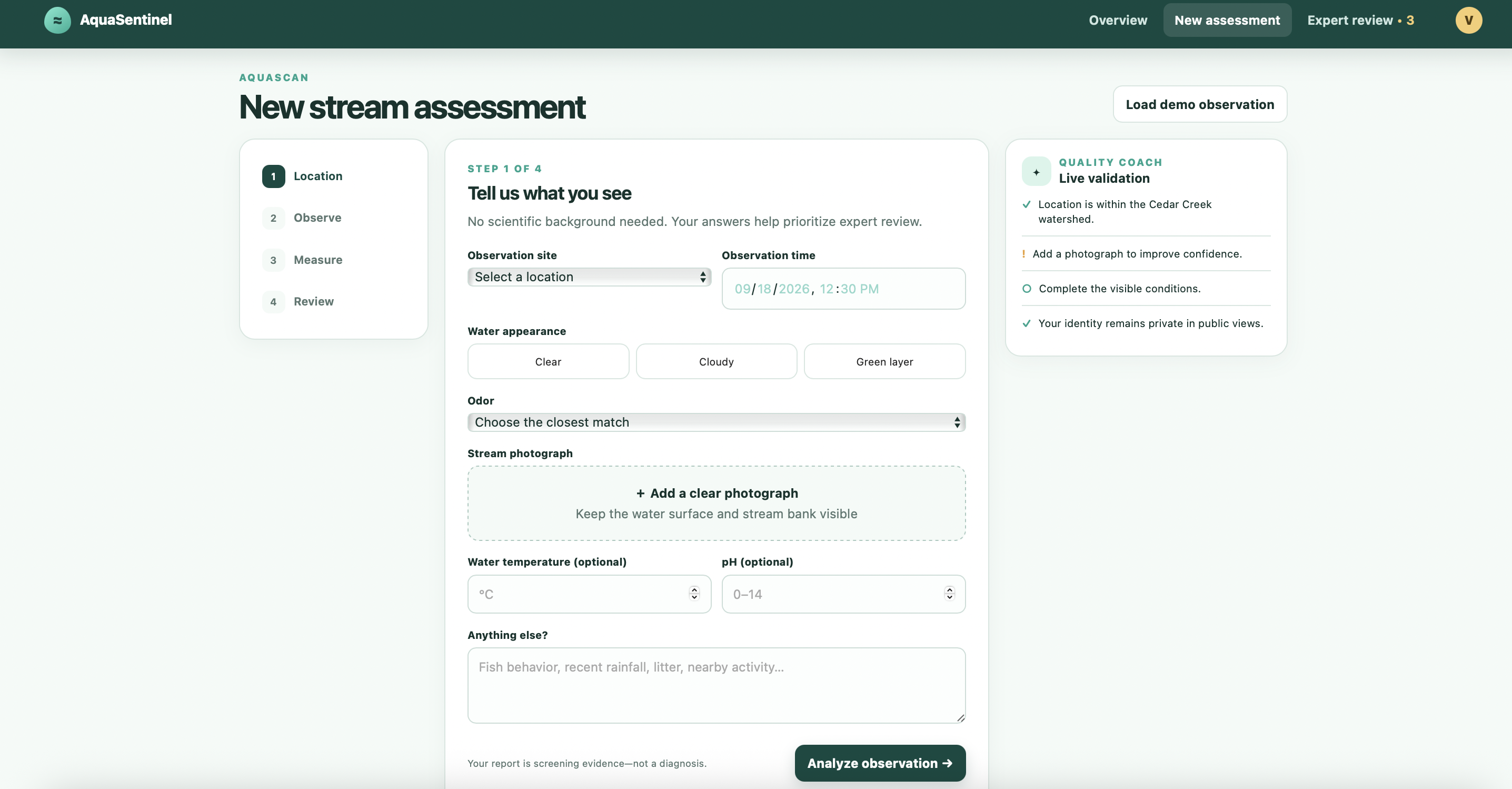
AquaSentinel guides users through a short stream assessment using photographs, location information, visible environmental indicators, and optional water measurements. Its AI Quality Coach identifies missing information, poor-quality images, conflicting responses, and unusual values before an observation is submitted.
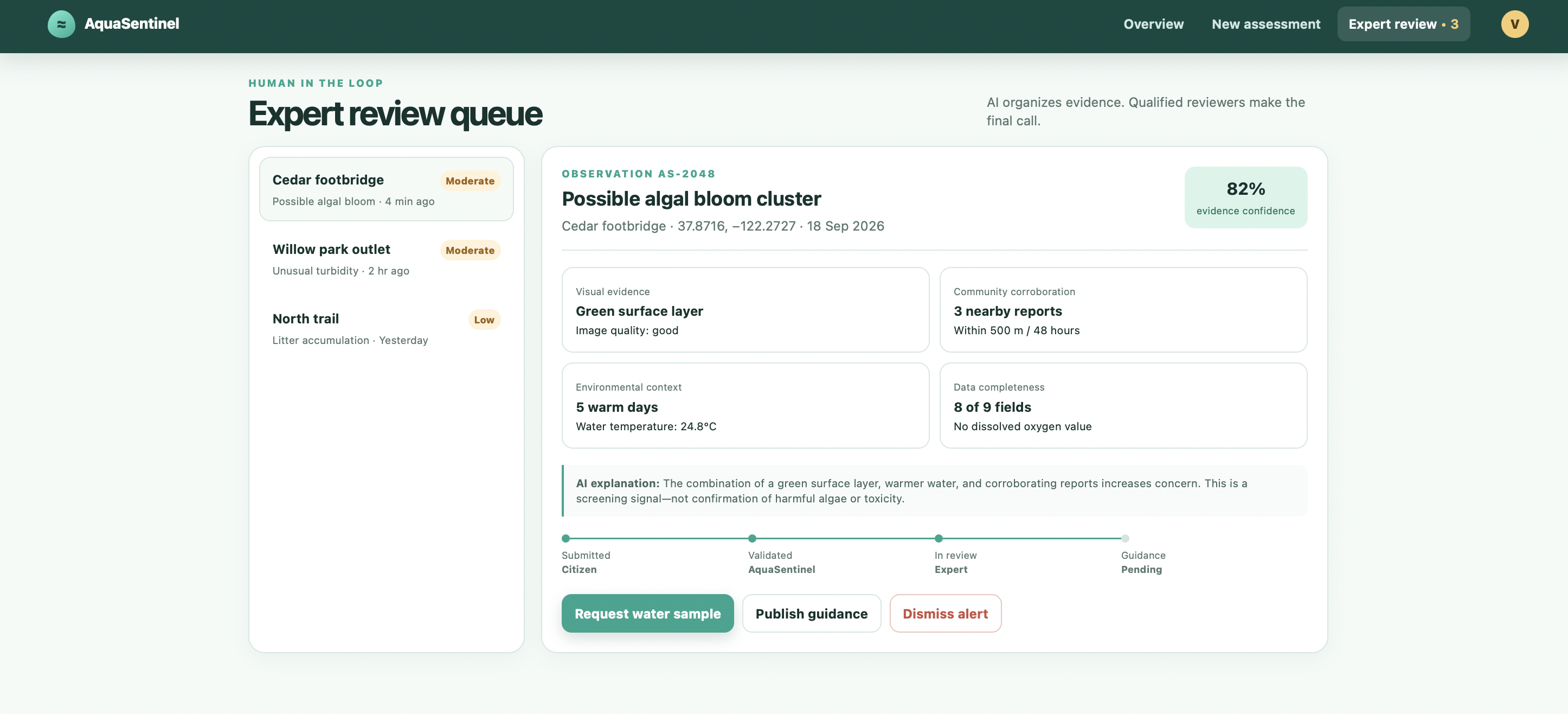
The platform combines the report with nearby observations, historical patterns, and environmental conditions to produce an explainable risk card. Instead of making a definitive diagnosis, AquaSentinel communicates:
- What was observed
- Why the observation may matter
- How confident the system is
- Which environmental, animal, or human-health concerns may require attention
- What action should be taken next
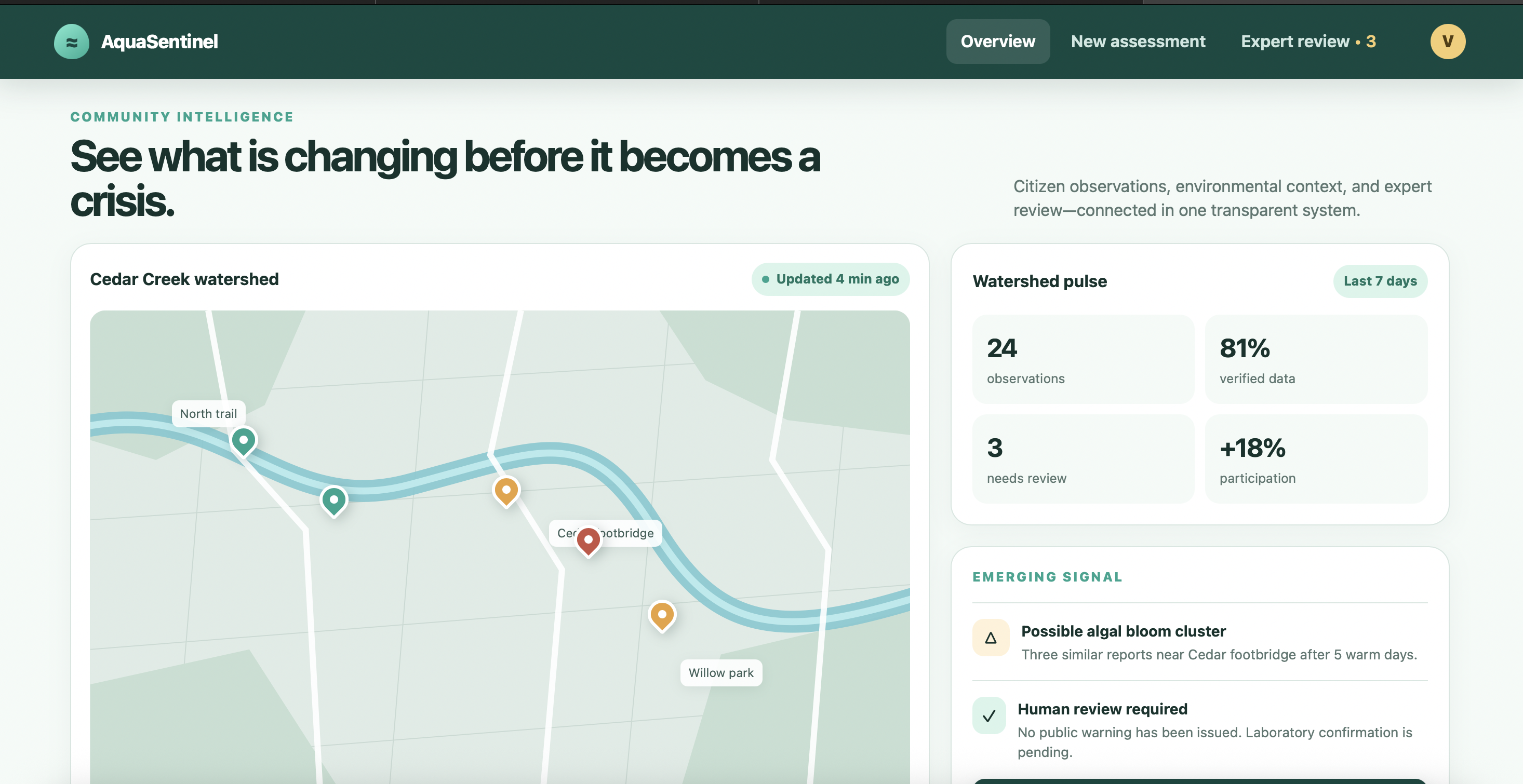
Potential risks appear on a community map and are sent to an expert-review dashboard. Authorized reviewers can verify, revise, or dismiss an alert and publish appropriate guidance. This creates a closed-loop process from community observation to responsible action.
How I Built It
I designed AquaSentinel as a modular platform with four main components: a guided citizen-reporting interface, an AI-assisted validation layer, an explainable risk engine, and a community-monitoring dashboard.
The interface simplifies ecological terminology and guides participants through each assessment step. The validation layer checks image quality, report completeness, inconsistent answers, and potentially abnormal observations. The risk engine uses transparent, rule-based logic to combine visual evidence, reported conditions, environmental context, geographic clustering, and changes over time. AI supports data interpretation and explains results in accessible language rather than issuing unverified diagnoses.
Each submission also receives a confidence passport describing its source, completeness, image quality, supporting evidence, AI confidence, and human-verification status. The dashboard displays observation clusters and trends while preserving the evidence behind every alert. I also designed the data structure with interoperability in mind so observations could eventually be exchanged with research, environmental, and digital-health systems.
Challenges I Faced
My biggest challenge was balancing early detection with responsible communication. A photograph or citizen report cannot confirm contamination, so I needed to avoid presenting uncertain findings as scientific conclusions. I addressed this by displaying confidence levels, explaining the evidence behind every result, and requiring human review before an alert becomes verified public guidance.
Another challenge was accounting for incomplete and inconsistent citizen-generated data. Users may interpret environmental conditions differently or submit unclear images. The AI Quality Coach improves submissions at the point of collection by requesting corrections instead of silently altering users’ responses.
I also had to translate complex environmental information into language community members could understand without oversimplifying it. Separating ecological, animal-health, and human-exposure concerns helped me communicate the One Health relationship more clearly.
What I Learned
I learned that effective environmental technology depends on trust as much as technical capability. People need to understand why a system flagged an observation, what evidence supports it, and where uncertainty remains.
I also learned that citizen science becomes more valuable when participants receive meaningful feedback. Instead of treating residents only as data collectors, AquaSentinel shows them how their observations contribute to broader community patterns and potential interventions.
Most importantly, I learned that responsible AI should strengthen human judgment rather than replace it. By combining explainable analysis, transparent confidence indicators, community participation, and expert verification, AquaSentinel turns local observations into actionable One Health intelligence while keeping people at the center of every decision.
Built With
- fastapi
- fhir
- github
- hl7
- next.js
- openai
- openstreetmap
- python
- react
- supabase
- typescript
- vercel


Log in or sign up for Devpost to join the conversation.