Inspiration
Freshwater ecosystems are often affected by problems that citizens notice before formal monitoring systems can respond. Changes in water appearance, surface films, algae, floating waste, unusual color, or other visible signs can provide valuable early observations.
However, citizen observations can be subjective, inconsistent, and difficult to interpret. We were inspired to build AquaSafe AI to bridge this gap by using AI to support citizens in turning simple freshwater observations into structured, explainable environmental evidence.
Our goal was not to replace environmental experts with AI, but to create a responsible human-in-the-loop system where AI can assist with assessment, highlight uncertainty, and help experts prioritize observations that need verification.
What it does
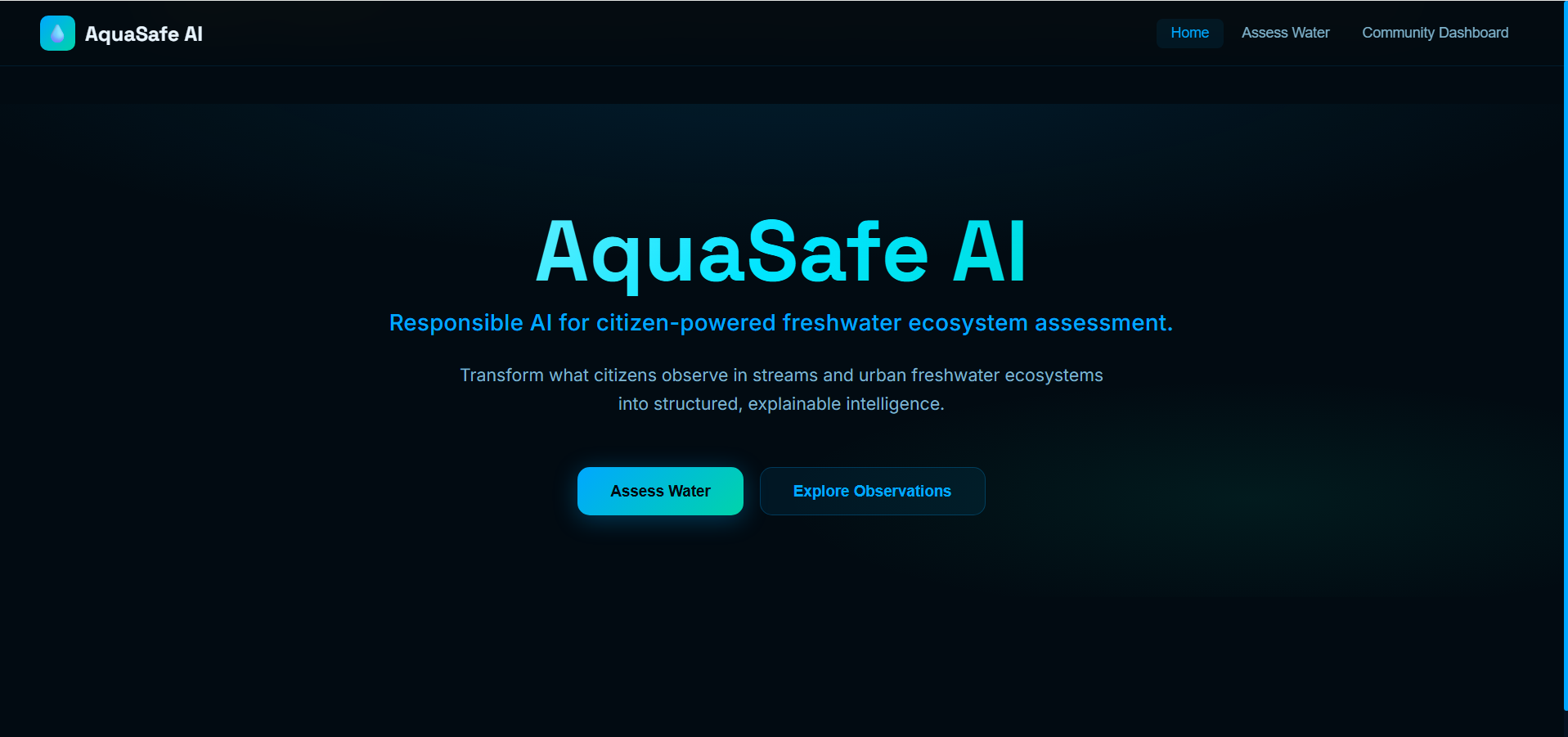
AquaSafe AI is an explainable AI-assisted citizen-science platform for freshwater ecosystem assessment.
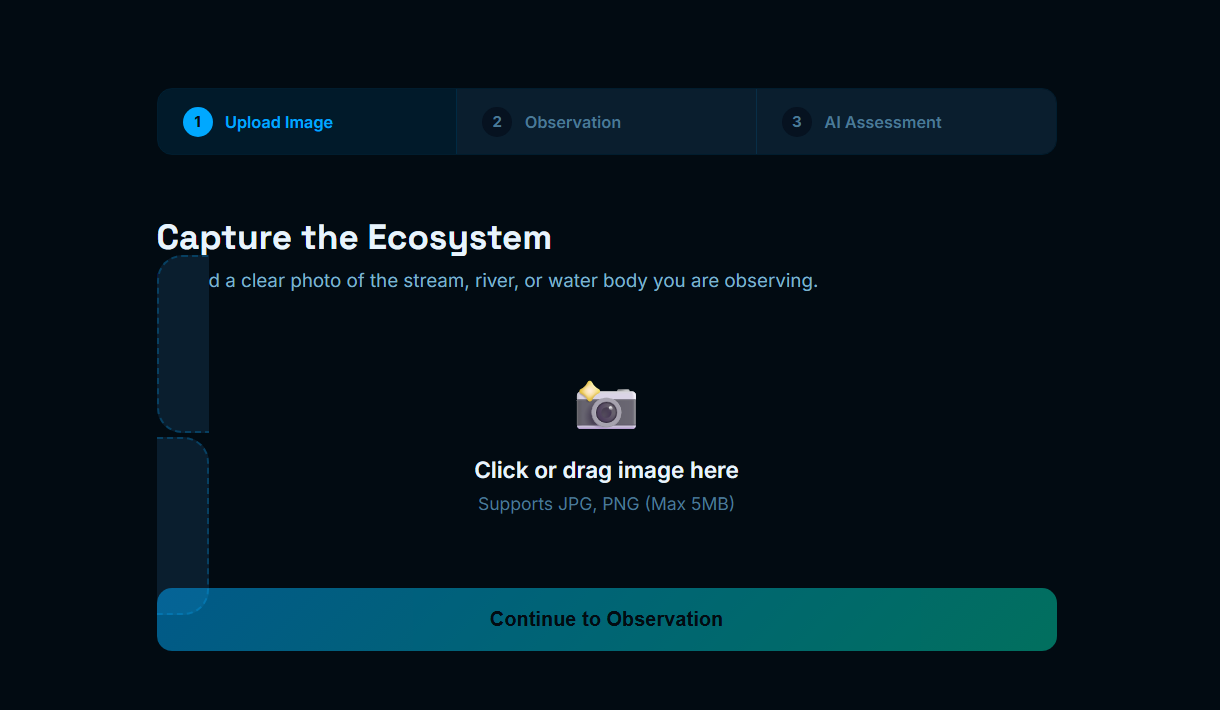
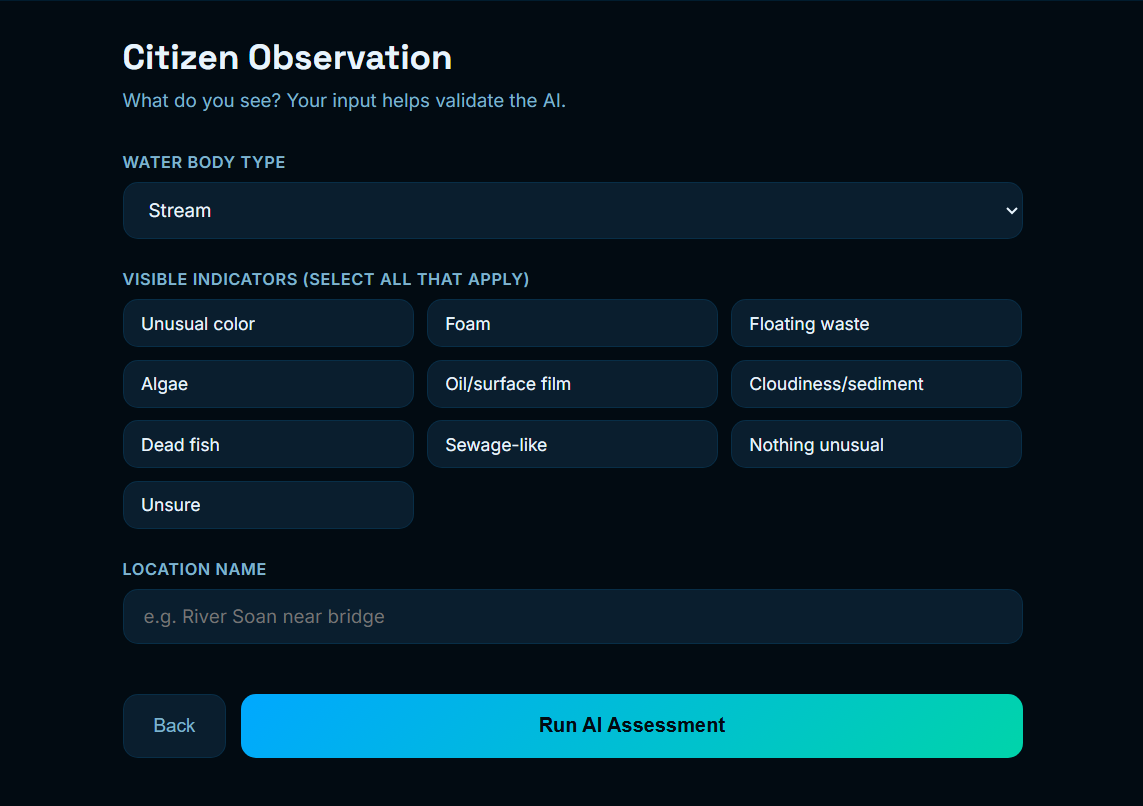
A citizen can submit a water image along with simple observations about what they see. The platform then:
- Validates the submitted image and its quality.
- Uses multimodal AI to analyze visible environmental indicators.
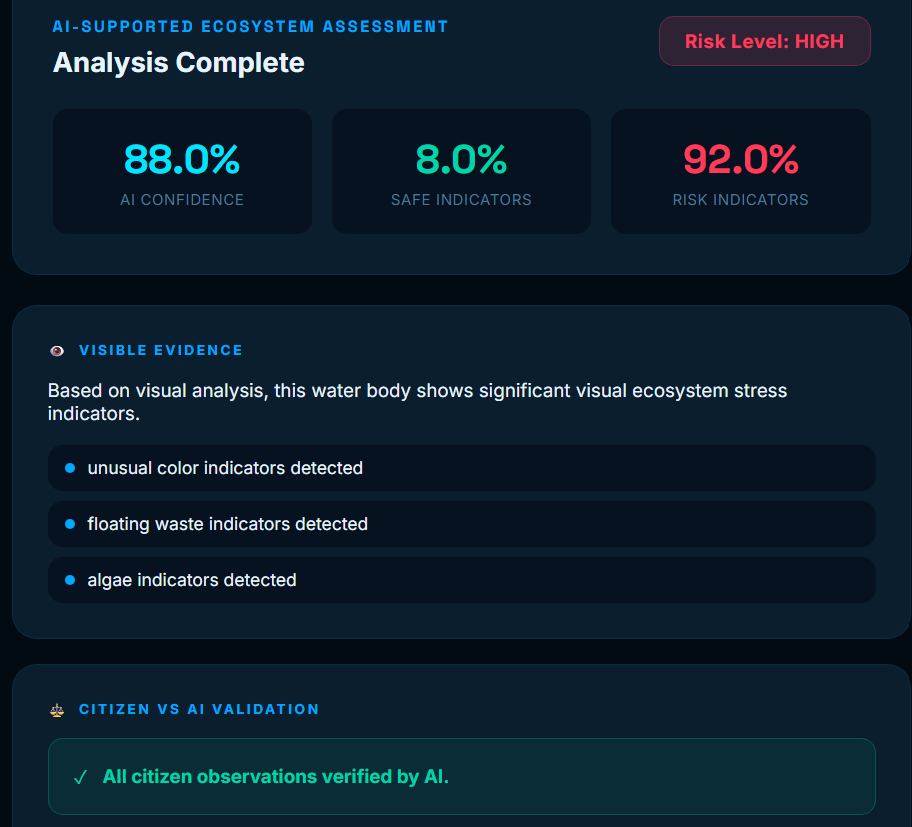
- Produces a structured assessment with a risk level and confidence.
- Explains the visible evidence behind the assessment.
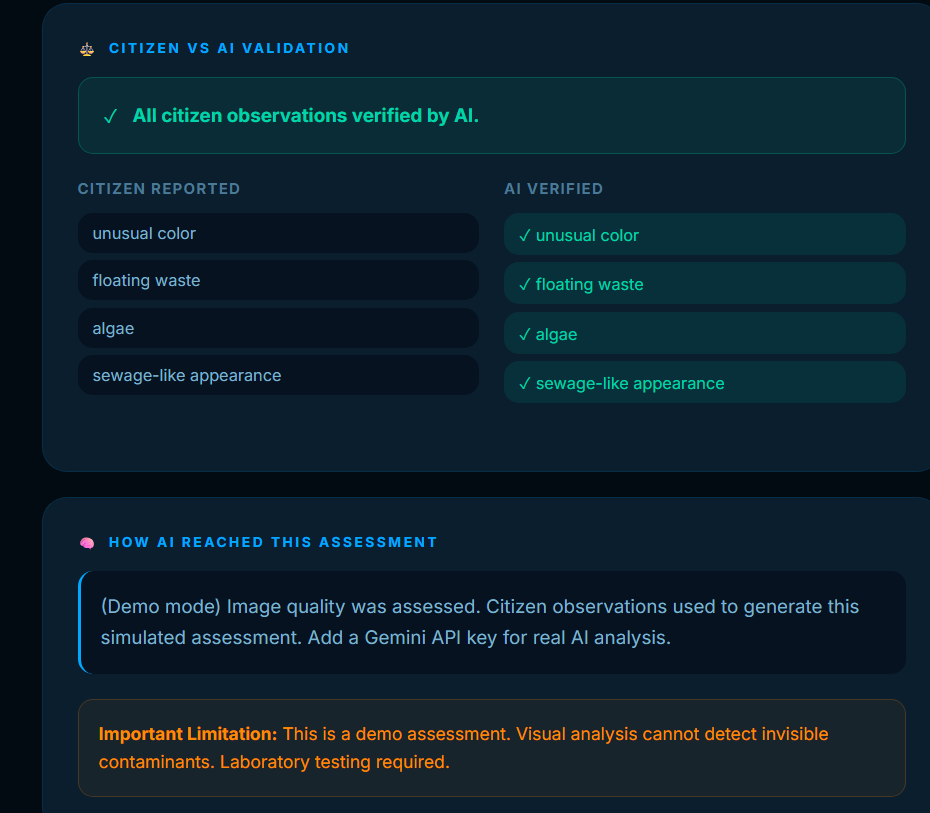
- Compares citizen observations with AI observations and identifies potential mismatches.
- Routes observations into a human verification workflow.
- Generates a cautious One Health-oriented insight connecting ecosystem conditions, aquatic life, and potential human/environmental relevance.
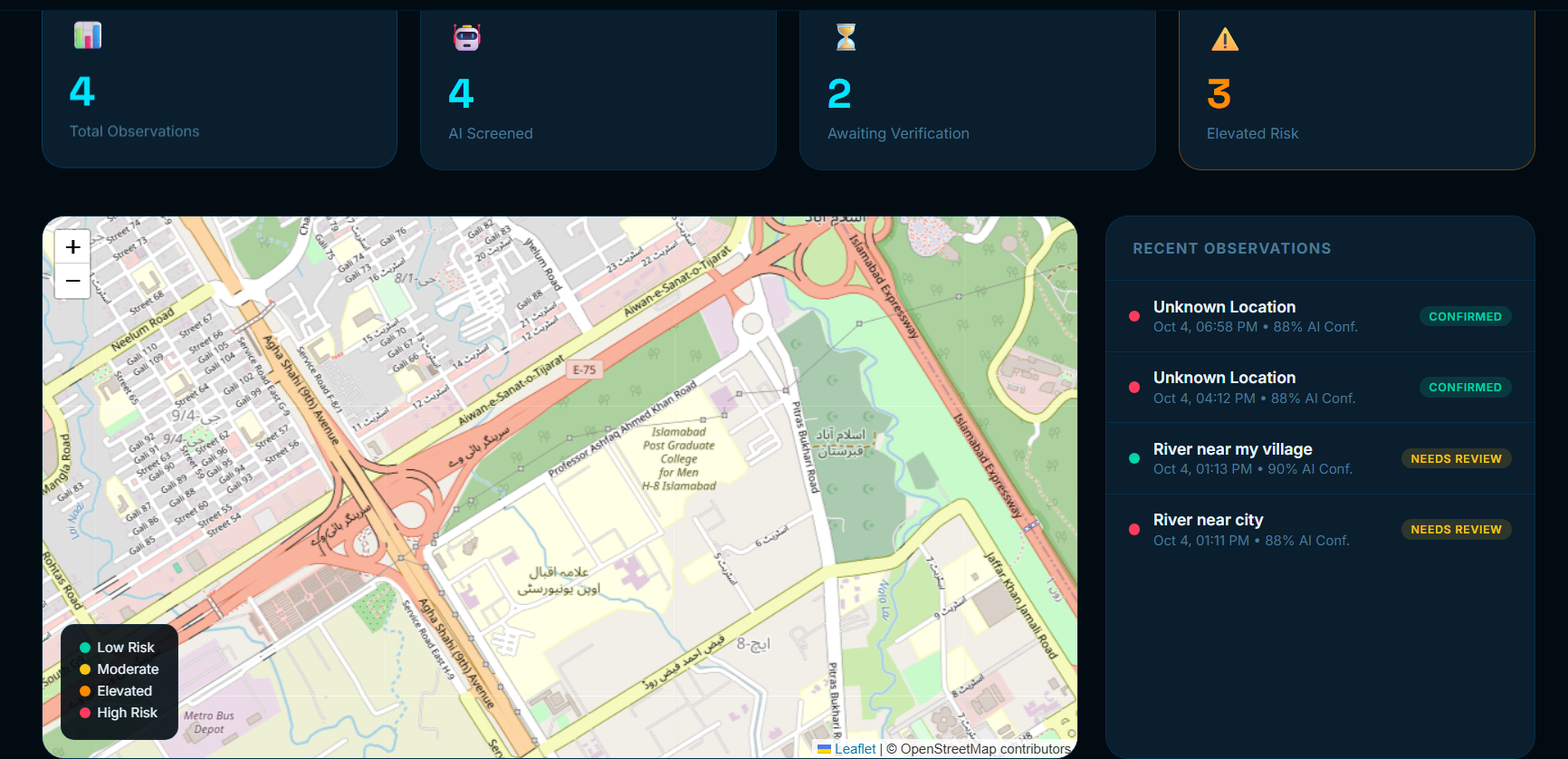
- Aggregates observations into a dashboard to help identify broader patterns.
The system is designed around responsible AI. AquaSafe AI does not claim that an image can determine whether water is safe to drink, and it does not attempt to detect invisible contaminants such as bacteria, viruses, heavy metals, pesticides, pH, or salinity from an image alone.
Instead, it focuses on visible ecosystem indicators and recommends human or field verification when further investigation is needed.
Primary Hackathon Track: Track 3 AI-Supported Assessment
How we built it
AquaSafe AI combines computer vision/image validation, multimodal AI, structured outputs, validation logic, and a human-in-the-loop workflow.
The core assessment pipeline is:
Citizen Observation -> Image Validation-> AI Assessment -> Explainable Results -> Citizen/AI Validation -> Human Verification -> One Health Insight
The AI assessment uses multimodal analysis to identify visible environmental indicators from submitted images. Structured outputs allow the application to consistently represent information such as:
- Risk level
- Confidence
- Image quality
- Visible evidence
- AI observations
- Explanation
- Uncertainty and limitations
- Recommended next action
The application is built around a modular architecture so that individual AI assessments can later be aggregated into larger-scale ecosystem monitoring and resilience workflows.
We also designed the interface around a simple citizen-science experience so that users do not need specialized environmental knowledge to submit an observation.
Challenges we ran into
One of the biggest challenges was determining how to use AI responsibly in environmental assessment.
A water image can contain useful visual information, but it cannot reveal every factor that determines actual water quality. We therefore had to carefully define what the AI should and should not claim.
Another challenge was making AI results understandable to non-technical users. Instead of presenting a prediction as an unexplained answer, we focused on showing the visible evidence, confidence, image quality, limitations, and recommended next action.
We also wanted to avoid creating a system where AI automatically makes environmental decisions. This led us to introduce a human verification stage, where AI acts as an assistant and environmental observations can be reviewed before being treated as verified evidence.
Finally, we had to balance a meaningful technical architecture with a simple user experience suitable for citizen science.
Accomplishments that we're proud of
We are proud of turning a simple water-image analysis concept into a broader AI-assisted citizen-science workflow.
Our strongest accomplishment is the human-in-the-loop design. Instead of treating an AI prediction as the final answer, AquaSafe AI creates a workflow where observations can move from:
AI Screened → Awaiting Human Verification → Confirmed / Requires Further Testing / Dismissed
We are also proud of the explainability layer. Users can see not only an assessment, but also the visible evidence, confidence, image quality, limitations, and recommended next action.
Another accomplishment is connecting individual observations to a broader ecosystem perspective through dashboard-based aggregation and pattern identification.
Most importantly, we designed AquaSafe AI around the principle that AI should support environmental experts and citizen scientists, not replace human judgment.
What we learned
We learned that building responsible AI is not only about improving model predictions. It is equally about communicating uncertainty, defining limitations, validating observations, and designing appropriate human oversight.
We also learned that citizen science becomes more valuable when raw observations can be transformed into structured and understandable information.
From a technical perspective, we learned how multimodal AI can be integrated into an application through structured outputs and validation workflows rather than simply returning free-form text.
The project also reinforced the importance of designing for the real user. A powerful AI model is not enough if citizens cannot easily understand what to submit, what the result means, or what they should do next.
What's next for AquaSafe AI
Our next goal is to expand AquaSafe AI from individual AI-assisted assessments into a larger freshwater monitoring and resilience platform.
Future development could include:
- Larger-scale community observation networks
- More robust geographic mapping and temporal trend analysis
- Improved environmental expert review workflows
- Integration with field-testing and sensor data
- More advanced anomaly and emerging-pattern detection
- Interoperability with environmental and health data systems
- Multilingual and accessibility-focused citizen experiences
- Long-term monitoring of freshwater ecosystem changes
Ultimately, we envision AquaSafe AI as a bridge between citizens, AI, environmental experts, and One Health decision-making.
Our vision is simple:
Turn everyday freshwater observations into explainable evidence that humans can verify and act upon.

Log in or sign up for Devpost to join the conversation.