Inspiration
Water data is public, but it is scattered: different agencies, formats and languages. A citizen, a journalist or a local officer cannot simply ask it a question. And when an AI answers instead, nobody can tell whether the numbers are real.
We wanted the opposite of a confident chatbot: an assistant that shows its evidence, checks its own numbers and knows when to stop. That is the One Health spirit applied to data: decisions about water, people and ecosystems should rest on traceable facts, with the human judgment left to the humans who are responsible for it.
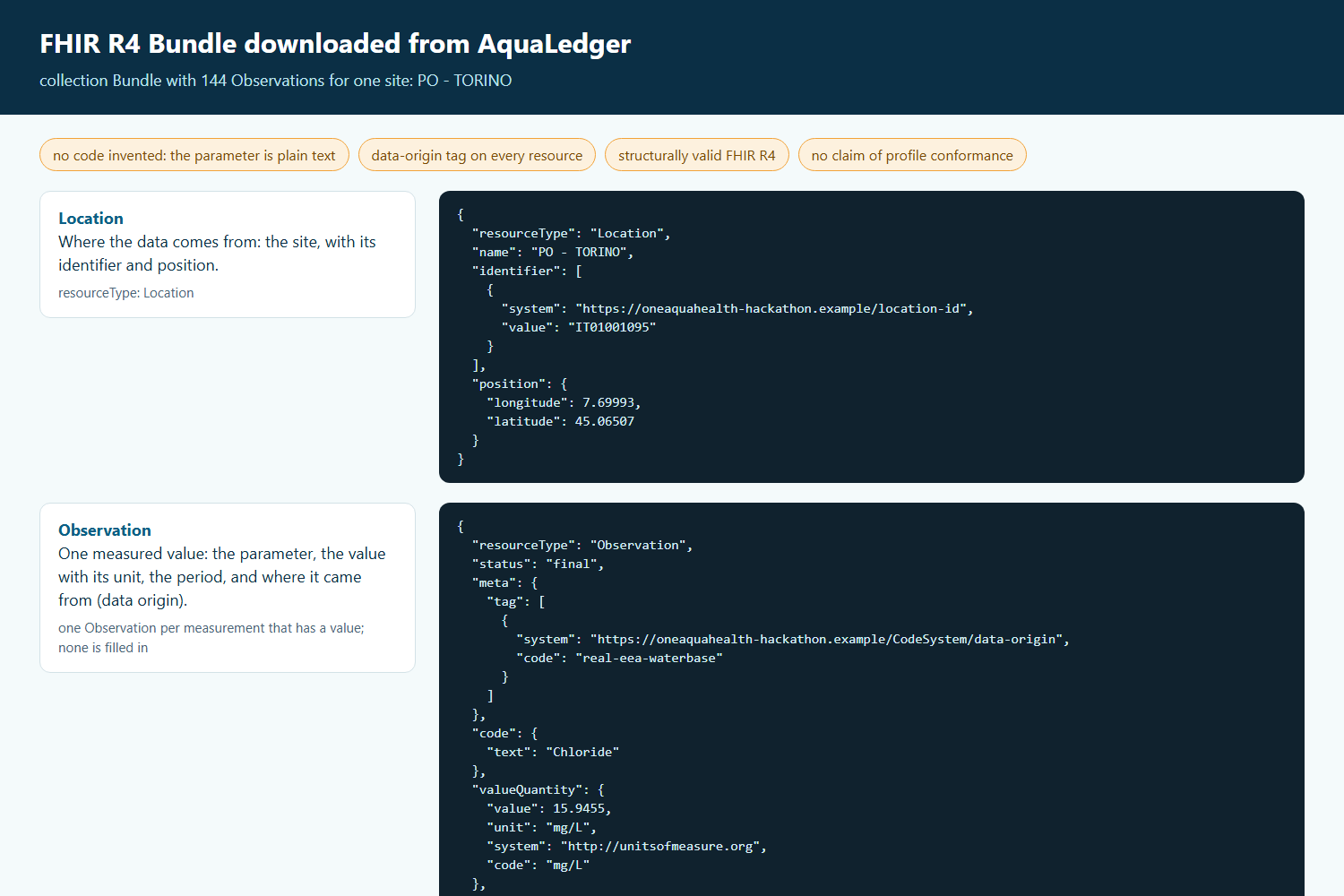
Track 7: Digital Health Standards. AquaLedger puts standards on the way in (the public HL7 Europe OneAquaHealth sandbox is read as FHIR R4) and on the way out (the measurements of any site download as a FHIR R4 Bundle), with an AI agent on top.
What it does
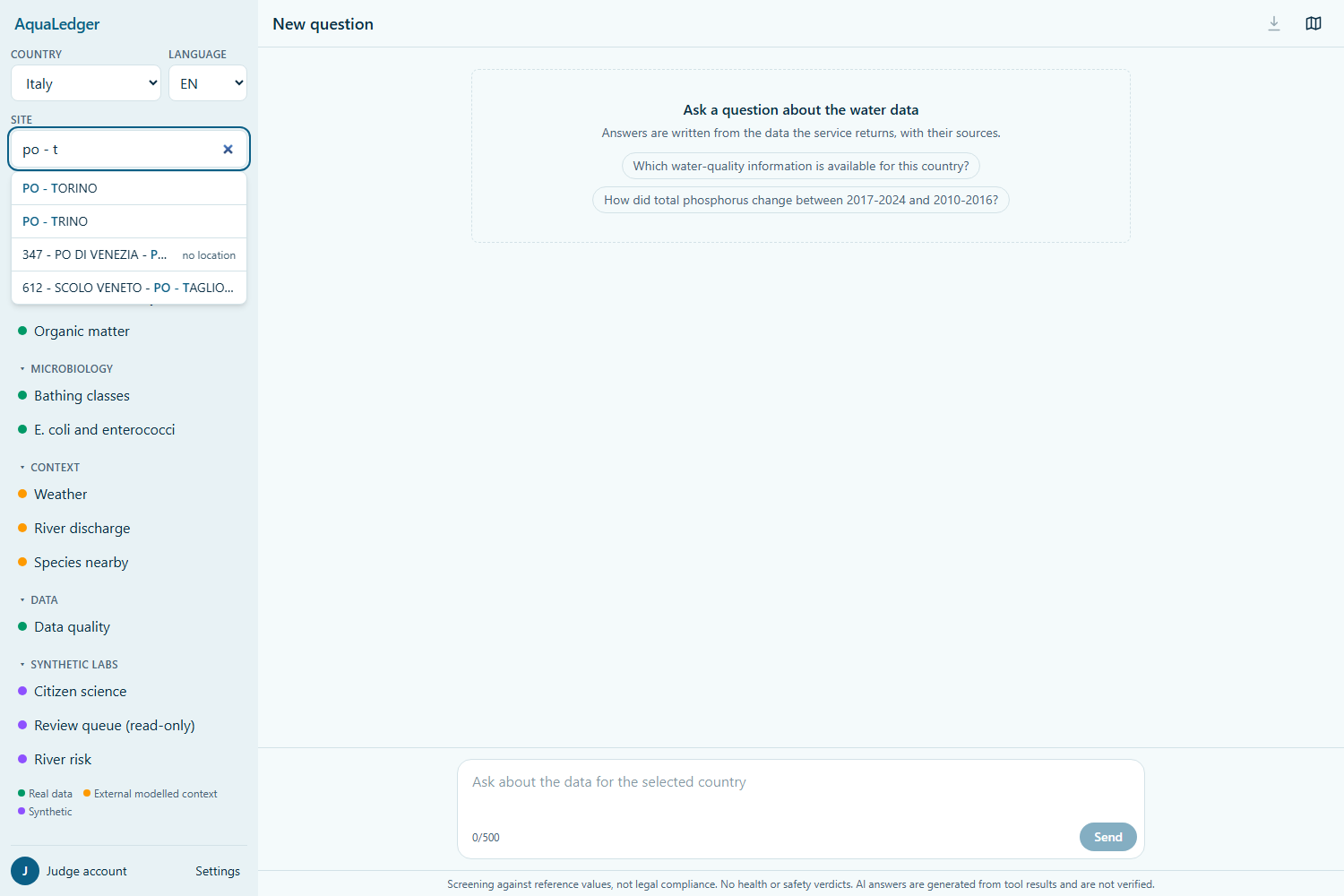
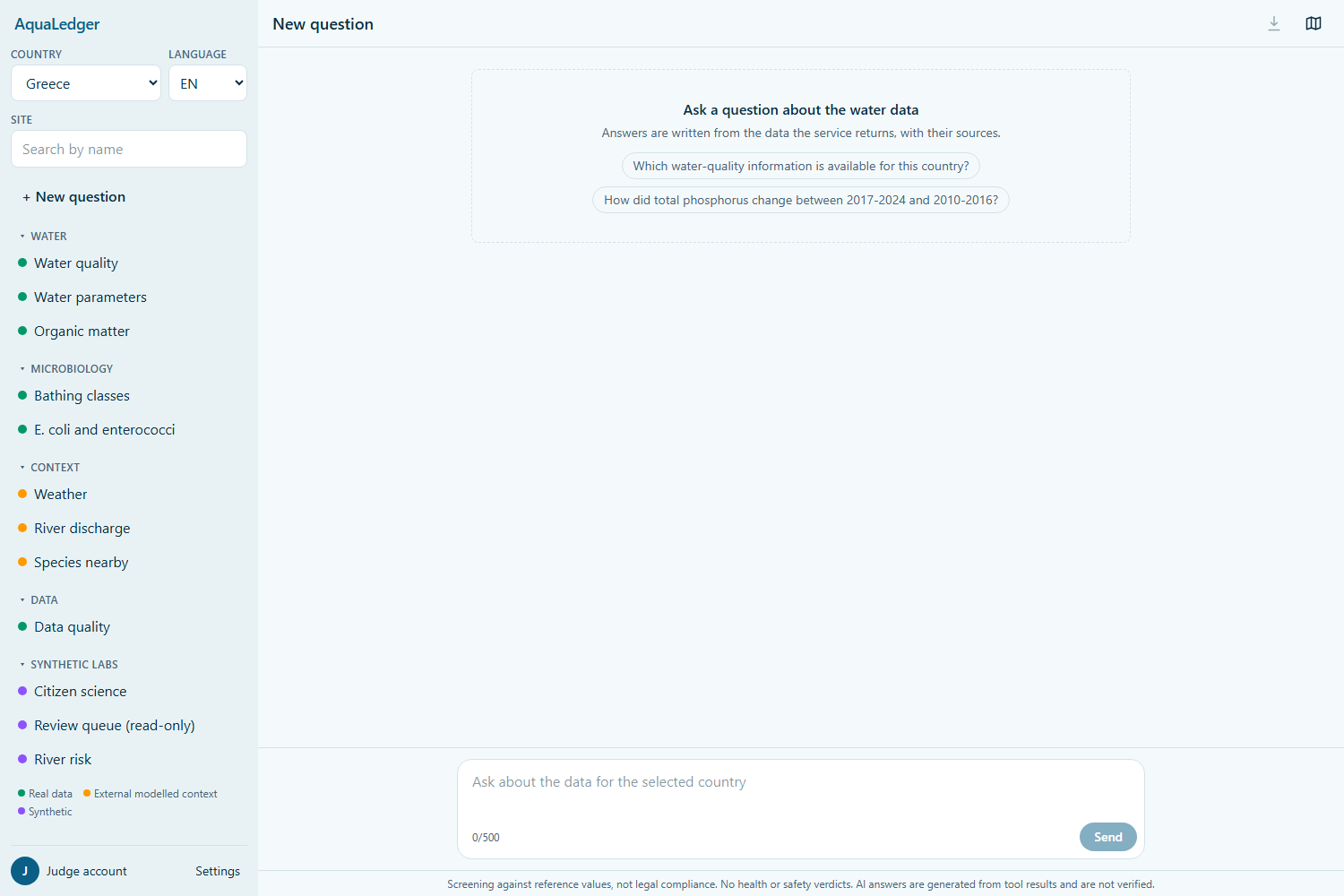
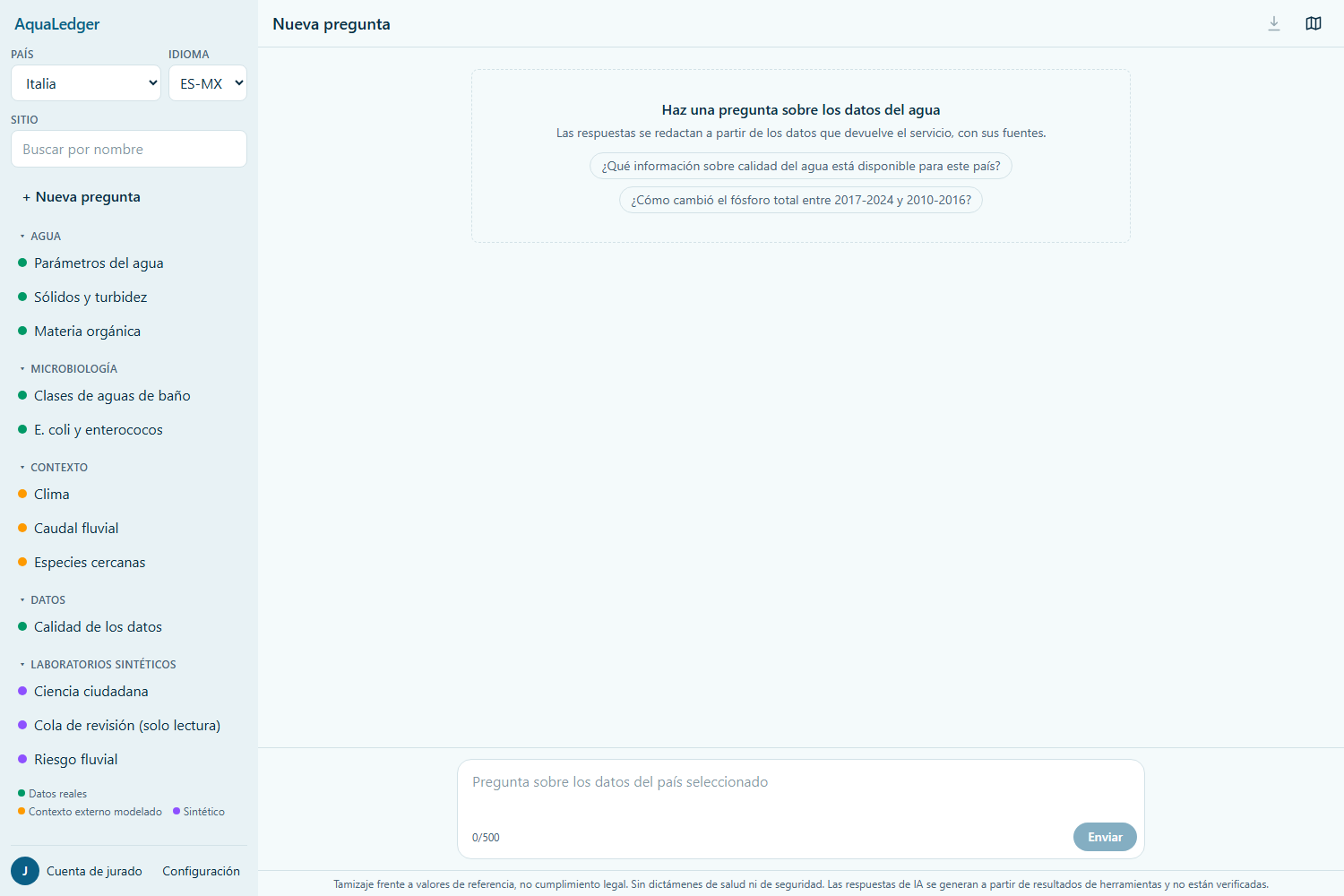
Ask a plain question about the rivers, lakes and bathing waters of Greece, Italy and Norway, in 26 languages, and get an answer written only from the European data the agent retrieved:
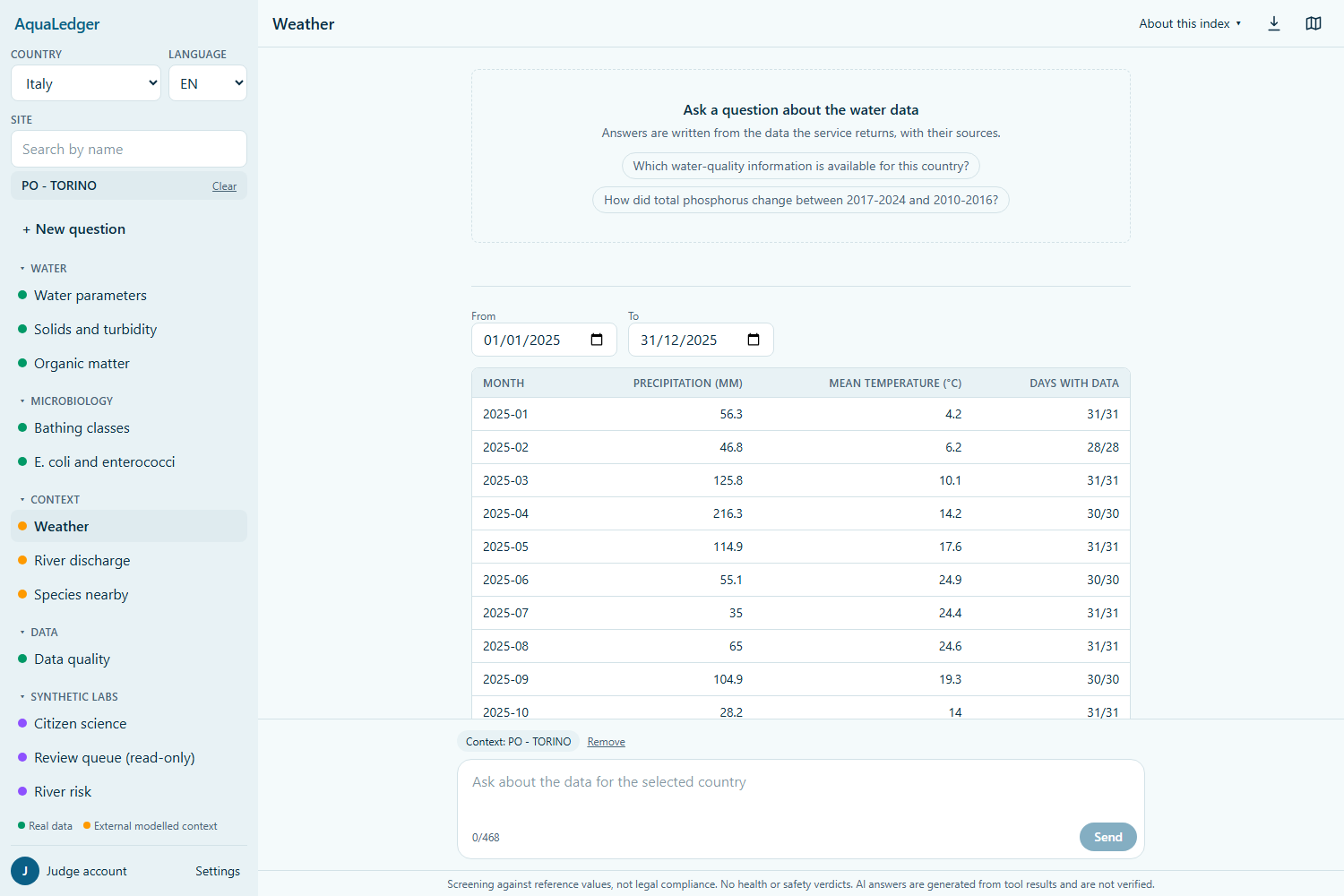
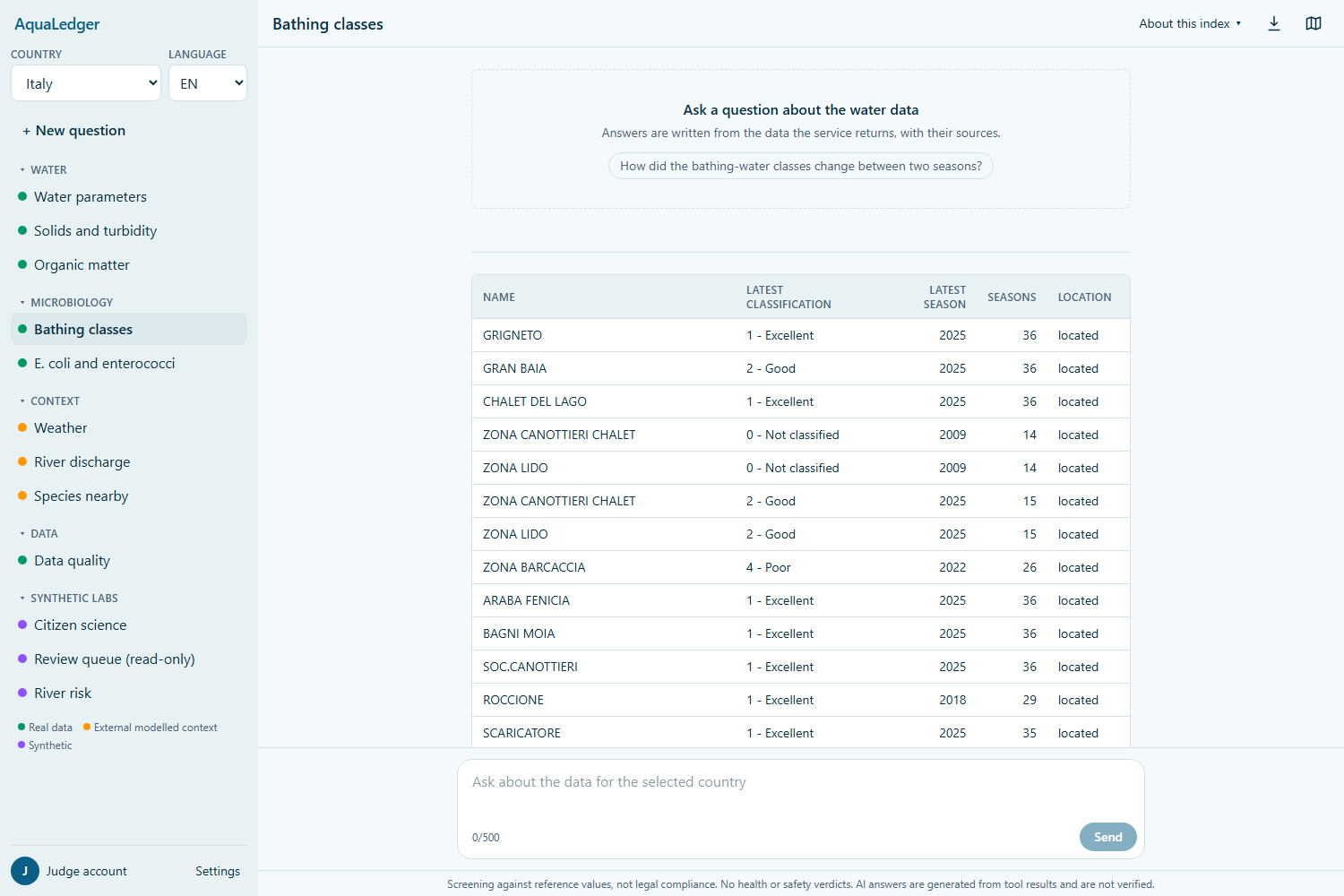
- EEA Waterbase (river and lake measurements), the EEA Bathing Water Directive classifications and individual E. coli and enterococci samples, and the HL7 Europe sandbox. Modelled context (weather, river discharge, species records) is shown, always labelled as modelled.
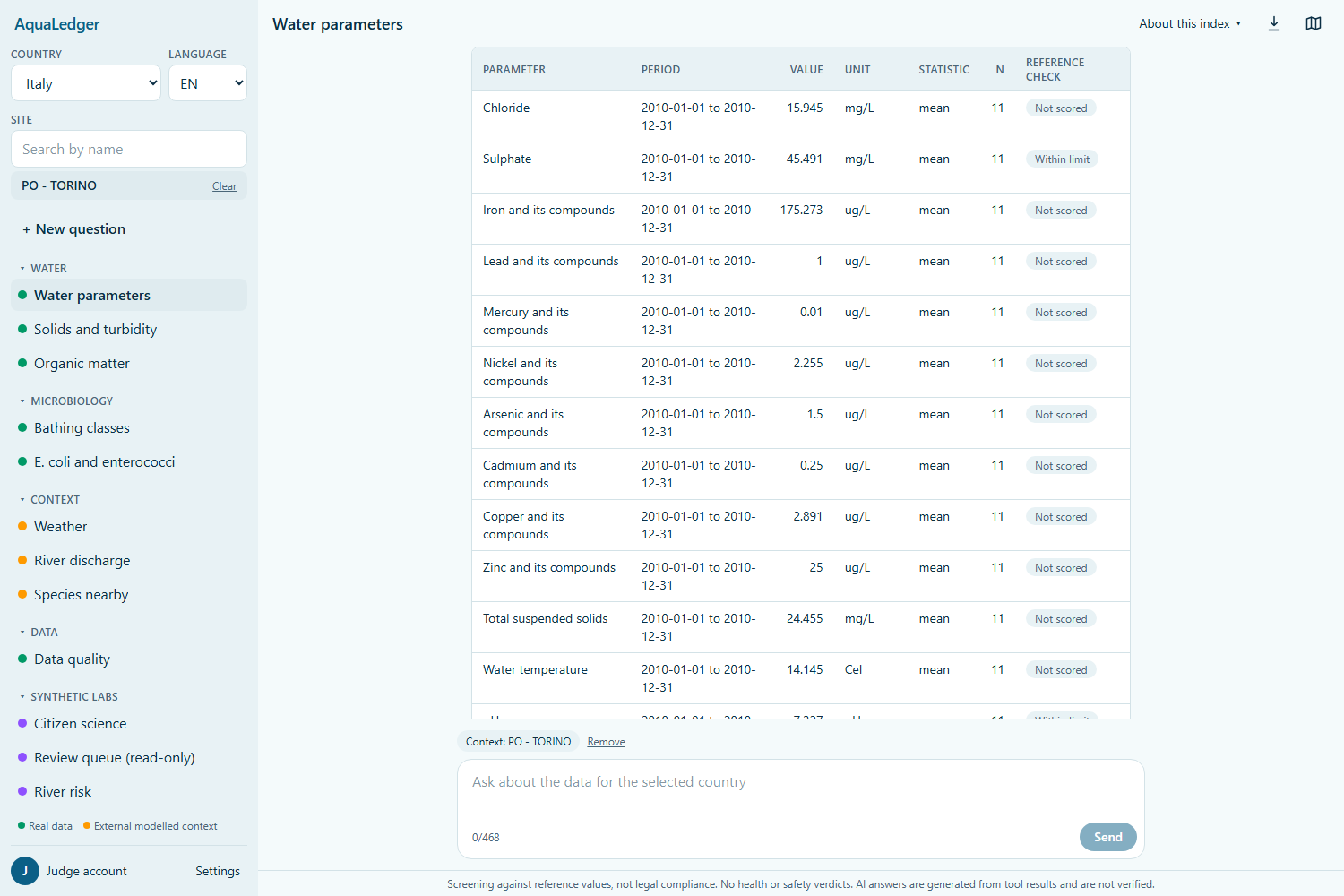
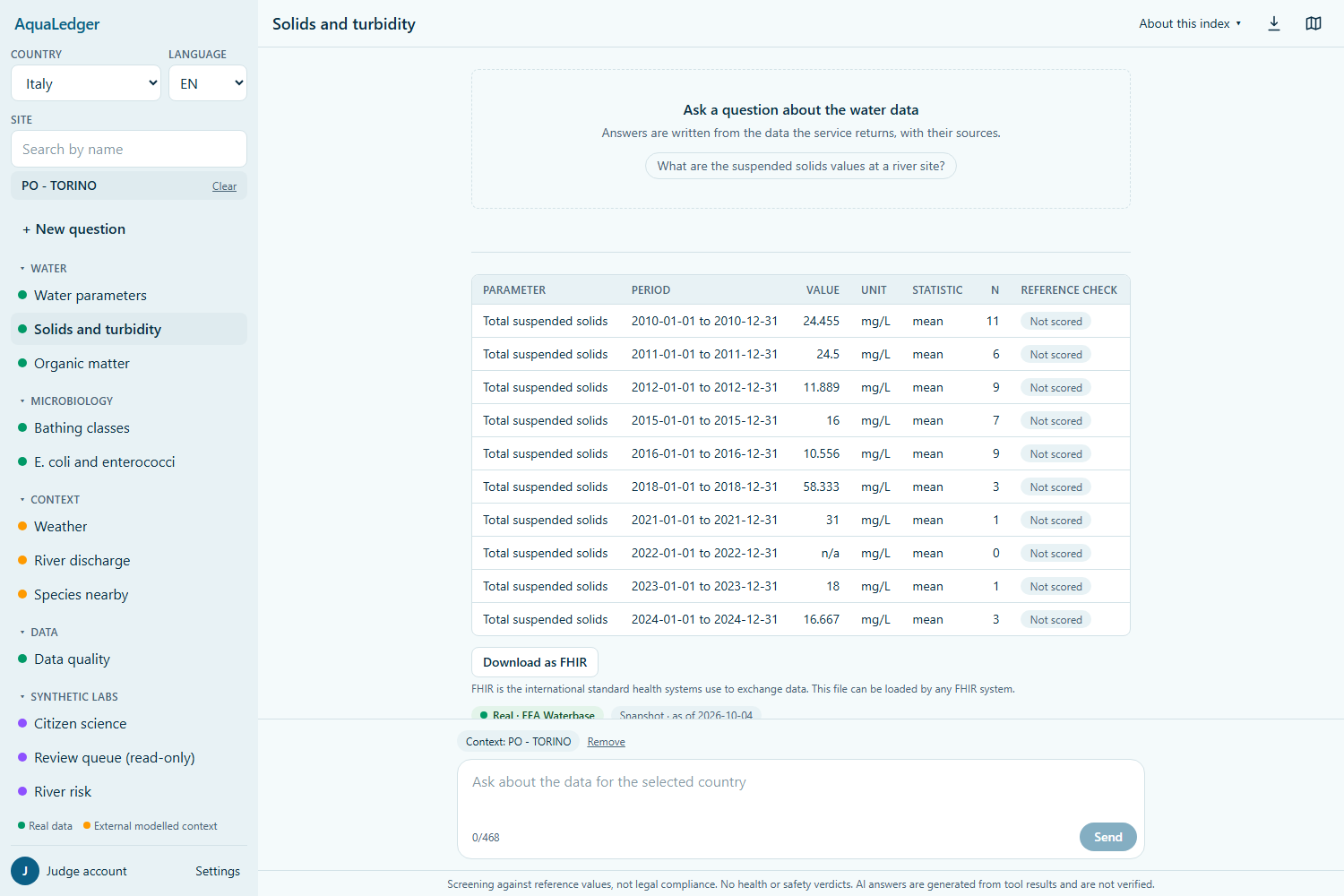
- Every answer carries its sources, licence, method and the reference values used, labelled as screening aids, never as legal limits.
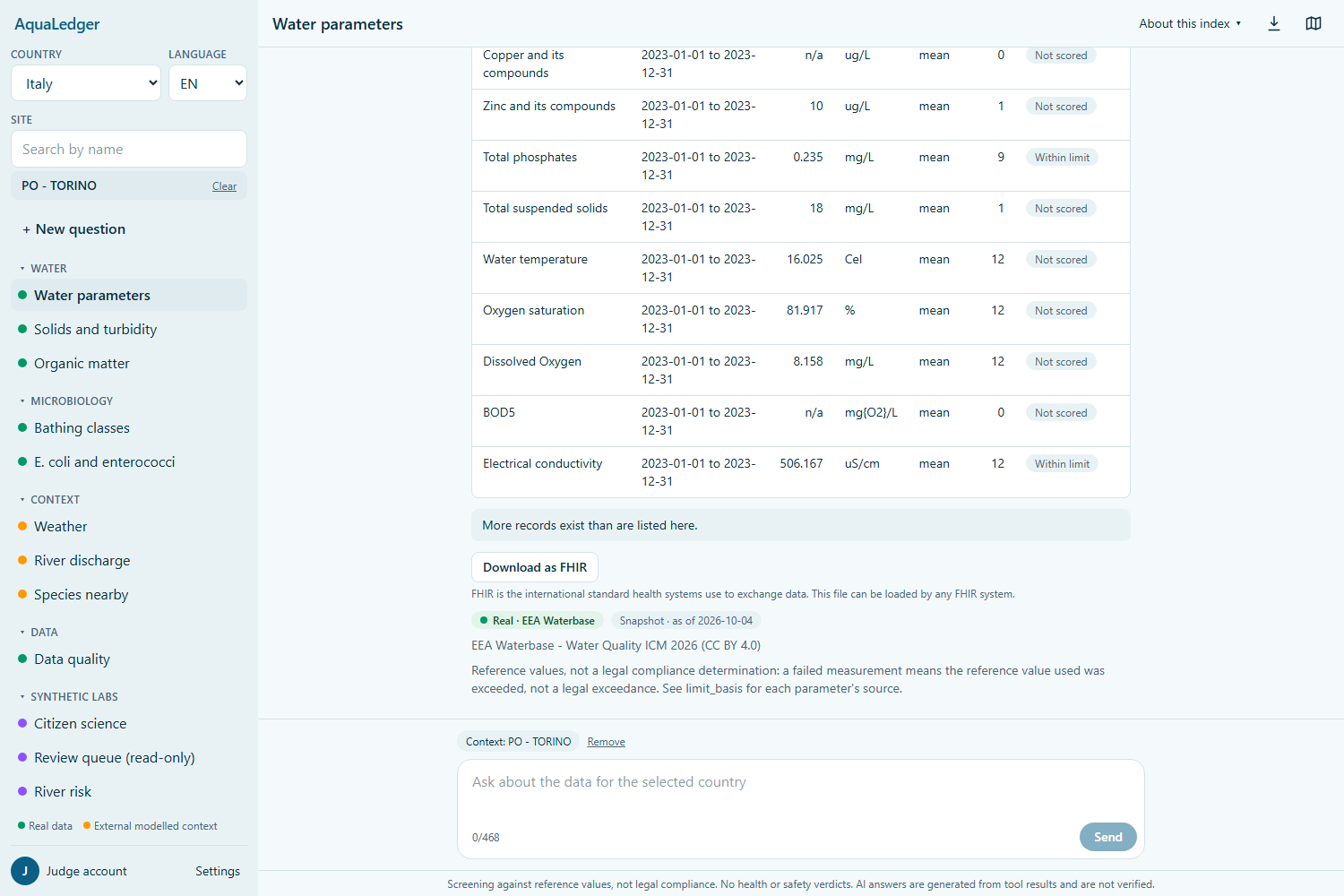
- No invented limits. Where there is no reference value (turbidity, organic matter, lakes) the value is shown as measured and marked Not scored; "within limit" and "exceeds limit" appear only where a real reference value exists.
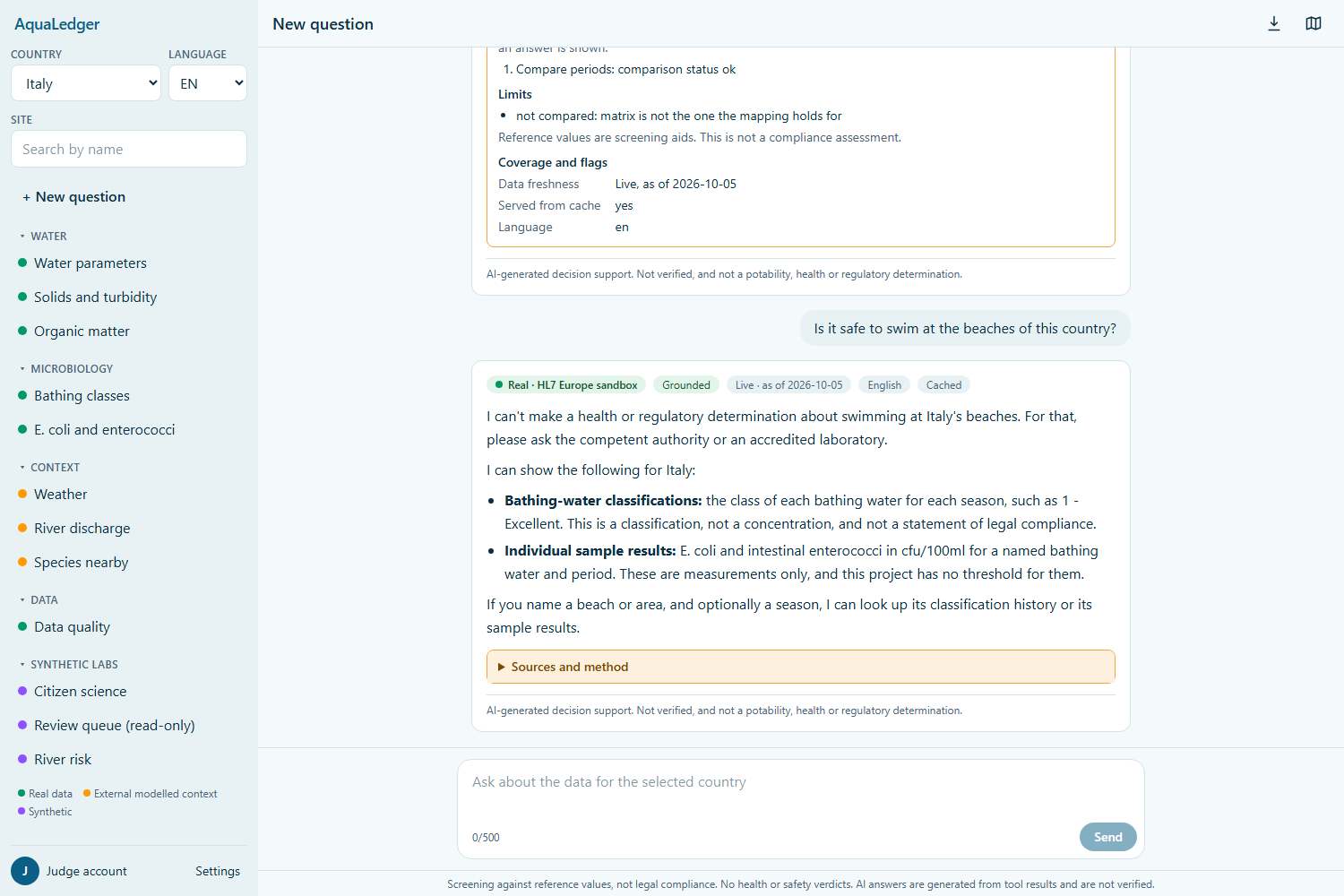
- No health verdicts. Ask "is it safe to swim?" and it declines and points to the competent authority.
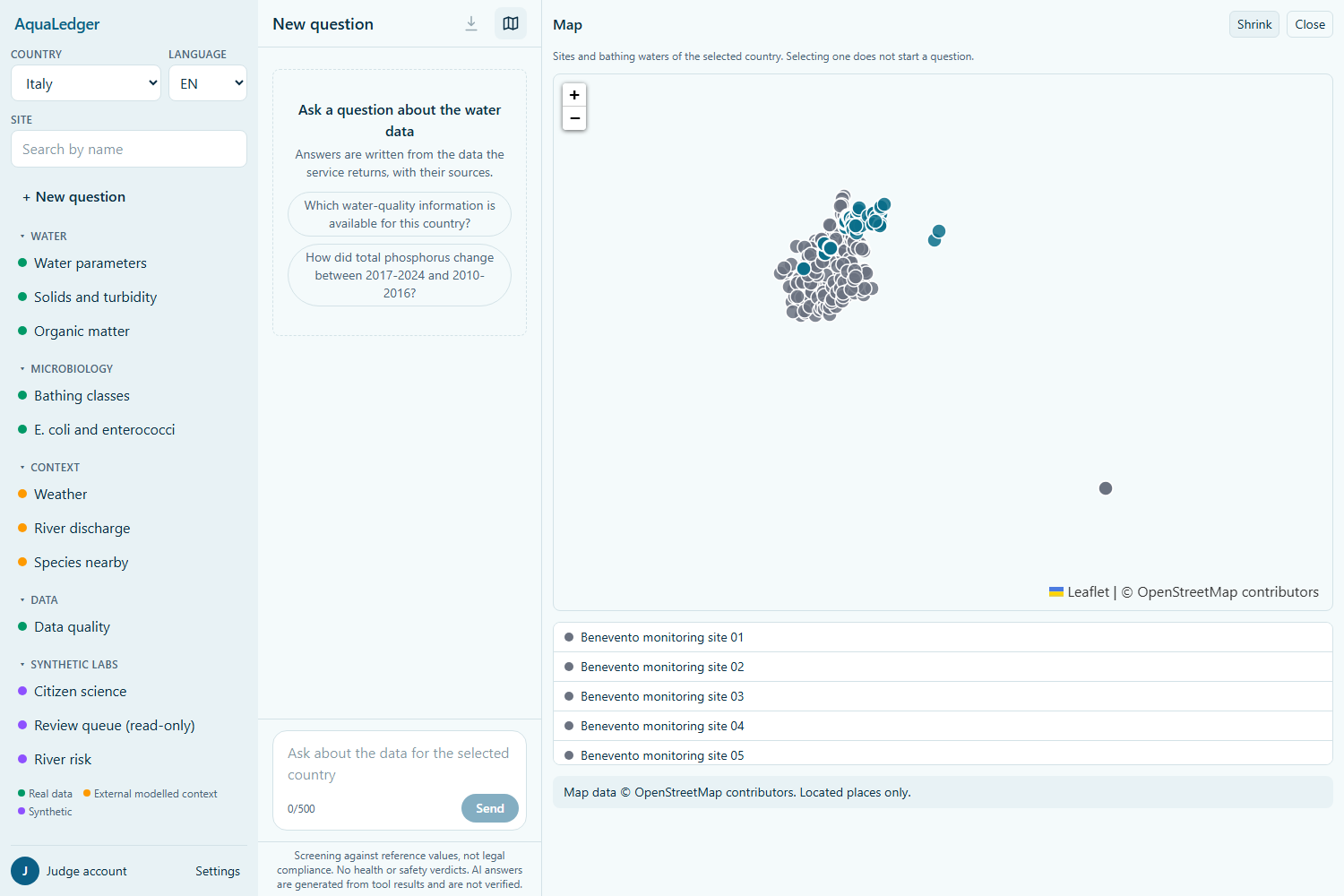
- Search a site as you type, see places on a map, read the data under the conversation, and download it as FHIR.
How we built it
- Backend: FastAPI on Google Cloud Run. Three prebuilt SQLite stores (Waterbase aggregates, bathing-water classifications, 754,451 bathing-water samples), a read-only tool-use agent (Claude, Anthropic API) that chooses which data tool to call, a hash-chained audit log that stores digests only, rate limits and spend caps.
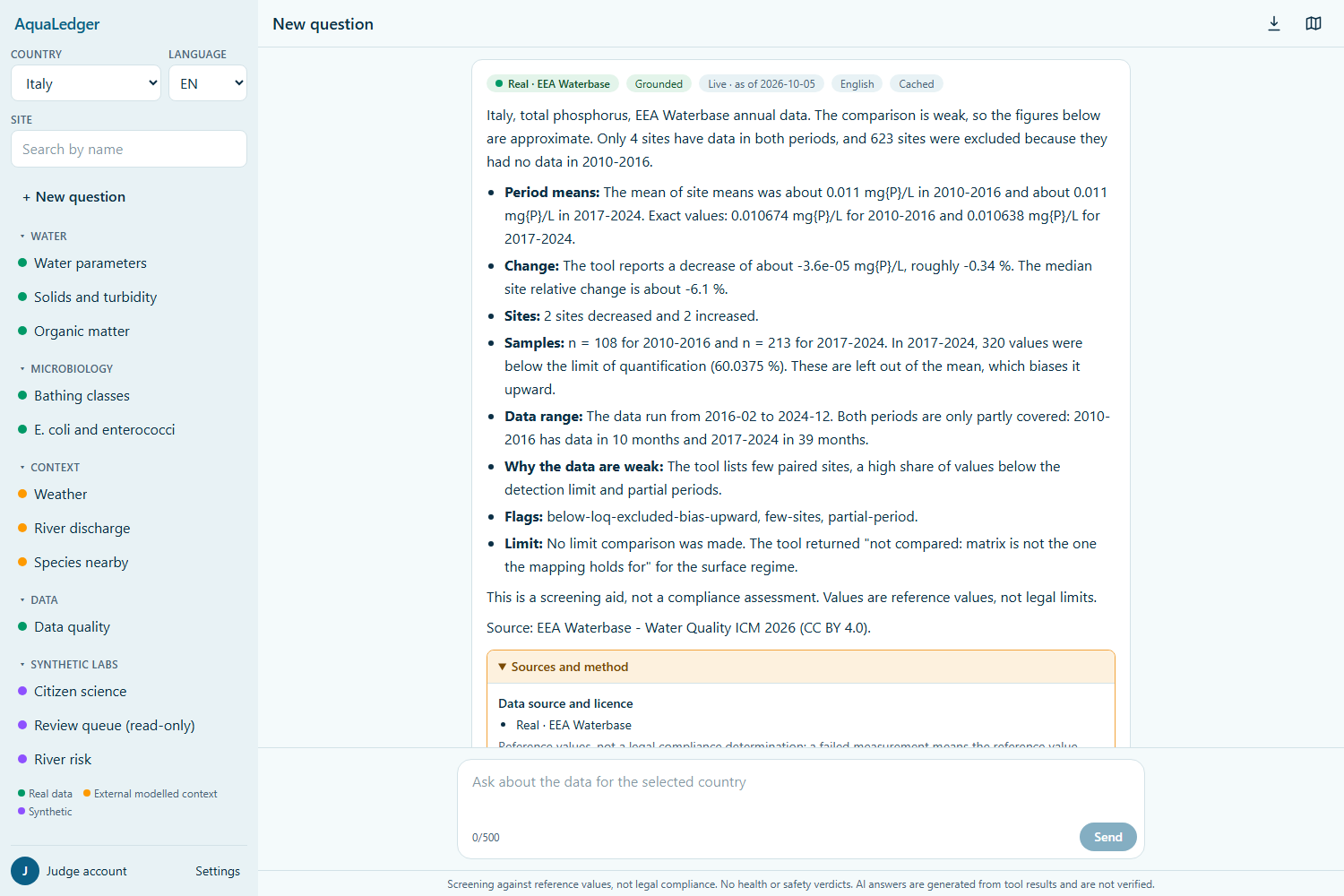
- The rule that makes it trustworthy: before an answer is shown, every number the model wrote, and its unit, is matched against the data it retrieved. A number written with \( d \) decimals is accepted only if the following holds for some value of the tool results; otherwise the answer is withheld and the evidence is shown instead.
$$|x_{\text{text}} - x_{\text{data}}| \le 0.5 \times 10^{-d}$$
- The model is not allowed to compute: a change between two periods comes from a tool. The store keeps the sum and the count of every month, so any coarser mean is exact: \( \bar{x} = \sum_i s_i \,/\, \sum_i n_i \).
- Standards: the sandbox is read as FHIR R4 against the OneAquaHealth implementation guide (the official HL7 validator found 0 errors on 485 real sandbox resources). A site's measurements are exported as a FHIR Bundle (Location, Observation, Provenance). We never invent a code: a parameter without a standard code is plain text.
- Web: Next.js, with the access key kept on the server, a CSP, and an allow-list proxy. The whole interface, not only the answers, follows the selected language.
- Quality: more than 3,400 automated tests (97 % line coverage at the last measurement, 26 September), continuous integration, a typed OpenAPI contract and a documented, reproducible setup. The repository is public and the backend can be run by anyone.
Challenges
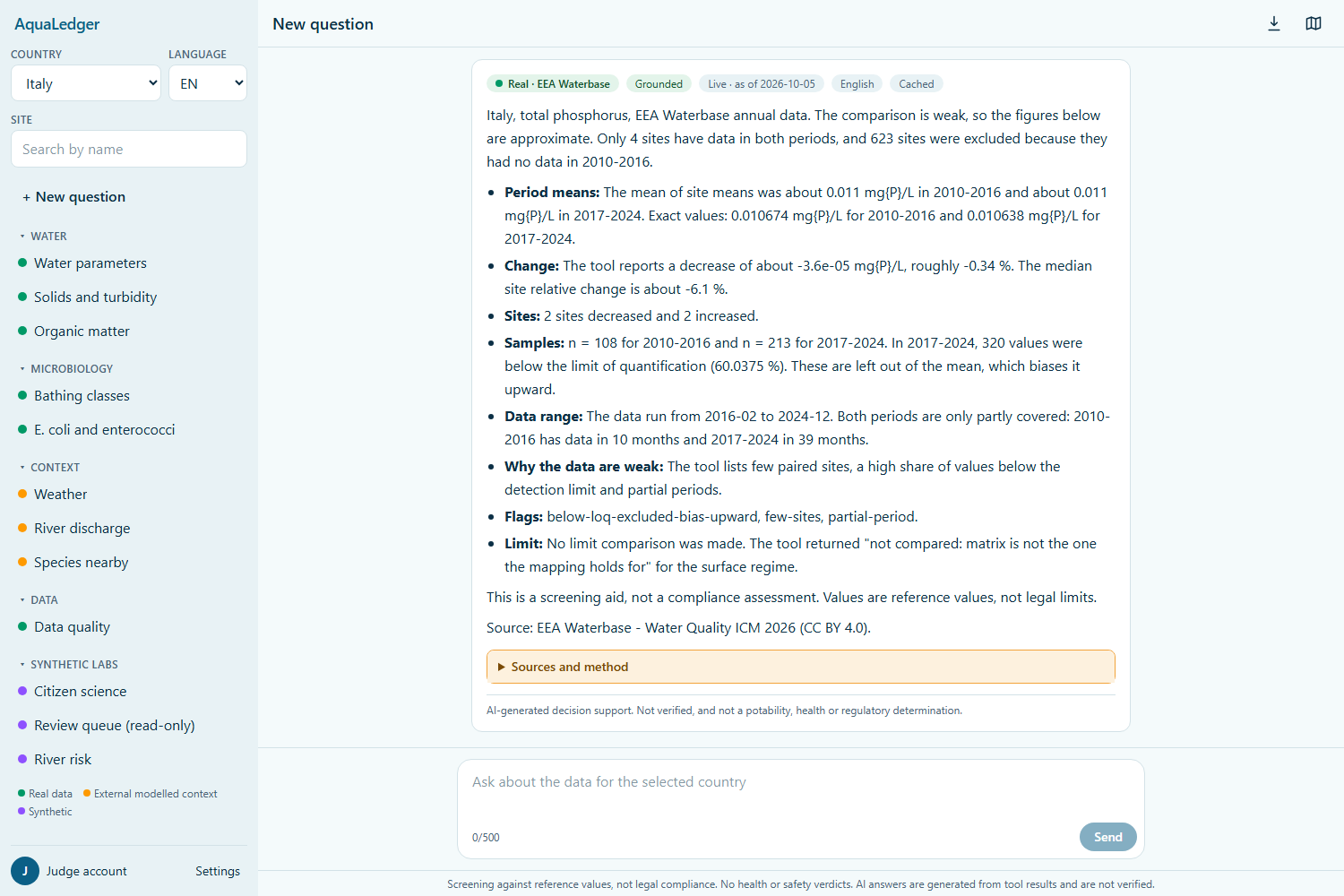
- Models like to compute. Asked how phosphorus changed between two periods, the model subtracted two means itself and wrote a number that was in no tool result. Our own check withheld a correct-looking answer. The fix was not to loosen the check: the agent now gets one revision with a precise note (use the figures the tool returned; say data is missing only if it really is), and the revised text passes the same checks.
- Guardrails have false positives. Live testing showed a Markdown label (
**Sandbox data:**) read as a web address, and a word like "two" counted as an invented number. We fixed both, with tests, and measured the result on the live site. - Real data is dirty. The Italian pH data held values that cannot exist; the build now drops anything outside the pH scale (805 values in that build) and counts it.
- Honesty under time pressure. We label what is real, modelled and synthetic, and what we could not verify.
What we learned
A useful AI assistant for public data is mostly plumbing for trust: provenance, deterministic checks, refusal rules and tests for the refusals. The model writes the sentence; the system decides whether it may be shown.
Honest limits
The 25 non-English translations of the interface are machine drafts and have not been reviewed by native speakers. The FHIR download is structurally valid FHIR R4 but does not claim conformance to the OneAquaHealth profiles. Citizen-science data exists only as a clearly labelled synthetic lab. The data are prebuilt snapshots, rebuilt by script, not a live feed. Rate limits live in memory, so the service runs as one instance. Answers vary between runs.
What's next, and how
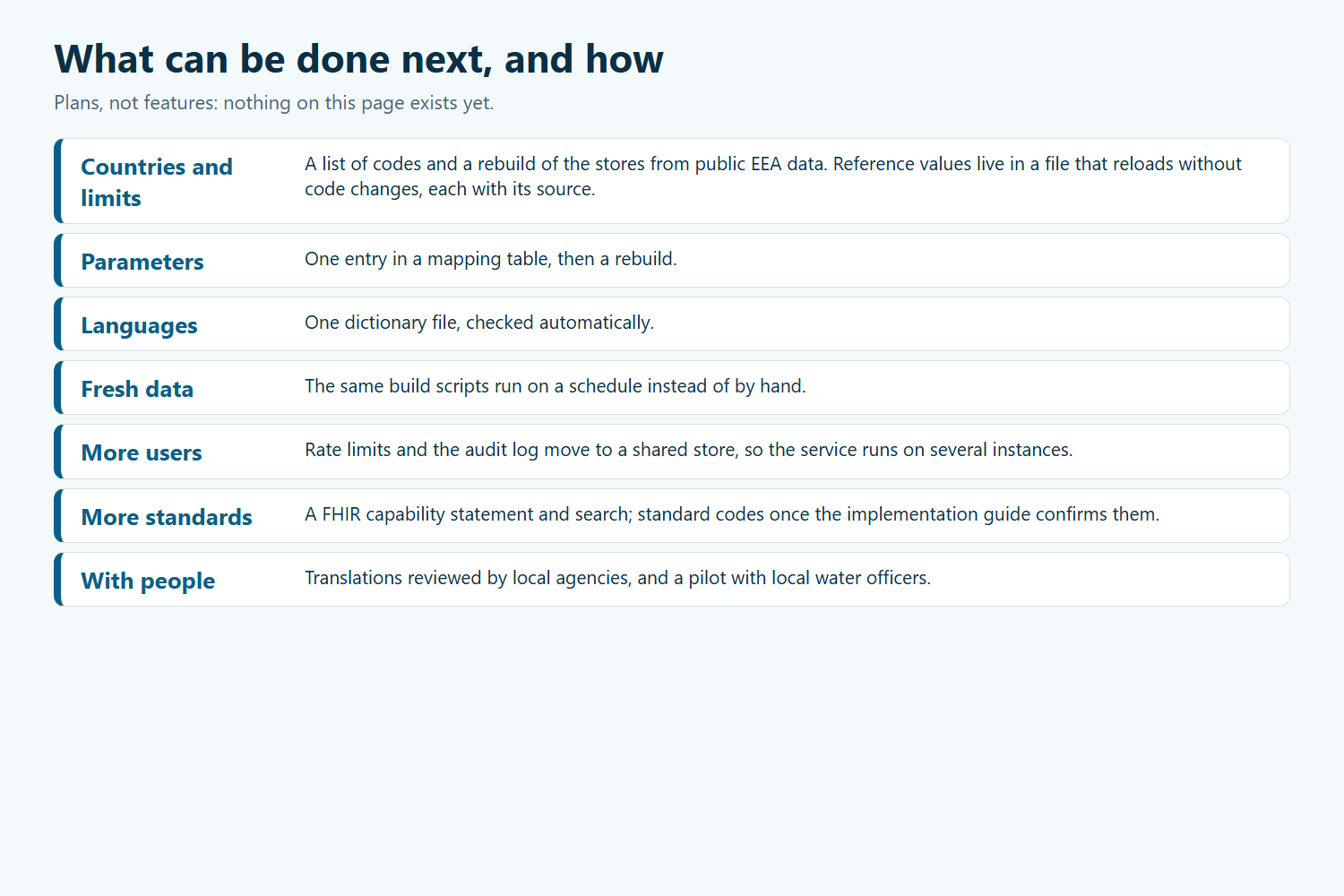
None of this exists yet; each item says how it would be done.
- More countries, with their own limits: the three stores are built by scripts from public EEA data, and reference values live in a file that reloads without code changes, each value carrying its source.
- More parameters: one entry in a mapping table, then a rebuild.
- More languages: one dictionary file, checked automatically (no link or markup may be added by a translation).
- Fresh data: the same build scripts, run on a schedule instead of by hand.
- More users: rate limits and the audit log move from memory to a shared store, so the service can run on several instances.
- More standards: a FHIR capability statement and search, standard codes once the implementation guide confirms them, and profile-conformant export of every answer's evidence; citizen-science observations as a real input (FHIR in).
- With people: translations reviewed by local agencies, and a pilot with local water officers.
Try it: https://one-aqua-health-candelero.vercel.app/ — Code: https://github.com/jacandelerocervantes-cmd/OneAquaHealth-Candelero every answer's evidence.
Built With
- anthropic-api
- claude
- docker
- eea-data
- elevenlabs
- fastapi
- fhir
- github-actions
- google-cloud-build
- google-cloud-run
- google-secret-manager
- hl7
- leaflet.js
- next.js
- open-meteo
- openstreetmap
- pydantic
- pytest
- python
- react
- sqlite
- tailwindcss
- typescript
- vercel
- vitest

Log in or sign up for Devpost to join the conversation.