Inspiration
Air pollution is something we experience every day, but understanding what is happening at a local level is still difficult. A city may have only a limited number of monitoring stations, while pollution can change from one street or neighborhood to another because of traffic, industries, construction, weather, and wind.
This made us think: What if we could build a system that does more than simply show the AQI?
We wanted AQIntel to help people understand where pollution is getting worse, what might be causing it, what could happen next, and where attention is needed most. That idea became the starting point for AQIntel – AI-Powered Hyperlocal Air Quality Intelligence.
What it does
AQIntel brings together different sources of environmental information, including IoT sensors, government monitoring stations, weather data, satellite observations, GIS information, roads, traffic context, and industrial locations.
Instead of looking at these sources separately, AQIntel combines them to build a more detailed picture of air quality at the local level.
The system is designed to:
- Monitor and understand local air-quality conditions
- Identify potential pollution hotspots
- Forecast future air-quality conditions
- Analyze possible pollution sources
- Explain why an AI model made a particular prediction
- Assess environmental risk
- Provide information that can support better decisions
Our goal is to move from simply asking “What is the air quality?” to asking “Why is it changing, what might happen next, and what should we pay attention to?”
How we built it
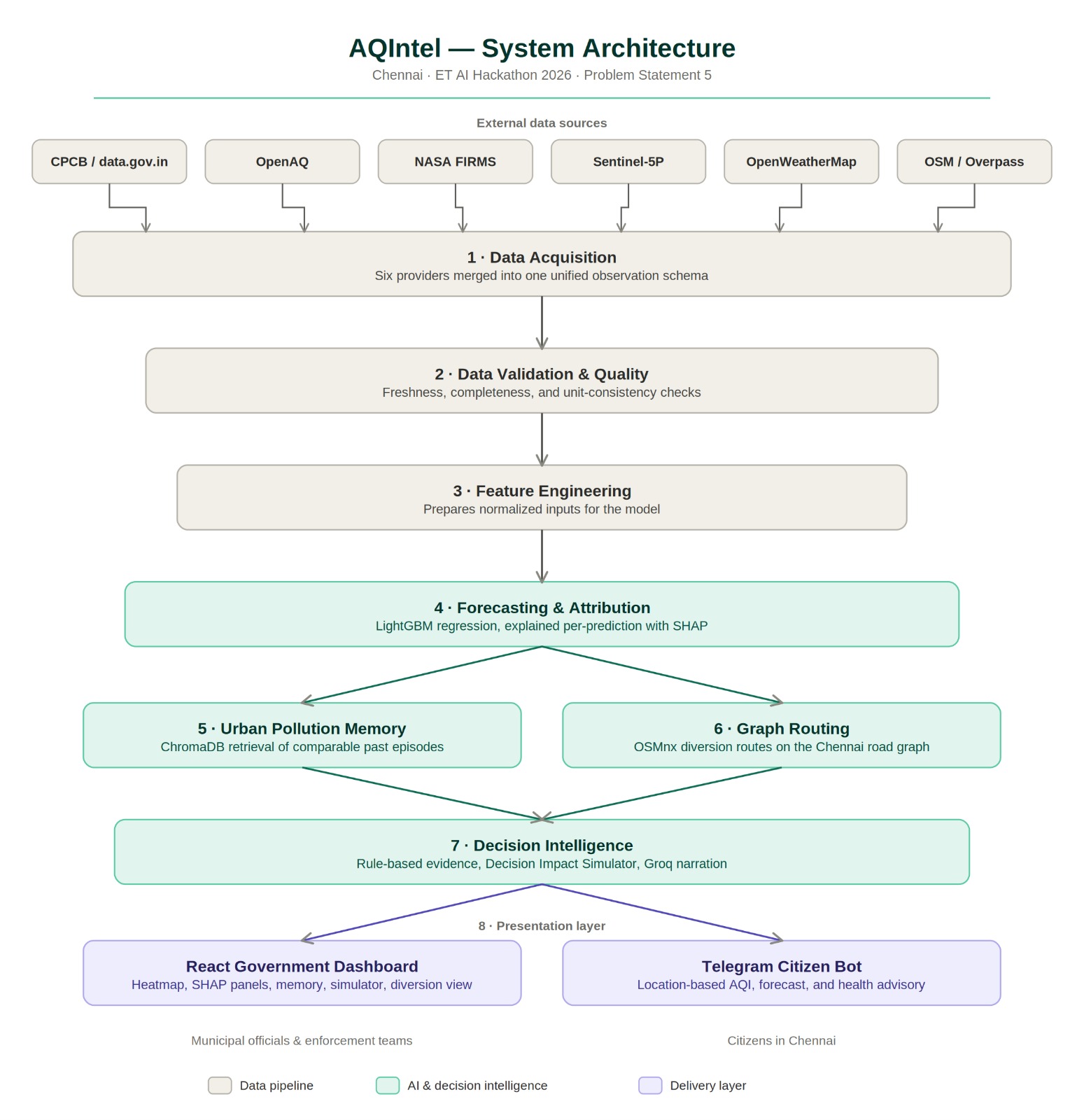
We designed AQIntel as a modular system so that different data sources and technologies can work together.
The overall pipeline follows:
Data Collection → Data Validation → Data Fusion → Hyperlocal Analysis → Forecasting → Source Attribution → Explainable AI → Decision Support
We use environmental and geospatial data to understand local conditions, machine-learning techniques for prediction, and explainability methods such as SHAP to make the AI output easier to understand.
The idea was not to build just another dashboard. We wanted to connect the data, AI, and decision-making parts into one system.
Challenges we ran into
One of the hardest parts was dealing with real-world environmental data. Different sources have different formats, timestamps, locations, resolutions, and levels of reliability. Some data can also be missing or noisy.
Another challenge was combining all these sources without losing their meaning. We had to think carefully about how weather, geography, traffic, sensors, and other environmental factors relate to each other.
We also wanted the system to be understandable. A prediction is much more useful when users can see the reasoning behind it, so explainability became an important part of our design.
Finally, we wanted AQIntel to be useful beyond a single location. Designing it in a way that can adapt to different cities, datasets, and sensors was another important challenge.
Accomplishments that we're proud of
We are proud that AQIntel brings several different areas together in one framework:
- IoT-based environmental sensing
- Multi-source environmental data fusion
- Hyperlocal air-quality intelligence
- AI-based forecasting
- Pollution source attribution
- Explainable AI
- Geospatial analysis
- Environmental risk assessment
- Decision support
Most importantly, we are proud of the idea behind the project. AQIntel is not designed only to display pollution numbers. It is designed to help turn those numbers into information that people and authorities can actually understand and use.
What we learned
Building AQIntel taught us that solving a real-world problem with AI is not just about choosing the best model.
We learned how important data quality, spatial context, time, uncertainty, and explainability are when working with environmental information.
We also learned that an accurate prediction is not always enough. If people cannot understand the result or know what to do with it, the value of the prediction is limited.
Most importantly, we learned to think about AI from the perspective of the problem and the decision that needs to be made, rather than only from the perspective of the technology.
What's next for AQIntel – AI-Powered Hyperlocal Air Quality Intelligence
AQIntel is only the beginning.
Our next goal is to strengthen real-world validation and improve the system's ability to work across different locations and environmental conditions.
In the future, we would like to explore:
- Edge AI for faster local processing
- Mobile and drone-based sensing
- More advanced satellite and weather integration
- Graph-based AI models
- Federated learning
- Environmental digital twins
- Citizen and community sensing
- Multi-city deployment
- More advanced environmental decision support
Our long-term vision is simple:
Help cities move from simply observing pollution to understanding it, predicting it, explaining it, and taking smarter action.
AQIntel is our attempt to make air-quality intelligence more local, understandable, connected, and useful.
Built With
- ai
- data
- docker
- environmental
- esp32
- explainable
- fastapi
- geopandas
- geospatial
- gis
- iot
- learning
- lightgbm
- machine
- mongodb
- mqtt
- openstreetmap
- prophet
- python
- satellite
- shap
- visualization

Log in or sign up for Devpost to join the conversation.