-
-
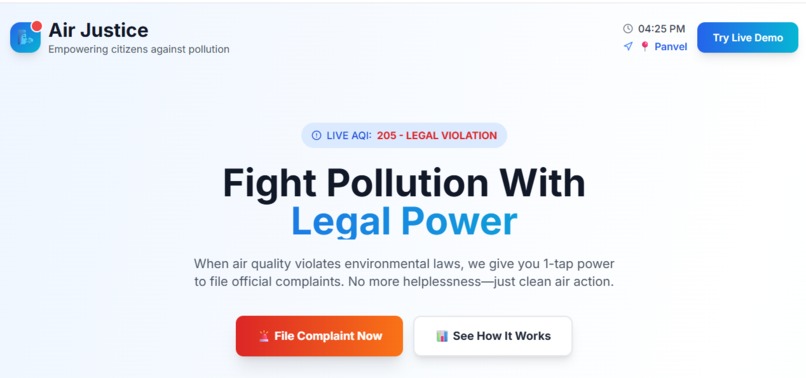
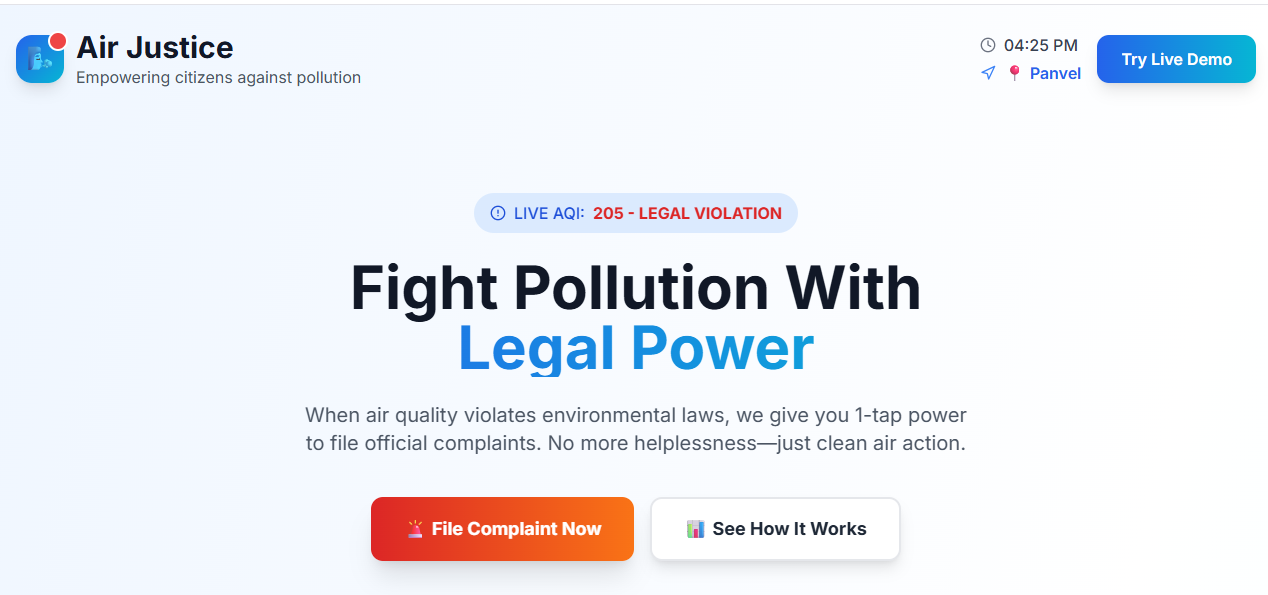
The homepage introduces Air Justice as a platform to fight pollution with legal power, showing an AQI of 205 (legal violation).
-
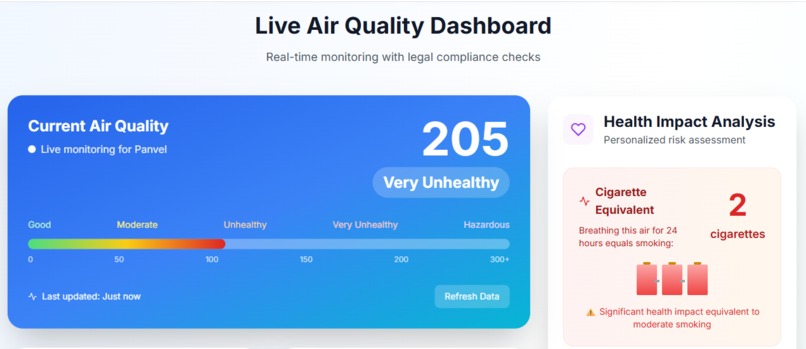
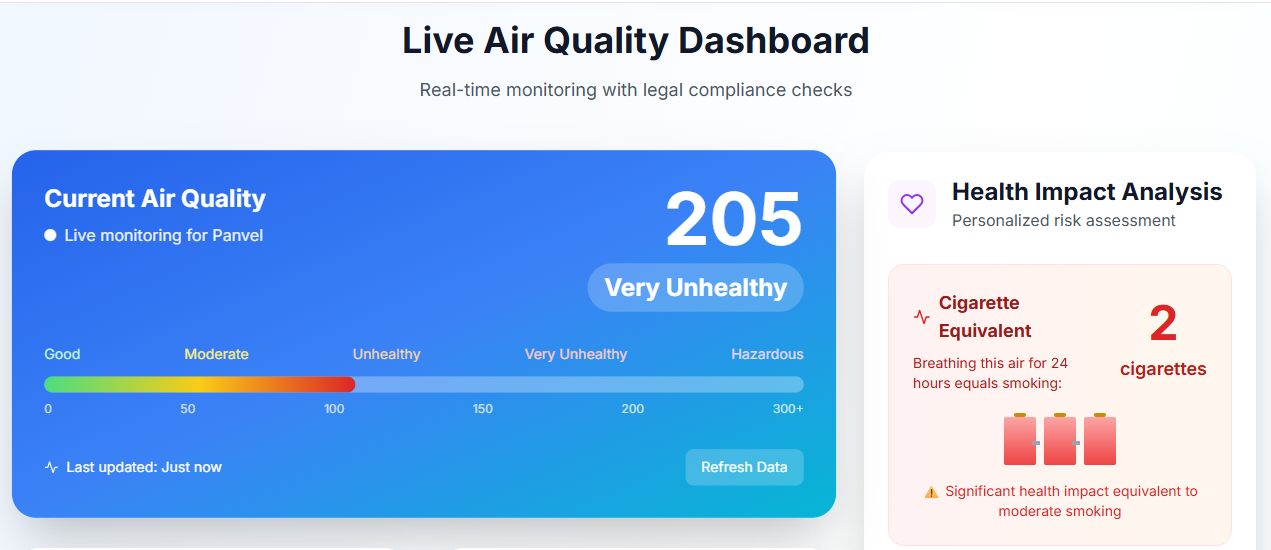
Dashboard showing real-time AQI of 205 (Very Unhealthy) with health impact equal to smoking 2 cigarettes in 24 hours.
-
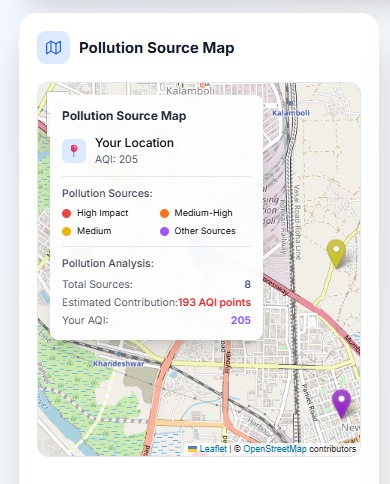
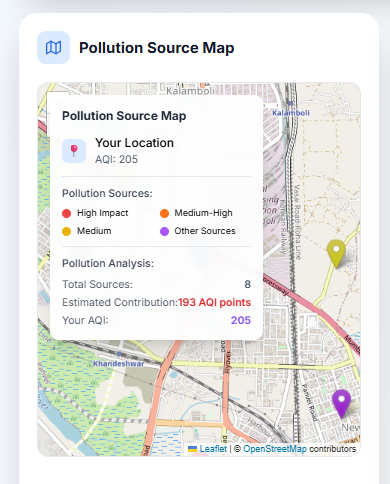
Interactive map displaying user's location, AQI 205, and 8 pollution sources contributing an estimated 193 AQI points total.
-
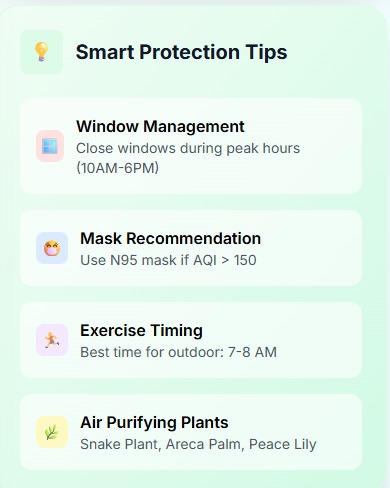
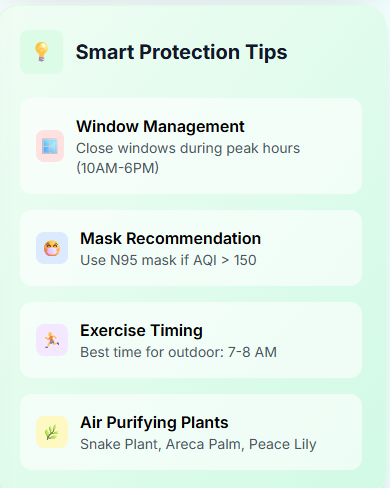
Advice for better health.
-
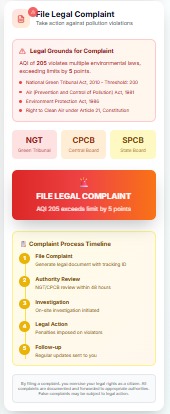
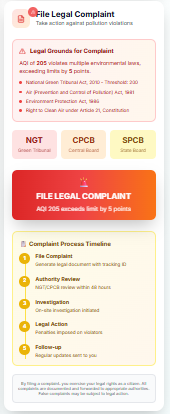
Legal complaint filing page listing violated laws (NGT, CPCB, SPCB) with step-by-step complaint process timeline shown.
-
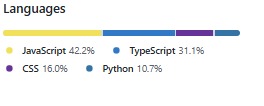
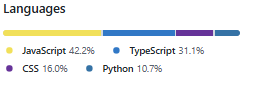
languages used in this project
Inspiration
Air pollution kills 7 million people annually, yet citizens remain powerless spectators. When I saw the Air Quality Index in my city hit 205—a clear legal violation—I realized people need more than data. They need action. In India alone, 1.4 billion people breathe air that violates national standards, and 290+ cities consistently exceed safe limits. But filing environmental complaints requires navigating complex bureaucratic processes, understanding legal frameworks, and investing 3+ hours per complaint.
Air Justice was born from a simple question: What if fighting pollution was as easy as checking your phone? What if every citizen could become an environmental watchdog with the same legal tools that environmental lawyers use?
What it does
Air Justice transforms citizens into environmental enforcement agents by combining real-time air quality monitoring with automated legal complaint filing. When pollution violates environmental laws, users can file official complaints to the Central Pollution Control Board (CPCB), State Pollution Control Boards (SPCB), and National Green Tribunal (NGT) with a single tap.
How we built it
AQI_Justice was built as a full-stack civic-tech platform with a strong focus on real-world usability and legal accuracy.
We used FastAPI (Python) for the backend to handle AQI processing, legal compliance checks, and complaint generation logic. The backend evaluates real-time air quality data against Indian environmental standards and determines whether a legal violation has occurred.
The frontend was built using Next.js with TypeScript and Tailwind CSS, enabling a fast, responsive, and accessible user experience. We designed the interface to make complex information—like AQI values, health risks, and legal status—simple and actionable for everyday citizens.
We integrated location-based AQI monitoring, health impact analysis (including cigarette-equivalent exposure), pollution source visualization, and an automated legal complaint workflow that maps violations to the correct authority (CPCB, SPCB, or NGT).
Throughout development, we prioritized clarity, speed, and impact, ensuring that a user could go from seeing polluted air to taking legal action in seconds.
Challenges we ran into
One of the biggest challenges was translating environmental laws into executable logic. Legal thresholds are written for policy documents, not software, so mapping AQI values to enforceable violations required careful interpretation and validation.
Another challenge was making AQI data meaningful to non-technical users. Raw numbers do not communicate urgency, so we had to design intuitive health impact indicators that were both scientifically grounded and easy to understand.
Balancing technical accuracy with user simplicity was also difficult. The platform needed to feel powerful without overwhelming users with legal or medical jargon.
Finally, building a legally-oriented system under hackathon time constraints required rapid iteration, strong architectural decisions, and constant focus on the core impact.
Accomplishments that we're proud of
*Built a working end-to-end product, not just a prototype
*Successfully connected real-time AQI data to legal compliance checks
*Enabled one-tap, evidence-based legal complaint filing
*Translated air pollution into human health impact users can understand
*Designed a clean, intuitive UI for a complex civic problem
*Created a solution with real potential for adoption by citizens, NGOs, and regulators
*Most importantly, we built a platform that turns citizen frustration into civic action.
What we learned
We learn how to tackle real-life problems.
What's next for AQI_Justice
Phase 1 (Current) Live AQI monitoring • Legal compliance checks • Automated complaint filing • Health impact analysis Phase 2 (Q2 2026) Community collaboration • Complaint tracking system • Legal status notifications • Multi-language support Phase 3 (Q3 2026) AI-powered source detection • Pollution prediction models • Success story database • NGO partnerships Phase 4 (Q4 2026) International expansion • Industrial accountability metrics • Policy impact dashboard • Legal victory database


Log in or sign up for Devpost to join the conversation.