-
-
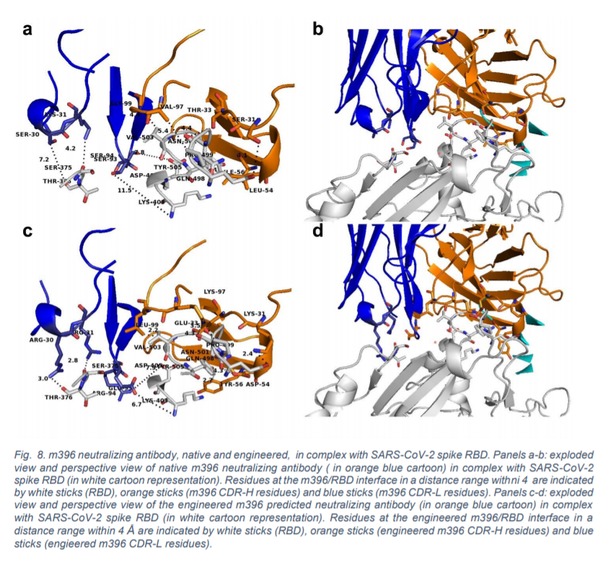
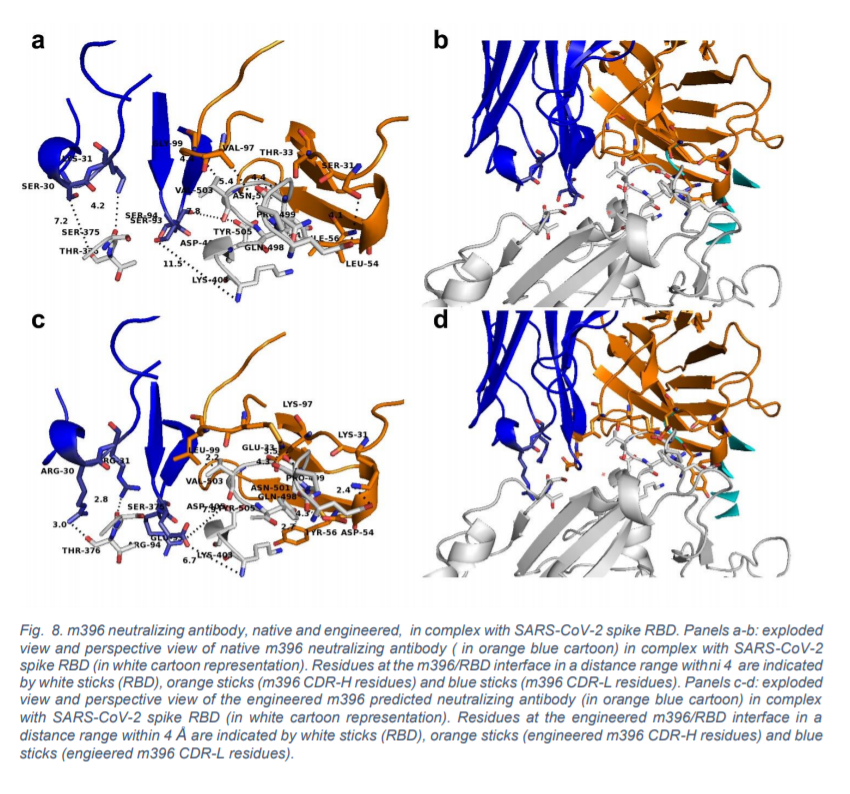
This image shows the 3D interaction between the investigated/proposed antibodies and SARS.CoV.2 Spike RBD
Inspiration
Due the Covid-19 outbreak, to the high number of dead people, and to our expertise in 3D protein modeling and protein protein interactions we started to analyse all the known data about SARS.CoV.2 aiming to set-up a molecular framework for building a 3D model of a neutralizing antibody based on the available crystallized structures about SARS.CoV.1 and SARS.CoV.2 spike proteins interacting with 3 known antibodies (SARS.CoV.1) or ACE2 (both SARS.CoV.1 andSARS.CoV.2. Thus, we started at the end of February analyzing and searching for a possibile strategy for building an efficient antibody
What we did
We retrieved two antibodies (S230 and m396) known for being able to target SARS.CoV.1 spike receptor binding domain (RBD). We ascertained that SARS.CoV.1 and SARS.CoV.2 spike RBD show the 75% of identical amino acids. Thus, we performed a comparative analyses that allowed us to verify that m396 might be able to neutralize also SARS.CoV.2. Furthermore, based on CDR composition and space-restaints based in silico mutagenesis performed also according to Chotia rules, we prepared in silico a new antibody based on m396 that should be more specific for SARS.CoV.2.
How we built it
Most of the employed structures for our comparative analysis were retrieved from the protein data bank. We modelled the interaction between SARS.CoV.2 spike RBD and the investigated antibodies by superimposition of the available crystallized structures obtained by using several molecular visualizers. We minimized energetically all the built models by using dedicated computational tools. All the results of our analyses are freely accessible https://www.biorxiv.org/content/10.1101/2020.04.17.046185v1 and our manuscript is under revision on a well impacted international journal
Challenges we ran into
Our challenging scope is to express in vitro the designed recombinant antibodies, the SARS.CoV.2 spike protein trime, the single spike RBD and the human ACE2 receptor for estimating affinity of the proposed antibodies vs SARS.CoV.2 spike RBD and to verify through kinetics assays in vitro the ability of our antibody in preventing SARS.CoV.2 spike RBD interaction with the human ACE2
Accomplishments that we're proud of
We retain that our work can be useful for scientists that are working on therapies for treating COVID-19 patients and we would be happy to show in vitro that our antibodies might be efficient in targeting SARS.CoV.2 spike RBD preventing ACE2 binding.
What we learned
We learned that the Spike protein can be targeted with ad hoc antibodies for preventing interactions with ACE2 used by the virus to enter the host cell. We analyzed the conformations and states of the spike protein trimer in several conformations (pre-fusion, ligated, post-fusion), also thanks to the 3D comparative model built for the SARS.CoV.2 spike protein in post-fusion conformation. We highlighted spike RBD residues crucial for interactions with ACE2 and we mimic ACE2 surface for improving affinity of m396 antibody for SARS.CoV.2 spike RBD. We set up an ideal pipeline and a molecular framewor that could be used for docking possible antibodies against RBD and for estimating their affinity for RBD.
What's next for Anti-SARS.CoV.2 Spike-RBD antibody
The team have interest to continue this study and to have the opportunity to produce the antibody to be used as a therapy for slowing down SARS.CoV.2 infection and COVID-19 complications. Furthermore, results of our analyses about RBD-ACE2/Ab interactions can be used for developing ad hoc vaccines based on the entire SARS.CoV.2. spike protein trimer, or on the single spike RBD, for win the ongoing fight against the virus. We also retain that if our approach will be successful, our molecular framework and pipeline can be used also for contrasting new outbreak that could raise in future due to other viruses that will use their spike protein for invading human cells through interactions with the human ACE2.
Built With
- 3dmodeling
- data
- english
- fasta-protein-similarity-search
- paper
- pubblication
- rcsb-protein-data-bank
- review
- ssearch-protein-similarity-search









Log in or sign up for Devpost to join the conversation.