-
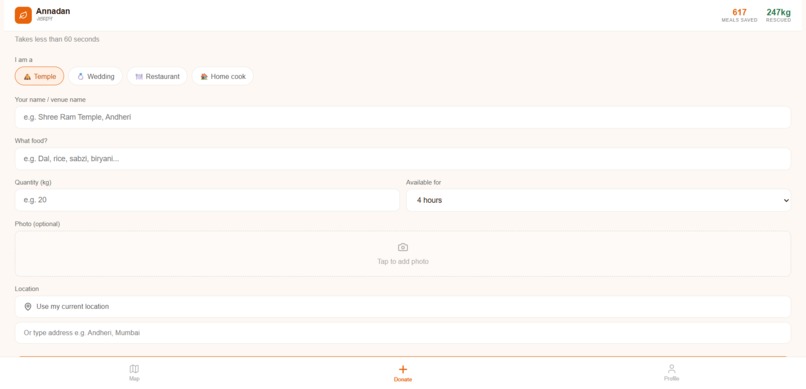
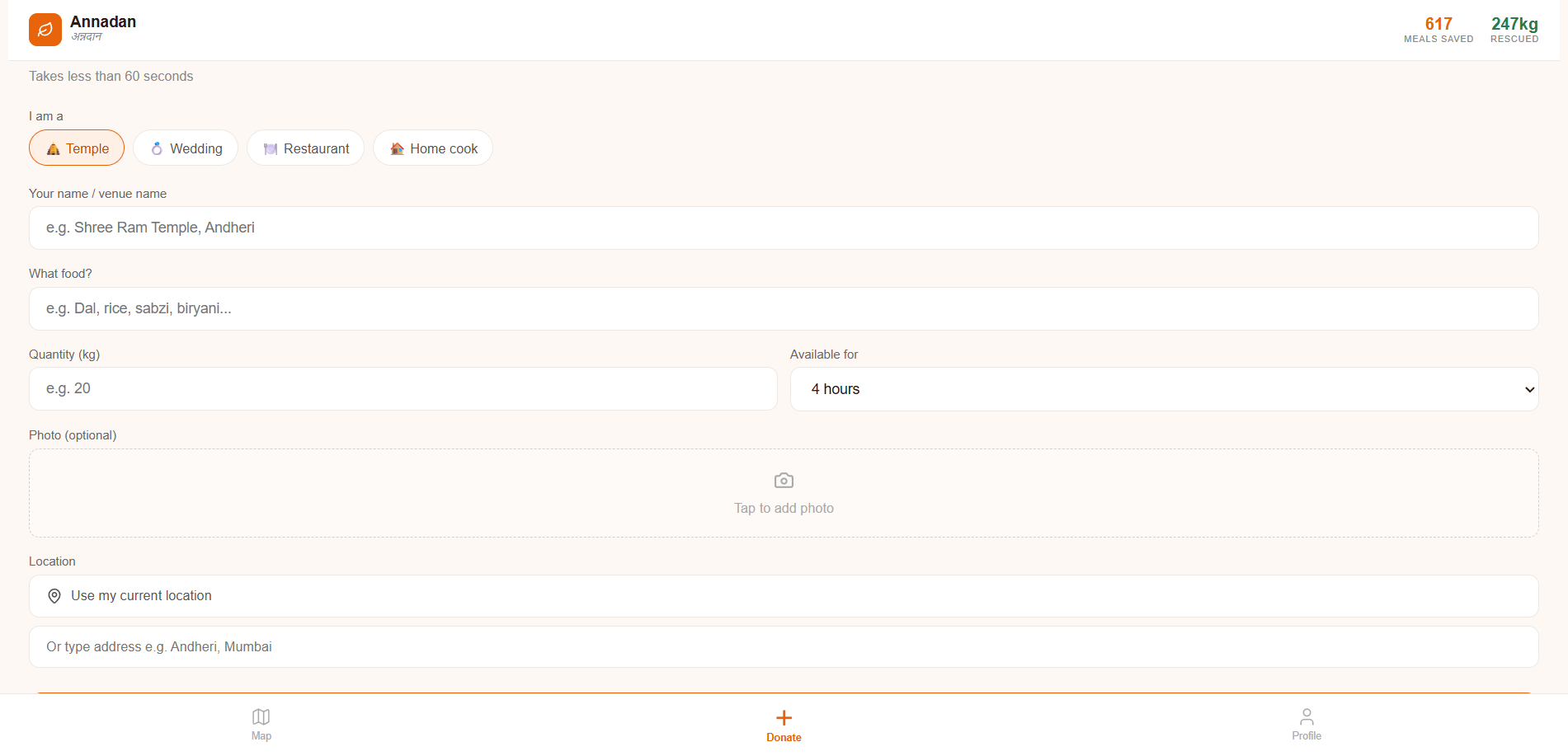
Donate Screen - Web
-
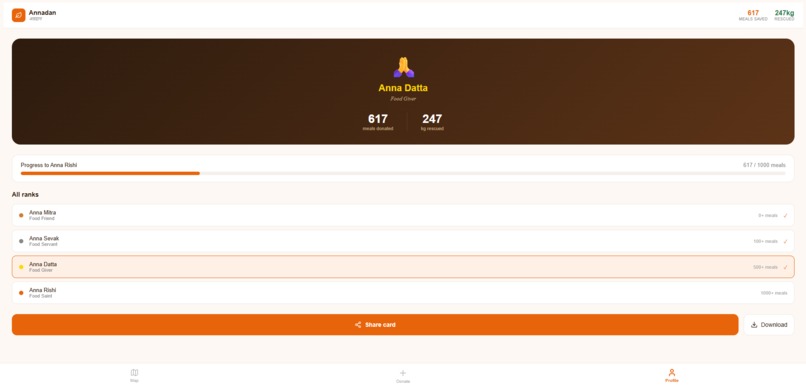
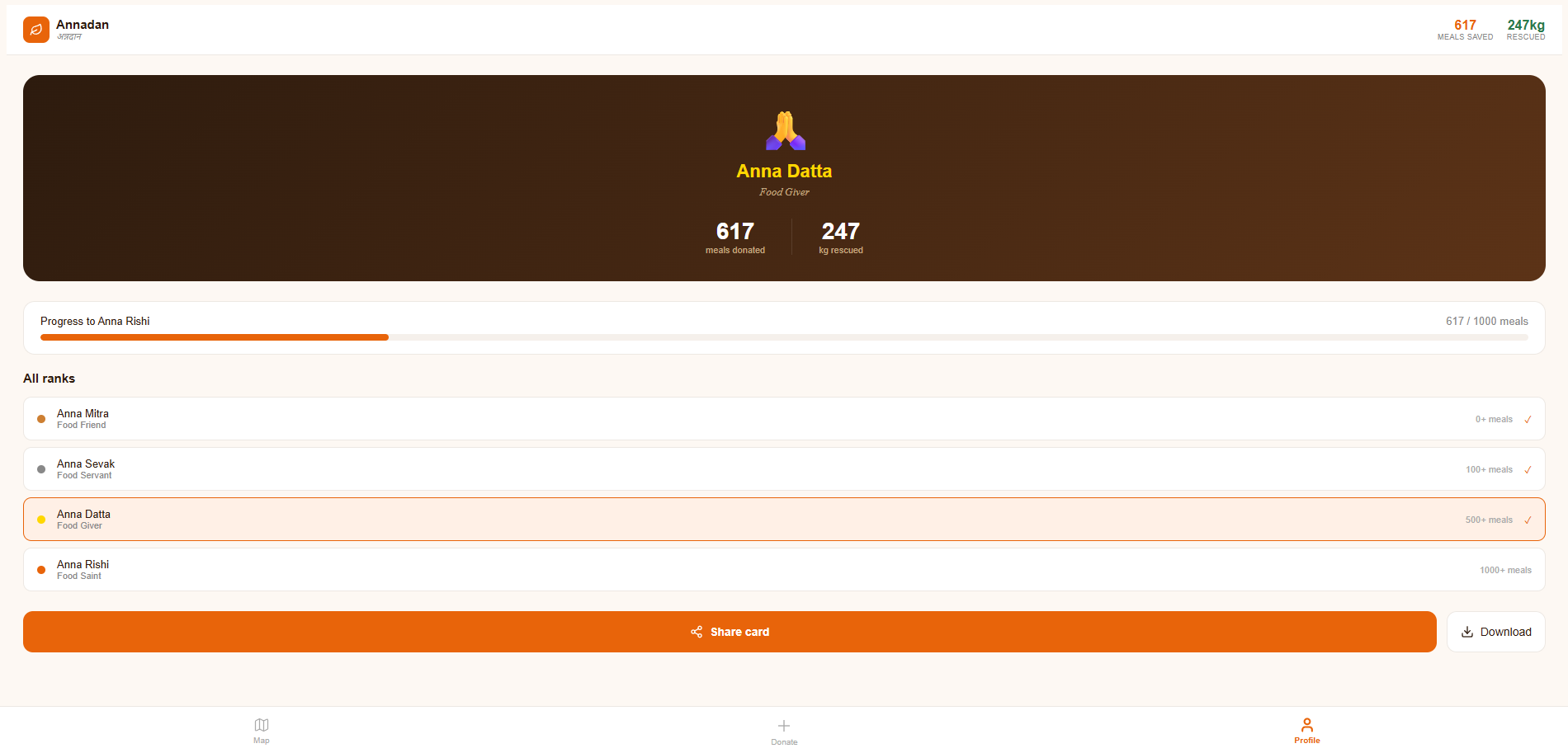
Profile Screen - Web
-
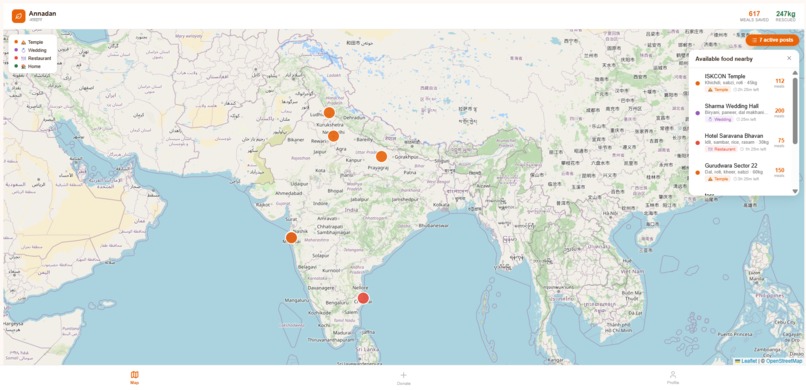
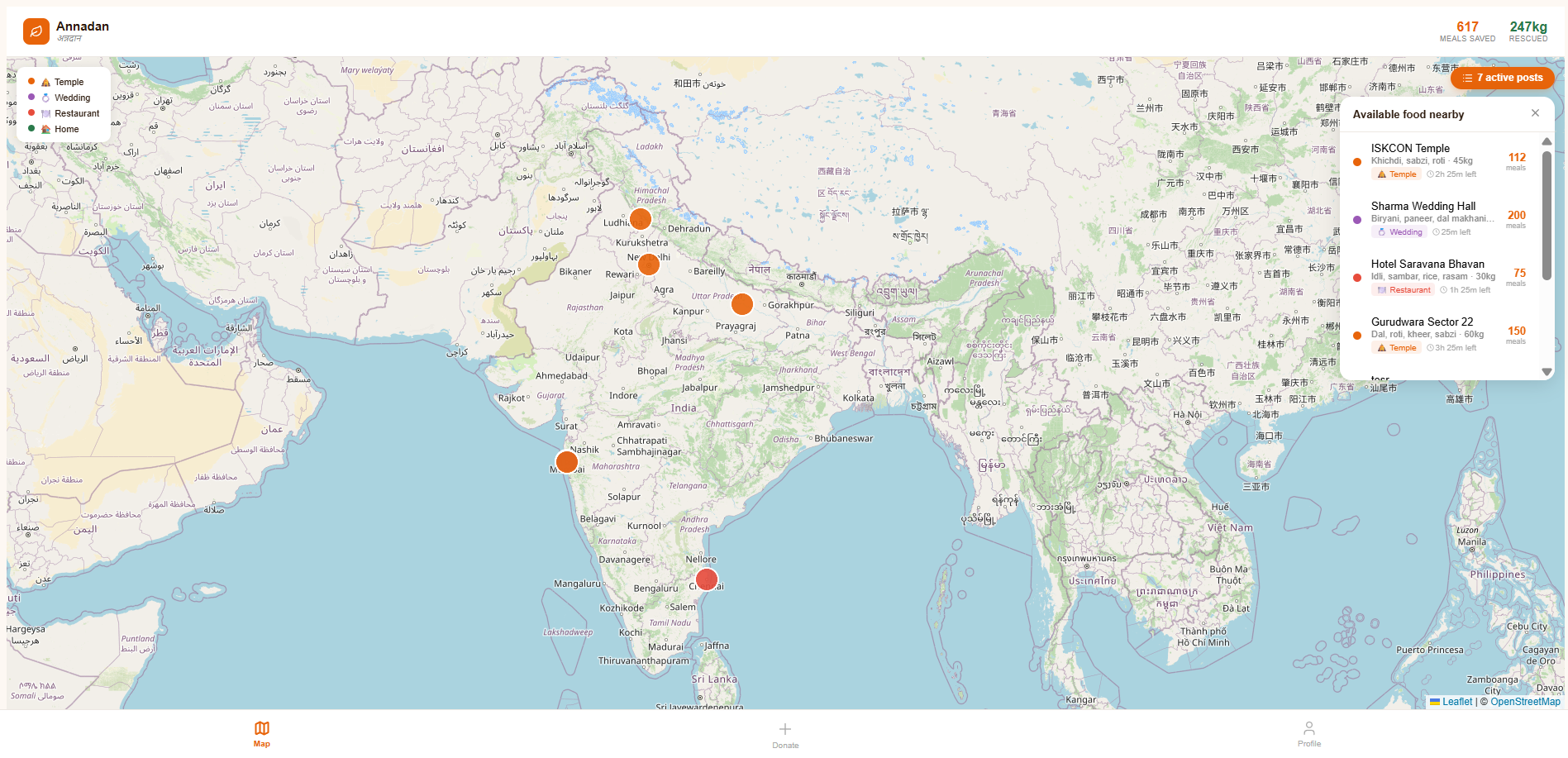
Map Screen - Web
-
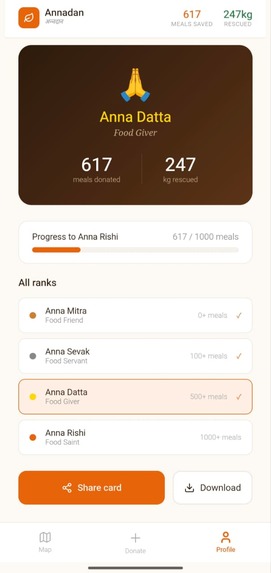
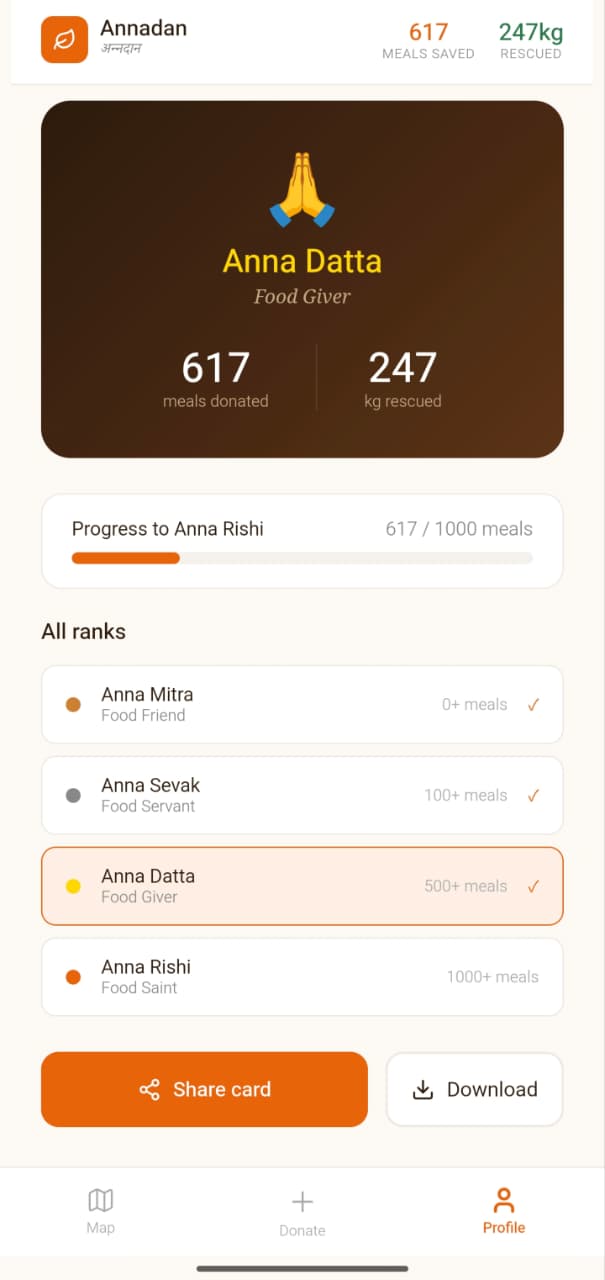
Profile Screen - Mobile
-
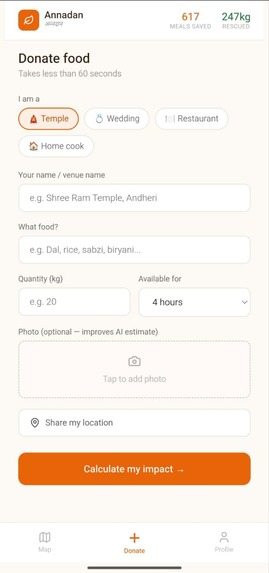
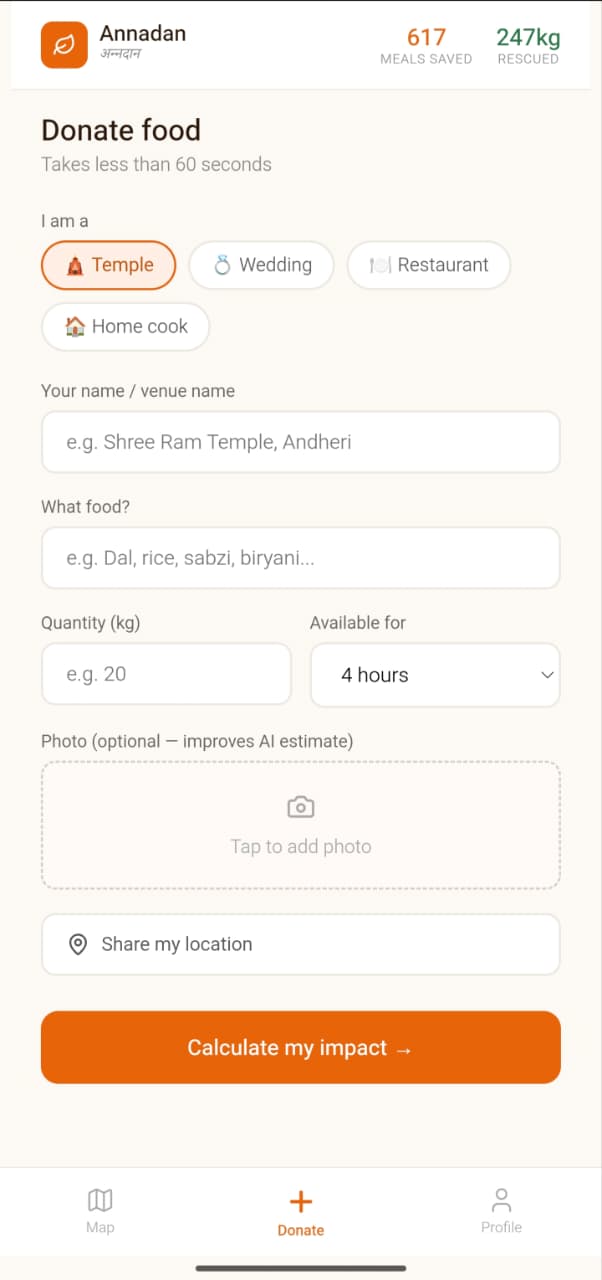
Donate Screen - Mobile
-
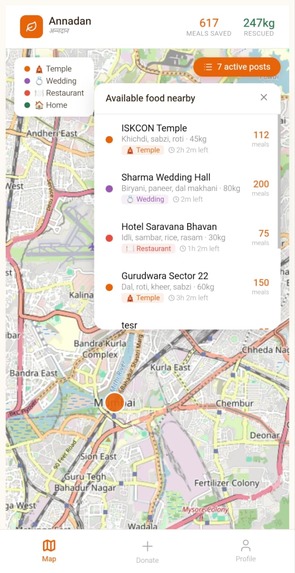
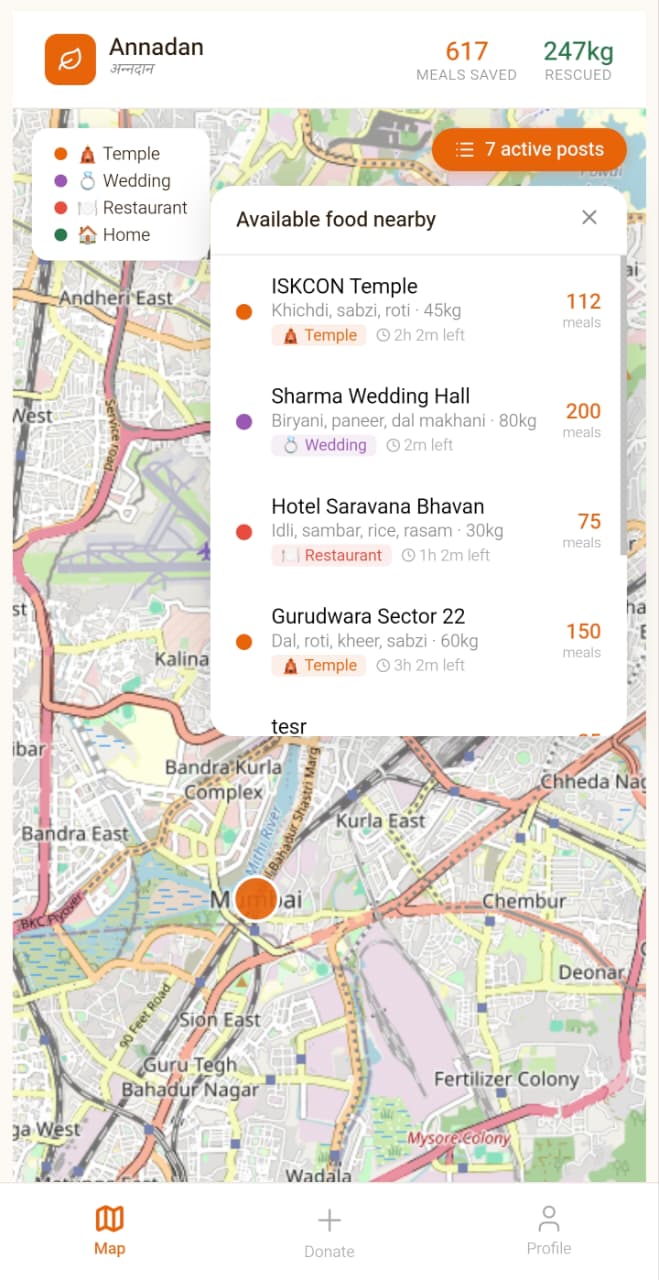
Map Screen - Mobile
Inspiration
Growing up in India, I watched mountains of food get thrown away at weddings, temples, and family functions, while people outside struggled. The food existed. The need existed. Nothing connected them.
India wastes 68 million tonnes of food every year while 189 million people go undernourished daily. That's not a food shortage. That's a coordination problem.
I wanted to build something that worked with Indian culture, not against it. Seva, langar, prasad — generosity around food is already in our DNA. Annadan doesn't introduce a new behavior. It just makes it more powerful.
What it does
Annadan is a real-time web platform where temples, wedding halls, restaurants, and home cooks post surplus food in under 20 seconds. Anyone nearby sees it on a live map and volunteers to pick it up and distribute it in their neighborhood.
- 🗺️ Live map of available food nearby — color coded by source
- ⚡ 20-second posting flow — photo, quantity, location, done
- 🤖 AI-powered impact estimation — every donation shows meals provided and CO₂ saved
- 📍 Address autocomplete via OpenStreetMap — works across all of India, free
- 🏆 Donor rank system — Anna Mitra → Anna Sevak → Anna Datta → Anna Rishi
- 📊 Real-time city counter — meals and kg rescued update live as donations are posted
- 📱 Mobile-first — works on any Android or iOS browser, no app download needed
Nobody ever has to identify as hungry. Food reaches communities through volunteers — dignity preserved on both sides.
How I built it
The architecture is intentionally simple — a single Next.js app, fully serverless, that any developer can clone and run in minutes. Real-time updates are powered by Supabase subscriptions so new food posts appear on the map instantly without refreshing.
I deliberately avoided every paid API. The entire app runs free forever — making it genuinely sustainable for a social impact project with no funding.
Challenges I ran into
The dignity problem — How do you connect food to people in need without making anyone feel like a charity case? The answer was the volunteer relay model. Donors post, volunteers distribute, recipients receive through their community. Nobody's need is ever exposed.
Building without paid APIs — Google Maps requires a credit card. I switched entirely to OpenStreetMap-based tools — completely free, no account needed, and actually better coverage of Indian streets and neighborhoods.
CORS issues with geocoding — Nominatim blocks direct browser requests. I had to proxy all geocoding through Next.js API routes server-side. Small fix, important lesson.
India's address diversity — Addresses in India don't follow neat formats. The autocomplete handles this well but required careful UX design to make manual entry feel just as valid as GPS.
Accomplishments that I'm proud of
- Built and deployed a fully working real-time app solo in a single hackathon sprint
- Solved the dignity problem — nobody using Annadan ever has to ask for food
- The cultural naming — Annadan (अन्नदान), rank titles in Sanskrit — makes the app feel rooted in India, not imported from the West
- Zero paid APIs — the entire stack runs free, making it genuinely scalable for a social impact project
- The 20-second posting flow — timed it repeatedly, it works
What I learned
- Dignity in product design matters as much as features — who you build for changes everything about how you build
- Cultural framing is a product decision — "Annadan" and "Anna Rishi" land completely differently than "FoodShare" and "Top Donor"
- Real-time apps are more achievable than they look — Supabase subscriptions made live map updates trivial
- Never call third-party APIs directly from the browser — always proxy through your own backend
What's next for Annadan - India's Food Surplus Network
- WhatsApp bot — post surplus without downloading anything, just message a number
- Certified venue badge — temples and wedding halls earn an "Annadan Certified" Google listing badge, turning donation into a competitive advantage
- NGO dashboard — larger organizations can see demand heatmaps and coordinate bulk pickups
- Multilingual support — Hindi, Tamil, Telugu, Bengali so the app works for every donor across India
- Offline-first PWA — works in low connectivity areas where food insecurity is highest
$$\text{If 1\% of India's venues join Annadan:}$$ $$10,000,000 \text{ kg rescued} = 25,000,000 \text{ meals} = 25,000,000 \text{ kg CO}_2 \text{ avoided}$$
अन्नदानं परं दानं — "The gift of food is the greatest gift."
Built With
- leaflet.js
- next
- openstreetmap
- react
- supabase
- tailwind
- typescript
- vercel


Log in or sign up for Devpost to join the conversation.