-
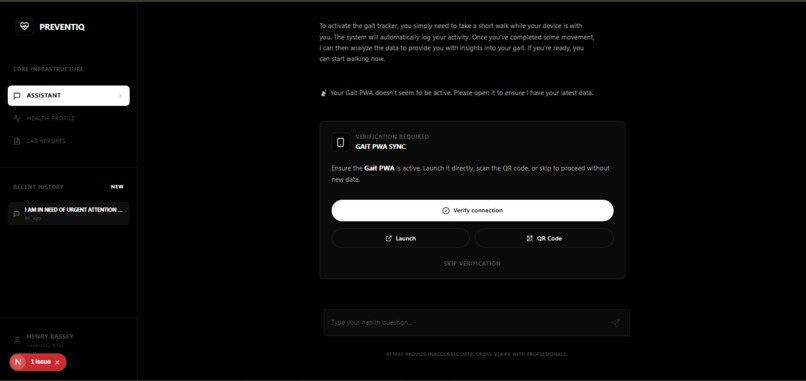
interface
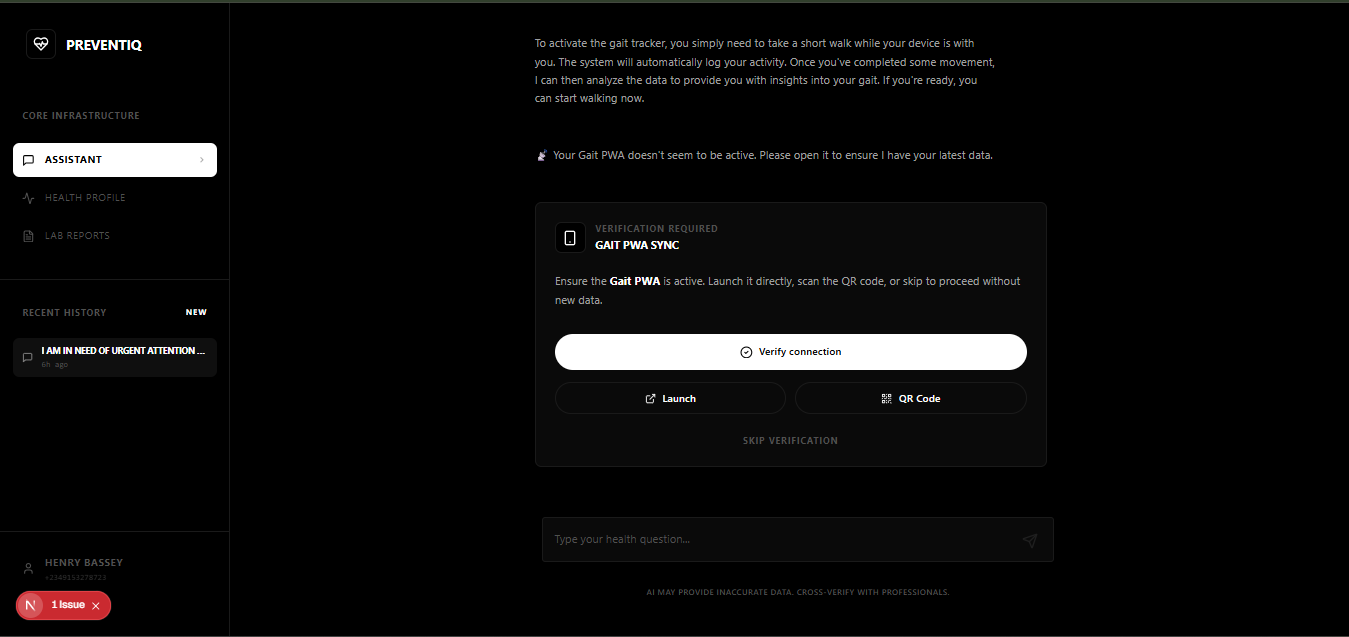
Inspiration
Nigeria faces a silent health emergency regarding chronic non-communicable diseases (NCDs). Over 77 million Nigerians live with hypertension, yet most cardiovascular and neurological conditions are only detected when they become acute emergencies.
When Team Alpha looked at the digital health space, we saw a massive engineering flaw: health apps rely on users typing in symptoms after they are already sick. That is reactive, not proactive. Furthermore, existing continuous monitoring solutions require expensive smartwatches—a hardware dependency that excludes 95% of our market. We were inspired to bridge this data gap by building a platform that turns the device everyone already owns—a standard smartphone—into a continuous, proactive biometric sensing layer.
What it does
PreventIQ is a continuous health intelligence platform that catches early indicators of physiological stress and ailments before they become emergencies.
Zero-Hardware Vitals: Utilizes the phone's sensors (accelerometer) for heart rate in Beats per minute through Ballistocardiography
Background Gait Analysis: Collects accelerometer data to track step regularity and detect neurological or musculoskeletal fatigue.
Actionable Routing: When our anomaly engine detects a severe deviation (e.g., compounding fatigue combined with elevated cardiovascular stress), the AI immediately triggers our Nearby Clinic feature, charting the user to the closest facility via OpenStreetMap and logging the biometric data for the doctor.
How we built it
We engineered PreventIQ as a scalable, low-latency distributed system:
The Sensing Layer (Frontend): A Progressive Web App (PWA) built with Next.js. We utilized device motion APIs to capture the raw biometric data directly from the browser.
The Intelligence Layer (Backend): Node.js running on the Cloudflare-ready Hono framework for millisecond edge-computing, writing to a serverless PostgreSQL database (Neon) via Prisma ORM.
AI & Mathematics: We integrated LangGraph.js for stateful diagnostic reasoning, using Groq (Llama 3) for instant conversational inference. To ensure our AI didn't hallucinate medical data, we built a strict mathematical engine using an Exponential Moving Average (EMA) algorithm to continuously calculate the user's true physiological baseline.
Responsible Use of AI Tools Transparency:
- we made use of claude as primary infrastructure research partner - we made sure never expose sensitive or private data to AI tools, only numerical insights - agentic support was used to bootstrap and streamline repetitive tasks
Challenges we ran into
One big engineering hurdle was the signal-to-noise ratio in the accelerometer data. When a phone is in a user's pocket, it picks up random vibrations (like riding in a bus or car) that completely ruin gait analysis. We solved this by implementing bandpass filtering to reject random frequencies, successfully isolating the actual kinetic impact of the user's footsteps.
Additionally, network reliability in Nigeria is unpredictable. We overcame this by heavily leveraging PWA Service Workers and the Wake Lock API. Our frontend caches biometric snapshots locally and automatically queues the sync to our REST API only when a strong connection is restored.
Accomplishments that we're proud of
We successfully shifted the paradigm from "AI as a Chatbot" to "AI as a continuous Biometric Engine." We proved that you do not need a $300 smartwatch to track high-fidelity health indicators. By engineering the mathematical baseline engine, we built a fully functioning, zero-hardware biometric pipeline in under 24 hours.
What we learned
We learned that AI is fundamentally useless in healthcare if it is generic. An LLM is only as powerful as the contextual data grounding it. By feeding our LangGraph agent a continuous stream of mathematically processed biometric anomalies—rather than just text prompts—our AI transitioned from giving generic web-search answers to providing highly specific, personalized triage.
What's next for Alpha
Our roadmap is focused on scaling this infrastructure:
B2B Clinic API Licensing: Allowing local HMOs and clinics to generate their own QR "Connection Ports" for waiting rooms. This means doctors will receive a patient's biometric triage data before they even walk into the consultation room.
Public Health Dashboards: We plan to aggregate anonymized anomaly data by Local Government Area (LGA) to provide the NCDC with early epidemic warning signals based on localized fatigue and stress spikes.
Built With
- gemini-2.5-flash
- groq
- hono
- langchain
- langgraph
- llama-3
- neon
- next.js
- node.js
- openstreetmap
- postgresql
- prisma
- pwa
- pytorch
- react
- tailwind-css
- tensorflow
- typescript

Log in or sign up for Devpost to join the conversation.