Alexandria
We dream of a distributed science publication system, without middlemen such as traditional publishers


Updates

Final Submission!
Finally we arrived to the final submission with three great videos and a lot of working code.
Videos
Development
Week 3 deliverable:
Prototype of the Solution
We have prototyped our solution with two developments:
An Ethereum Distributed Autonomous Journal (DAJ) contract. An Ethereum contract to govern distributed journals has been developed to show the information architecture and logic behind our proposal. The Solidity code is available in GitHub.
Several paper mockups. Paper mockups are great tools to test the Minimum Viable Product proposed by a project. Focusing on our three target users (editors, authors and reviewers), we are developing a user interface to serve each of these users during their publishing user journeys. The mockups are going to be tested, and once validated, they are going to be developed into working code (Web App) linked to the Ethereum Distributed Autonomous Journal previously described.
Testing the Minimum Viable Product
We have developed two strategies to test our MVP.
Video campaign: a whiteboard animation
First, we are going to launch a video consisting of a whiteboard animation explaining the problems that scientific publication faces today and how our tool tries to solve them. We are going to measure the funneling of the conversions between the number of video views, the number of landing page visits, and the number of subscriptions to the project news.
Thus, with this video campign we aim to validate the proposal by obtaining a list of interested people who may be our future early adopters.
The script of the video can be found in our GitHub repository.
Paper Mock up: The three target user interfaces
Following the approach of fail cheap, fail often to learn as fast as possible, we are developing three mockups of the user interfaces of our product, one for each target user (authors, editors, and reviewers). This mockups are based in the user journeys of the user.
They are going to be tested and transformed iteratively with user feedback to finally be connected with the Ethereum contract of a Distributed Journal once validated.
Log in or sign up for Devpost to join the conversation.
Week 2 deliverable:
- [x] Who are your clients/users? (persona of your user)
- [x] What are their pain points?
- [x] What is your product's value proposition?
- [x] What is your distribution and go-to-market strategy? Who can you partner with?
- [x] What are the risks associated with your solution?
- [x] What is the impact of your solution? How will it be measured?
- [x] Define the technical specifications and development roadmap
- [x] Define your impact criteria and how you measure it
Who are your clients/users? (persona of your user)
The main user of our product is represented by Alice, a young researcher that needs to finish her PhD and get recognition for her work. She is a cryptographer that needs to send papers in recognized journals such as BOB (Big Overpriced Boring journal). She likes to work in science, a sexy profession where she can do cool things and impact the world. However, sometimes the work is time consuming and unfair reviews can make the already slow peer review process even harder.
Other users are:
- The whole scientific comunity, interested in the open access and difussion of science.
- Citizens (Open Access to knowledge) including disenpowered communities that cannot currently afford the access to scientific knowdledge.
- Institutions: cheaper access to Journals.
- Innovation actors such as startups, research and development organizations, etc. Having a cheap and quick access to new knowledge.
What are their pain points?
- Need to publish in Indexed Journals in order to get accreditation (e.g. for becoming an associate professor).
- Time to publish.
- Non-transparent processes.
- Unfair anonymous reviews.
- Time consuming.
- Low salaries.
What is your product's value proposition?
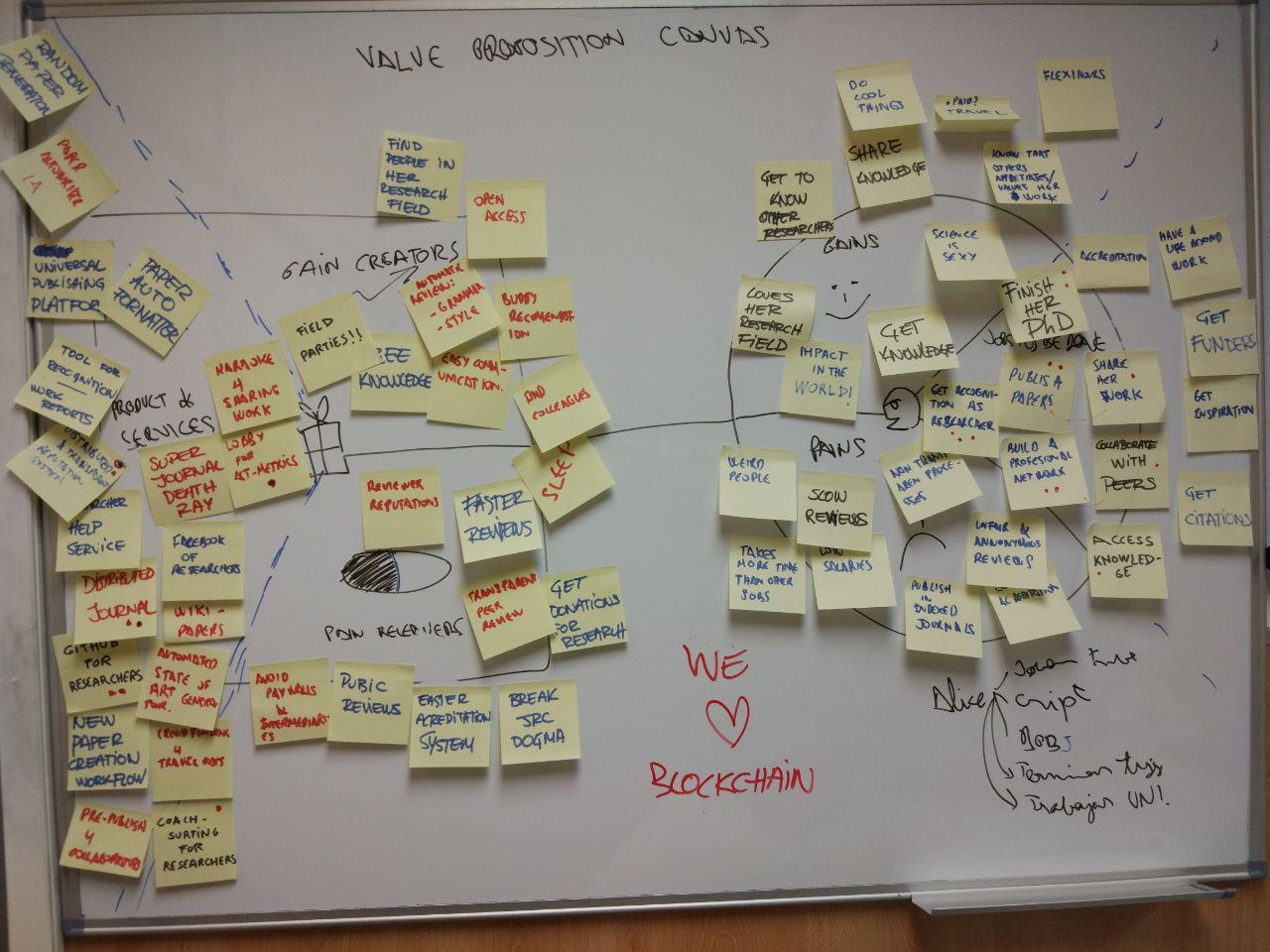
In order to find our product's value proposition we conducted a brainstorming session in which we used a Value Proposition Canvas. These are the results of the session:
We aim to build a new generation of distributed journals. It will enable transparent processes for science publishing and remove unnecesary intermediaries and costs.
This journals ecosystem will rely in a decentralized network of reviewers, that will gain reputation in their field as they provide good peer reviews. Thus, we aim to encourage better and faster reviews through that reputation system, that will improve publishing experience for authors and journals, enabling more transparent processes.
Journals will be able to govern themselves with Smart Contracts, making their processes even more transparent and becoming Distributed and Autonomous, and papers will be openly shared and published using the IPFS P2P technology. By removing intermediaries, we aim to provide a method for publishing open science that is free for everybody.
What is your distribution and go-to-market strategy? Who can you partner with?
There are several Open Access journals that could benefit with our technology, making the publishing process easier for authors, reviewers and editors while reducing costs and pains. We aim to serve these journals first by providing a network of reputable and fast reviewers, and after by helping them publish through P2P technology and to establish their processes as transparent Smart Contracts.
Other potential partners are:
- Academic institututions such as universities.
- Researchers
- Research groups
- New Open Access Journals
What are the risks associated with your solution?
- Monpolistic strategies against our journals (JCR, the defacto standard, is produced by a Status Quo company affected by the project).
- Risk aversion of researchers, that will not send papers unless impact is likely.
- Big inertia of Academia and Academic Publishing, that could not be ready for big changes.
What is the impact of your solution? How will it be measured?
- Provide a new supply chain for science ditribution that removes intermediaries and improve efficiency while enabling innovation in the research publication processes and workflows.
- Increase the number of Open Access Journals.
- Break the vampirist chain of publishers who benefit with other people's work.
Define the technical specifications and development roadmap
Proof of concept:
- Develop a sample contract in Ethereum that sets a journal gobernance model:
- Test the contract.
- Review the contract rules.
- Review contract security.
- Develop an infrastructure for submiting, reviewing and publishing papers in IPFS:
- Best data structure for papers and reviews.
- Distribution and access strategies from current web technologies.
- Provide cryptographic solutions for double blinded peer review and other processes we aim to support.
- Provide DOIs or other identifiers for published papers.
First descentralized journal, the Distributed Open Journal of Distributed Open Technologies (DOJôDOT):
- DOJôDOT first call for papers:
- Create and deploy the Journal's governance contract in Ethereum.
- Develop an initial network of reviewers.
- Publish a sample paper to IPFS.
- Accept the published sample paper through Journals governance (maybe in the form of an editorial).
Define your impact criteria and how you measure it
Being our goal to help researchers to publish their work in transparent peer reviewed journals with good metrics (both standard such as JCR or Alternative Metrics), our most relevant impact metrics are defined as follows:
- Author satisfaction:
new author to recurrent author convertion ratio - Journal satisfaction:
new journal to recurrent journal convertion ratio - Peer-review quality:
average review rating / average time of review - Recognized Impact:
number of published papers * (number of citations - number of unrecognized citations / number of citations)
from which we derive our
- KEY METRIC:
number of authors * author satisfaction
We understand our key metric as dependant to other metrics, as the number of satisfied authors depends on how many recognized journals are in the system and how our system improves peer review process.

Following we list the factors identified as relevant to our product.
- # of decentralized journals
- # of decentralized journals with JCR
- # of decentralized journals with good Alt-Metrics
- # of authors
- # of submissions
- # of published papers
- # of reviewers
- # of citations
- # of peers sharing papers (seeds)
- # impact factor of journals
- # time of response of journals
- perceived quality of Journal vs traditional Journals (Through formulaires)
- Value of reviews (through reviewers rating system)
Log in or sign up for Devpost to join the conversation.

Log in or sign up for Devpost to join the conversation.
An appetizer for our week 2 deliverable: our value proposition canvas: https://github.com/Amanuenses/Alexandria/blob/master/Week2/valuePropositionCanvas.jpg

Log in or sign up for Devpost to join the conversation.

Week 1 milestones
Week 1 September 7 - September 14: Defining assumptions
- [x] Confirm your team members (by 9/7/17):
- [x] Choose which challenge you are going to be working on
- [x] Define specific problem you're addressing
- [x] Why is Blockchain needed to solve this problem?
- [x] What is the size of the market?
- [x] What other solutions are currently being used to address this problem? (other companies, workarounds, systems or processes that can compete with or substitute your product)
End of Week Deliverable – Document answering the above questions
Team members
Viktor Jacynycz, Antonio Tenorio, Sem, Tati Nazarova
Challange we are working on
Supply Chain
Problem we are addressing
The current science distribution model was developed before the Internet age. In the past, the only way to access state of the art knowledge was to subscribe to specialized academic journals, but nowadays this model is obsolete. The publishing process is extremely slow, sometimes lasting years in which the authors of a paper cannot share their scientific advances with the community until the article is published. This obstructs the access to knowledge, instead of promoting it.
This model is only serving the interests of big publishing oligarchies, not the interests of society and the scientific community. This distribution model is so unfair that publishers usually get the scientific papers and reviews for free from their authors, while they charge scientists, institutions and people to access those papers.
Many are the challenges that science distribution faces today, from providing open access to knowledge, to using alternative metrics for measuring the quality of science.
By using the Internet as a distribution platform and Blockchain technology to enable distributed governance and remove intermediaries, we aim to change the way science is distributed today. Concretely, we aim to use the IlnterPlanetary File System (IPFS) as an open, distributed, and non-censurable channel to share scientific papers; and develop an Ethereum Distributed Autonomous Organization (DAO) to enable a distributed peer-review process in which trusted reviewers can accept, propose changes and reject papers, being the accepted papers "published" in the DAO's distributed journal.
This approach enables open access by default, makes the peer review and publication process easier and faster, removing intermediaries such as publishers, and makes the process entirely transparent. Moreover, by changing the distribution model, the production model is also challenged. Making the distribution and evaluation of science easier may encourage new models of production similar to open-source, in which the knowledge is not considered static and it is easy for external contributors to propose enhancements.
Why is Blockchain needed to solve this problem?
With Blockchain technology we can develop Distributed Autonomous Organizations (DAOs) that replace traditional journals in the peer review and publishing process. The gobernace of these journals will be defined by the DAO's source code in Ethereum.
The DAOs will transparently define their rules, such as the number of favorable peer-reviews needed for a paper to be published, or who are the people that can decide if the paper is in the scope of the journal.
Thus, scientific community will be able to publish and access peer-reviewed papers without any cost. Moreover, anyone can create their own journal with custom gobernace rules to publish scientific knowledge.
The knowledge stored in these DAOs will be permanent, incensorable and globally accesible for everyone.
What is the size of the market?
According to a recent European Comission report, the total market size of Academic Publishing and Open Access publising are:
- Academic publishing: $10 billion / year
- Open Access: $500 million / year
We are aiming to change a market supported by old technologies and established oligopolies with decentralized disruptive technologies. This opens new opportunities for many new open access distributed journals, challenging business models built upon unneeded intermediaries.
Source: Johnson, Rob, Mattia Fosci, Andrea Chiarelli, Stephen Pinfield, and Michael Jubb. “Towards a Competitive and Sustainable OA Market in Europe-A Study of the Open Access Market and Policy Environment,” 2017. http://eprints.whiterose.ac.uk/114081/1/OA%20market%20report%20(Final%2013%20March%202017).pdf.
Other solutions currently in use
Many solutions have been proposed to provide open access to knowledge and to improve the publishing and distribution of science. There are two open-access distribution models, Green Open Access and Gold Open Access. On the one hand, authors using Green Open Access model share their work in an open repository (such as CiteSeer, arXiv, PubMed Central), but they can only share the work they have the rights of (usually only preprint versions). On the other hand, Gold Open Access provides free access to the content, while authors, subscribers, advertisers or founders are charged.
Both traditional and new publishers and journals (e.g. Elsevier and PLOSS, respectively) provide open access for science publication. However, both Green and Gold models make profit out of knowledge publication, either by charging for the final versions, or, alternatively, by charging the authors or making profit with other business models.
Open access to knowledge is also being promoted through sharing access to papers (either open access or not) with tools such as sci-hub.cc. These solutions are, however, accused of copyright infringement, and have been blocked in some countries.
Regarding publication speed, journals are beginning to adopt online and continuous publication to deliver accepted papers online as soon as they are ready. Using this approach, papers do not have to wait for other journal papers to be finished in order to publish the entire issue.
However, to our knowledge, there have been no attempts to grant open access through peer-to-peer technology by the journal/publishers or to provide transparency and efficiency in the peer review and publication processes through Blockchain technologies.
Log in or sign up for Devpost to join the conversation.
Leave feedback in the comments!
Log in or sign up for Devpost to join the conversation.
Log in or sign up for Devpost to join the conversation.