-
-
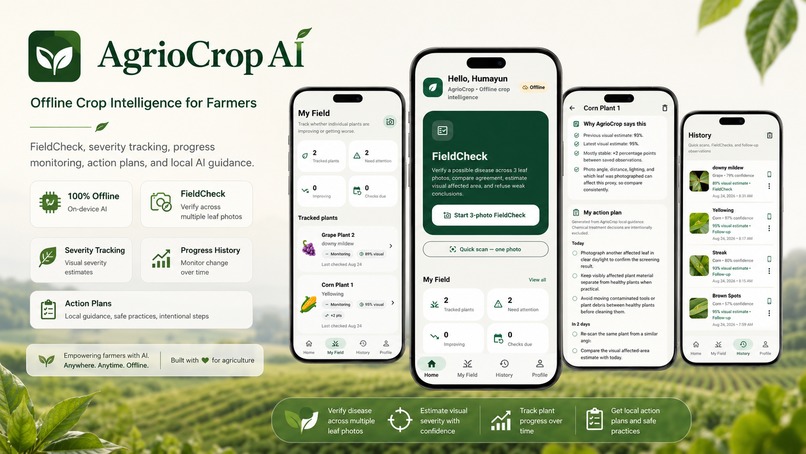
AgrioCrop dashboard with FieldCheck, My Field, progress tracking, history, and offline analysis.
-
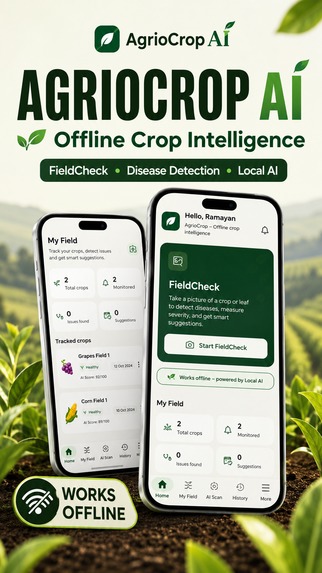
AgrioCrop AI: offline disease detection, FieldCheck, severity tracking, and local AI guidance.
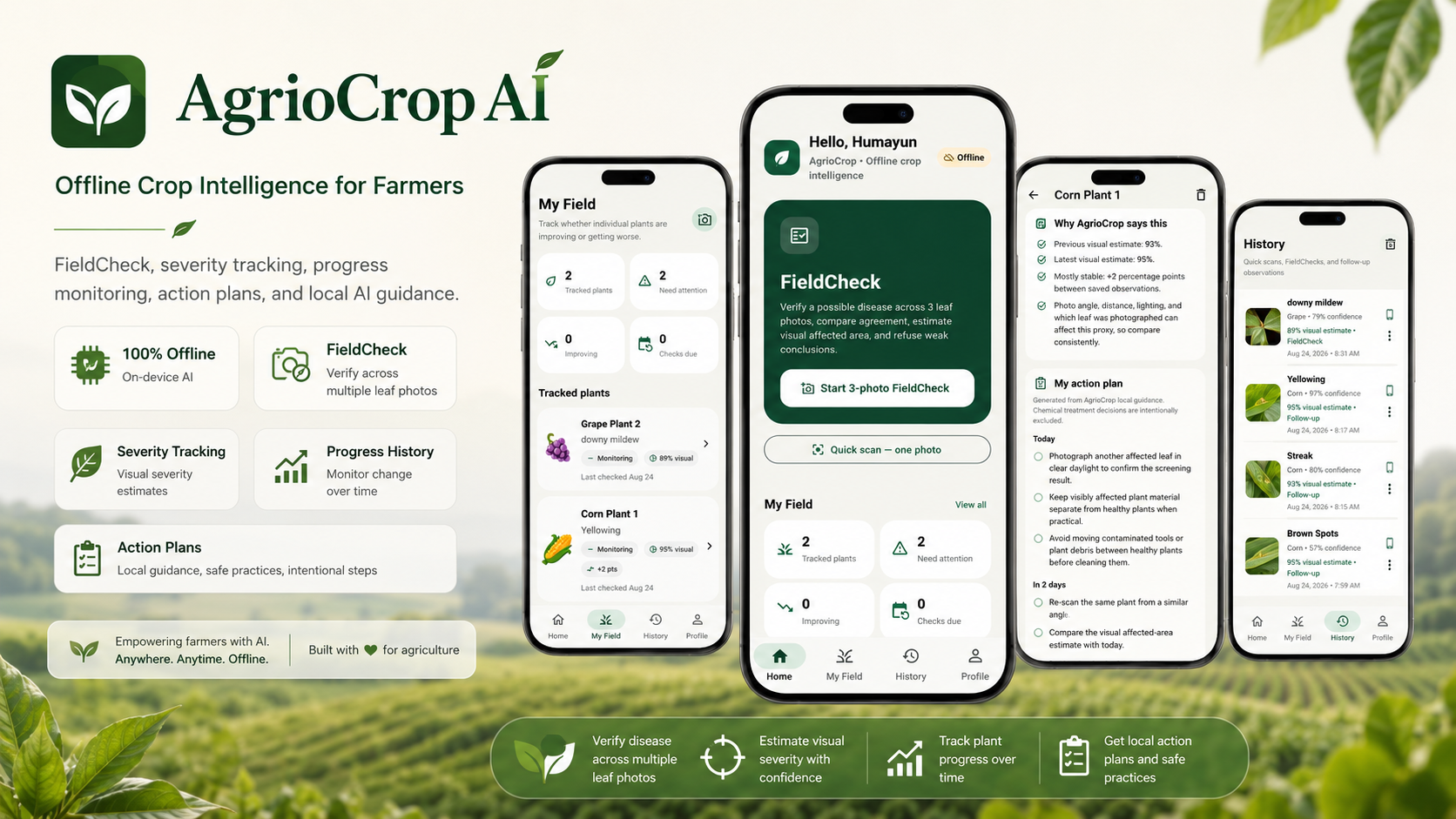
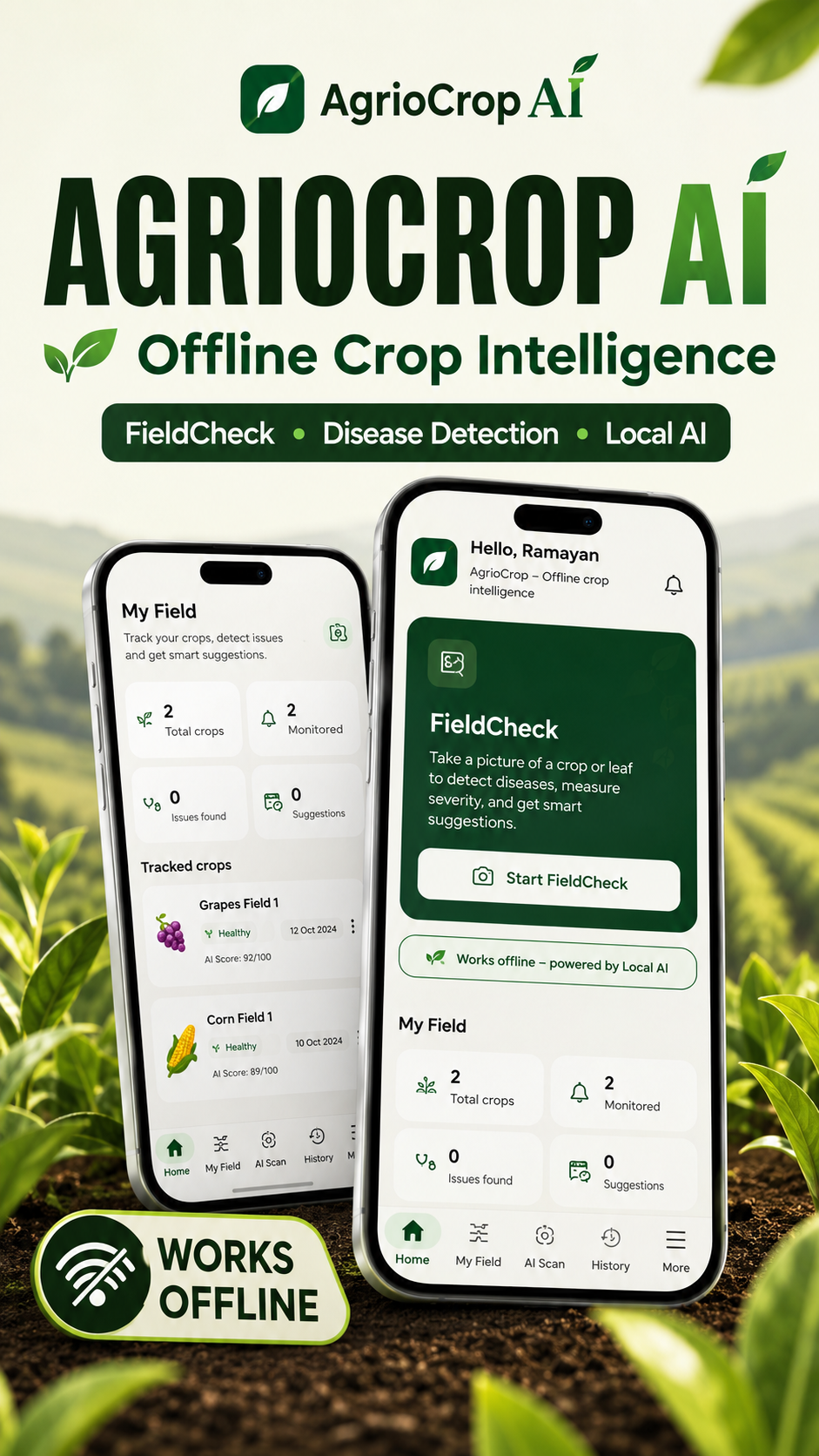
Farmers in rural areas often deal with unreliable internet access, while many AI-powered agriculture tools depend on cloud APIs. We wanted to build something that could still help a farmer when connectivity is poor or completely unavailable.
AgrioCrop AI started with a simple question: Can useful crop intelligence run directly on a farmer’s phone? We also wanted to go beyond a basic “take a photo and get a disease label” demo by helping farmers verify results, monitor changes, and understand what to do next.
What it does
AgrioCrop AI is an offline crop intelligence app that performs plant-disease screening directly on the device.
Farmers can take a photo or upload one from their gallery. A local YOLOv11x model covering 116 plant-disease classes analyzes the image without sending it to a cloud AI service.
AgrioCrop also includes FieldCheck, which analyzes three different leaf photos from the same plant and compares the predictions before presenting a stronger conclusion. If the evidence is weak or conflicting, the app asks for another scan instead of forcing a confident result.
The app also provides:
Estimated visual affected-area severity Plant tracking through My Field Follow-up scans and progress monitoring Improving, worsening, or stable trend indicators Scan and FieldCheck history Explainable AI results Local action plans Camera and gallery input Offline Qwen3-1.7B agricultural assistant English and Urdu support Optional privacy-preserving community crop signals
AgrioCrop is designed as an AI screening and monitoring tool, not as a replacement for a qualified agronomist.
How we built it
The application is built with Flutter for the mobile interface.
For plant-disease screening, we use a local YOLOv11x object-detection model with 116 plant-disease classes. The model is exported to ONNX and executed directly on the Android device.
Our processing pipeline is:
Camera/Gallery → Image Quality Check → YOLOv11x → Crop Validation → Confidence & Uncertainty Checks → Visual Severity Estimate → Local Guidance
For FieldCheck, the application analyzes multiple leaf images and combines their predictions using a consensus layer rather than relying on only one image.
AgrioCrop stores plant observations locally so users can compare severity estimates across follow-up scans and visualize progress over time.
For conversational guidance, we integrated Qwen3-1.7B Q4_K_M as a local GGUF model. The assistant receives the crop, screening result, confidence, symptoms, severity information, and locally stored guidance as context. A dedicated system prompt keeps the assistant focused on agriculture and prevents it from inventing chemical dosages or treatment schedules.
We use Firebase Authentication for user accounts and Firebase for selected cloud functionality, while the core image inference and local AI experience remain on-device.
Challenges we ran into
One of the biggest challenges was running meaningful AI models on a mobile device while keeping the experience usable.
The YOLO model is relatively large, so we had to handle model conversion, ONNX inference, image preprocessing, memory management, and mobile performance carefully.
Running a local LLM was another challenge. Larger models provided better responses but were significantly slower on a phone. We tested smaller alternatives before deciding that Qwen3-1.7B provided a better quality tradeoff for the agricultural assistant.
We also had to handle uncertainty correctly. A high-looking model score does not automatically mean a diagnosis is correct, so we added crop-specific filtering, confidence thresholds, multi-photo verification, and clear “possible disease” language.
Another challenge was turning raw detections into something actually useful. Instead of stopping at a disease label, we built plant tracking, severity estimates, progress history, action plans, and explainability around the AI output.
Accomplishments that we're proud of
We are especially proud that AgrioCrop works as more than a simple image classifier.
We built an end-to-end offline workflow where a farmer can:
detect → verify → understand → save → re-scan → compare → ask questions
FieldCheck is one of our favorite features because it challenges the idea that one photograph should always be trusted. AgrioCrop can compare evidence across three leaf images and refuse weak conclusions.
We are also proud of the My Field experience, where repeated observations can show whether a plant appears to be improving or worsening over time.
Finally, combining local computer vision with a local agricultural assistant means the most important parts of the experience can continue working even without internet connectivity.
What we learned
We learned that putting an AI model inside an application is only a small part of building a useful AI product.
Handling uncertainty, model limitations, device performance, user trust, privacy, and follow-up workflows can be just as important as model accuracy.
We also learned that smaller edge models require careful product design. Rather than asking the local LLM to know everything, we provide it with structured scan context and local disease guidance. This makes the assistant more focused and useful.
Most importantly, we learned that AI should not simply return an answer. For real-world applications, it should help users understand why a result was produced and what information they should collect next.
What's next for AgrioCrop AI
Next, we want to improve AgrioCrop through real field testing and evaluate the detection and severity pipeline across different phones, lighting conditions, crops, and disease stages.
We also plan to expand the reviewed local disease knowledge base, improve Urdu agricultural guidance, optimize local inference performance, and make FieldCheck more intelligent about image diversity and uncertainty.
A future version could allow farmers to optionally contribute anonymous, coarse regional disease signals, creating an early-warning map of emerging crop problems without uploading their plant images or precise farm locations.
Our long-term goal is to make AgrioCrop a practical offline crop intelligence companion that helps farmers detect problems earlier, monitor plants over time, and make more informed decisions where reliable internet access cannot be assumed.


Log in or sign up for Devpost to join the conversation.