-
-
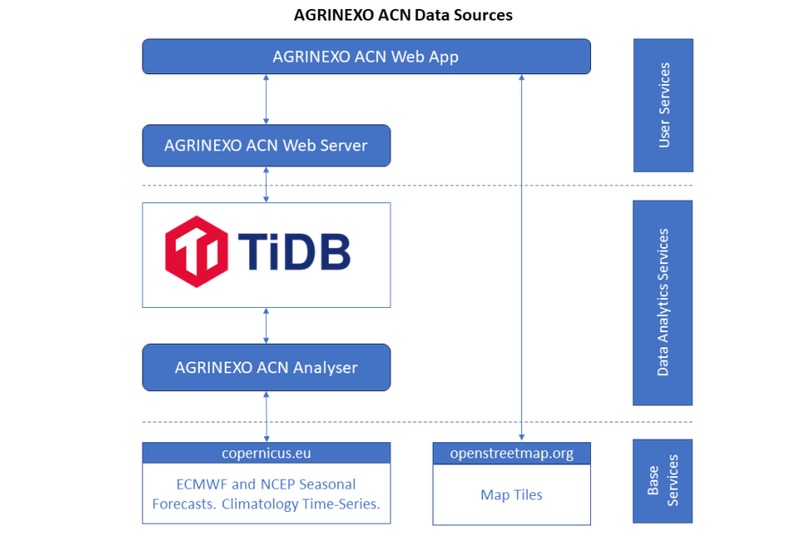
AGRINEXO ACN Data Sources
Inspiration
Agrometeorological seasonal forecasts with adequate resolution have the potential to become a key tool for farm planning, allowing for the adjustment of the cultivated areas and for the optimization of farming operations (planning of sowing, selection of optimal crop variety, planning of fertilisation and field interventions, pest and disease risk assessment, and irrigation management).
Agricultural production losses resulting from drought and heatwaves are largely driven by yield declines, with no significant changes in harvested area [1]. Although those crop losses are not avoidable under most circumstances, improved local agrometeorological seasonal forecasts would allow decision makers to adjust cultivated areas, irrigation, and fertilization, to the expected productivity in adverse conditions.
Copernicus C3S Seasonal Climate forecasts are global forecasts with regional scale, modelling the large-scale interaction of the main factors influencing Earth climate over several months and are not intended to be directly used in field level crop models. For an operational use in field level crop models, expected temperature and precipitation regional averages must be transformed in expected temperature and precipitation averages at specific locations and the forecast quality for that specific location also needs to be assessed in a meaningful way for the decision makers at the agricultural production units (farmers and technicians).
Our aim is to provide a local agrometeorological seasonal forecast that is usable and evaluable by farmers and technicians, bridging the gap between state-of-the-art regional scale seasonal forecasts and the local scale information required to optimize conservation practices and farming operations.
What it does
AGRINEXO ACN is an agroclimatology analyser providing key agroclimatic parameters at local level (0.25 degrees base grid) and enabling for the comparison of seasonal forecasts based on diverse climatic models.
How we built it
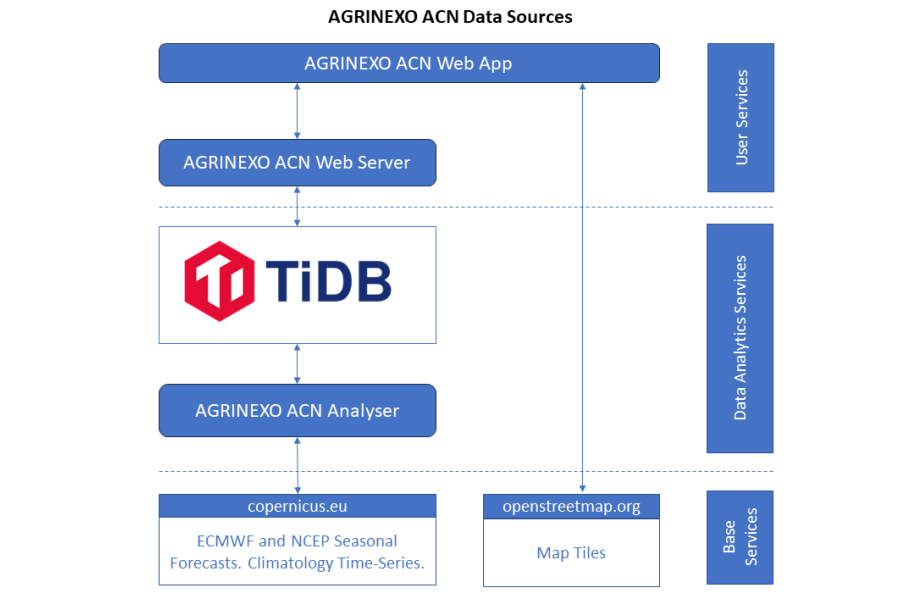
Seasonal forecasts based on ECMWF and NCEP models are derived from Seasonal forecast anomalies on single levels and climatic data is derived from ERA5 monthly averaged data on single levels from 1959 to present, both available from the Copernicus Climate Change Service as open data.
Reference evapotranspiration is computed using the Hargreaves–Samani Method. Crop water requirements are estimated using a single crop coefficient [2] and assuming , well-fertilized crops, grown in large fields, under optimum soil water conditions and achieving full production under the given climatic conditions
A TiDB serverless cluster is used as a central repository of application data, enabling for an efficient communication and synchronization mechanisms between the main application services, namely between the front-end web service and the climate analyser service.

What's next for AGRINEXO ACN
The current pre-release version implements simplified forecast downscaling procedures and current development efforts are addressing these limitations.
We are also refining requirements with major stakeholders as farmers and agricultural engineers, to improve the solution.
References
[1] Brás, T. A., Seixas, J., Carvalhais, N., & Jägermeyr, J. (2021). Severity of drought and heatwave crop losses tripled over the last five decades in Europe. Environmental Research Letters, 16(6), 065012.
[2] R. Allen, L. Pereira, D. Raes, and M. Smith, “Crop evapotranspiration: Guidelines for computing crop water requirements,” U.N. Food & Agriculture Org., Rome, Italy, FAO Irrigation and Drainage Paper #56, 1998.
Built With
- copernicus.eu
- javascript
- openstreetmap
- php
- python
- tidb

Log in or sign up for Devpost to join the conversation.