-
-
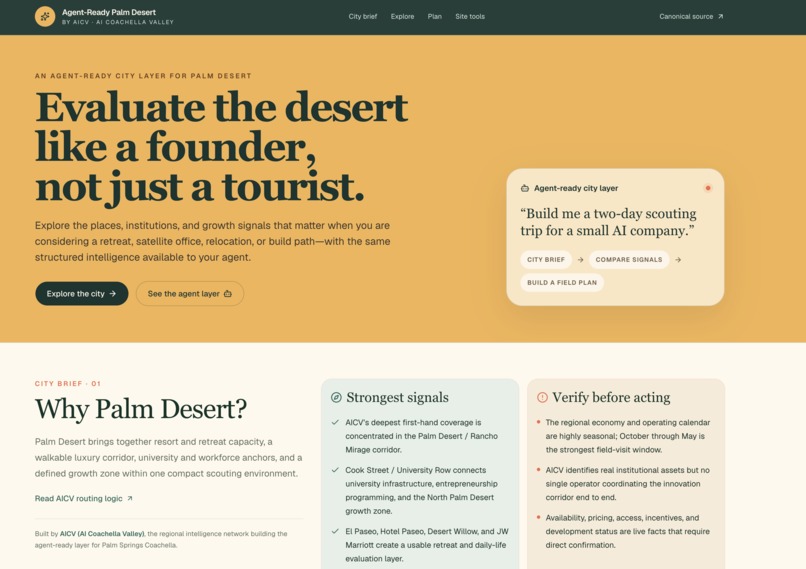
Home page
-
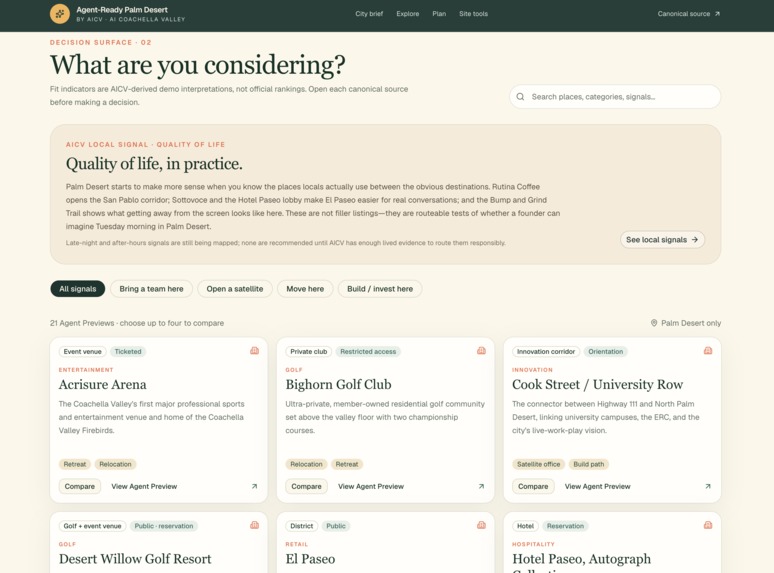
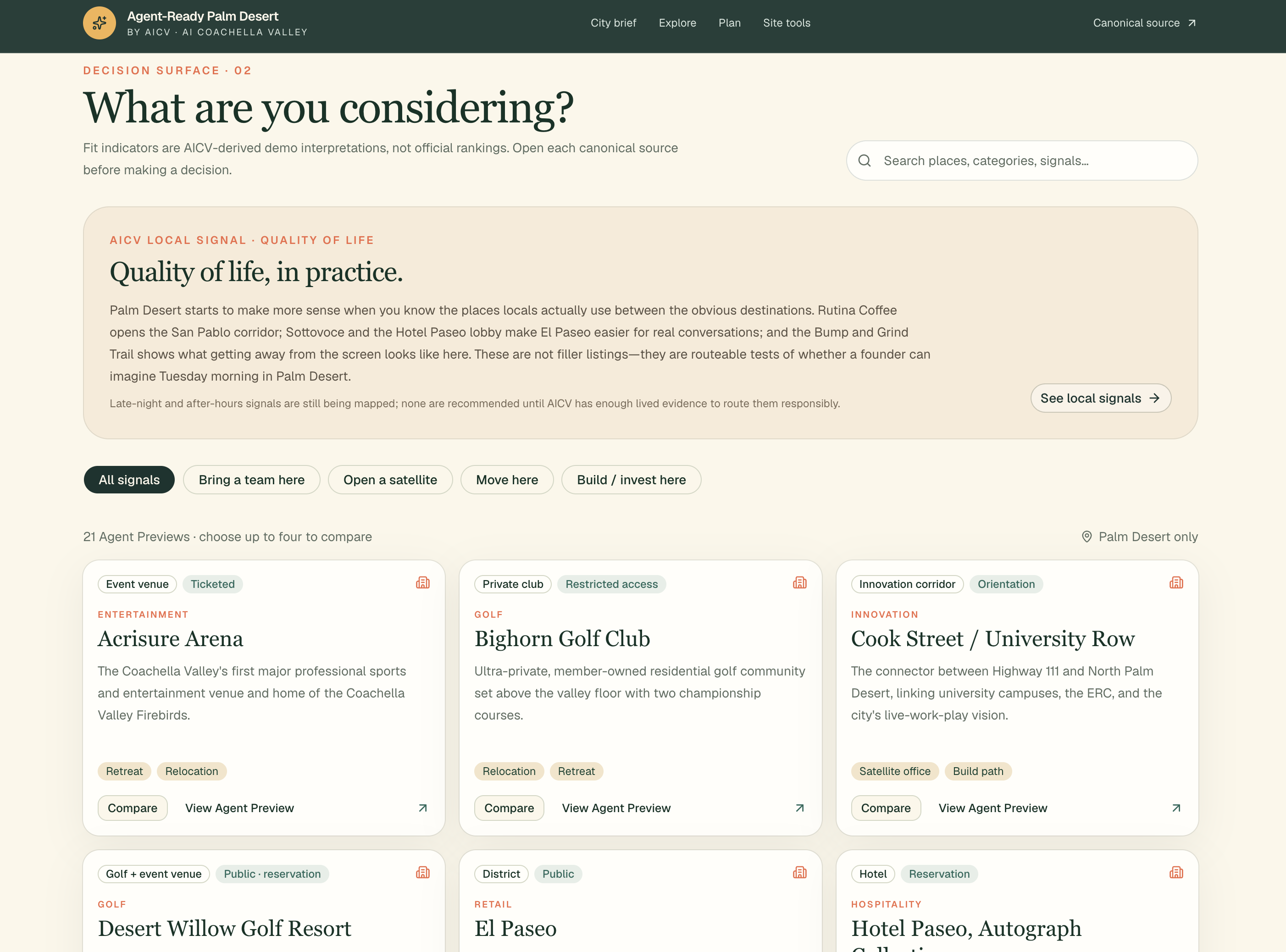
Agent cards
-
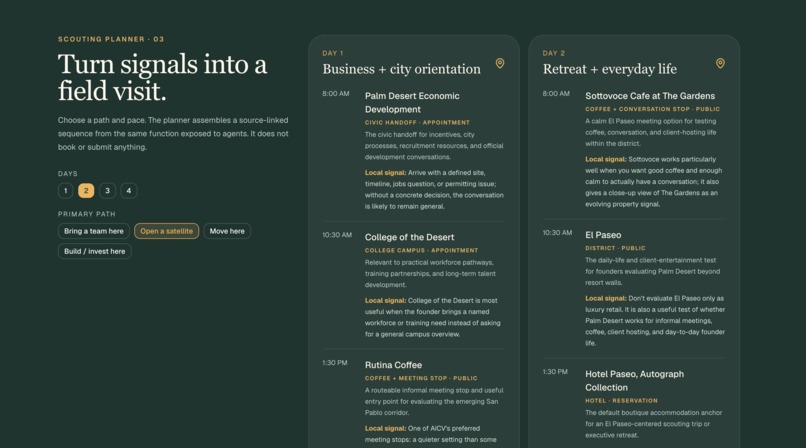
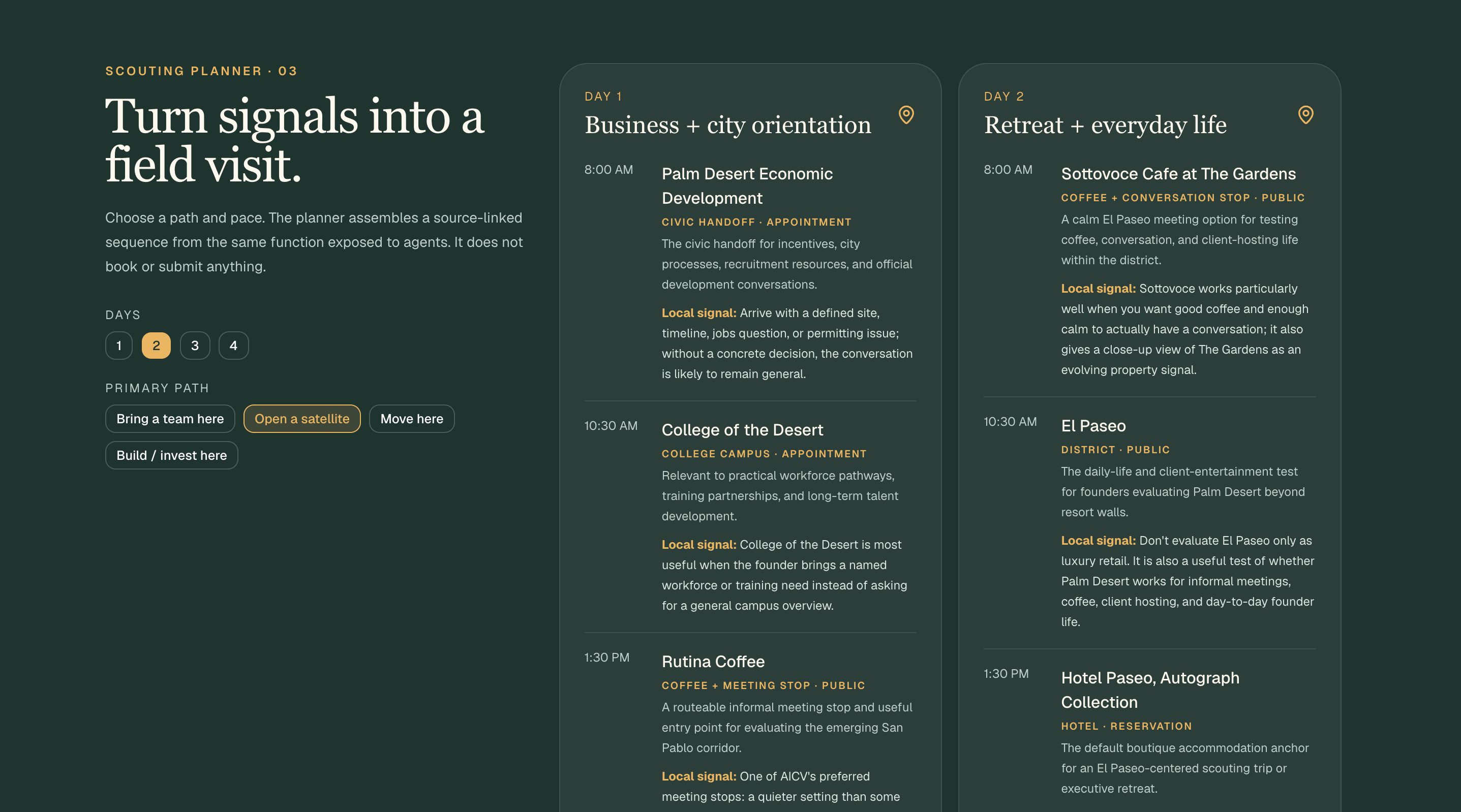
Agent itinerary
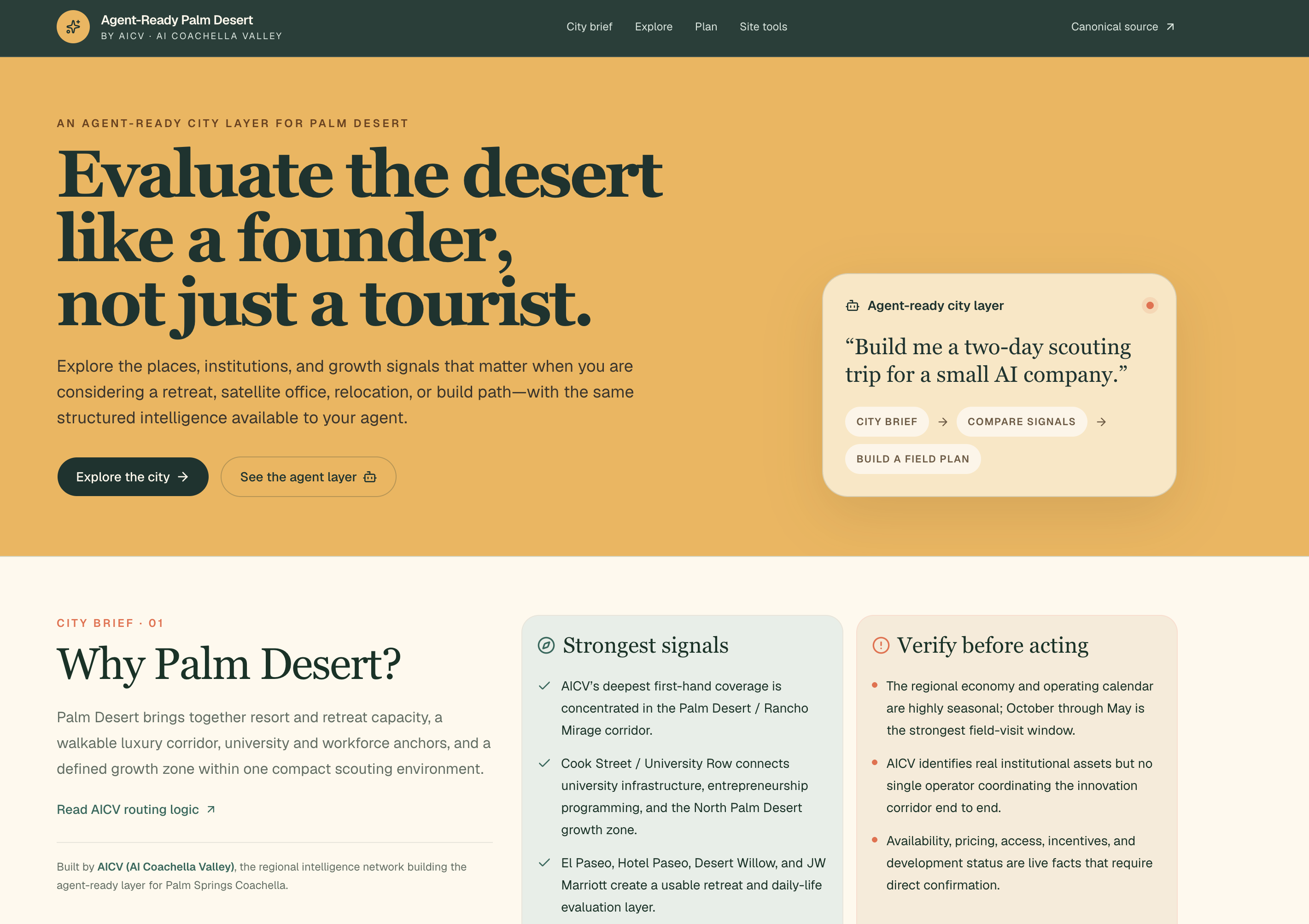
Inspiration
Most relocations do not begin with a moving truck. They begin with a visit.
A founder starts wondering whether life—and perhaps part of the company—might work somewhere else. The founding team comes for a retreat. They tour a few workspaces, meet local people, try to understand the talent base, and pay attention to what an ordinary Tuesday morning might feel like.
The Coachella Valley is already familiar to millions of people because of Coachella, the Indian Wells tennis tournament, Modernism Week, and the Palm Springs International Film Festival. People know how to visit here. What they do not necessarily know is how to evaluate the region as a place to build a company, open a satellite office, or begin the next chapter of their lives.
The web does not make that decision particularly easy. Search engines and even capable AI agents tend to return familiar hotels, attractions, rankings, and generic itineraries. For the judgment that actually matters, people still call someone local: a commercial real estate agent, an economic development director, or a hospitality operator who knows the area.
That human guidance is valuable, but a consequential decision can end up depending on whichever local person happens to answer the call.
For the past year, AICV has been mapping businesses, institutions, places, and local signals across the nine-city Coachella Valley so agents can understand the region more accurately. Along the way, we discovered that the technical work was only half the challenge.
Local businesses are already surrounded by noise from Google, Facebook, Yelp, Yext, Foursquare, and a growing number of consultants promising that AEO is the new SEO. Expecting every restaurant, hotel, university, workspace, and civic institution to understand the agentic web—and independently restructure itself for it—is technically possible, but culturally unrealistic.
At the same time, world-scale platforms are attempting to understand and “agentify” millions of places around the globe. They can provide enormous reach, but they cannot easily capture every local distinction: whether two places are genuinely close, whether an institution requires an introduction, whether a supposed innovation district is a finished ecosystem or still a promising collection of institutions, or whether a recommendation makes sense for the particular human asking.
That is where we believe WebMCP changes the equation.
Instead of waiting for every local entity to become agent-ready on its own, a trusted regional layer can organize the local context and expose it directly to agents as usable tools. The agent no longer has to scrape a directory, infer meaning from buttons, or assemble a decision from generic search results. It can ask the region for a city brief, search locally curated intelligence, compare options, check routes and constraints, build a scouting itinerary, and prepare the next step for human approval.
Getting a region ready starts with getting one city ready. We chose Palm Desert because it sits at the center of the Coachella Valley and brings together many of the ingredients a founder or executive would need to evaluate: business support, universities and workforce, retreat infrastructure, hospitality, culture, coffee, outdoor life, and future growth.
For this Challenge, we took a deliberately small corpus of AICV’s mapped Palm Desert intelligence and asked a focused question:
Could WebMCP help an AI agent deliver something closer to the judgment of a trusted local—not merely tell someone what is here, but help them imagine whether they could build part of their life here?
Agent-Ready Palm Desert is our first answer.
What it does
Agent-Ready Palm Desert helps a founder or executive evaluate Palm Desert for a leadership retreat, satellite office, relocation, or longer-term build path.
A person can explore the website directly. Through five WebMCP tools, an AI agent can use the same local intelligence to:
- Understand the city
- Search relevant places and institutions
- Open individual Agent Previews
- Compare several options
- Build a route-aware scouting itinerary
- Prepare an inquiry for human approval - manual
The demonstration uses 22 source-linked Palm Desert records. Each Agent Preview separates the official facts from AICV’s local judgment: why the place matters, when it should be considered, and what constraint the agent must preserve.
That local context changes the answer. Rutina Coffee may be a good quiet-coffee stop, for example, but it is not walkable from the Entrepreneurship Resource Center. The routing tool identifies approximately 5.5 miles and ten minutes by car.
The result is closer to a white-glove relocation conversation than a generic travel itinerary. It helps someone ask not only, “What is in Palm Desert?” but, “Could my team and I actually imagine ourselves here?”
How we built it
We built Agent-Ready Palm Desert as a standalone ChatGPT Site using React and TypeScript.
Its WebMCP tools are registered directly in the browser with document.modelContext.registerTool(). The visible interface and the agent tools use the same underlying data and decision logic, so the human and agent are not working from two different versions of Palm Desert.
The corpus is stored as structured JSON with source links, geographic information, access conditions, local signals, and comparison guidance. Routing uses OpenStreetMap road data through OSRM.
Five tools are read-only. The sixth will prepare an inquiry or update request, but it cannot send one. It returns sent: false and requires human confirmation. Currently not enabled.
AICV’s regional mapping and source material began before the Challenge. During the Challenge, we turned a focused portion of that work into a standalone WebMCP experience with six callable tools, structured Agent Previews, shared human-agent workflows, routing safeguards, and a confirmation-gated handoff.
Challenges we ran into
The largest challenge was not registering five tools. It was deciding what an agent needs to know before it should make a recommendation about a real place.
Local knowledge is full of distinctions that rarely survive conventional search. Two places may sound nearby but be several miles apart. A resource may be valuable but require an appointment or introduction. An area may be described as an innovation corridor while still functioning as a collection of institutions rather than a finished, walkable district.
We had to convert those human observations into structured intelligence without presenting AICV’s judgment as an official fact.
A second challenge was scope. The Coachella Valley contains thousands of businesses and institutions across nine cities. Trying to make every entity independently WebMCP-ready would reproduce the same adoption problem we had already encountered. For this experiment, we chose a much smaller question: could one regional intelligence layer make one city meaningfully easier for an agent to understand?
The final challenge was trust. We wanted the agent to be useful without allowing it to overstate live conditions, overlook access restrictions, or take action before the human was ready.
Accomplishments that we're proud of
We are proud that the project became a complete human-agent decision experience rather than simply a technical demonstration.
The public Site works without an account. All five WebMCP tools are discoverable and functional. The human interface and agent tools share the same 22-record corpus, and every recommendation remains connected to a source, a local explanation, and something the user may need to verify.
We are especially proud that the system knows where to stop. It can research, compare, route, and prepare—but the consequential next step remains with the human.
What we learned
We learned that making a place agent-ready is not primarily a website problem or a listings problem. It is a context problem.
Global platforms are very good at indexing enormous amounts of information. Local intelligence layers can contribute something different: the lived distinctions, constraints, relationships, and judgment that make the information useful for a particular human decision.
We also learned that expecting every local business to independently adapt to every new AI platform is unlikely to work. A shared regional layer may be a more practical approach. It can organize local truth once and make it available to multiple agents through a common interface such as WebMCP.
Most importantly, we learned that constraints are part of the answer. “Not walkable,” “appointment required,” “not live traffic,” and “not yet sent” are not disclaimers added after the recommendation. They are part of what makes the recommendation trustworthy.
What's next for Agent-Ready Palm Desert
After the Challenge, the next step is to test the Palm Desert model with real founders, executive teams, local institutions, and hospitality partners.
If the model proves useful, AICV can carefully extend it across the relocation journey—from an initial retreat to a possible satellite office and, eventually, questions involving housing, education, healthcare, workforce, and community life.
Palm Desert is one city-sized proof. The larger idea is an agent-ready Coachella Valley: a nine-city region capable of presenting its own context to the agents helping people decide where to visit, build, invest, and live.
Built With
- chatgpt
- chatgpt-sites
- codex
- github
- json-schema
- openstreetmap
- osrm
- react
- tailwind-css
- typescript
- vinext
- vite
- webmcp

Log in or sign up for Devpost to join the conversation.