Inspiration
Modern microservices generate chaotic logs—different languages, frameworks, and formats. Traditional solutions like ELK require rigid schemas, creating operational overhead and causing pipelines to break when logs don't conform.
The pain: Security incidents buried in terabytes of messy logs, false positives overwhelming engineers, and fraud patterns going undetected.
The insight: What if AI could gracefully handle messy reality instead of demanding perfect structure? What if agents could both monitor in real-time AND investigate historical patterns on-demand?
AegisFlow uses intelligent agents as a safety net: when logs break expectations, AI steps in.
What it does & How we built
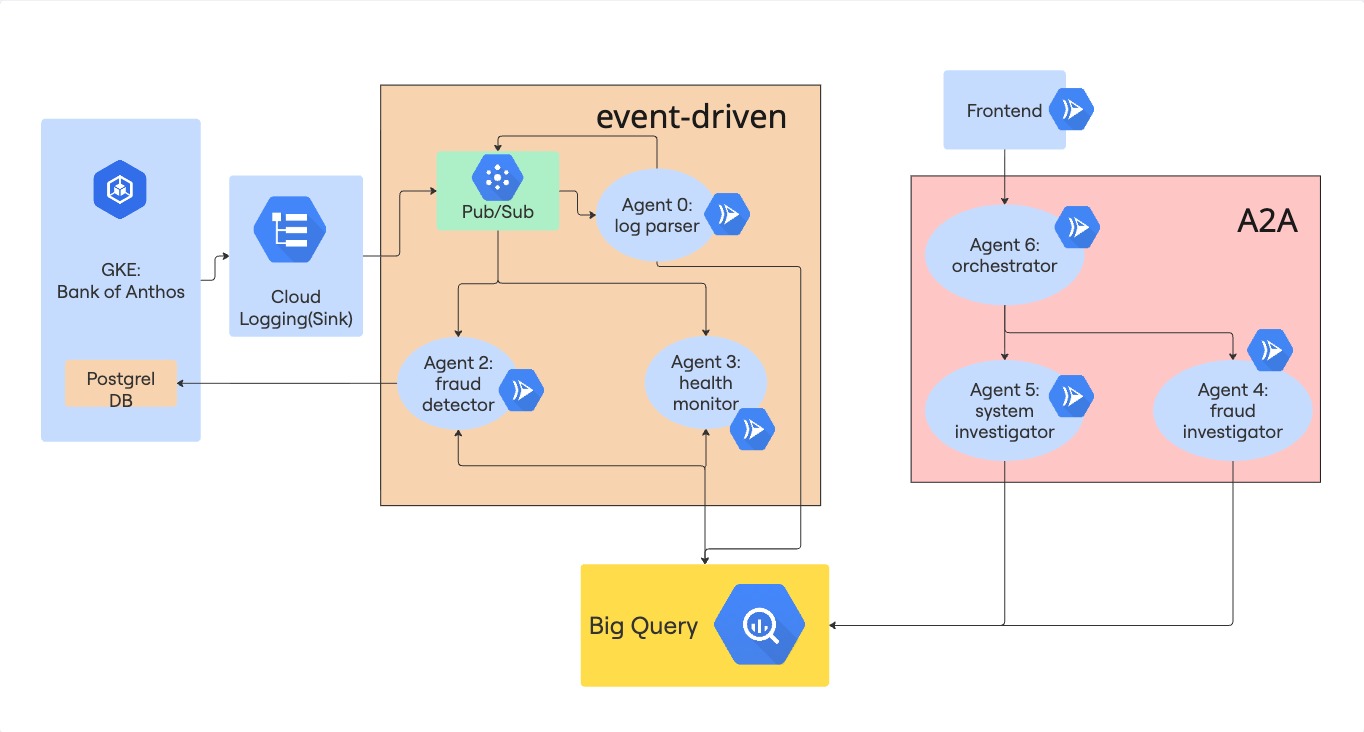
AegisFlow is a dual-mode multi-agent observability system deployed entirely on Google Cloud. It operates in two complementary modes:
Mode 1: Real-Time Event-Driven Detection (Background Workers)
Three specialized agents continuously process streaming logs via Cloud Pub/Sub:
Agent 0 - Log Parser:
- Ingests raw, unstructured logs from Bank of Anthos microservices (GKE)
- Primary parser: Fast keyword/regex extraction for well-formatted logs (zero LLM cost)
- Fallback parser: Gemini NLP when keyword parsing fails on malformed/unexpected formats
- This hybrid approach optimizes cost: only invoking LLM when necessary
- Publishes clean JSON events to downstream agents
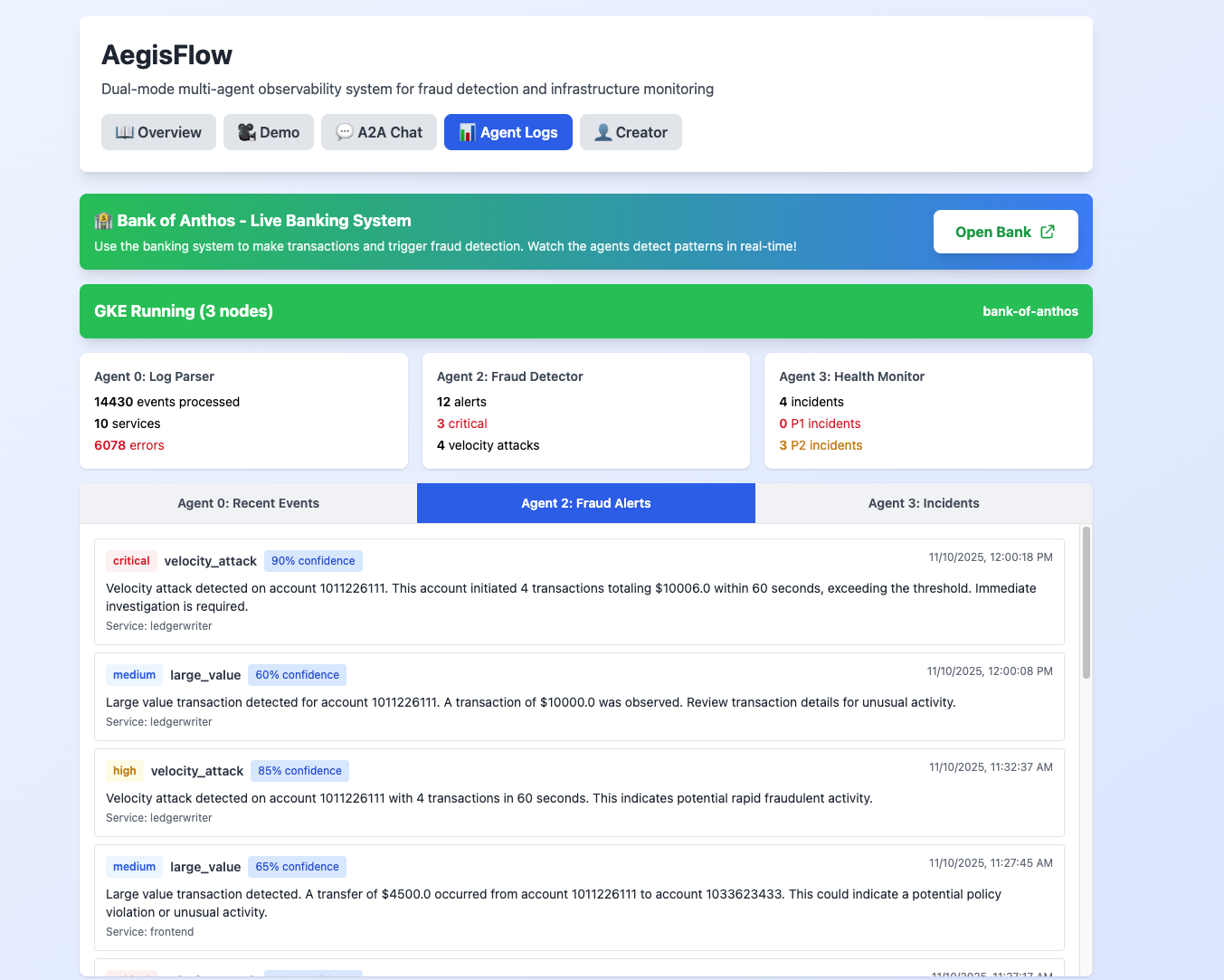
Agent 2 - Fraud Detector:
- Analyzes structured events for suspicious patterns in real-time
- Detects: velocity attacks, brute force attempts, large-value transactions, self-payment fraud
- Assigns confidence scores (0-100) and severity levels (low/medium/high/critical)
- Sends Slack alerts for critical threats and logs all alerts to BigQuery
Agent 3 - Health Monitor:
- Monitors infrastructure health by detecting error spikes across services
- Correlates failures across multiple microservices to identify cascading issues
- Classifies incidents using SRE severity levels (P1/P2/P3/P4)
- Triggers Slack notifications for P1/P2 incidents affecting customer transactions
Mode 2: Interactive Investigation (A2A Agent Network)
Three interactive agents allow security and SRE teams to investigate historical patterns:
Orchestrator Agent:
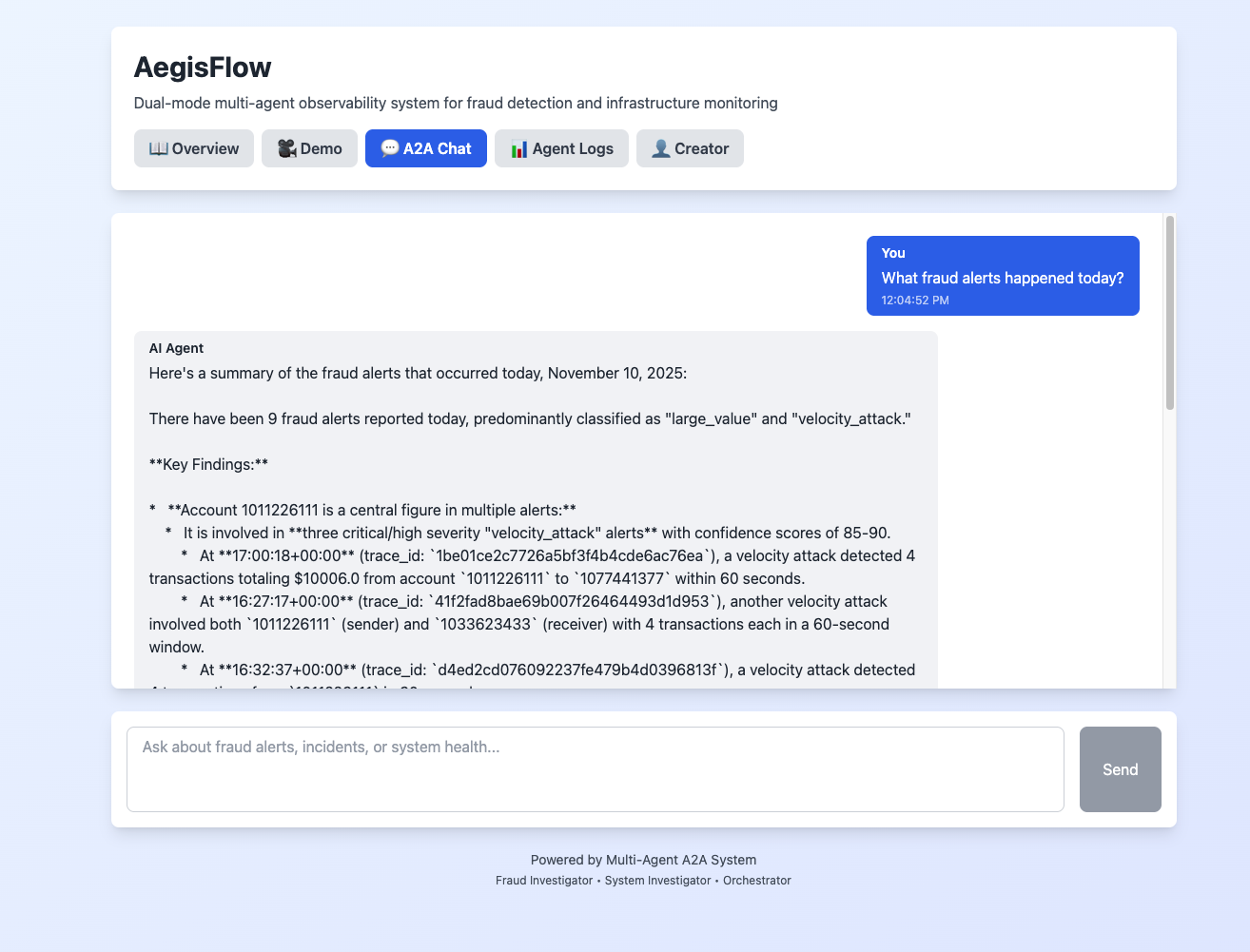
- Receives natural language queries from users (CLI/Web UI)
- Routes fraud-related questions to Fraud Investigator
- Routes infrastructure questions to System Investigator
- Returns comprehensive analysis combining multiple specialists
Fraud Investigator Agent:
- Queries BigQuery
alertstable using natural language - Analyzes historical fraud patterns, trends, and suspicious accounts
- Provides actionable insights: "Show me all velocity attacks in the last 24 hours"
System Investigator Agent:
- Queries BigQuery
incidentstable for infrastructure issues - Identifies root causes, affected services, and incident trends
- Supports SRE workflows: "What P1 incidents happened today?"
Key Innovation: The same BigQuery tables feed both real-time detection (Agents 2/3 write) and historical investigation (A2A agents read), creating a closed-loop intelligence system.
Challenges we ran into
1. Event-Driven Agent Architecture - A New Paradigm
The concept of agents as background workers processing Pub/Sub streams was entirely new territory. Traditional agent frameworks expect request-response patterns, but we needed agents to continuously consume events from message queues. Key challenges:
- Session management: How does an agent maintain context when processing thousands of independent events?
- Backpressure handling: What happens when Gemini API is slower than the Pub/Sub message rate?
- Error recovery: If an agent crashes mid-processing, how do we ensure no events are lost?
We solved this by using Cloud Run's worker pool pattern with manual acknowledgment, allowing agents to process events at their own pace while preserving message delivery guarantees.
2. Orchestrating 8 Google Cloud Services
Building a production pipeline across GKE, Cloud Logging, Log Router, Pub/Sub, Cloud Run (workers + services), BigQuery, and Cloud Build required careful orchestration.
The hardest part: IAM permissions. Cloud Run workers need Pub/Sub read + BigQuery write. A2A services need to invoke each other. All while following least-privilege principles. Getting this right took multiple iterations and debugging sessions.
3. Making LLMs Reliable in Production
Gemini occasionally skipped tool calls, generated malformed SQL, or forgot to send critical notifications—even with detailed prompts.
Solution: Explicit validation and fallbacks. If the agent doesn't call BigQuery's execute_sql, we fall back to direct insertion. If SQL fails due to escaping errors, we retry with corrected examples in the prompt. Production reliability requires defensive programming, even with AI.
What we learned
💡 Agents as infrastructure components - Not just chatbots. Agents can be autonomous background workers processing event streams, making this a fundamentally new architectural pattern.
💡 Serverless scales effortlessly - Google Cloud's serverless stack (Cloud Run + Pub/Sub + BigQuery) handled everything with zero infrastructure management. Deployed 6 agents, auto-scaling included.
💡 Specialist agents > Monoliths - The A2A pattern (orchestrator + specialists) mirrors microservices architecture but for AI. Routing queries to focused experts works better than one "do everything" agent.
💡 Cost-conscious AI - Pre-filtering with rules before LLM invocation saved 95% of costs. Smart engineering beats brute-force AI.
Accomplishments that we're proud of
✅ 6 agents in production - Deployed 3 background workers + 3 interactive investigators working together seamlessly
✅ Dual-mode architecture - Real-time event detection AND on-demand historical investigation using the same data foundation
✅ Closed-loop intelligence - Background agents write to BigQuery, investigator agents read from it—creating a self-reinforcing system
✅ Zero infrastructure management - Entire system runs serverless, auto-scales from zero to thousands of requests
✅ Production-grade reliability - Hybrid parsing, fallback logic, and defensive programming ensure the system handles real-world chaos
What's next for AegisFlow
🤖 Auto-remediation agents - Don't just alert, automatically fix issues (restart services, scale resources, block IPs)
📊 ML-based anomaly detection - Unsupervised learning to catch unknown attack patterns beyond rule-based detection
Built With
- cloudrun
- google-bigquery
- google-cloud
- k8s
- python

Log in or sign up for Devpost to join the conversation.