-
-
Today
-
Insights
-
Plan
-
Overview
-
Explore
-
Dashboard
Inspiration
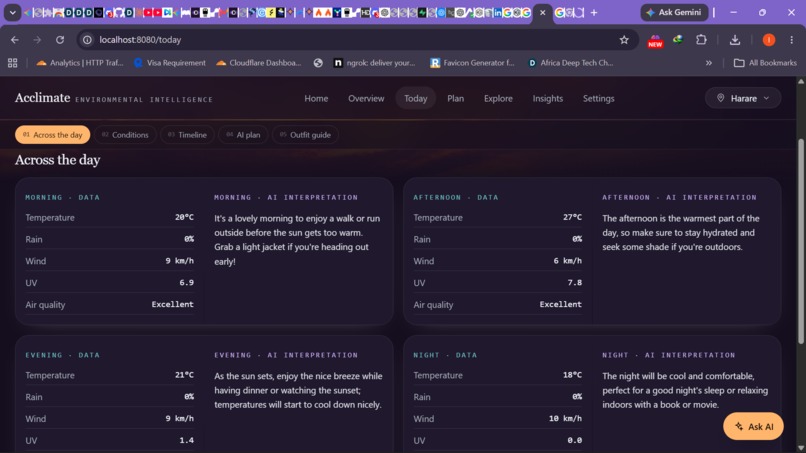
Every morning, millions of people check weather apps, only to be greeted by raw numbers: 22°C, 65% humidity, 14 km/h wind, UV Index 6. But numbers don't answer real human questions: Is it a great time for a run? Should I bring a light jacket? Is it safe to host an outdoor dinner party tonight?
I wanted to bridge the gap between complex atmospheric metrics and actual daily decision-making. I built Acclimate to turn raw environmental data into actionable, practical advice for everyday life.
What it does
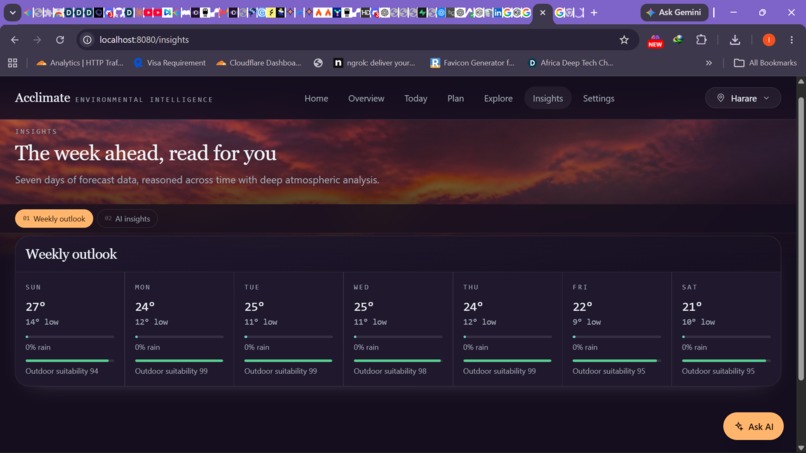
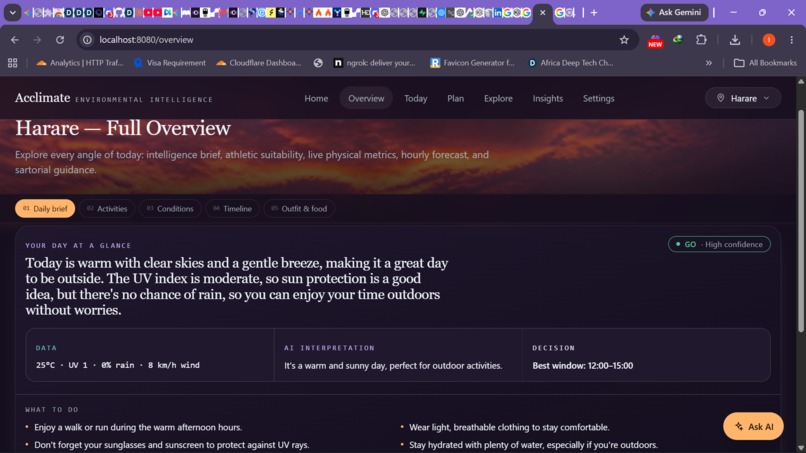
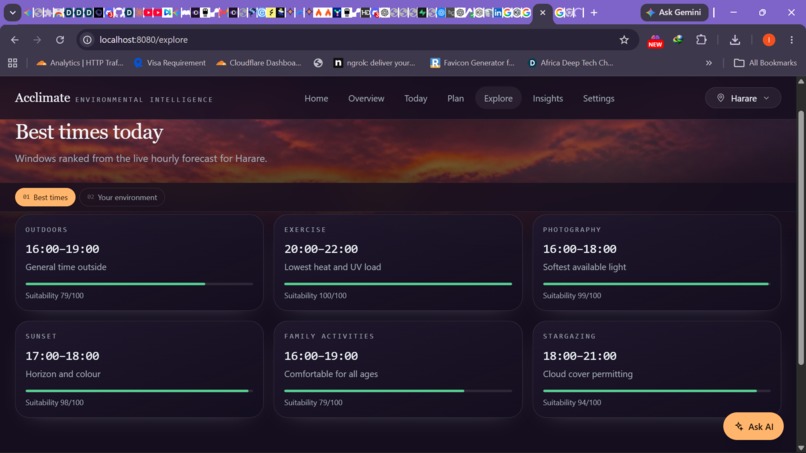
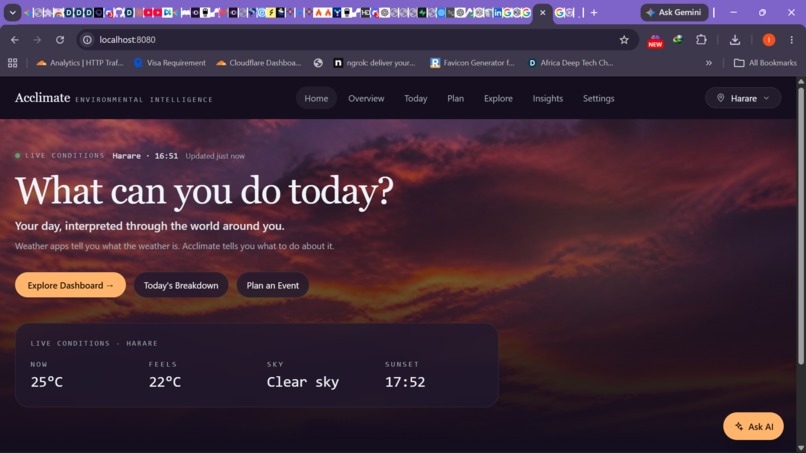
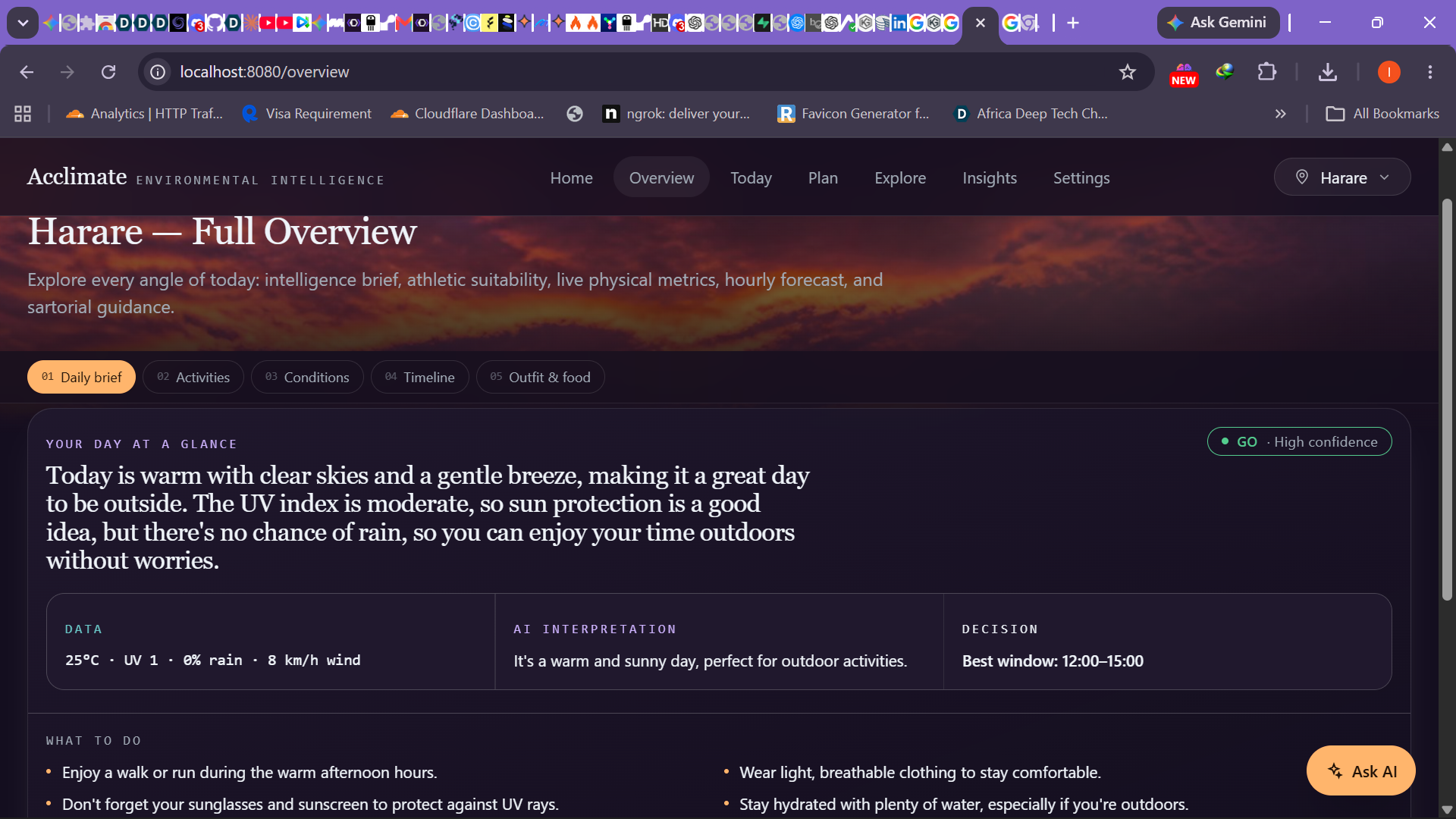
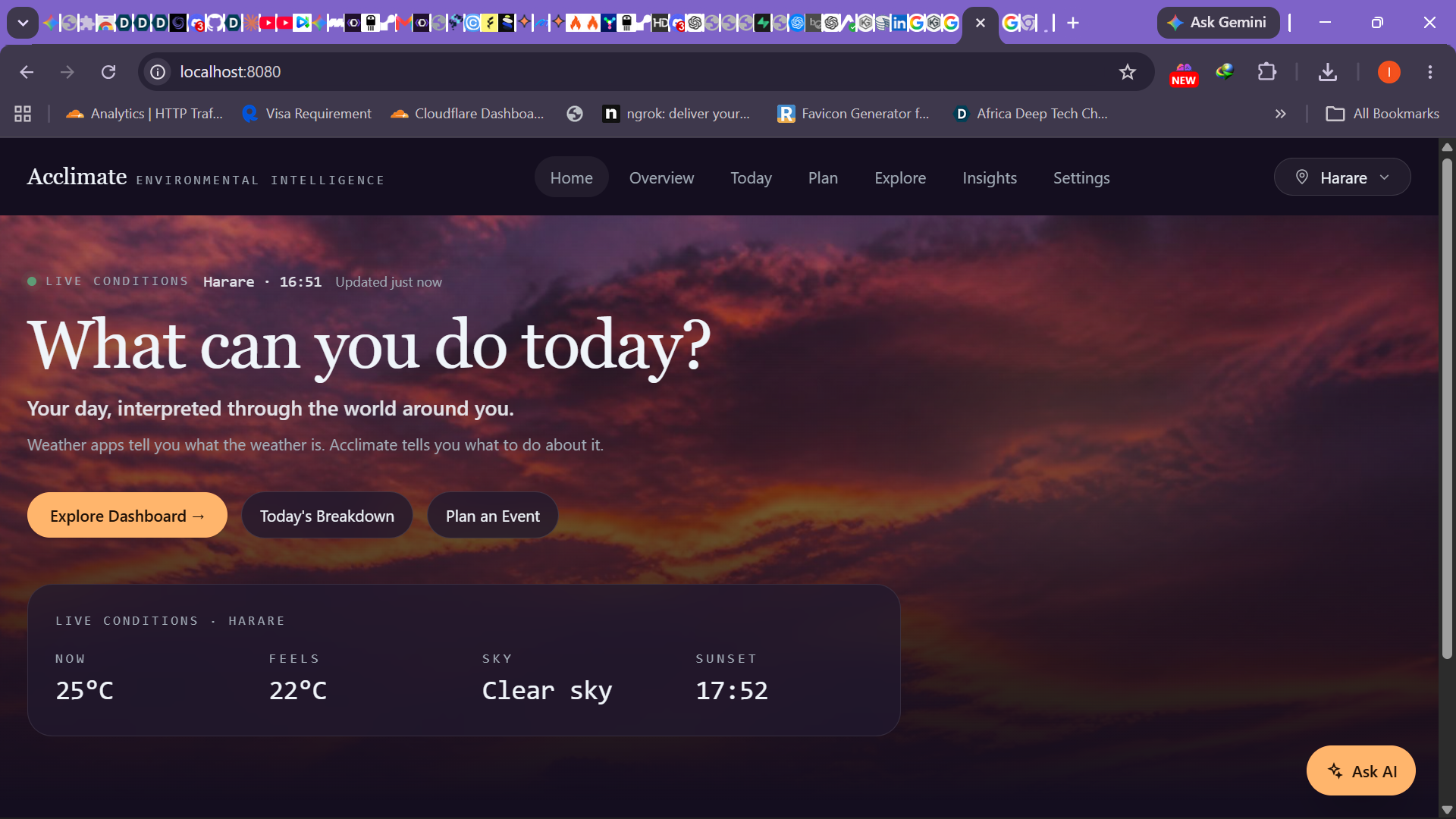
Acclimate is an environmental intelligence platform that interprets live weather, air quality, solar position, and UV levels into clear daily guidance:
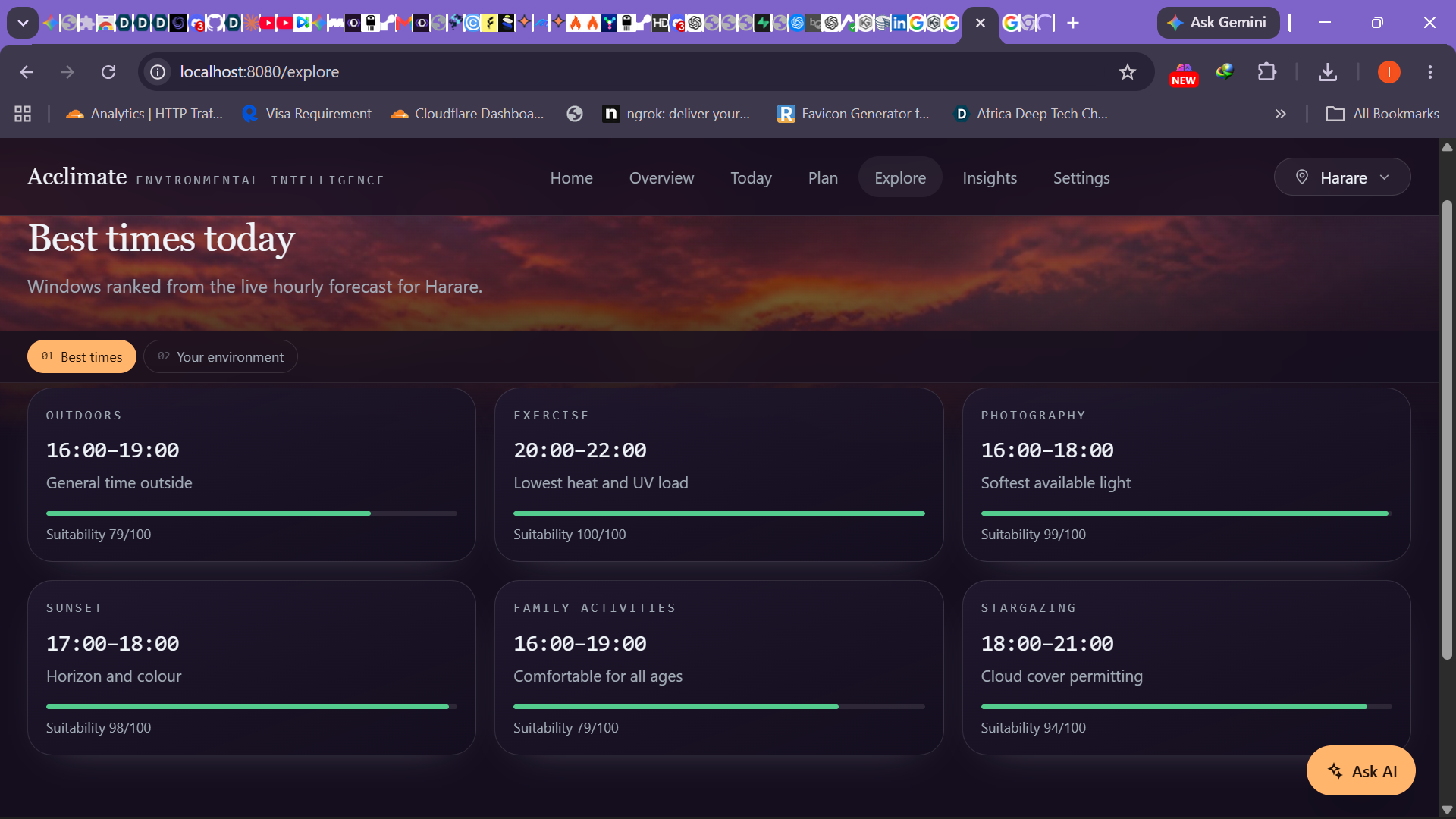
- What Can You Do Today? — Real-time suitability ratings for outdoor activities like running, cycling, stargazing, clothes drying, and outdoor dining.
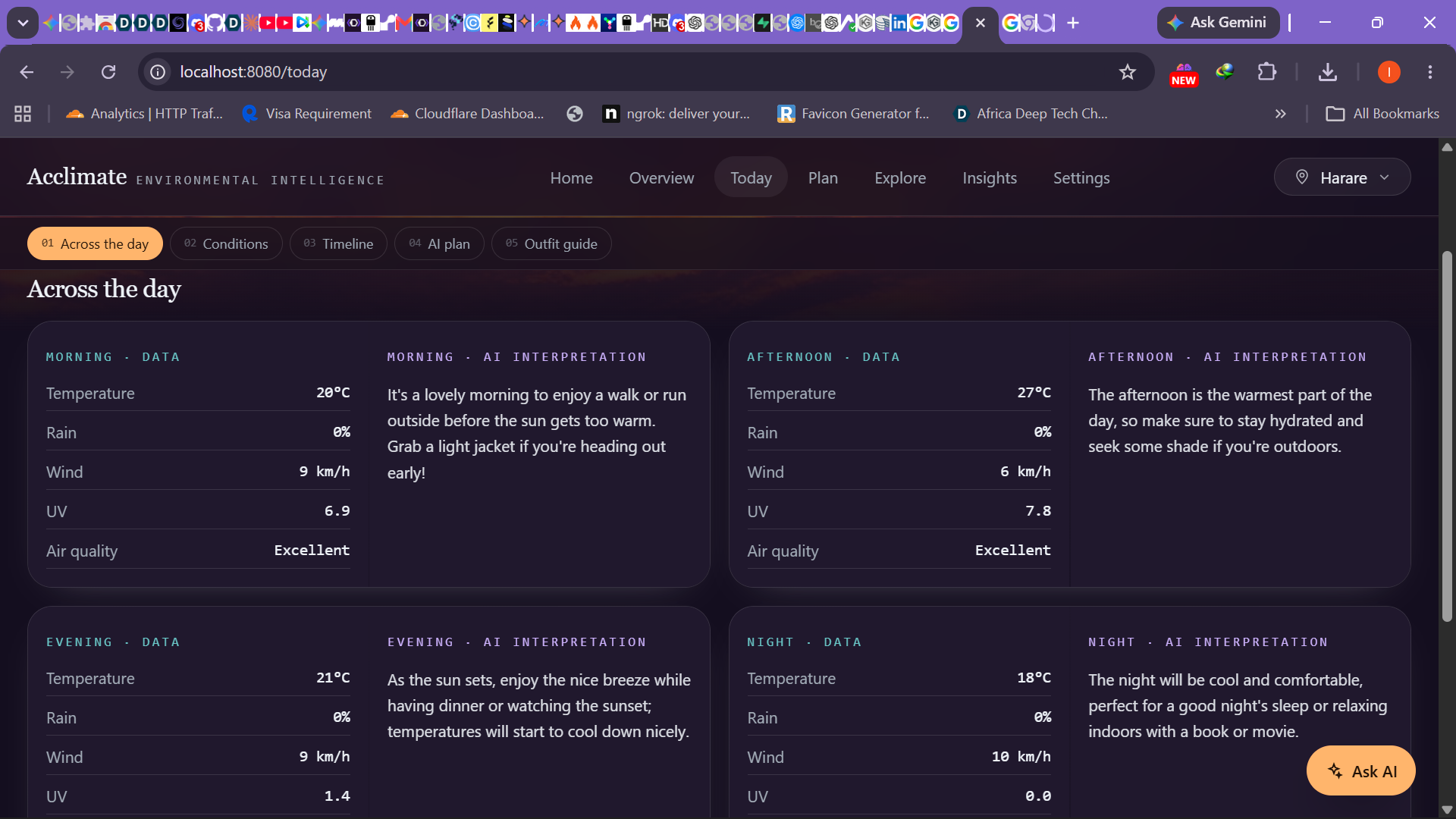
- Today's Breakdown — An interactive, hourly timeline tracking temperature, apparent feel, precipitation risk, wind gusts, and UV levels.
- Smart Outfit Planner — Dynamic clothing recommendations tailored to temperature, wind chill, rain probability, and solar exposure.
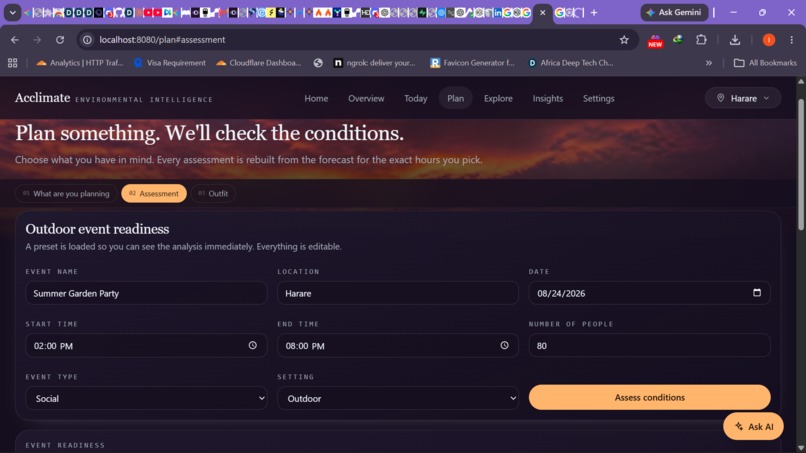
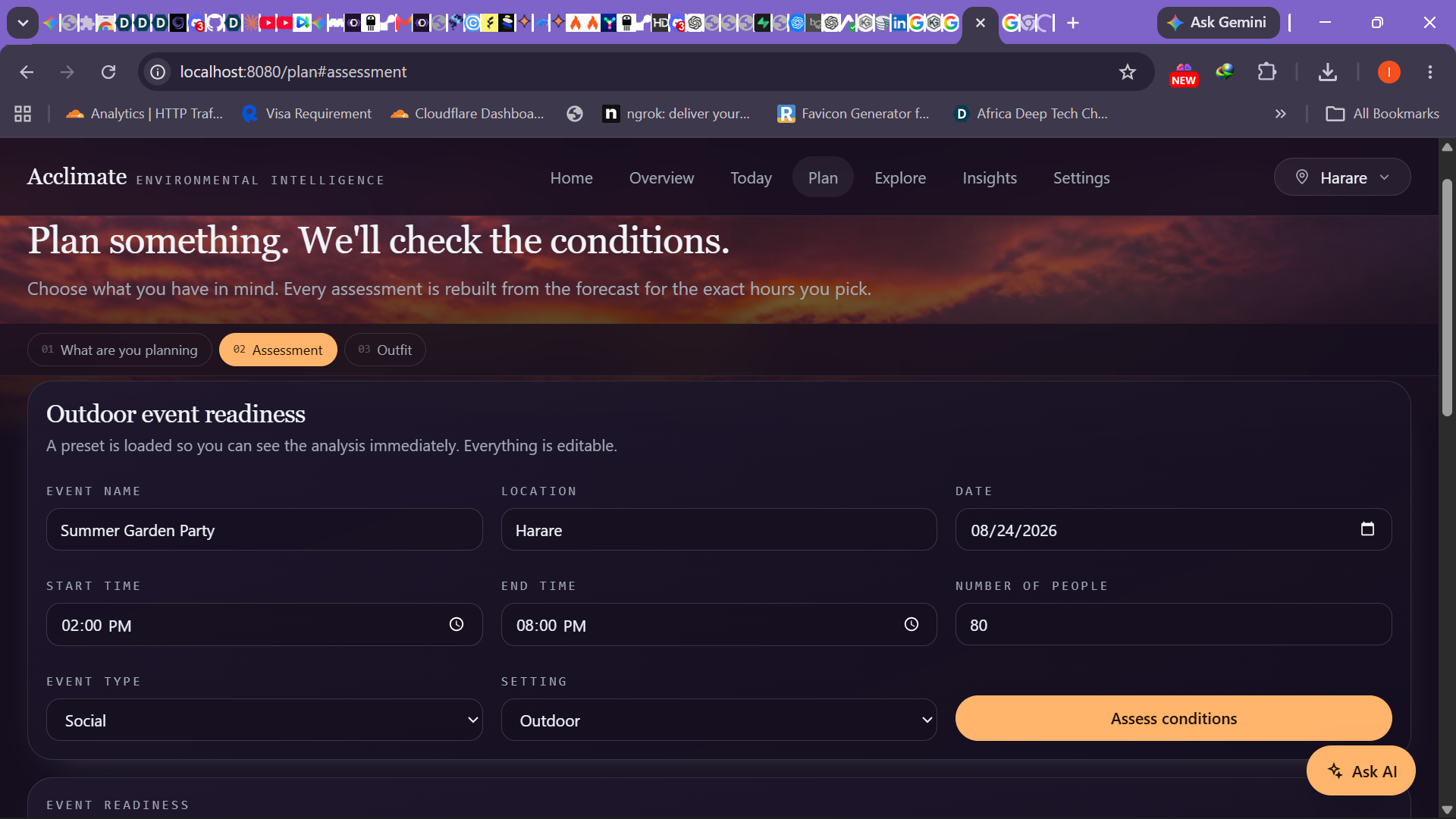
- Event Planner — A risk-assessment engine that evaluates forecast hazards for outdoor events and gatherings.
- Ask Acclimate AI — A contextual AI assistant grounded in real-time atmospheric readings to answer specific lifestyle questions.
- Dynamic Atmospheric Scenes — Immersive backdrop visual themes that automatically adapt to live conditions like thunderstorms, golden hour, snow, fog, or clear night skies.
How we built it
- Frontend & Architecture: Built with React 19, TypeScript, and Vite for ultra-fast performance.
- Routing & State: Utilized TanStack Router for file-based navigation and TanStack Query for smooth data caching.
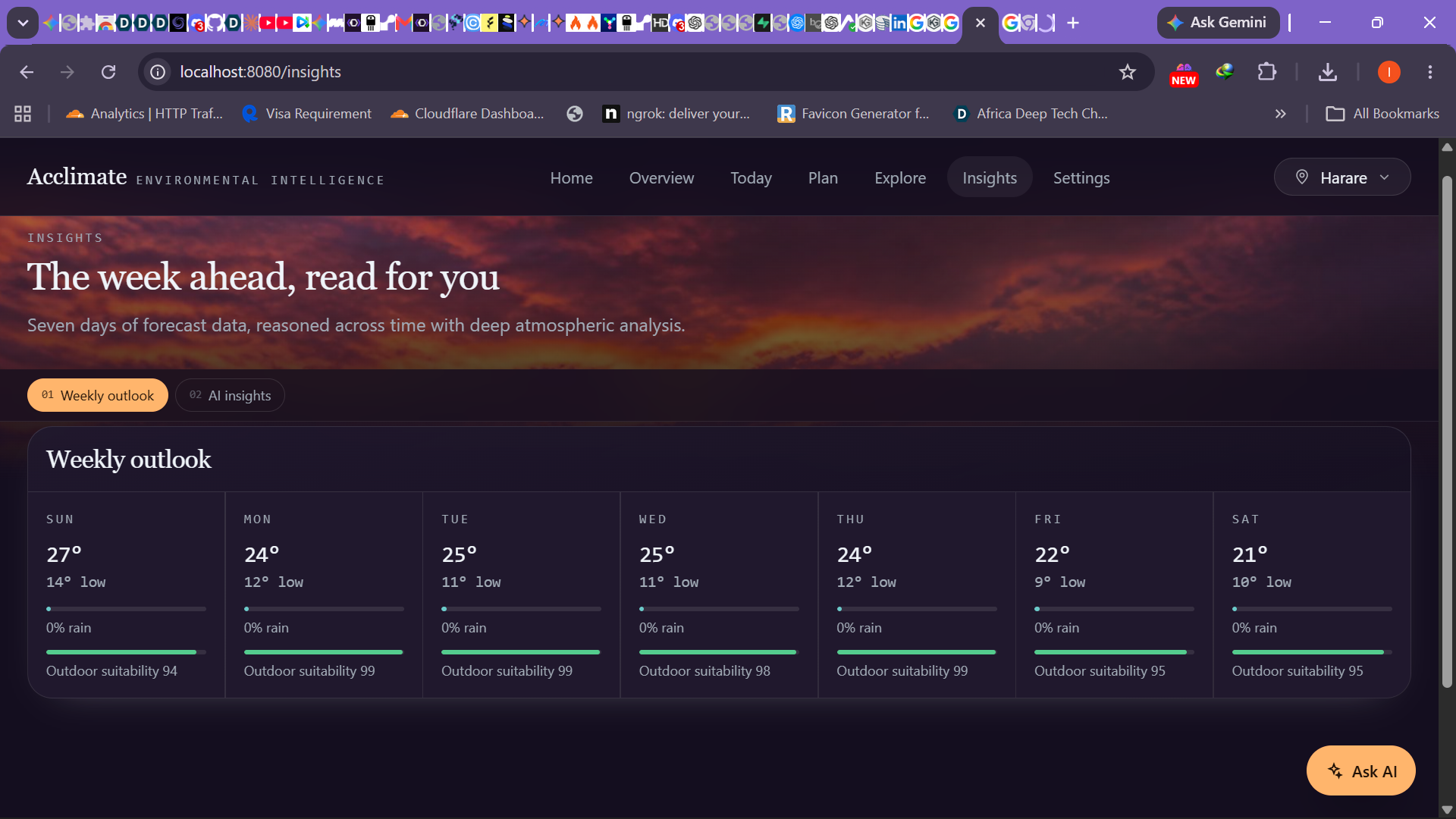
- UI & Design: Crafted with Tailwind CSS v4, Radix UI primitives, Recharts for visual analytics, and Lucide Icons.
- Live Environmental APIs:
- Open-Meteo API for hyper-local forecasts, wind, cloud cover, and UV indices.
- OpenAQ API for real-time PM2.5, PM10, and Air Quality Index (AQI) readings.
- SunriseSunset API for solar elevation, civil twilight, and golden hour timing.
- OpenStreetMap Nominatim & Open-Meteo Geocoding for location search.
- AI Engine: Designed a multi-provider AI system that supports Gemini and OpenAI, backed by a deterministic local fallback engine.
Challenges we ran into
- Multi-Source Data Harmonization: Combining heterogeneous data streams, varying from weather codes and wind vectors to particulate matter (PM2.5) and solar elevation angles, into unified activity scores required careful math and domain modeling.
- Performant Dynamic Backdrop: Creating the
EnvironmentScenebackdrop to visually reflect real-time conditions (rain particles, lightning, fog overlays) without degrading UI frame rates or responsiveness. - Graceful Fallbacks: Ensuring that the AI recommendations remain accurate, fast, and fully functional even when external LLM API keys aren't provided by using structured local reasoning.
Accomplishments that we're proud of
- Instant Human Translation: Transforming raw scientific values into simple, intuitive human guidance in milliseconds.
- Zero-Latency Design: Building a complete, rich web experience without needing heavy server infrastructures.
- Polished Visual Experience: Delivering a responsive, glassmorphic dark-mode UI with live interactive charts, unit switching (°C / °F), and smooth micro-animations.
What we learned
- How to efficiently process and normalize multi-source environmental datasets entirely on the client side.
- Techniques for grounding AI prompts with structured live context to eliminate hallucinations.
- The importance of designing resilient offline/fallback logic for third-party API dependencies.
What's next for Acclimate
- Proactive Alerts: Push notifications for sudden microclimate changes, approaching rain fronts, or dangerous UV spikes.
- Personalized Profiles: Customizing activity thresholds based on individual health needs (e.g., asthma/pollen sensitivity, athlete training zones).
- Historical Microclimate Trends: Comparative analysis to track seasonal weather and air quality shifts over time.
Built With
- air-quality-api
- artificial-intelligence
- google-gemini
- html5
- javascript
- lucide-react
- open-meteo-api
- openai-api
- openaq-api
- openstreetmap
- react
- recharts
- tailwindcss
- tanstack-router
- typescript
- vite


Log in or sign up for Devpost to join the conversation.