Inspiration
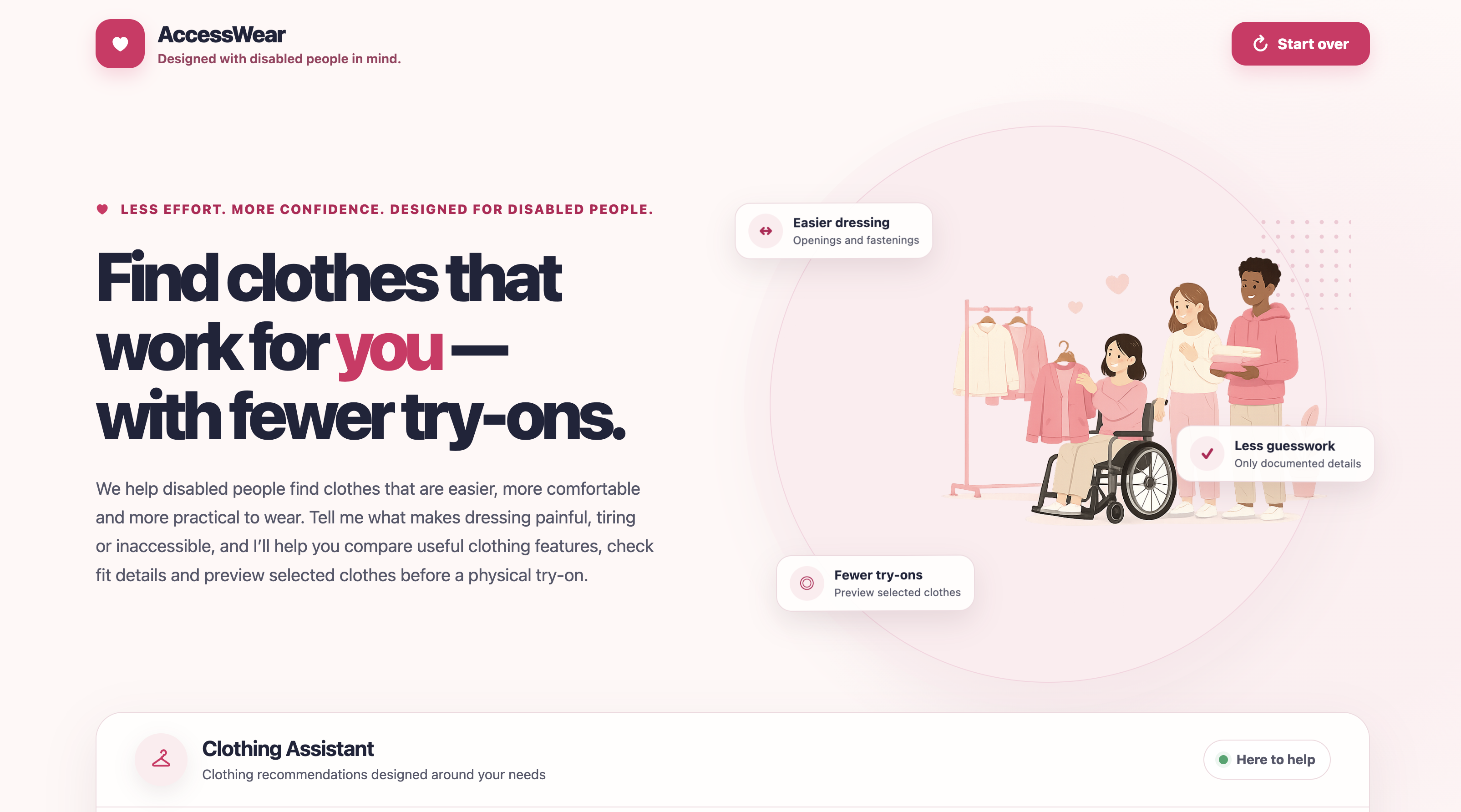
Online clothing shopping often assumes that trying on and returning several items is easy. For many disabled people, repeated dressing, travel and returns can consume significant energy or cause pain. Product pages also rarely make fastenings, opening locations and garment measurements easy to compare against an individual's access needs.
What it does
AccessWear lets a user describe what they need and what makes dressing difficult. It turns that conversation into structured clothing requirements, then checks a grounded fictional catalogue using deterministic matching logic. It distinguishes documented matches from missing information instead of inventing accessibility claims.
Users can save body measurements once per conversation and compare them with the documented measurements for every available garment size. They can then select a product and use Perfect Corp.'s YouCam Apparel VTO to create a visual preview before deciding whether a physical try-on is worth the effort. The preview is clearly separated from fit evidence because generative imagery cannot confirm comfort, sizing or accessibility. AccessWear also offers an alteration-service finder using OpenStreetMap data, including documented step-free information where available and home or remote support prompts.
How we built it
- Accessible HTML, CSS and browser JavaScript frontend hosted on Cloudflare Pages.
- Cloudflare Worker backend with strict JSON-schema validation, origin checks, rate limiting and controlled provider errors.
- OpenAI Responses API with Structured Outputs for bounded conversational interpretation.
- Deterministic catalogue and measurement matching in application code.
- Perfect Corp. YouCam File API and Clothes VTO task API for secure upload, task creation and result polling.
- Cloudflare Turnstile before paid generation requests.
- OpenStreetMap Nominatim and Overpass for the low-traffic tailor prototype.
Challenges we ran into
YouCam Apparel VTO is not included as a standalone novelty. It is the final step in an energy-saving decision journey: first understand the user's access needs, then narrow products using documented evidence, and only then offer a visual preview of a deliberately selected garment. This helps the user decide which physical try-ons may be worth their effort.
Accomplishments that we're proud of
- A complete working YouCam upload and asynchronous generation flow.
- Explicit consent, server-side secrets, Turnstile and provider rate limits.
- Evidence-based matching that does not infer needs from disability labels.
- Dynamic measurement comparisons for every mock product and size.
- Keyboard-accessible controls, visible focus states and reduced-motion support.
- A test suite covering 164 catalogue, chat, matching, upload, VTO, location, security and API behaviours.
What we learned
I learned that accessible clothing support needs more than virtual try-on. A useful experience must combine disabled people’s individual dressing needs with documented garment features, measurements and honest uncertainty. I also learned to keep AI grounded: OpenAI interprets the conversation, deterministic code checks compatibility, and YouCam provides a visual preview—not a fit guarantee. Building the complete flow strengthened my understanding of accessible interaction design, consent, privacy and secure third-party API integration.
What's next for AccessWear
The next stage is an authorised retailer-data integration with verified accessibility attributes, followed by partnerships with alteration services that can document step-free access, remote consultations and home visits.
Built With
- cloudflare
- codex
- javascript
- openai
- openstreetmap
- youcam

Log in or sign up for Devpost to join the conversation.