Inspiration
In Tijuana, daily mobility is still a major challenge for visually impaired citizens, wheelchair users, and elderly people. Damaged sidewalks, blocked ramps, unsafe crossings, and inaccessible pathways make even short journeys stressful and dangerous. Traditional navigation systems optimize only for distance, but they ignore accessibility. We wanted to build a solution that could actively guide, protect, and support people in realtime while navigating the city. This inspired us to create AccessGrid AI — an AI-powered accessibility navigation platform designed for safer and barrier-free urban movement.
What it does
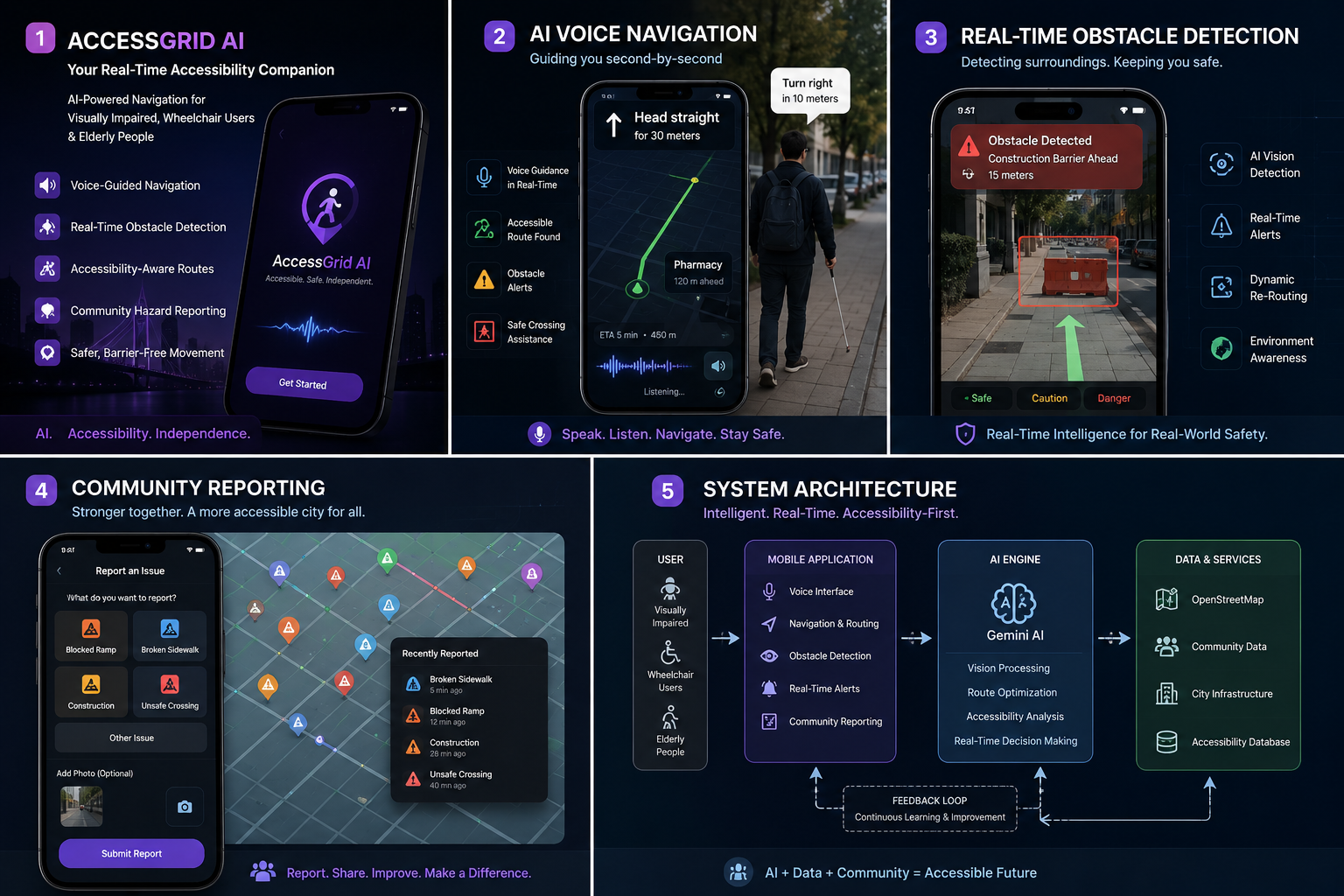
AccessGrid AI is a realtime accessibility navigation companion that helps visually impaired citizens, wheelchair users, and elderly people navigate cities more safely and independently. The platform combines AI voice guidance, accessibility-aware routing, realtime obstacle detection, and community-powered hazard reporting into one intelligent system.
Users receive:
- Live navigation assistance
- Realtime obstacle alerts
- Safer route recommendations
- Accessibility updates
- Voice-guided mobility support
Citizens can also report:
- Blocked ramps
- Broken sidewalks
- Construction barriers
- Unsafe crossings
This creates a living accessibility map for the city.
How we built it
We built AccessGrid AI using:
- Python
- Gemini AI
- OpenStreetMap
- Realtime computer vision pipelines
- Voice interaction systems
- Accessibility-aware routing logic
The frontend was designed as a futuristic mobile-first accessibility interface with realtime overlays, AI-guided navigation, and cinematic user interactions.
We integrated:
- Live map visualization
- Obstacle intelligence simulation
- Route analysis
- Realtime accessibility reporting
- AI voice guidance
into a unified accessibility platform.
Challenges we ran into
One of our biggest challenges was designing a system that supports multiple accessibility needs instead of focusing on only one type of user.
We also faced challenges in:
- Realtime AI interaction
- Accessibility-aware route generation
- Mobile UI responsiveness
- Visual clarity
- Creating believable realtime guidance systems
within a limited hackathon timeframe.
Accomplishments that we're proud of
We are proud of building a polished accessibility platform that combines:
- AI voice navigation
- Realtime obstacle awareness
- Accessibility routing
- Community reporting
- Blind assistance
- Wheelchair-friendly navigation
into one unified experience.
We are especially proud of the futuristic user experience and the realtime accessibility intelligence system.
What we learned
Through this project, we learned:
- The importance of accessibility-focused design
- How AI can improve urban mobility
- How realtime mapping and computer vision can work together
- The value of human-centered technology solutions
We also learned the importance of storytelling, usability, and emotional impact in hackathon demos.
What's next for AccessGrid AI
In the future, we plan to integrate:
- Advanced AI obstacle recognition
- Public transport accessibility support
- Offline accessibility navigation
- Multilingual voice support
- Smart wearable integration
- Live city infrastructure intelligence
Our long-term vision is to help cities become safer, smarter, and truly accessible for everyone.
Built With
- accessibility-aware
- ai
- assistance
- community
- computer
- css3
- design
- flask
- gemini
- hazard
- html5
- javascript
- mobile-first
- navigation
- openstreetmap
- python
- realtime
- reporting
- routing
- system
- ui
- vision
- voice


Log in or sign up for Devpost to join the conversation.