Inspiration
Palamaner is a small town in Andhra Pradesh, India — the kind of place where young people leave to pursue careers in cities like Bengaluru, Chennai, and beyond, while their parents remain in the homes they grew up in. Most days that is manageable. But a medical emergency does not wait for a convenient moment, and it does not matter whether someone is nearby to help.
When an elder living alone faces a medical emergency, there is often no one nearby to call for help, no quick way to identify the nearest hospital, and no mechanism for hospitals or ambulance teams to know who is arriving or what condition they are in. Meanwhile, their children, hundreds of kilometers away, can only wait and worry. I built Aasara to close that gap.
What it does
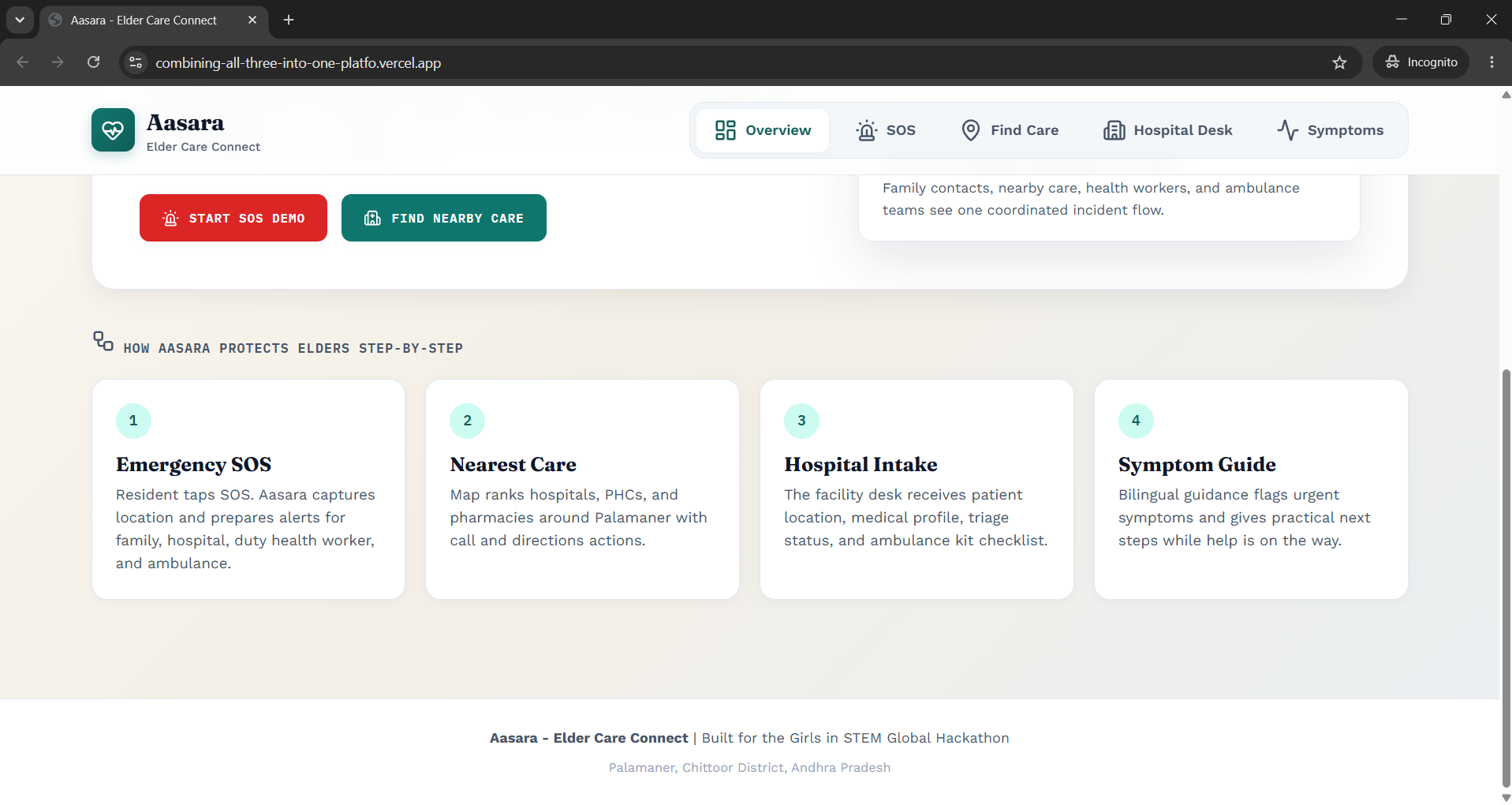
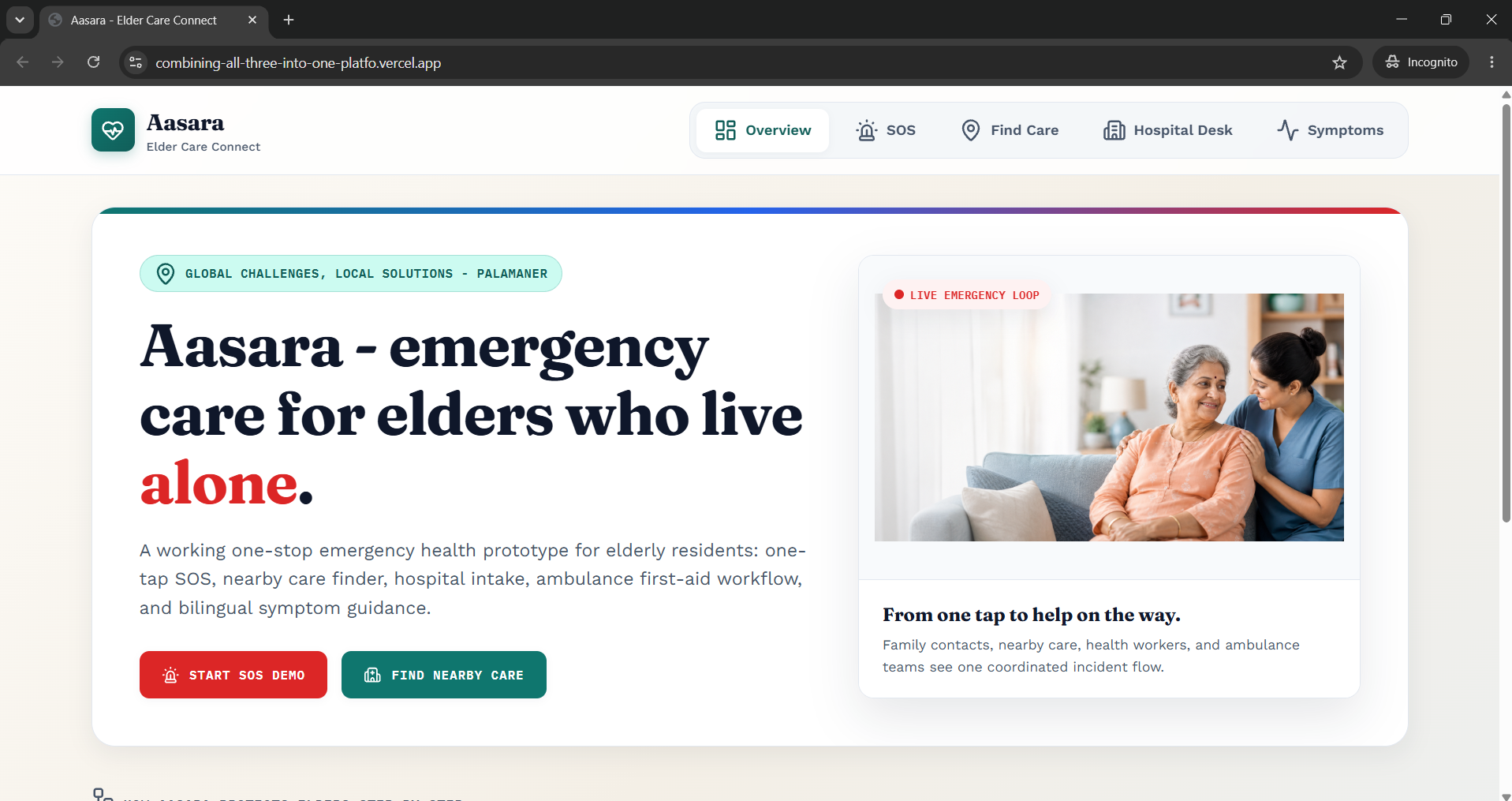
Aasara is a one-tap emergency care coordination platform for elders who live alone. It connects every link in the chain that matters during a medical emergency:
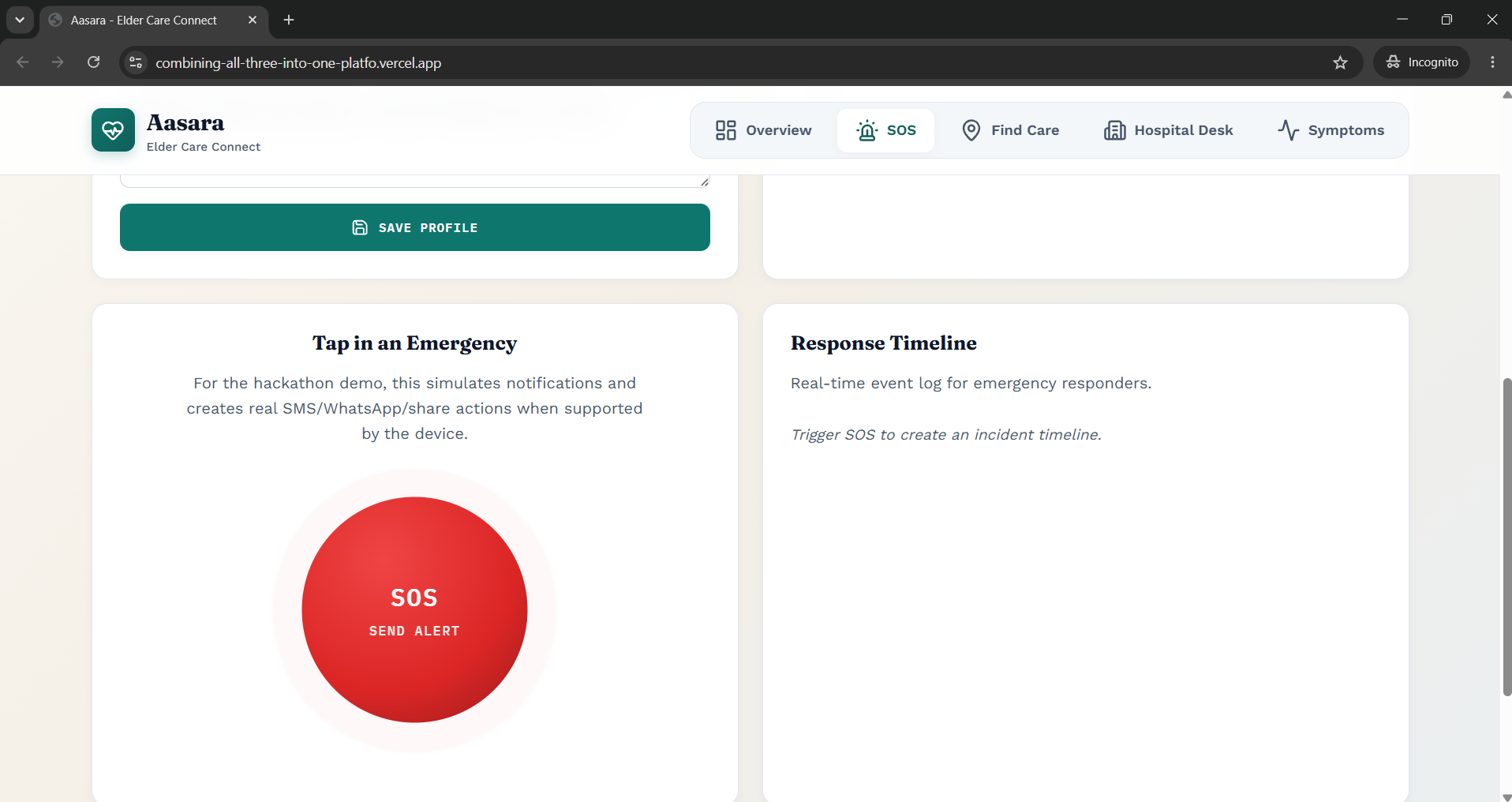
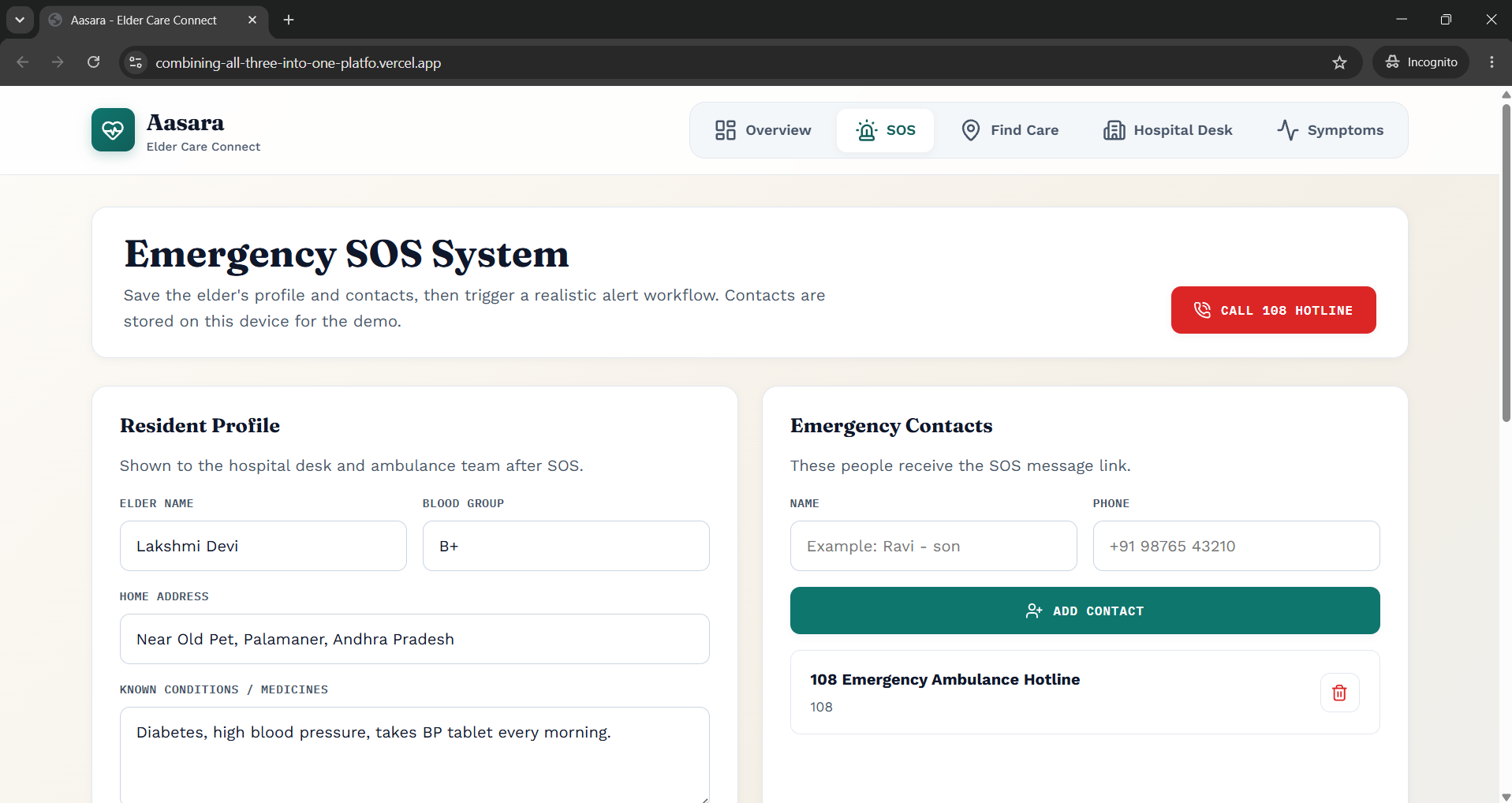
- Emergency SOS — A resident profile with emergency contacts (India's 108 ambulance service pre-loaded), a large one-tap SOS button, and a live Response Timeline that logs the incident as it unfolds. A Call 108 Hotline button remains visible at all times.
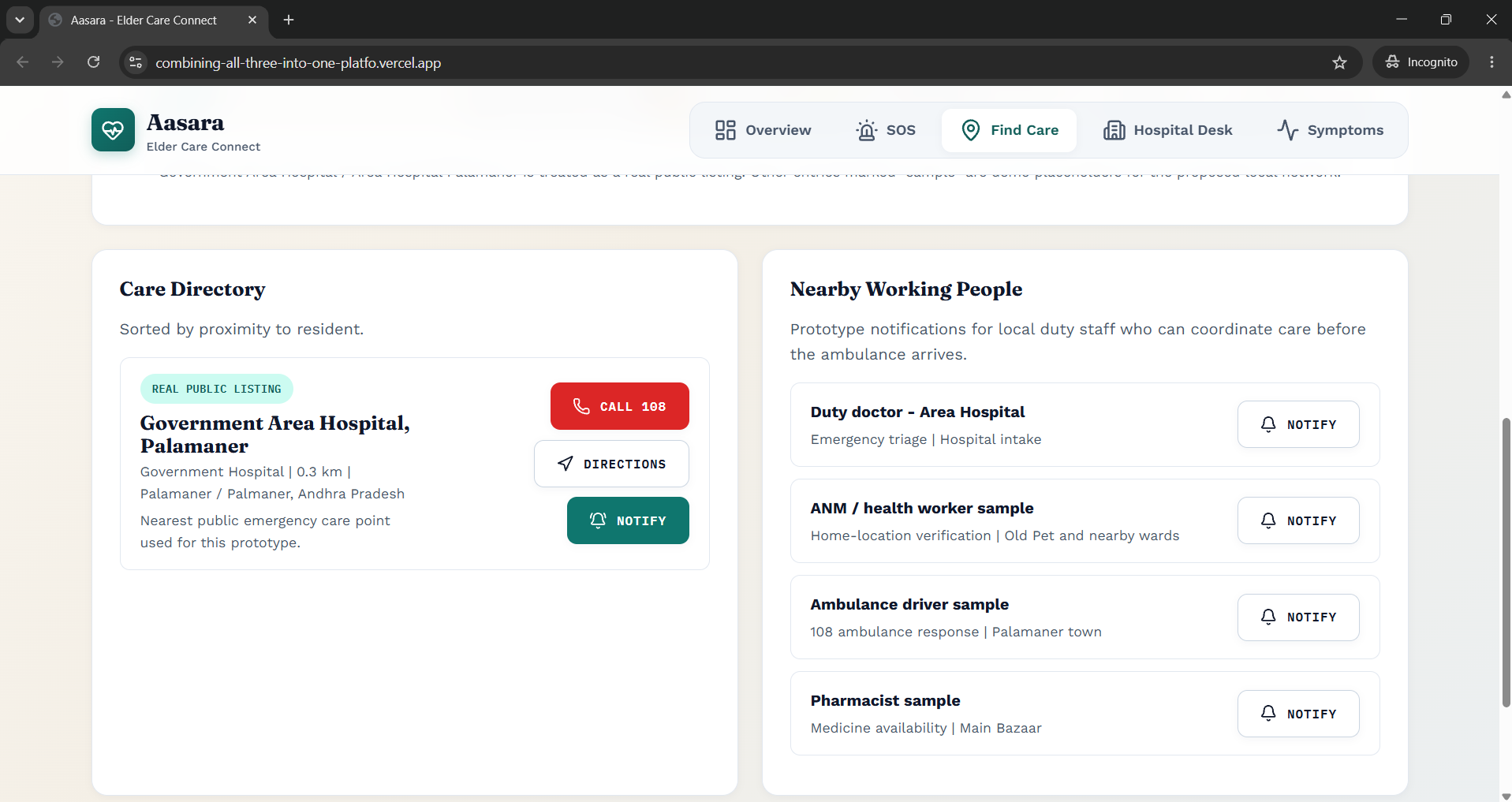
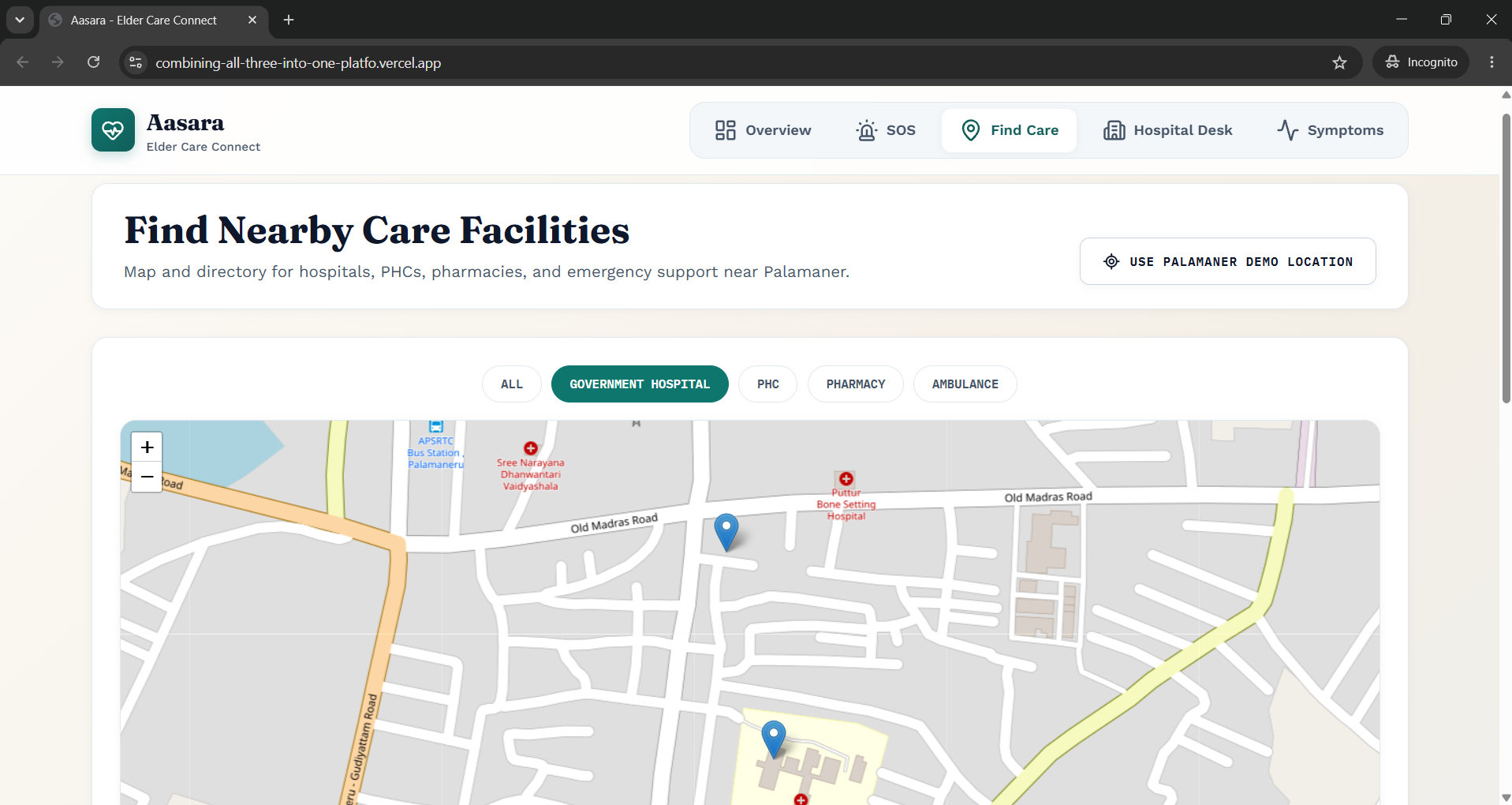
- Find Nearby Care — An interactive map built with Leaflet.js and OpenStreetMap featuring filters for hospitals, PHCs, pharmacies, and ambulances, backed by a Care Directory. Government Area Hospital Palamaner is included as a real, verified listing.
- Nearby Working People — One-tap notification actions for the duty doctor, ANM/health worker, ambulance driver, and pharmacist serving the resident's area.
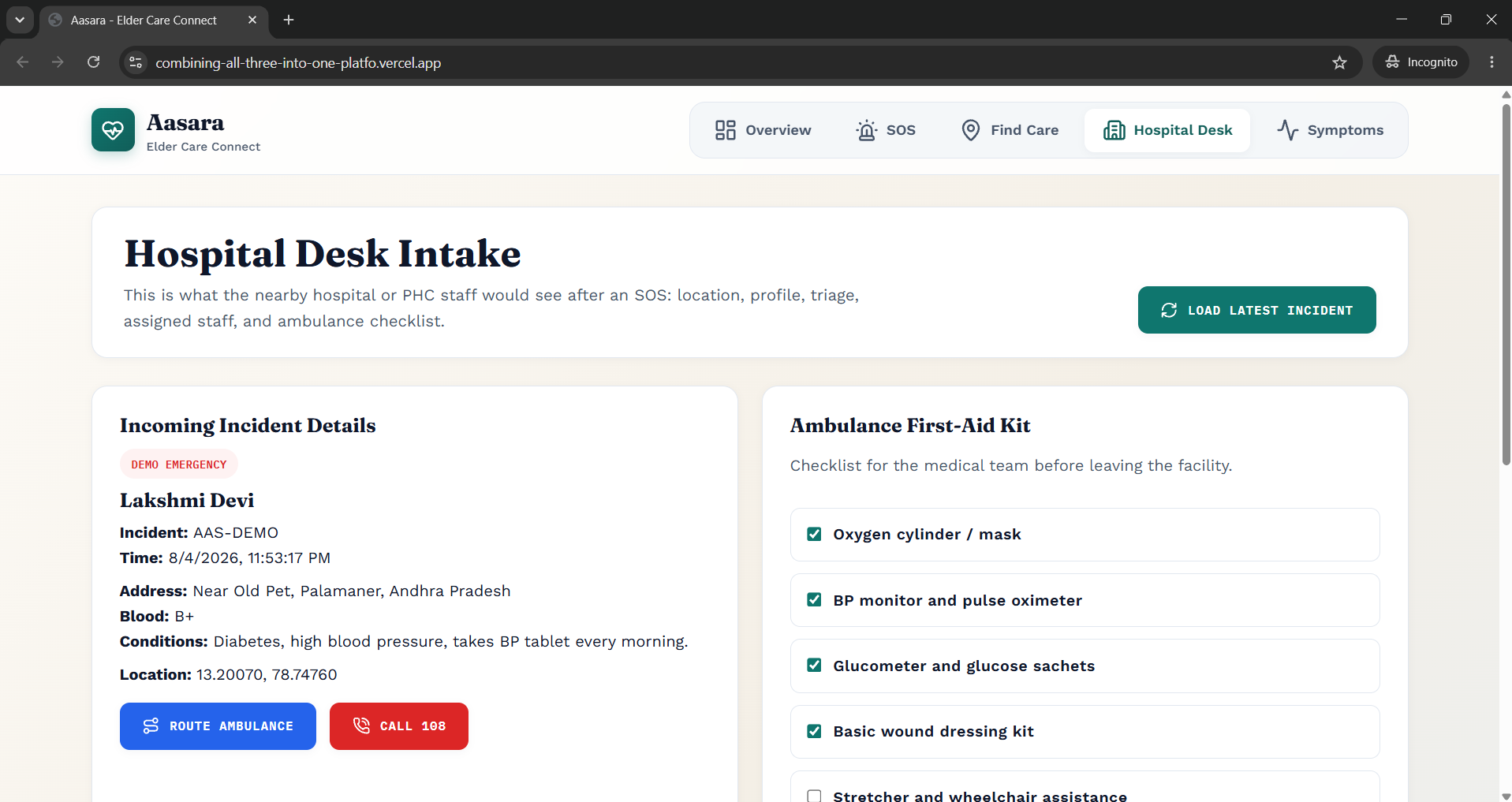
- Hospital Desk Intake — Provides receiving hospitals with immediate visibility into an incoming patient, including the patient profile, incident ID, address, blood group, known medical conditions, and current location.
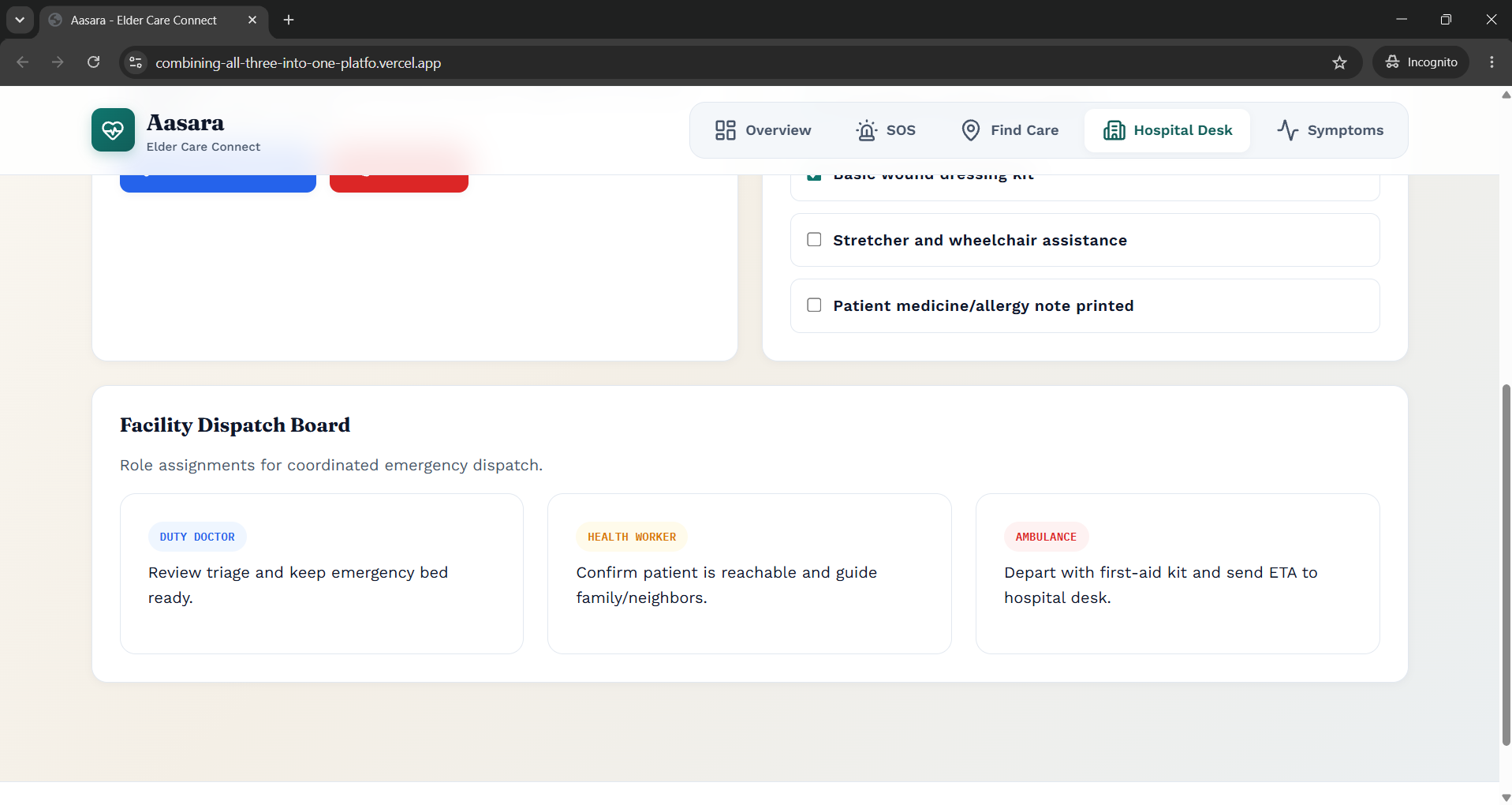
- Ambulance First-Aid Kit + Dispatch Board — A readiness checklist covering oxygen, BP monitor, pulse oximeter, glucometer, dressing kit, stretcher, and allergy/medicine notes, alongside role cards for the response team.
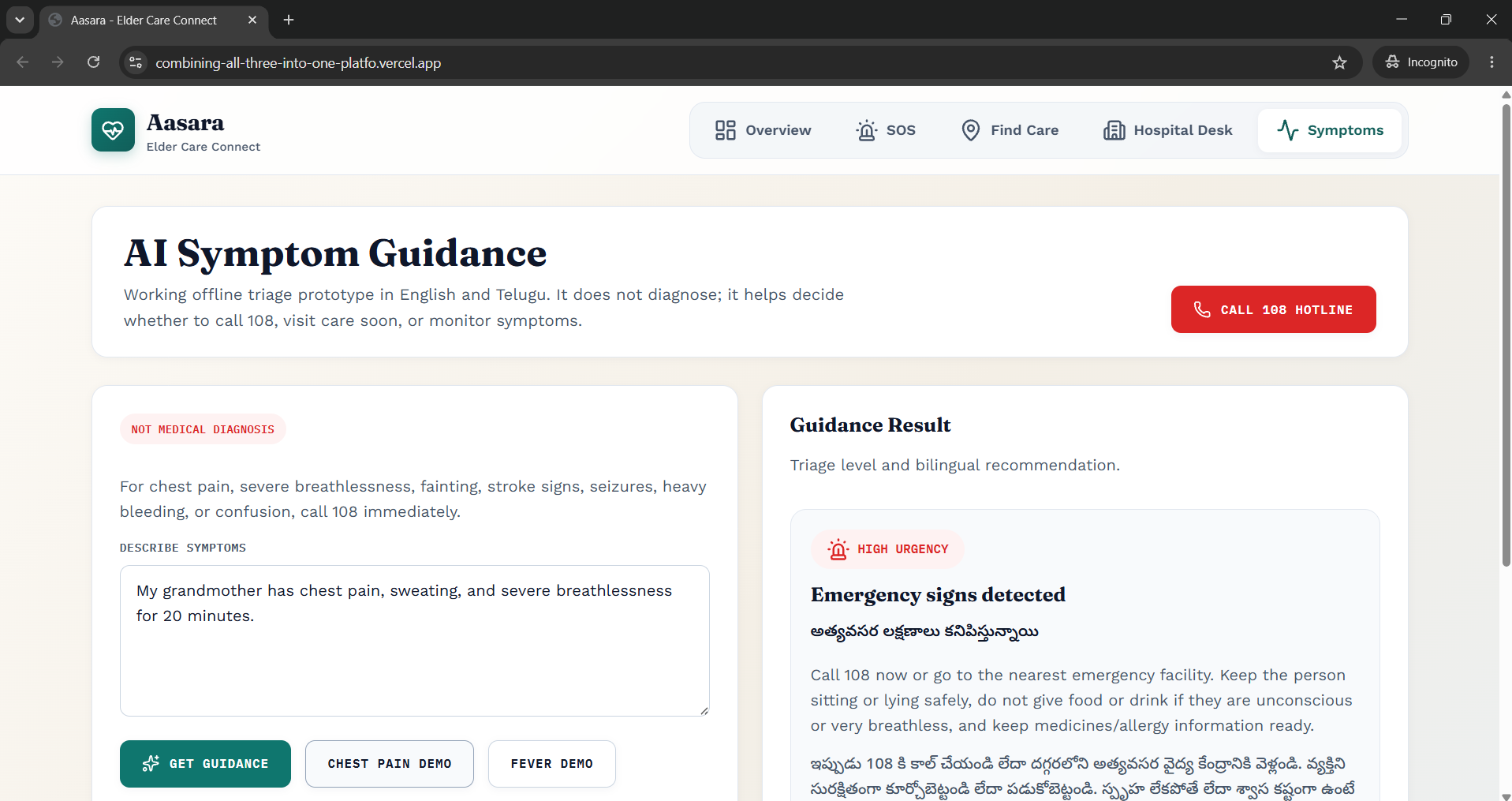
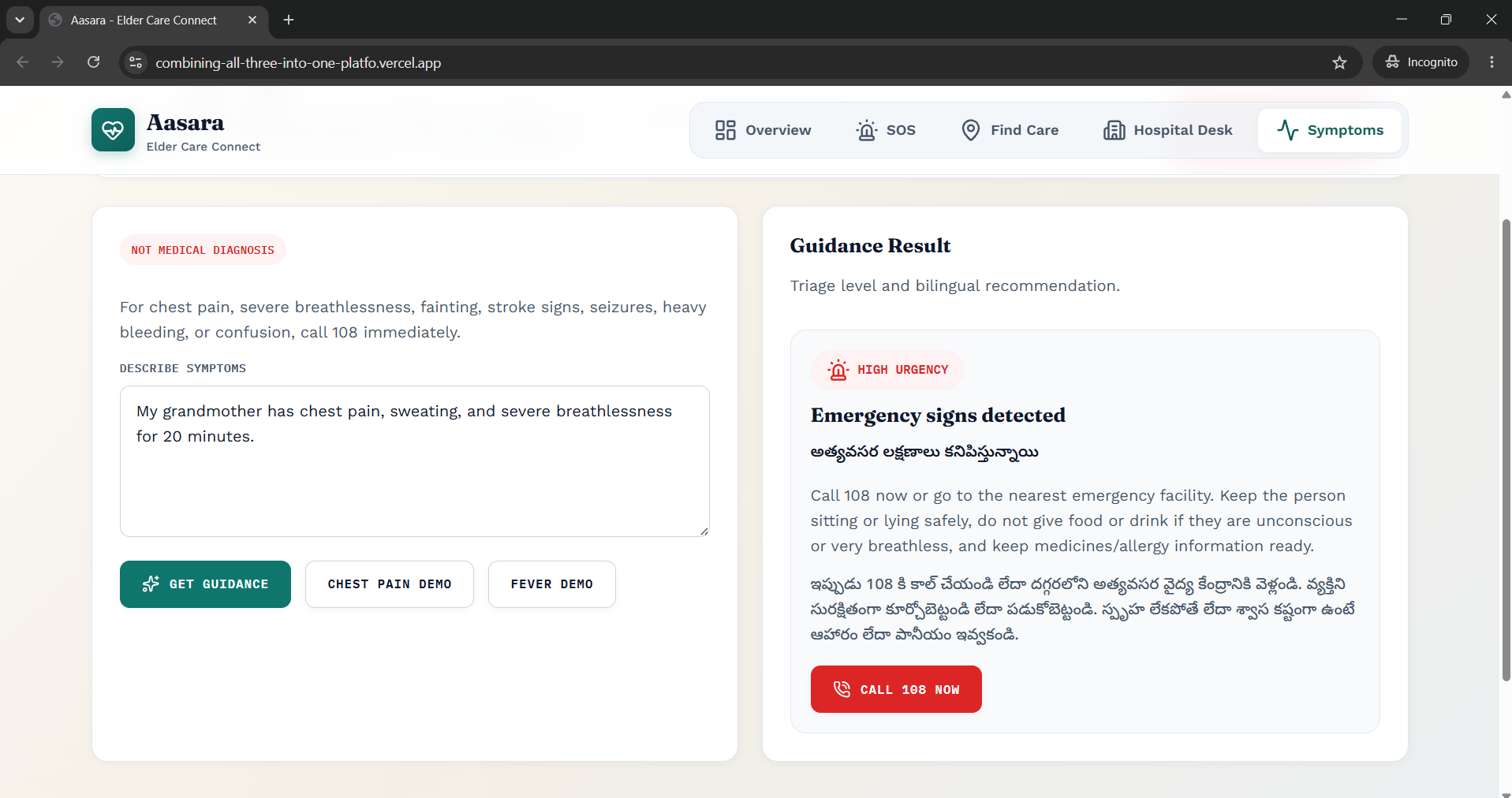
- AI Symptom Guidance — Bilingual (English and Telugu) symptom triage guidance with high, medium, and low urgency indicators, along with a direct Call 108 Now action for high-risk situations. It is clearly presented as guidance rather than a medical diagnosis.
Together, these features create a coordinated emergency workflow:
elder → family → nearby care → hospital → ambulance
This ensures that an elder living alone in Palamaner is never truly alone when it matters most.
How I built it
Aasara is a single static web page with no build step and no backend dependencies, built entirely using plain HTML, CSS, and JavaScript. I used Leaflet.js with OpenStreetMap tiles for the nearby-care map, the browser's Geolocation API to determine the resident's location, and localStorage to persist the resident's profile and emergency contacts directly on the device.
Emergency alerts are generated through SMS, WhatsApp, and Web Share deep links, allowing the application to notify family members or responders without requiring custom backend infrastructure. The application is deployed as a zero-dependency static site on Vercel and includes demo query parameters (?demo=1&view=...) so every screen can be explored immediately with realistic sample data, without requiring manual setup.
Challenges I ran into
Designing for five different user roles—the elder, their family, nearby health workers, the hospital desk, and the ambulance team—within a single-page application was the biggest challenge. Since I built the project entirely on my own, every workflow, interface, and interaction had to be carefully designed so that each role had the information it needed without making the experience overwhelming, especially for elderly users during stressful situations.
I also had to ensure the prototype remained credible. Instead of inventing an entire directory of fictional healthcare facilities, I included at least one real, verifiable listing—Government Area Hospital Palamaner—and clearly labeled every other entry as a demo placeholder to avoid overstating the application's capabilities.
Building the AI Symptom Guidance module responsibly was another challenge. I wanted it to provide meaningful urgency assessment in both English and Telugu while making it clear that it is not a diagnostic tool and should always defer to calling 108 during high-risk situations.
Accomplishments that I'm proud of
I'm proud that Aasara works as a complete end-to-end emergency response experience rather than a collection of disconnected screens. A single incident can be followed from the elder pressing the SOS button through family notification, hospital intake, and finally the ambulance dispatch workflow.
I'm also proud that I delivered the entire application without frameworks, backend services, or build tools while still supporting live maps, geolocation, bilingual triage guidance, and persistent resident profiles. Building every part of this five-role workflow as a solo developer required careful planning and execution.
Finally, grounding the prototype in a real community with a verified hospital listing made the project feel practical and authentic rather than being just another generic healthcare demo.
What I learned
Building Aasara taught me how many independent pieces must come together for an emergency response system to work effectively. A resident must be located, family members must be notified, hospitals need patient context before arrival, and ambulance teams need the right information and equipment. Missing any one of these steps weakens the entire response chain.
I also learned the importance of designing for accessibility during emergencies. Large touch targets, minimal user interaction, and always-visible emergency actions are significantly more valuable than visual polish when users may be elderly, panicked, or unfamiliar with smartphones.
Working with a real town and a real hospital also reinforced the importance of accuracy and responsible design when developing software intended for healthcare-related scenarios.
What's next for Aasara — Elder Care Connect
The next step is moving beyond localStorage and static data to a real backend capable of supporting live dispatch and multi-user synchronization, allowing family members to receive real-time updates as an emergency progresses.
I also plan to explore integration with local emergency services beyond the 108 hotline, expand verified hospital and PHC listings to additional towns facing similar elder-isolation challenges, add offline-first functionality for areas with unreliable internet connectivity, and investigate wearable or voice-activated SOS mechanisms for residents who may not be able to reach their phones during an emergency.
Built With
- css
- css3
- geolocation-api
- google-fonts
- html
- html5
- javascript
- leaflet.js
- localstorage
- lucide-icons
- openstreetmap
- responsive-design
- vercel
- web-share-api

Log in or sign up for Devpost to join the conversation.