-
-
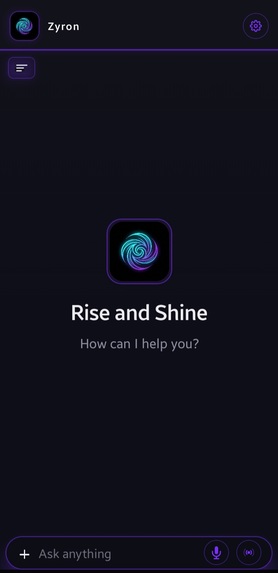
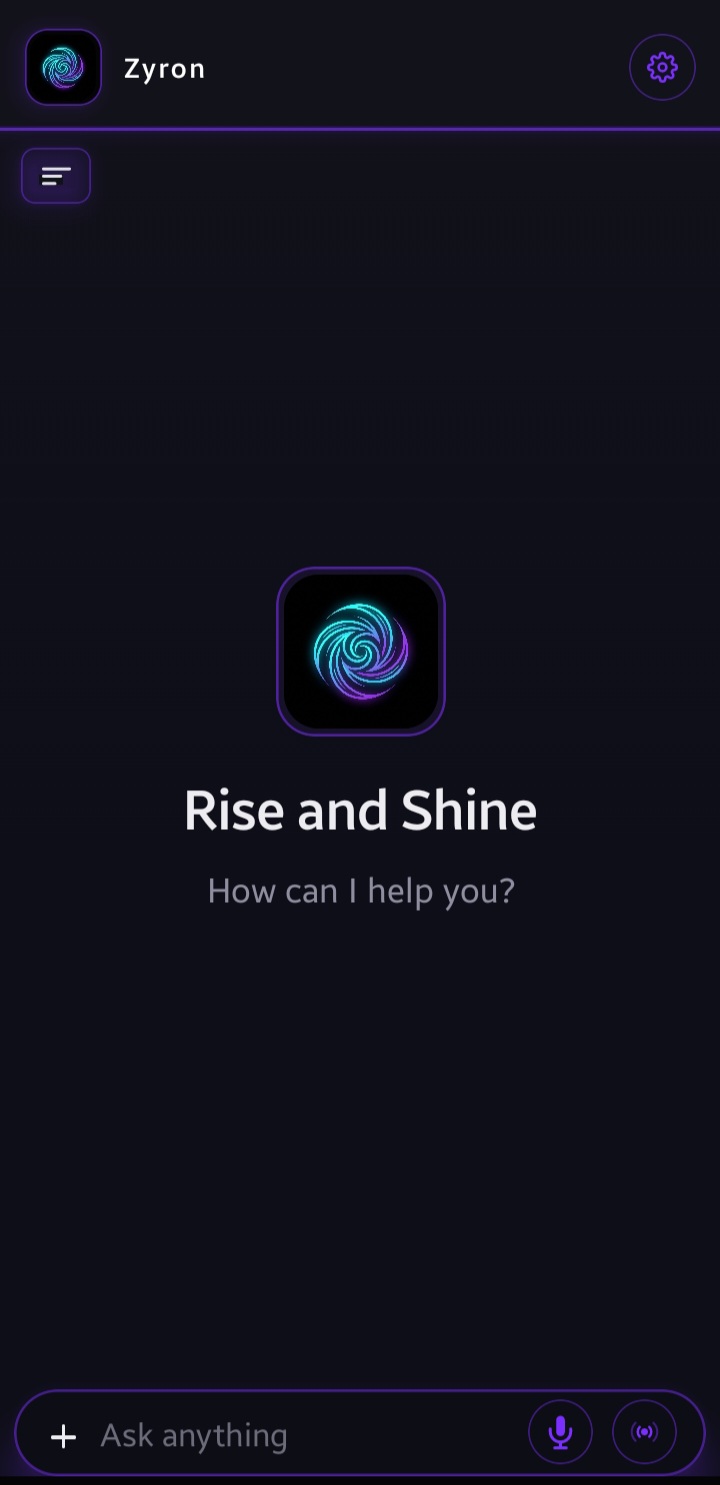
Time-aware welcome screen — Zyron greets you differently based on the hour. Clean dark UI with voice and chat input ready.
-
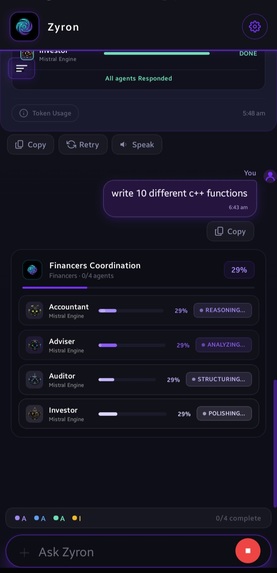
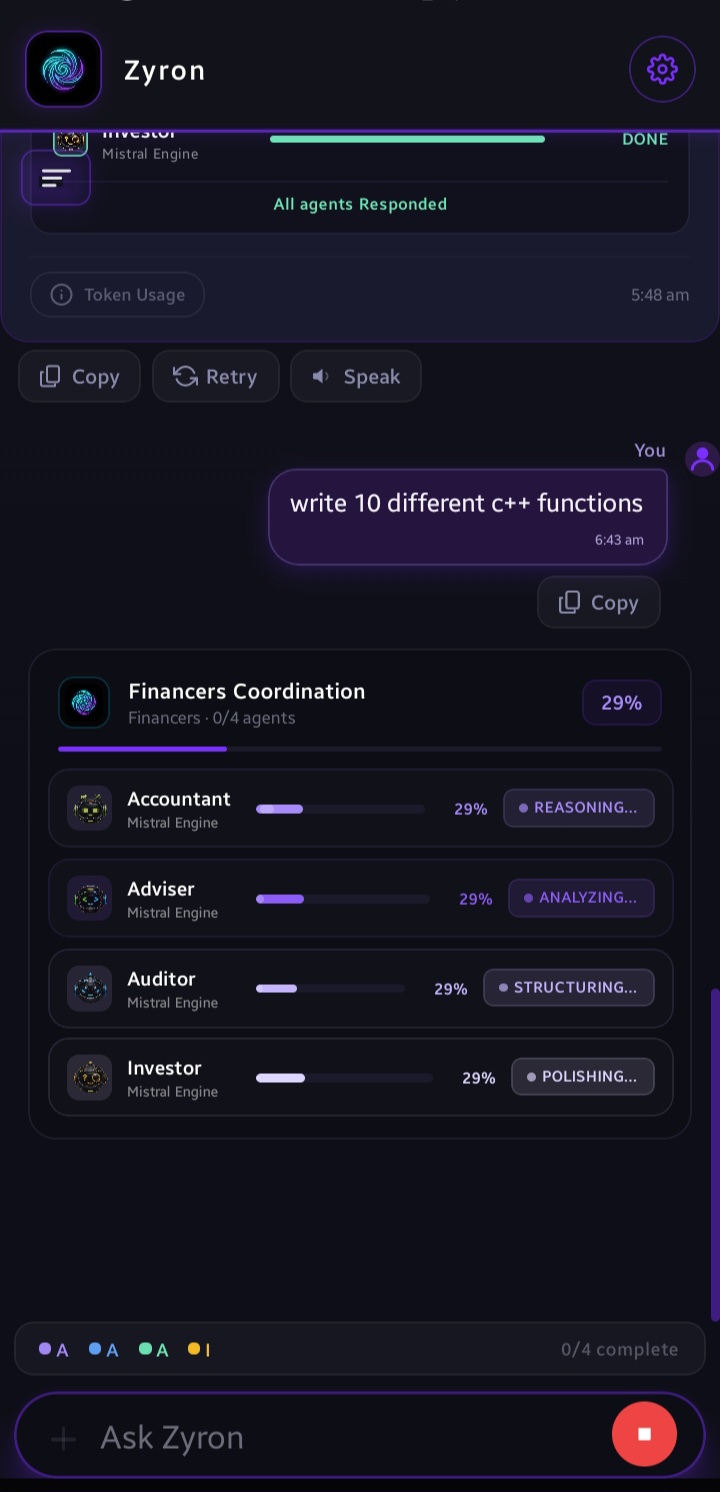
4 specialist agents running in parallel — each with live progress bars, real-time status badges, and independent AI engines.
-
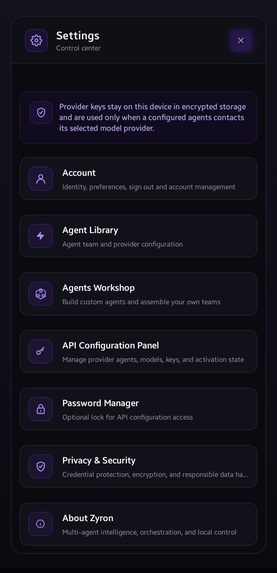
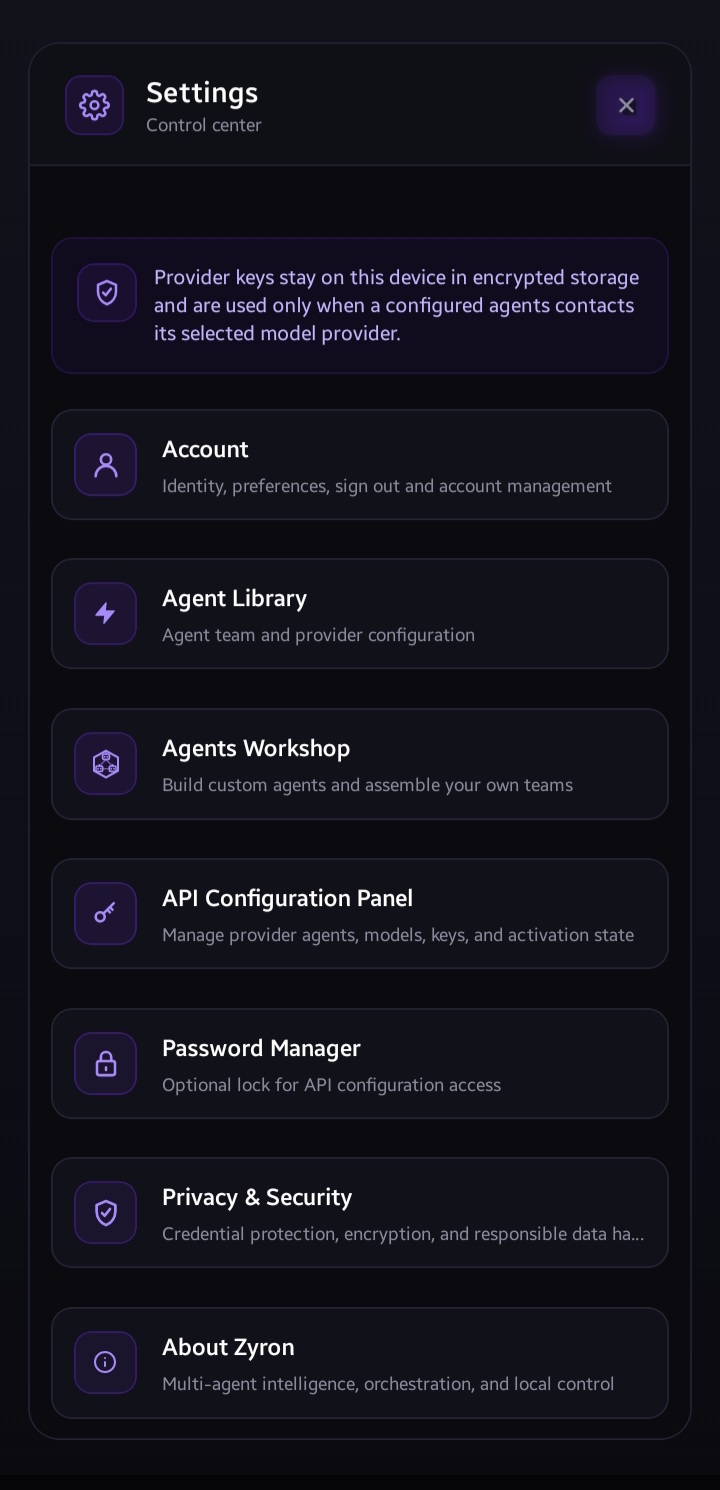
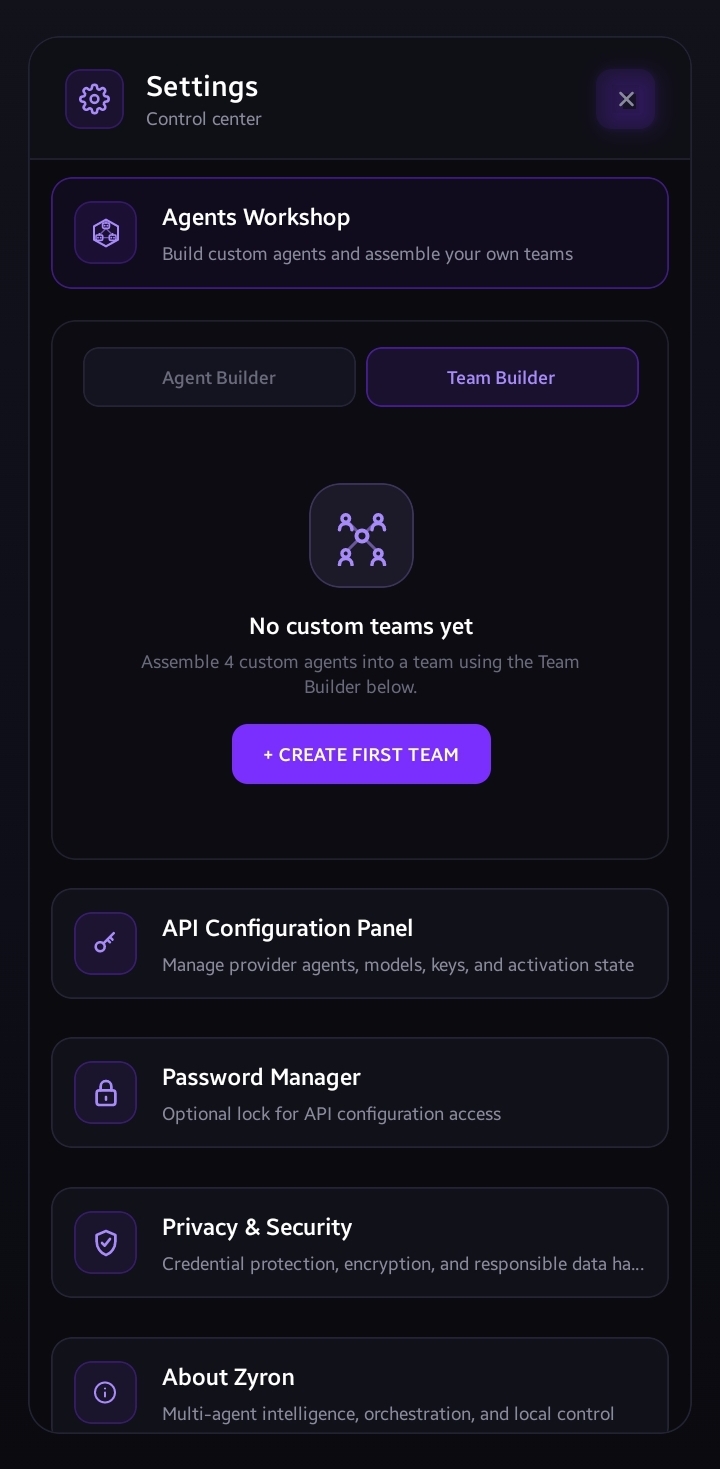
Full control center — Agent Library, Agents Workshop, API Config, Password Manager, Privacy & Security all in one place.
-
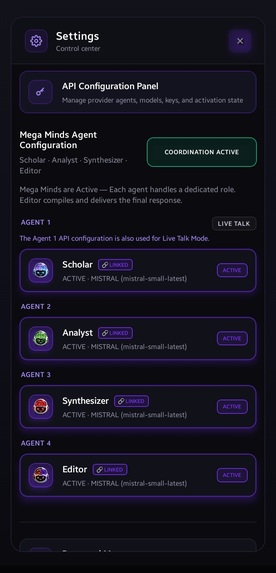
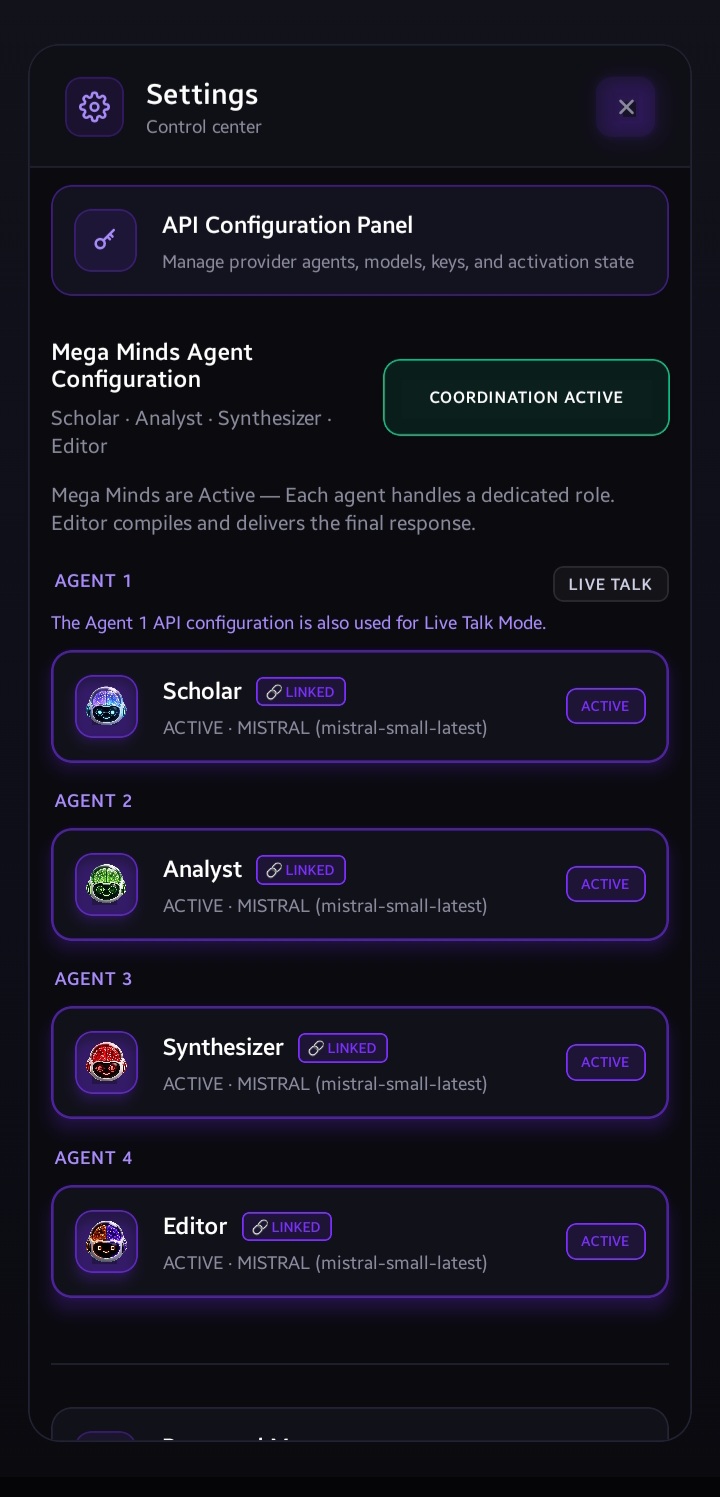
Per-agent API configuration — each of the 4 agents gets its own provider, model, and key. Coordination Active shown live.
-
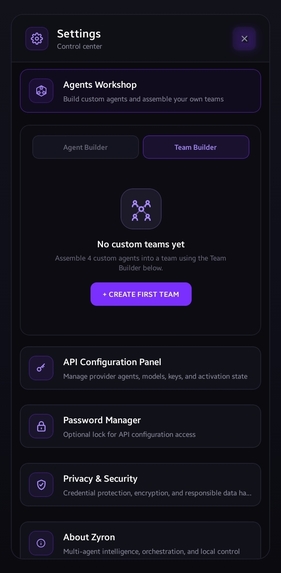
Agents Workshop — build custom agents and assemble your own 4-agent team from scratch. No code required.
-
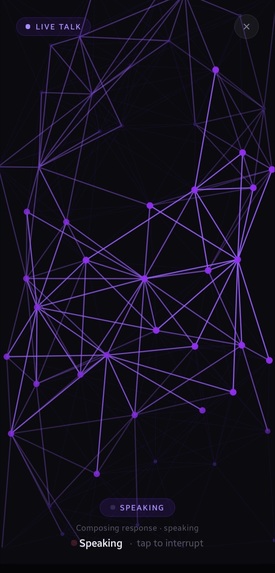
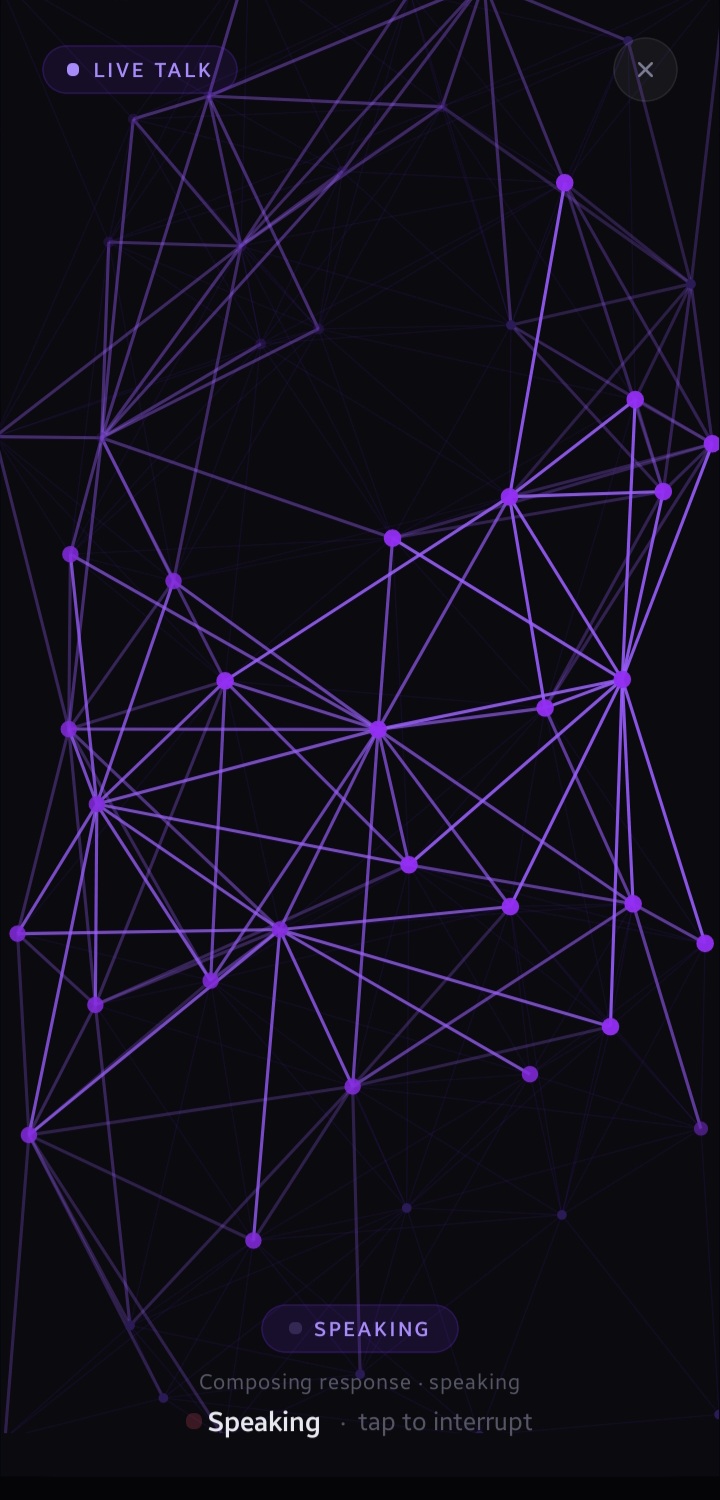
Live Talk mode — full-screen neural network animation pulses while Zyron speaks. Tap anywhere to interrupt mid-sentence.
-
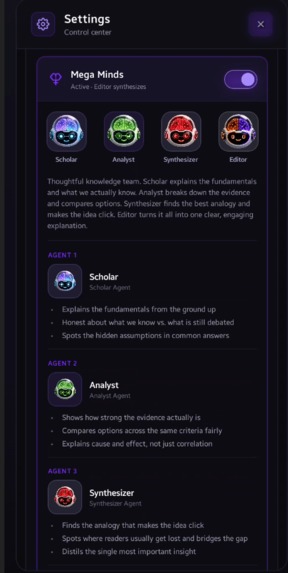
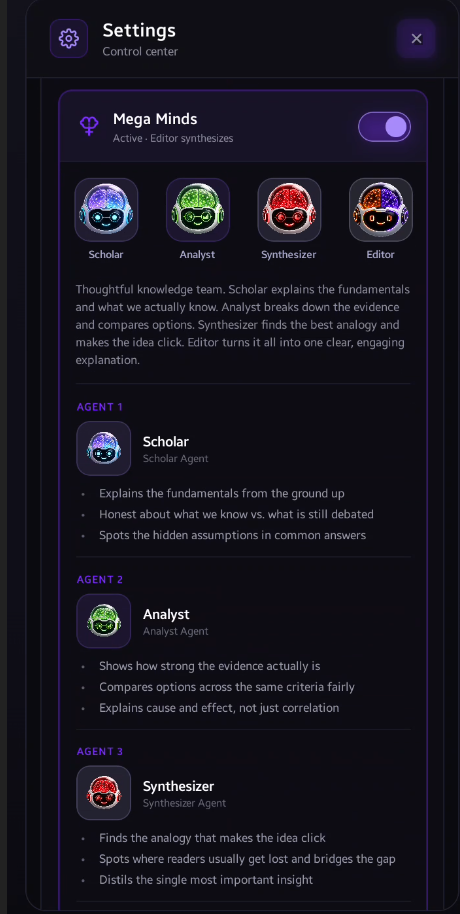
Mega Minds team — Scholar, Analyst, Synthesizer, Editor. Each agent has a strict role: facts, evidence, analogy, final answer.
-
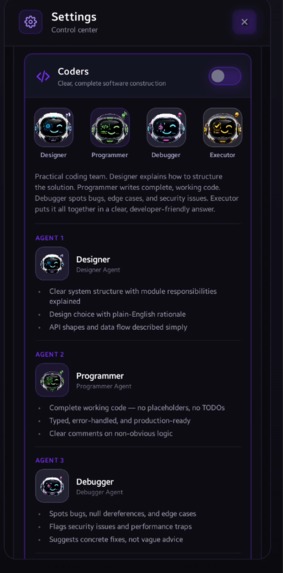
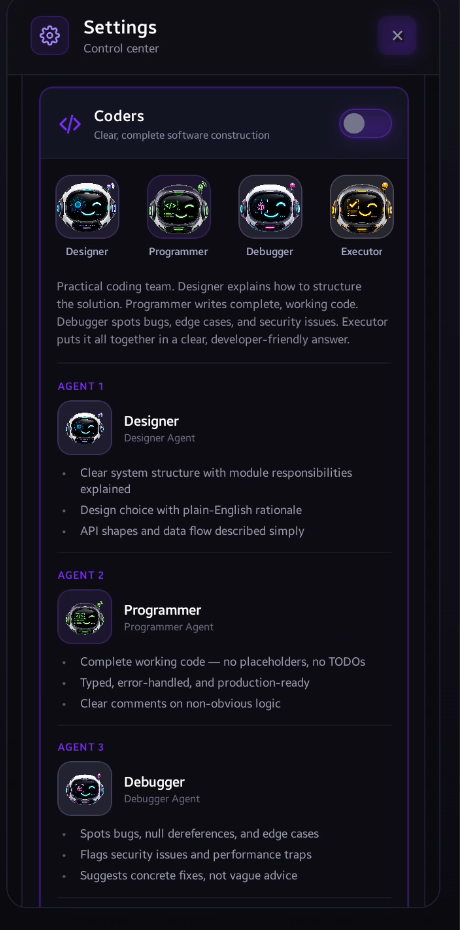
Coders team — Designer structures it, Programmer writes complete production-ready code, Debugger audits it, Executor delivers it.
-
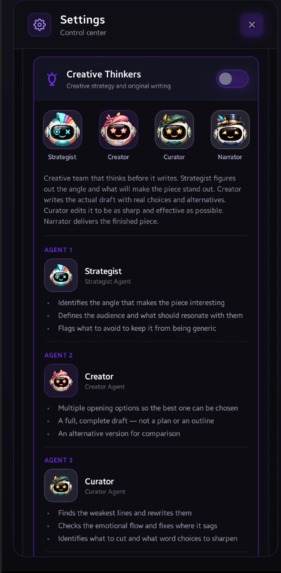
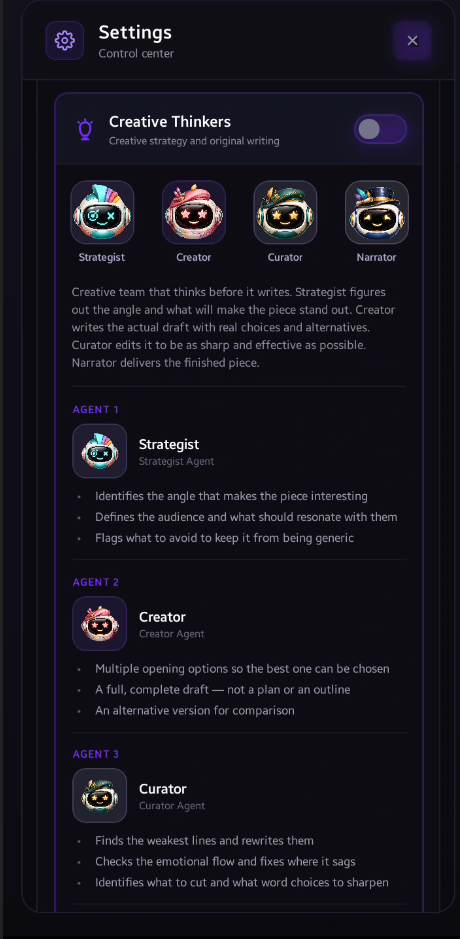
Creative Thinkers — Strategist finds the angle, Creator drafts it, Curator sharpens it, Narrator delivers the finished piece.
-
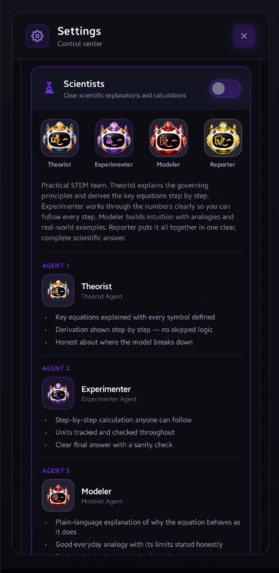
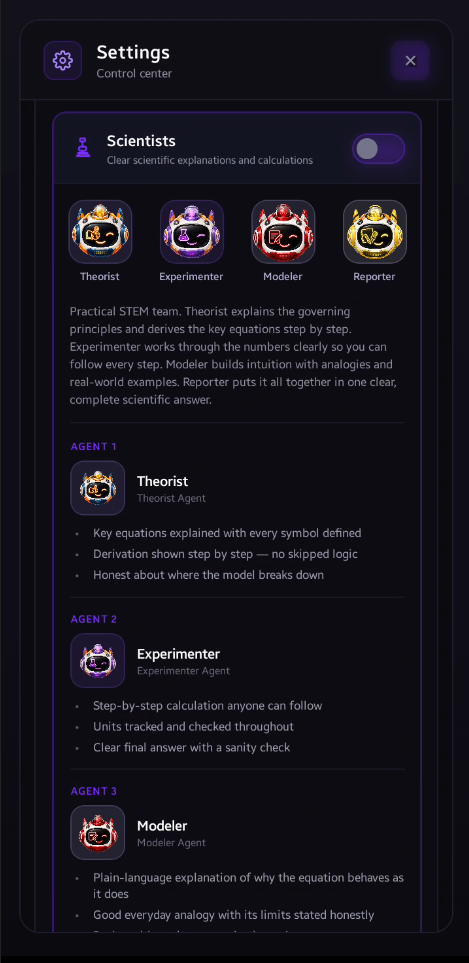
Scientists team — Theorist derives the equations, Experimenter runs the numbers, Modeler builds intuition, Reporter synthesizes it all.
-
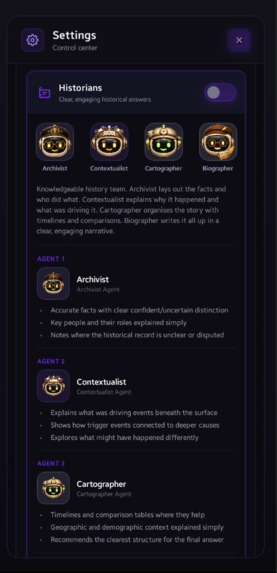
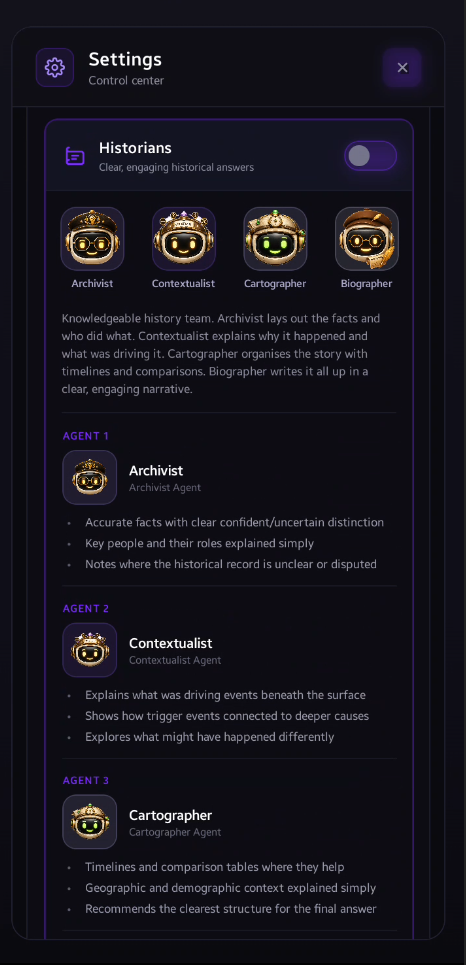
Historians team — Archivist lays out the facts, Contextualist explains why, Cartographer maps the timeline, Biographer writes the narrative.
-
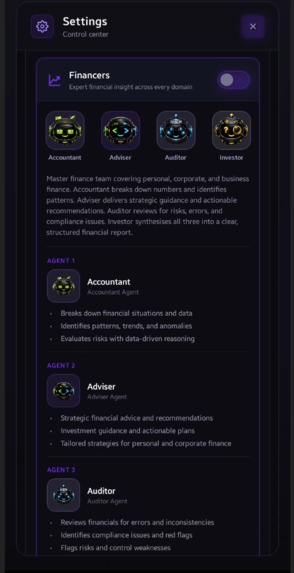
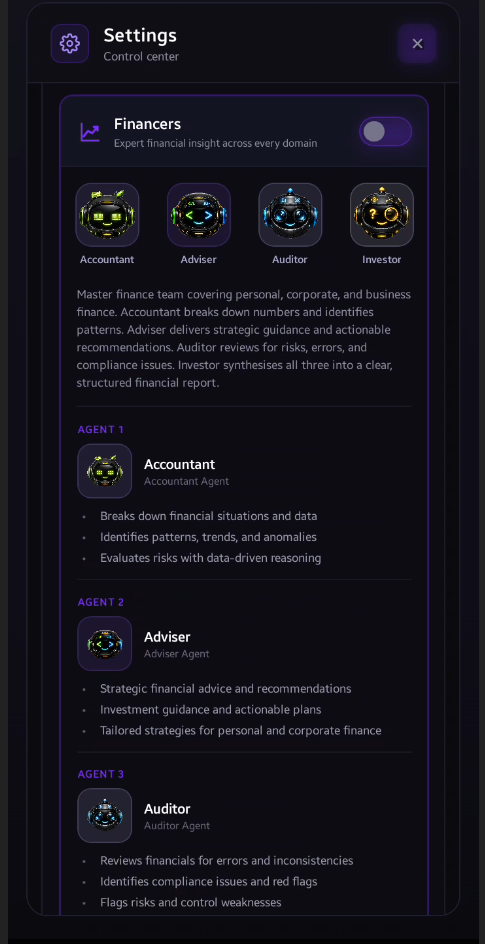
Financers team — Accountant reads the numbers, Adviser gives strategy, Auditor flags risks, Investor delivers the final financial report.
Inspiration
Most AI apps I tried felt very similar. You ask one model, and you get one answer.
I started wondering, what if you could ask a team of AI agents instead of just one?
That idea became Zyron.
I'm a second-semester BS Artificial Intelligence student, and I wanted to build something that was more than another AI chatbot. My goal was to create a real multi-agent AI system that works on Android and fits in your pocket.
What it does
Instead of using one AI model, Zyron uses 4 AI agents that work together on every request.
- Agent 1 – Analyst: Understands the problem and plans the solution.
- Agent 2 – Executor: Creates the main solution or writes the code.
- Agent 3 – Validator: Reviews the work, checks for mistakes, and finds missing details.
- Agent 4 – Writer: Combines everything into one clear and polished final response.
Before the agents start, a lightweight local analyzer decides how the request should be handled. Depending on the task, Zyron uses FULL, COMPACT, or NONE coordination to balance speed and quality.
Features
- 6 specialist teams with 24 AI agents
- Live Talk mode for natural voice conversations
- Web search with automatic provider fallback
- Document and image analysis (PDF, DOCX, and images)
- Custom AI agent and team builder
- Automatic AI provider fallback for reliability
- Secure API key storage using Android Keystore
- FastAPI + LangGraph backend with a local JavaScript fallback engine
How I built it
Frontend
- React Native
- Expo SDK 54
- TypeScript
- SQLite for conversation history
- Expo Secure Store with Android Keystore for API key security
Backend
- Python
- FastAPI
- LangGraph
- Railway
- Docker
Three AI agents run in parallel on the backend, and a fourth agent combines their work into the final response.
I also built a dual-engine architecture.
Normally, every request is sent to the Railway backend. If the backend is unavailable or there is a network problem, Zyron automatically switches to a fully local JavaScript orchestration engine. The switch happens silently, so users can continue using the app without noticing any difference.
AI Providers
Zyron supports multiple AI providers, including:
- OpenAI
- Anthropic
- Google Gemini
- Groq
- Mistral
- DeepSeek
- GLM (Zhipu)
- OpenRouter
I built the entire project myself in 30 days.
Challenges
The biggest challenge was making multiple AI agents work together without conflicting with each other. Since several agents run in parallel, they could easily repeat the same ideas or produce different answers. I spent a lot of time designing prompts and coordination logic so that each agent had a unique role and contributed something valuable to the final response.
Another challenge was improving response quality when users selected smaller or lower-cost AI models. My goal was to make Zyron generate the best possible answer regardless of which model was being used. This required many rounds of testing, prompt tuning, and refining the coordination process to get strong results even from less powerful models.
Building the coordination system itself was much harder than I expected. The real challenge was making the agents work like a team instead of four separate chatbots. It took a lot of experimentation to make them complement each other instead of simply repeating the same information.
Security was also an important challenge. Since users provide their own API keys, I learned how to use Android Keystore and built a secure system so the keys are never stored in plain text or exposed inside the app.
What I learned
This project taught me that building a multi-agent AI system is much more than writing prompts.
The hardest part is designing how the agents work together, share information, and improve each other's answers instead of repeating the same response.
I also learned that building a complete product under a short deadline forces you to focus on what really matters. Creating Zyron in 30 days helped me improve my problem-solving skills and taught me how to turn an idea into a working application.
Built With
- android-keystore
- anthropic-claude
- docker
- expo-secure-store
- expo.io
- fastapi
- google-gemini
- groq
- katex
- langchain
- langgraph
- llm-orchestration
- mistral
- multi-agent-systems
- openai-api
- openrouter
- python
- railway
- react-native
- sqlite
- tavily
- typescript
- webview

Log in or sign up for Devpost to join the conversation.