-
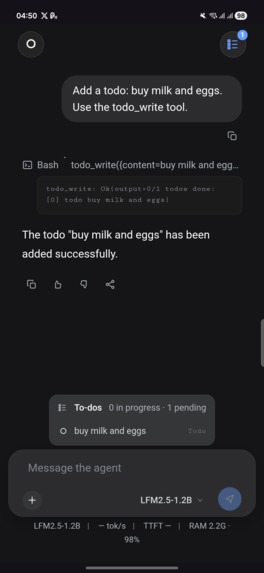
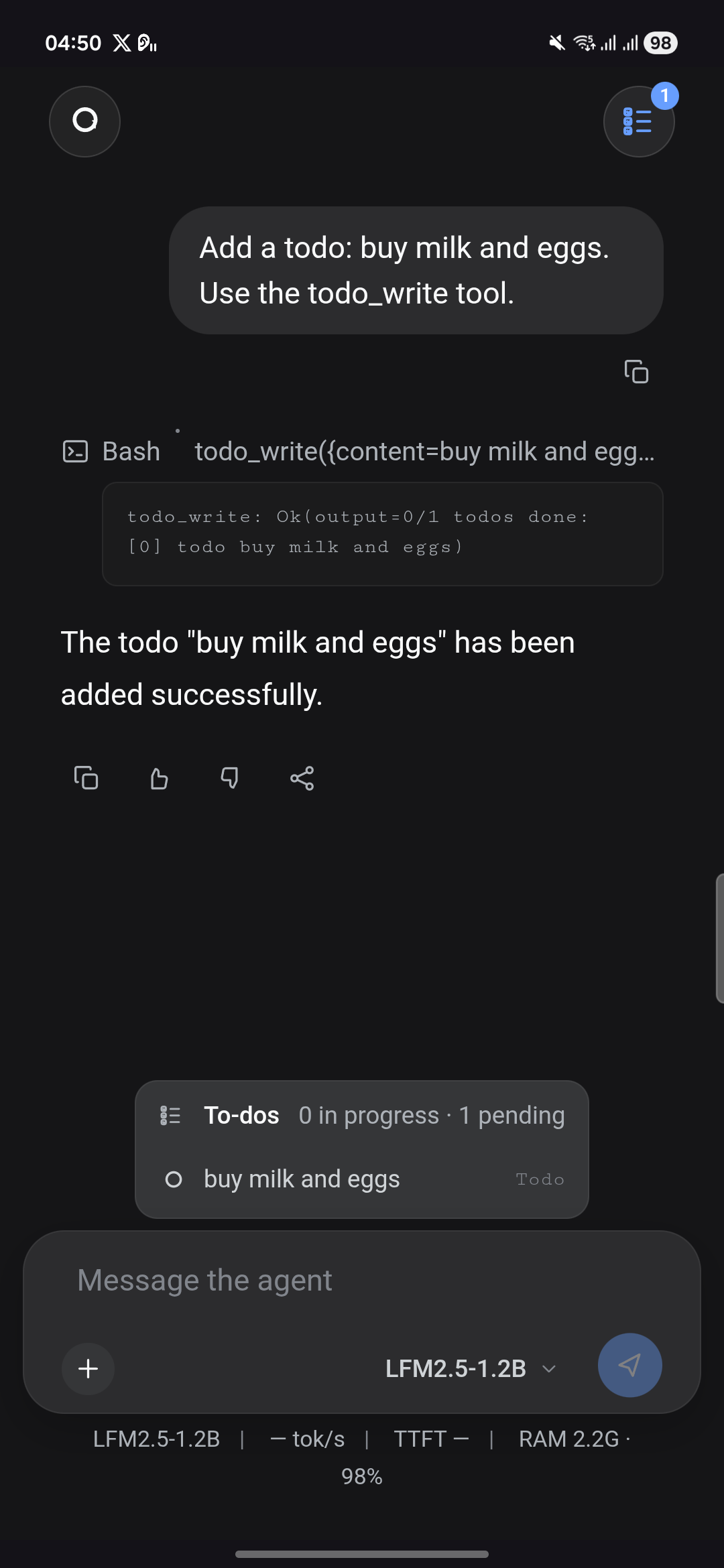
Todo List Tool Calling
-
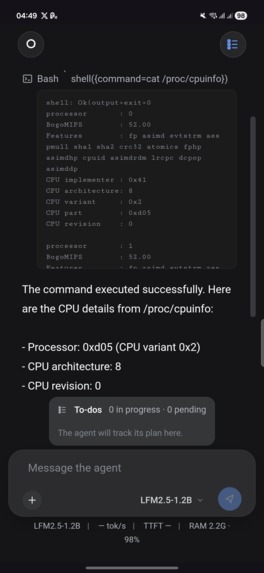
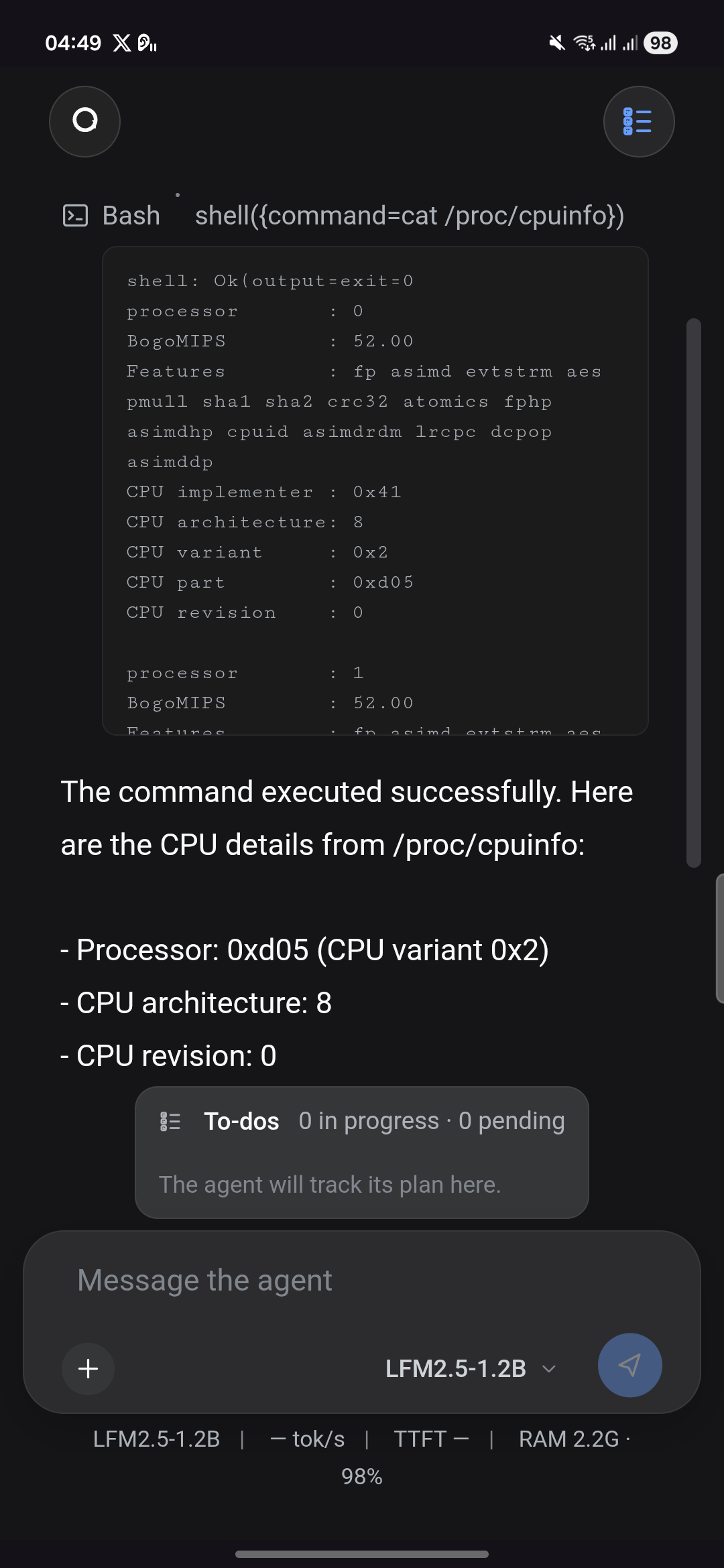
Shell Commands Tool Showcase
-
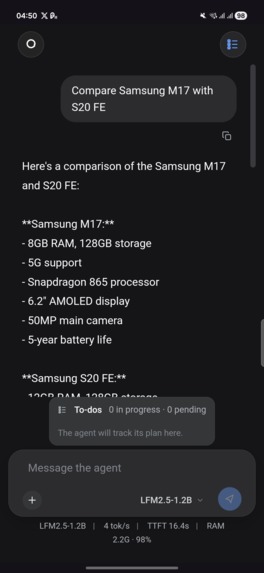
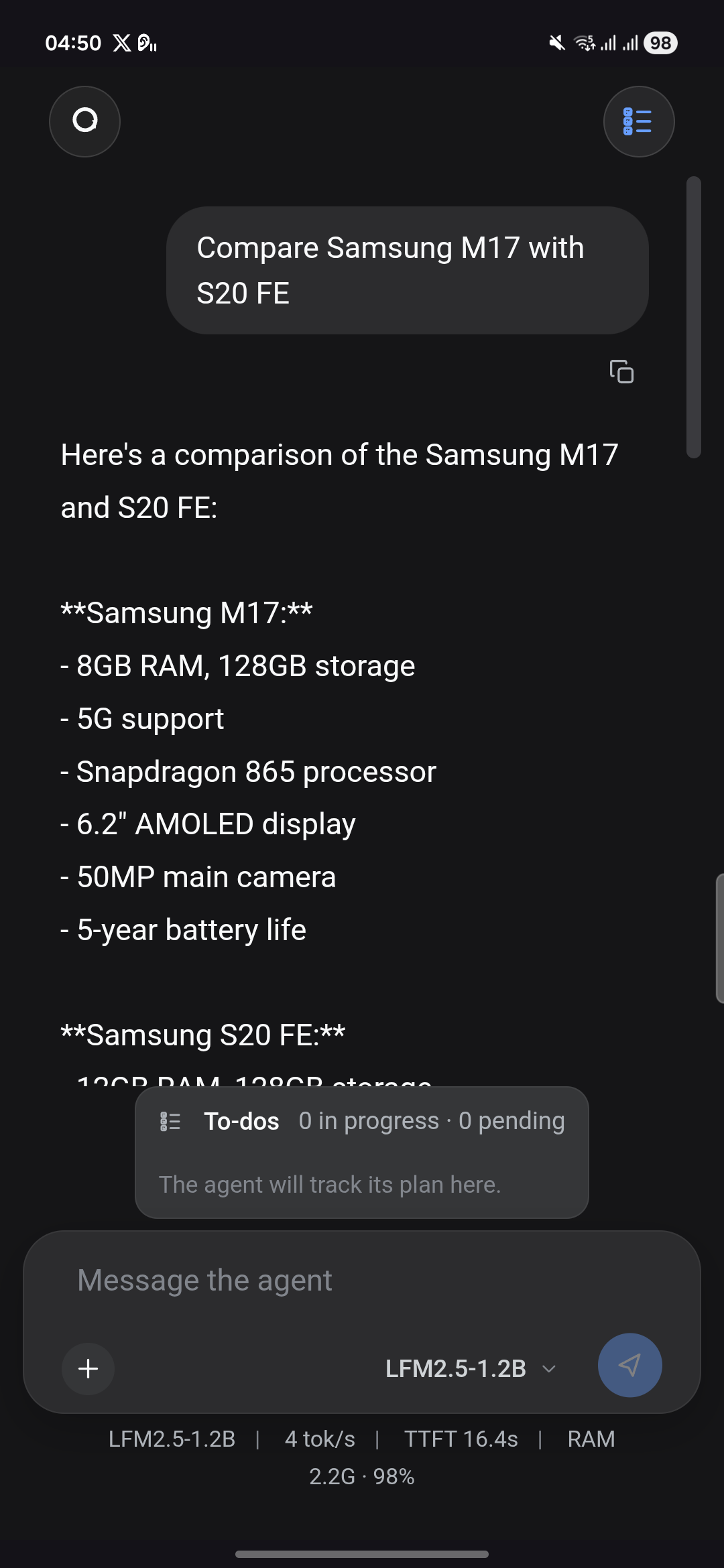
Product Comparison
-
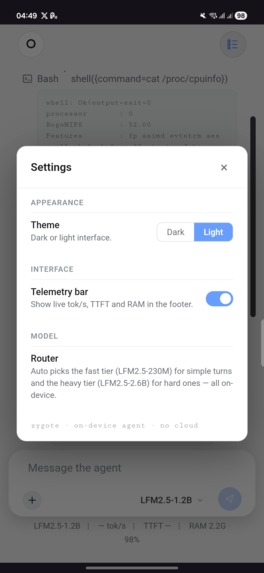
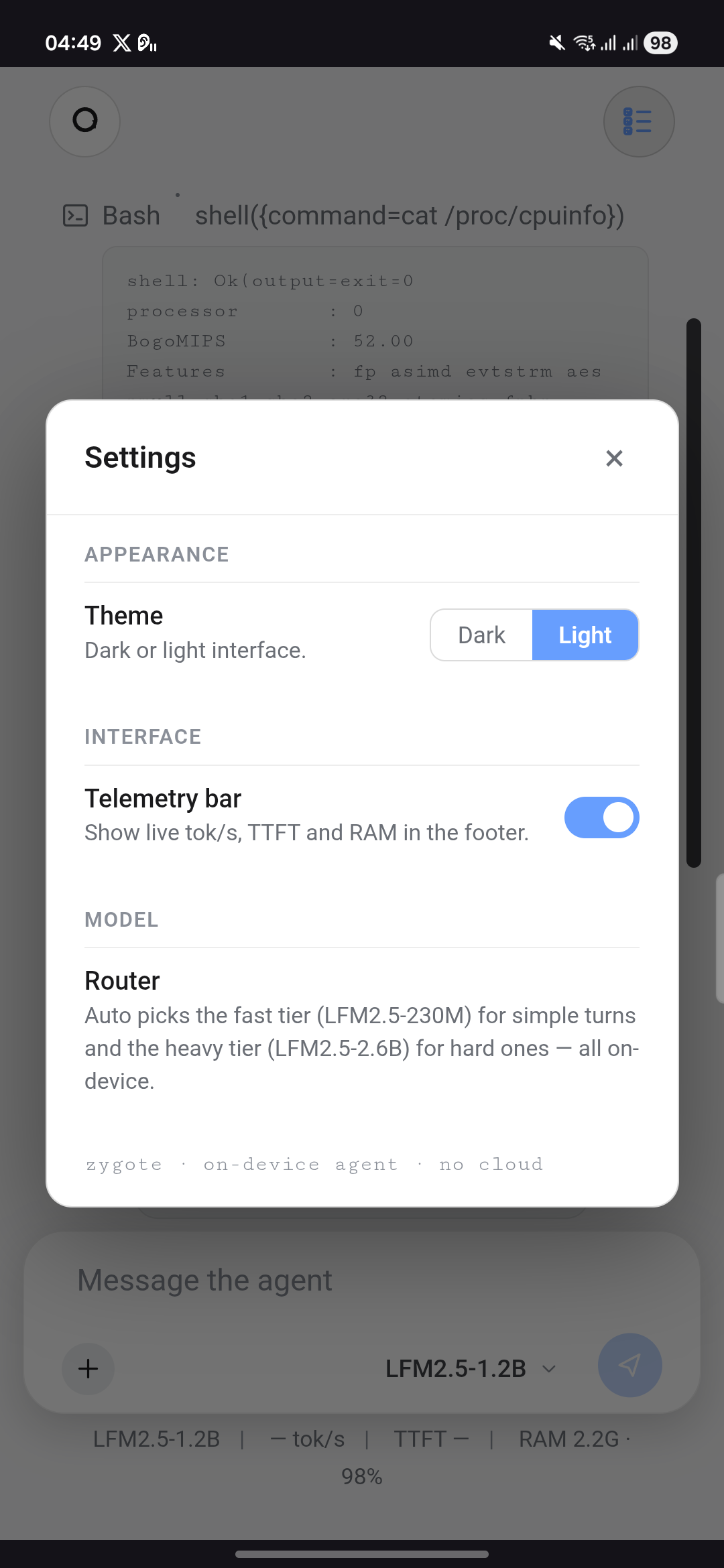
Settings
-
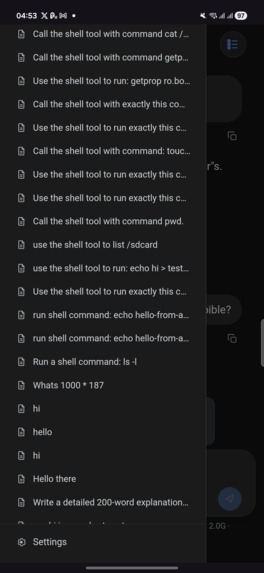
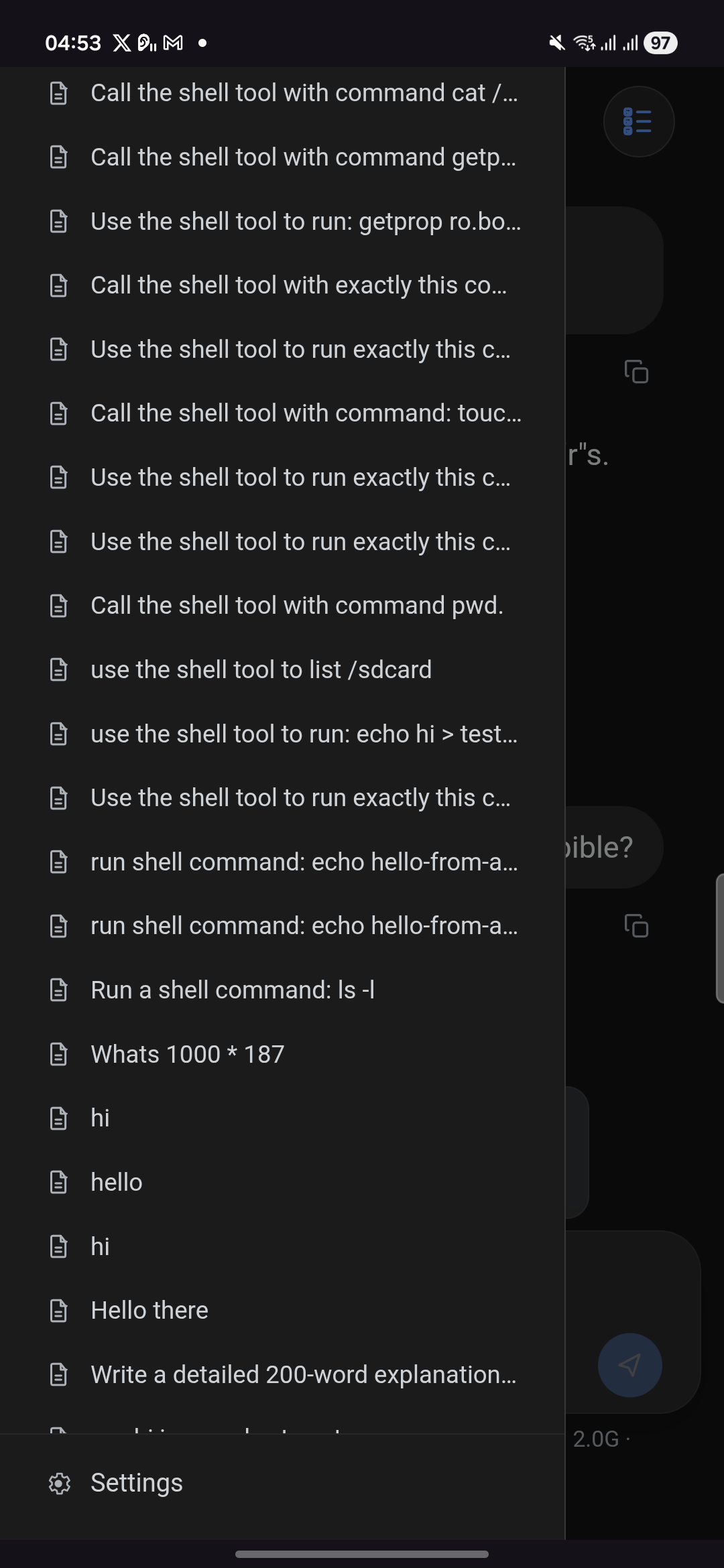
Session List from Model Testing
Inspiration
A $150 Samsung Galaxy M17 — Exynos 1330, 2×Cortex-A78, no NPU, 8GB RAM with only ~2.2GB free for weights — and the question: what does an agent look like when it has to live entirely on that? Not a cloud client, not a demo that streams from a server. Something that works in airplane mode, owns no external dependency, and is genuinely useful on the cheapest hardware people actually buy.
What it is
Zygote is an on-device agent harness for Arm phones: a native Kotlin agent loop (tools, sessions, telemetry) wrapped around a llama.cpp engine (KleidiAI, Q4_0) with an embedded OpenAI-compatible server (127.0.0.1:8787) and a hyper-minimal PWA served from app assets. A two-tier LFM2.5 stack: a 230M router (194 t/s prefill ≈ 2 ms intent classification) and a 1.2B generator (664 MB Q4_0). The agent has tools — a close-to-hardware shell (sandbox-aware, su fallback, hard timeouts), to-dos, and phone control — with honest per-session, segment-accurate telemetry.
How we built it
- Native engine: llama.cpp built with KleidiAI=ON; the A78 (Armv8.2 dotprod, no SME2/i8mm) correctly routes to the Q4_0 DotProd GEMV path — worth 2.06× prefill throughput over Q4_K_M.
- KV-prefix caching on a hybrid arch: LFM2.5 is a Gated DeltaNet (linear-attention) hybrid whose recurrent state can't be partially erased by default (
n_rs_seq = 0), sollama_memory_seq_rmsilently no-oped → batch position gaps → "failed to initialize batch". We enabled rollback snapshots in a vendored llama.cpp patch, sized them to the ubatch constraint (n_rs_seq = 256), and added a full-reset fallback. - Latency stack: tool-schema slimming +
relevantTools()keyword filter, 4096 context, Q8_0 KV cache, 8-thread big.LITTLE scheduling. - Server + PWA: raw-Socket OpenAI-compatible SSE server, run-in-flight guard, tool-loop orchestration, WebView-served React PWA.
Measured results
- Time to first token (multi-turn): 59.6 s → 1.7 s (34×)
- Decode speed: 7.5 t/s → 15.6 t/s
- KV cache: 1 GB @ 8K context → Q8_0 @ 4096
The decode bound is memory bandwidth: every token re-reads the 664 MB weight matrix — ~9.2 GB/s at 14 t/s, roughly half of LPDDR4X. That number shaped every decision.
$$ \text{tokens/s} \approx \frac{BW_{mem}}{W_{model}} = \frac{9.2\text{ GB/s}}{0.664\text{ GB}} \approx 14 $$
Challenges
- The hybrid KV bug (above) — digging into llama.cpp's memory-allocator contiguity checks to find a silent no-op was dropping our trim.
- Tool-call reliability on a 1.2B — LFM2.5 emits multiple calls per block; the parser had to extract every
name(args), and malformed calls forced a schema-slimming + relevance-filter redesign. - Sandboxed shell — an Android app's
shinherits cwd/with no HOME: we give it a writable home,sufallback, and hard timeouts. - Speculative decoding (honest negative): a 230M draft + 1.2B verify loop was fully built and measured at 20–39% acceptance — the 230M is a different model family, so the draft doesn't predict the target. It ships behind a flag with the numbers documented. A measured negative result beats a claimed one.
What we learned
Small models are a system problem: quantization path, cache layout, scheduling, and tooling each move the needle more than model swaps. On Arm, KleidiAI's microkernels are the single biggest multiplier available. And honest telemetry — no emulator numbers — is what makes an optimization story credible.
All code, benchmarks, and 6 known-issue tickets: github.com/system1970/zygote

Log in or sign up for Devpost to join the conversation.