-
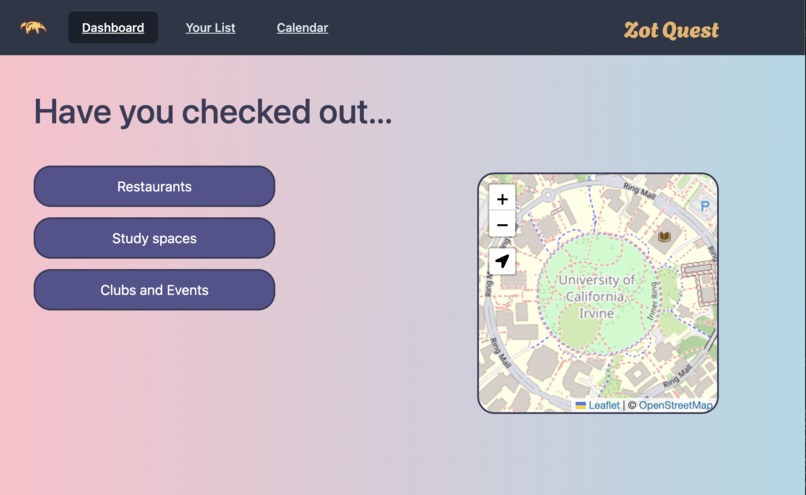
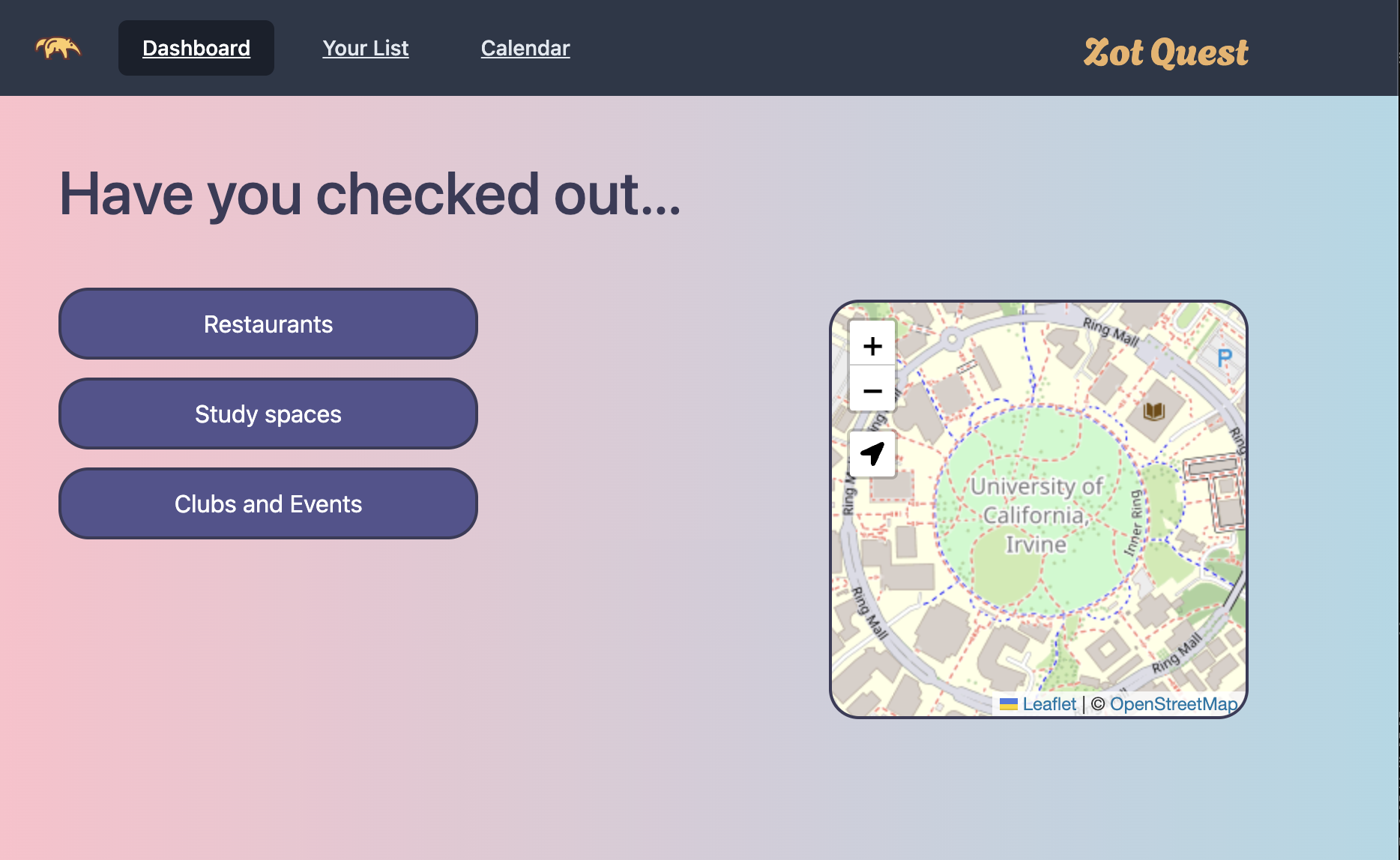
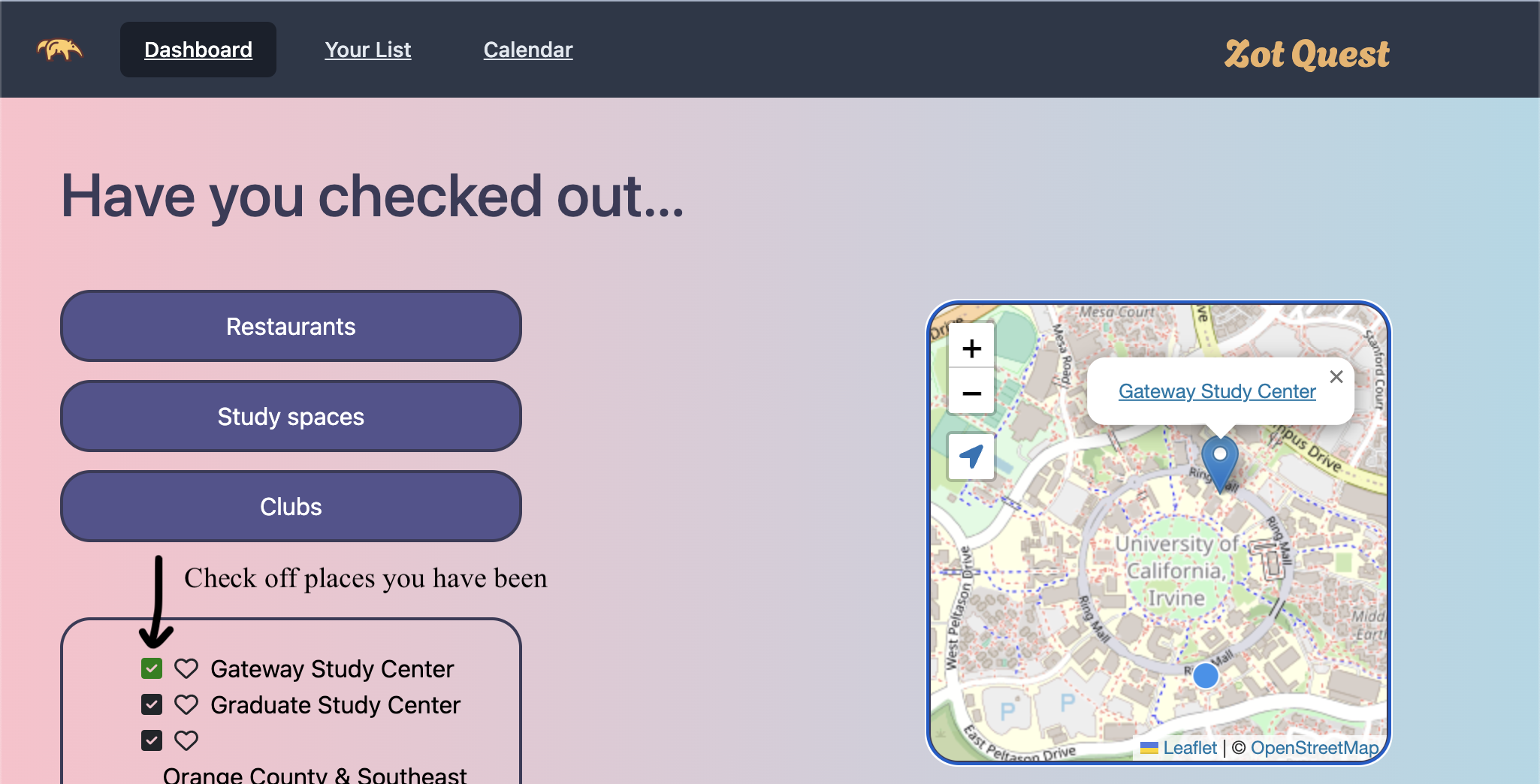
Dashboard of Zot Quest.
-
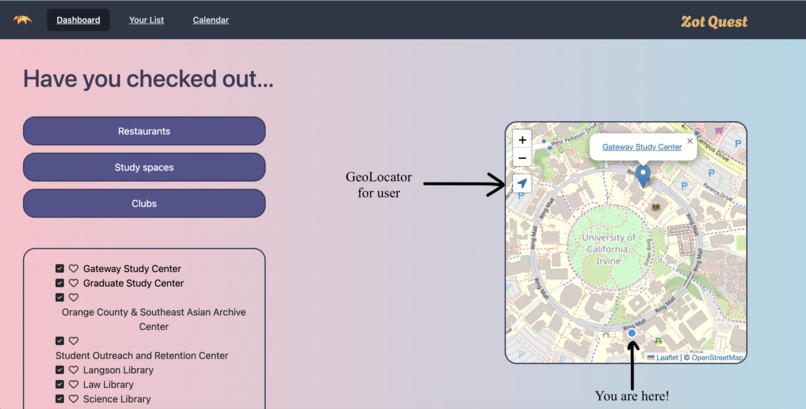
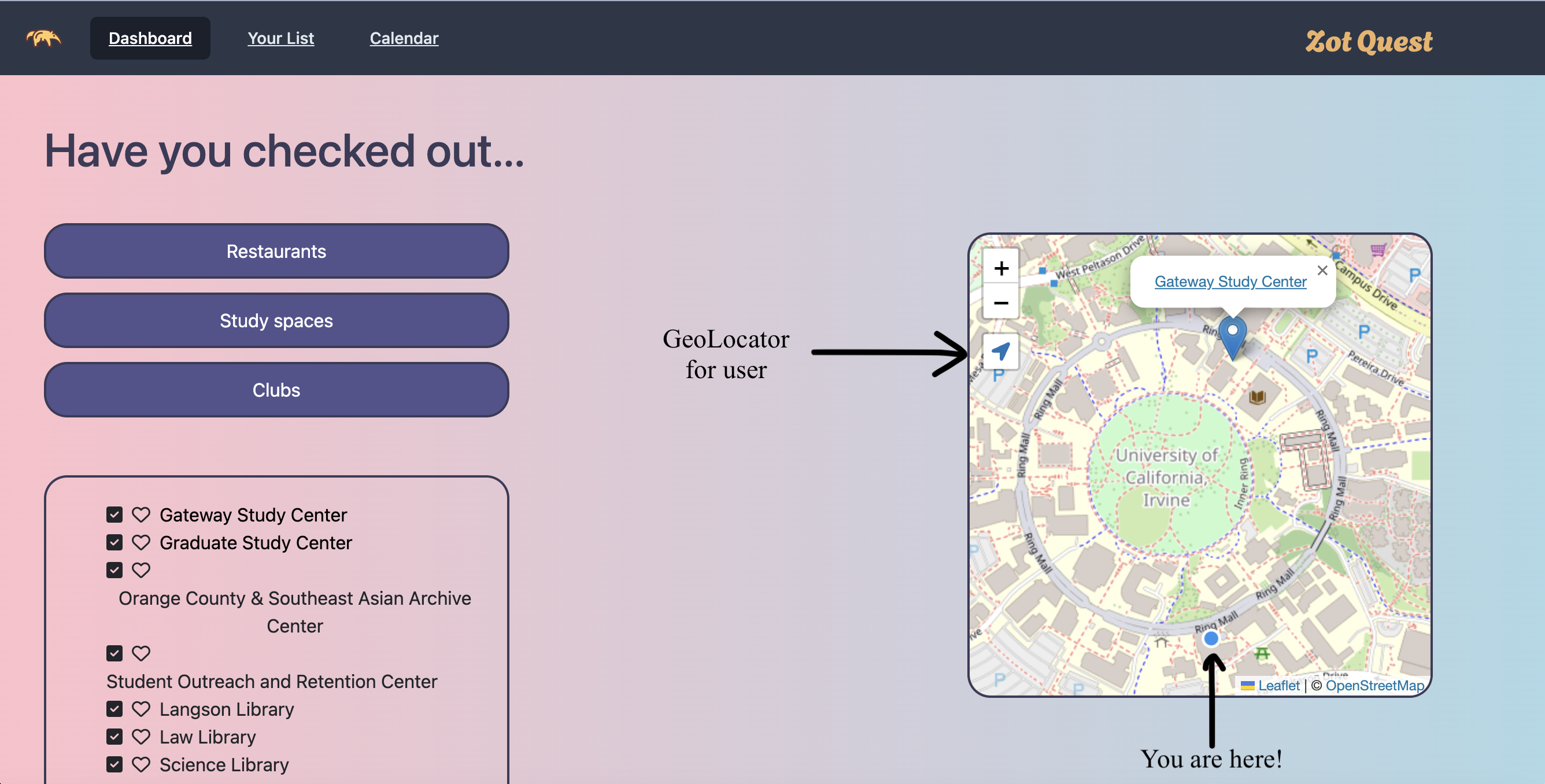
Once Study Spaces button is clicked, a list of study spaces appears. GeoLocator is accesible if user wants to turn on.
-
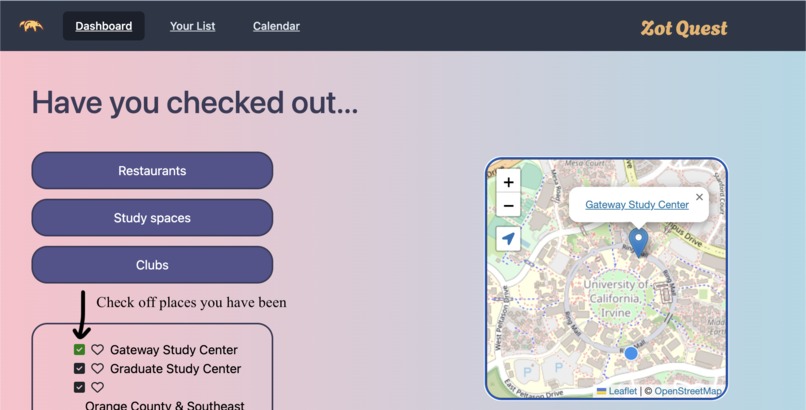
User can click on checklist icon to check off places they have been.
-
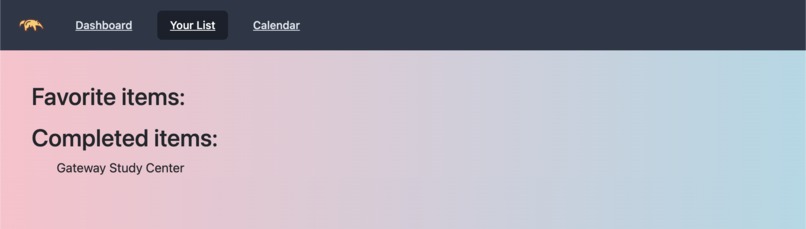
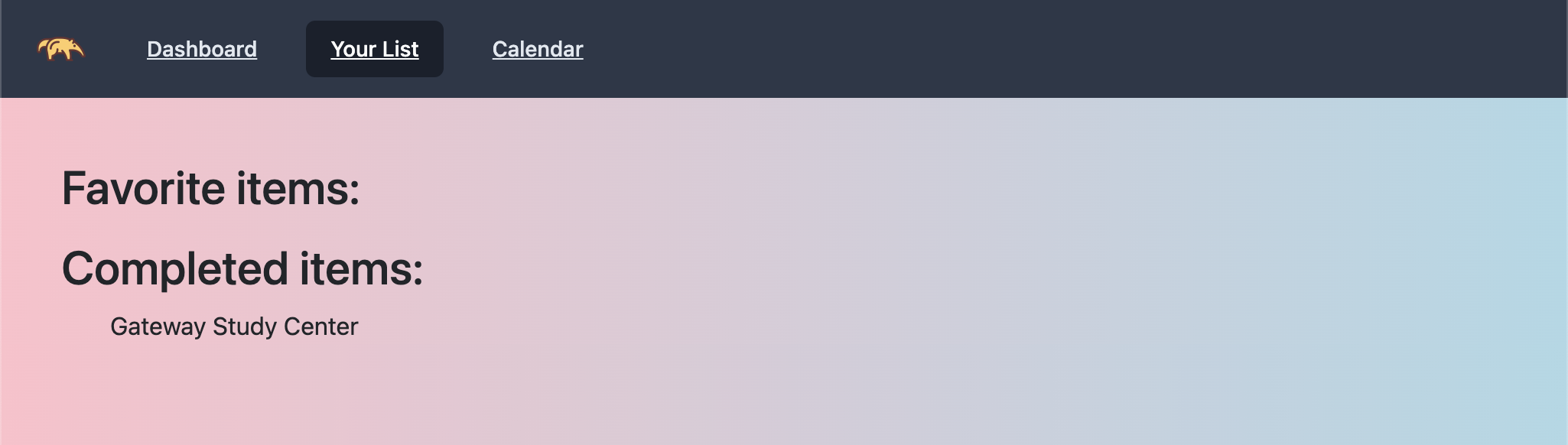
"Your List" shows any checklisted items from Dashboard, to this page.
-
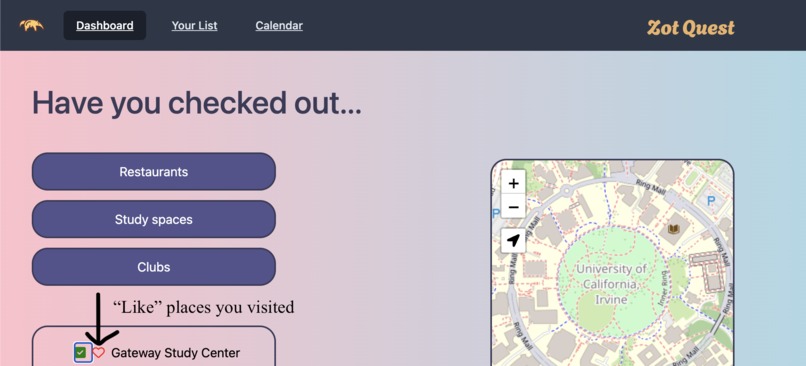
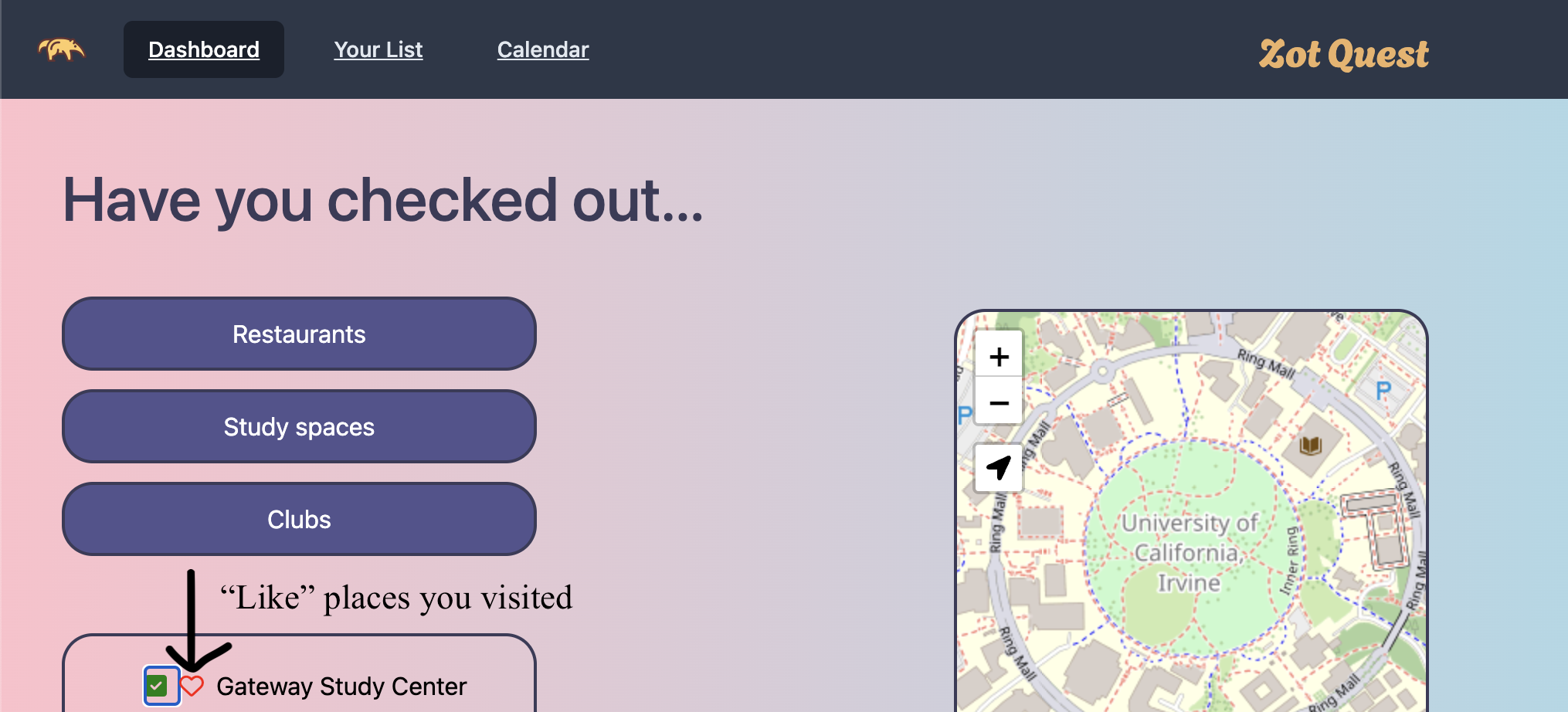
User can click on heart icon to "like" places they have visited.
-
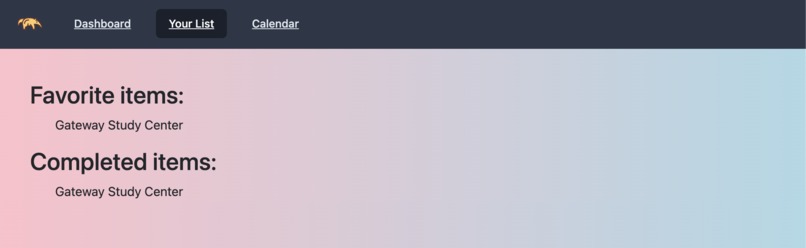
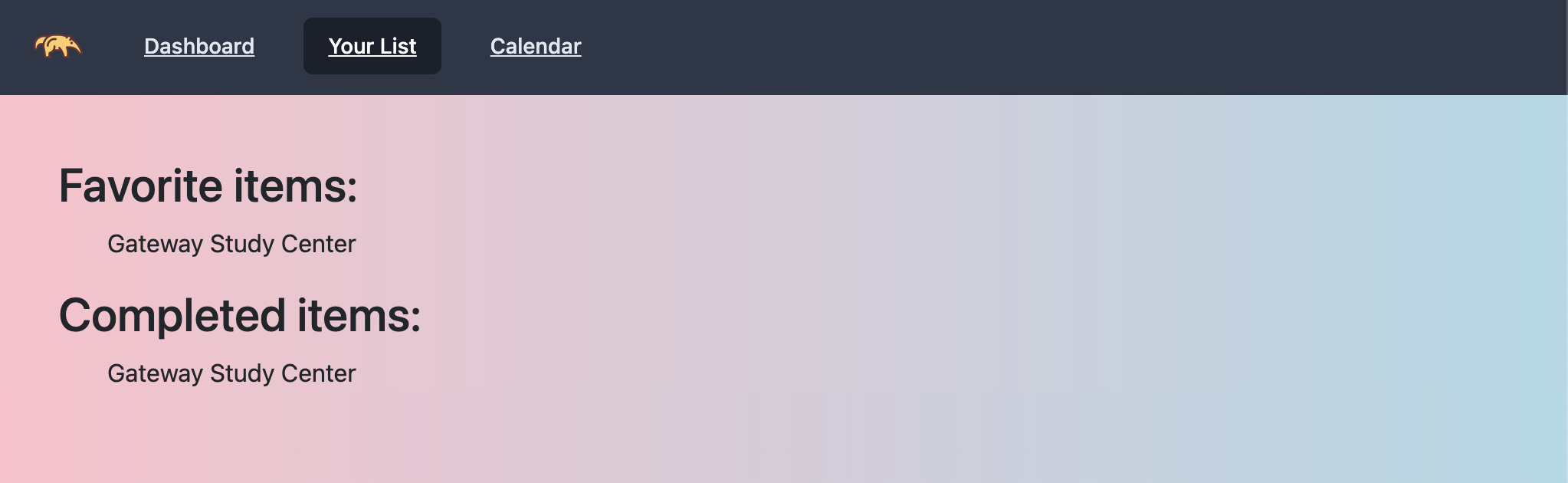
Both "liked" places and check off places appera here.
Inspiration
Our inspiration derived from aspects found on ZotFinder and Yelp (as avid food lovers). ZotFinder is an interactive map that allows students to search up buildings on campus, similar to Google Maps but more efficient for students. On the other hand, Yelp has features that allow users to organize their personal favorite restaurants and locations into customized folders. In hopes of implementing ZotFinder’s efficient way of exploring campus as well as Yelp’s personalized tool for discovering new places, we aim to allow students at UCI to branch out of their comfort zone and utilize UCI’s many wonderful resources.
What it does
ZotQuest hopes to perform as a handy personal bucket list as well as an all-in-one discovery web application. Upon first glance, ZotQuest displays various options in the following on-campus categories: restaurants, study spaces, and clubs. After clicking the desired topic, ZotQuest drops down a list of all the available options UCI offers! Additionally, once a specific location is selected, the map on the right will provide the pinned coordinates with an option to see where the user is at the present moment. This option is offered through an arrow button on the top left corner of the interactive map.
How we built it
This web app, ZotQuest, was built using the combination of HTML, CSS, and JavaScript, the most popular combination of languages used to design web apps. Since the app doesn't require any extremely complicated data structures, the backend was done with just JavaScript. In the future, we do hope to include more features that will include the usage of a more complex backend. The map shown on the page was made with leaflet.js, a library for maps in JavaScript. Besides that, we built the entire app by collaborating on Visual Studio Code with GitHub.
Challenges we ran into
As a team, our initial obstacle was figuring out where to start as our ideas varied in our skillsets and even more limited by the time frame. We had several ideas ranging from notetaking to mapping to traveling and even to toilet finding. However, it was brought to our knowledge and realization that in the span of 12 hours, our ideas may have been limited. Therefore, we began to list our similarities and eventually came up with the idea in regards to food. Our passion for not only eating but also discovering new food led us to our ultimate inspiration for our creation for this hackathon. Beginning the hackathon, one of our main enemies were the “git push” errors that would show up on each of our screens. Though we originally all freaked out from this consistent error, one of our members managed to solve the issue and would help all of us when this problem occurred. He taught us how to overcome this issue and by lunchtime, we barely saw this error again - becoming one of our main areas of.
Accomplishments that we're proud of
ZotHacks was our team's first experience coding in a group setting, and we are all so happy that we made it! Like we mentioned earlier, we had some initial setbacks, but we were able to work together as a team to help solve each other's problems at are lightly assigned roles. As we reflect on our last 12 hours at ZotHacks we are ultimately proud of everything we accomplished in that amount of time. Our app is functional and has all if not more of the features we originally wanted to include in the first round. Although we didn’t have a designated mentor, we were able to learn together in a fast-paced environment with ZotHacks staff consistently checking on us. With that, we are grateful for the opportunity to work together and make an app that we believe has great potential.
What we learned
Though overwhelming at first, this hackathon has been a constant journey of learning new languages, concepts, and most importantly the process of creating a web app as a whole. Since this was all of our first time creating a web app, we’ve all bonded through learning the basics and building upon that. We had an amazing experience trying out HTML, CSS, and JavaScript. Even more, we learned the most about the interactions and connections these three languages contributed to one another to create a final product we are all proud of.
What's next for Zot Quest
ZotQuest has a vibrant and ever-evolving future ahead. First, we intend to maintain the key points of our two inspirations: ZotFinder and Yelp. We hope to allow users to review the places & clubs listed for other users’ knowledge when browsing on ZotQuest. In the form of ZotFinder, we will one day implement a navigation service for students walking on campus- except it is not limited to school buildings and rather open to club meeting locations (those with consistent meeting spots). With that, clubs can hopefully collaborate with ZotQuest and take control by inserting their own upcoming events to the application for a true “all-in-one” feature. Locations of the upcoming events will be provided, navigated, and even reviewed if it is a consistent quarterly or annually event. Lastly, we see ZotQuest as a potential social media platform when we are able to implement a point system option for users. This would act like a game for friends, families, and even other students on campus to see who can truly explore the campus the most. This not only allows students to fully utilize UCI’s resources but also make new friendships simply by exploring the campus- without additional needed transportation!

Log in or sign up for Devpost to join the conversation.