💡 Inspiration
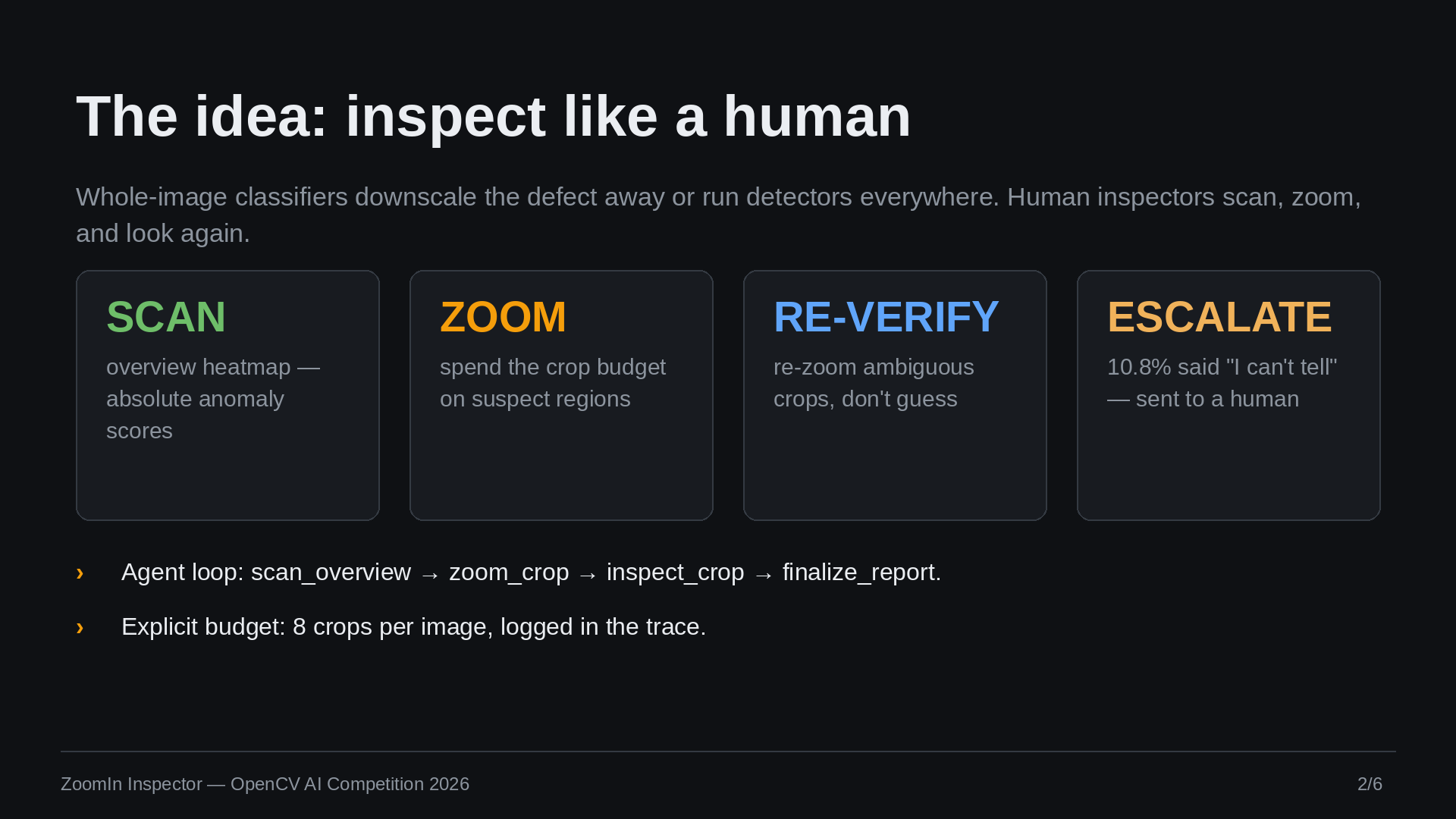
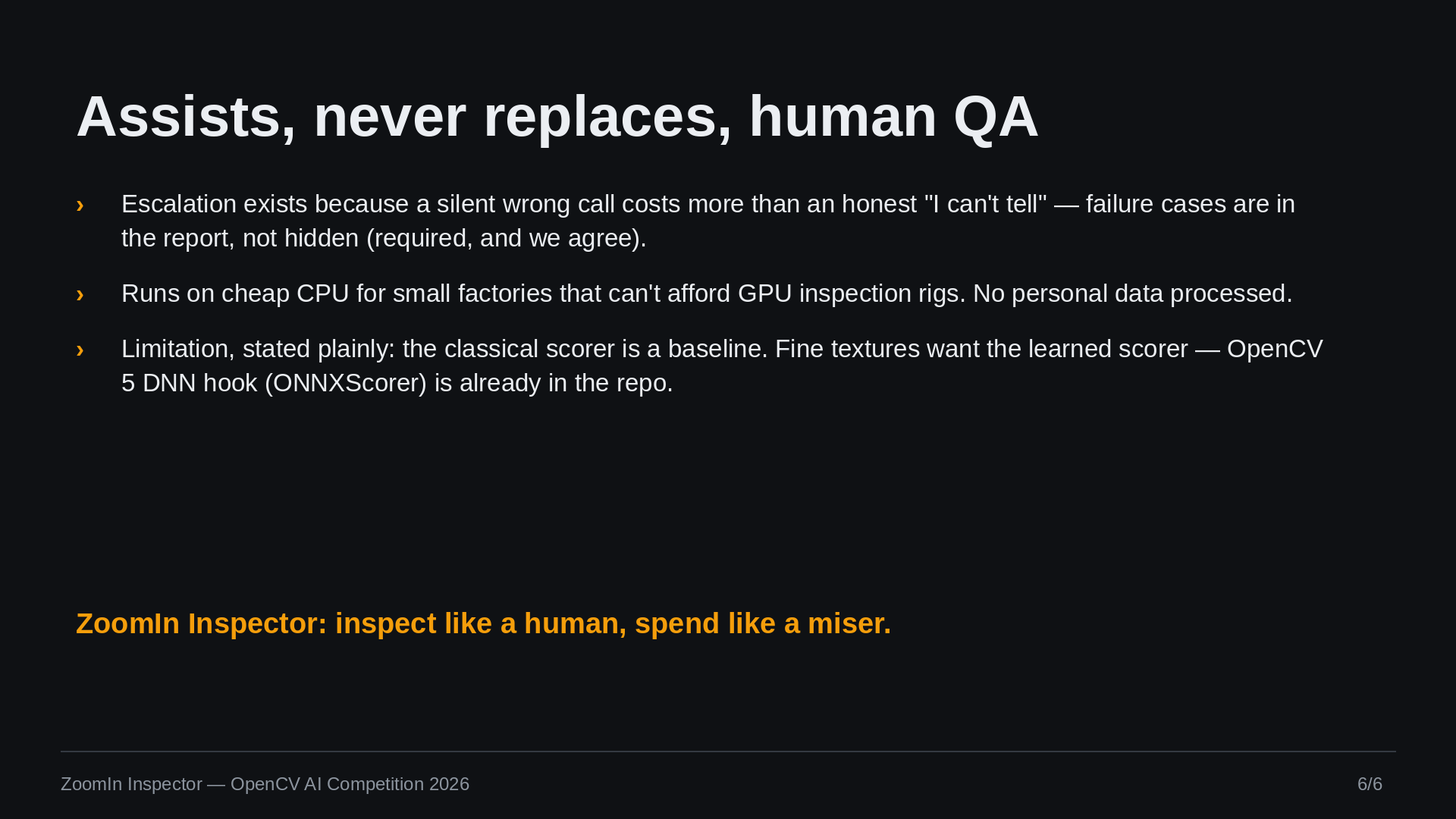
Industrial visual inspection wastes compute and misses small defects: whole-image classifiers either downscale the defect away or run expensive detectors everywhere. A human inspector does the opposite — scan the overview, zoom into the suspicious regions, look again when unsure, and call over a colleague when something is genuinely ambiguous. We built an agent that inspects the way a human does, under an explicit budget of eight crops, on CPU only — because the small factories that need this most cannot afford GPU inspection rigs.
🛠 What it does
ZoomIn Inspector is an agent loop (zoomin/agent.py) orchestrating five tools:
scan_overview— full-image anomaly heatmap from a classical per-pixel scorerzoom_crop— crops the top-k suspicious regions (the vision output decides the next tool call — this is the agentic-vision step)inspect_crop— re-scores the crop against aligned full-image statistics- re-plan /
decide— re-zooms the ambiguous region, confirms it as a defect when the tighter window's coverage is high enough, and otherwise hands it to a human with the visual trace attached instead of guessing
Measured honestly: a crop-budget ablation (1 crop vs 8, everything else fixed) adds 3 detections out of 212 defects and no false positives — the overview heatmap decides almost everything, and the loop's real contribution is the audit trail and the human-review channel. 40% of defects (84/212) pass silently because the overview proposes no region at all, which no amount of re-zooming can recover.
finalize_report— emits a defect report with localized masks
Two engineering choices carry the quality:
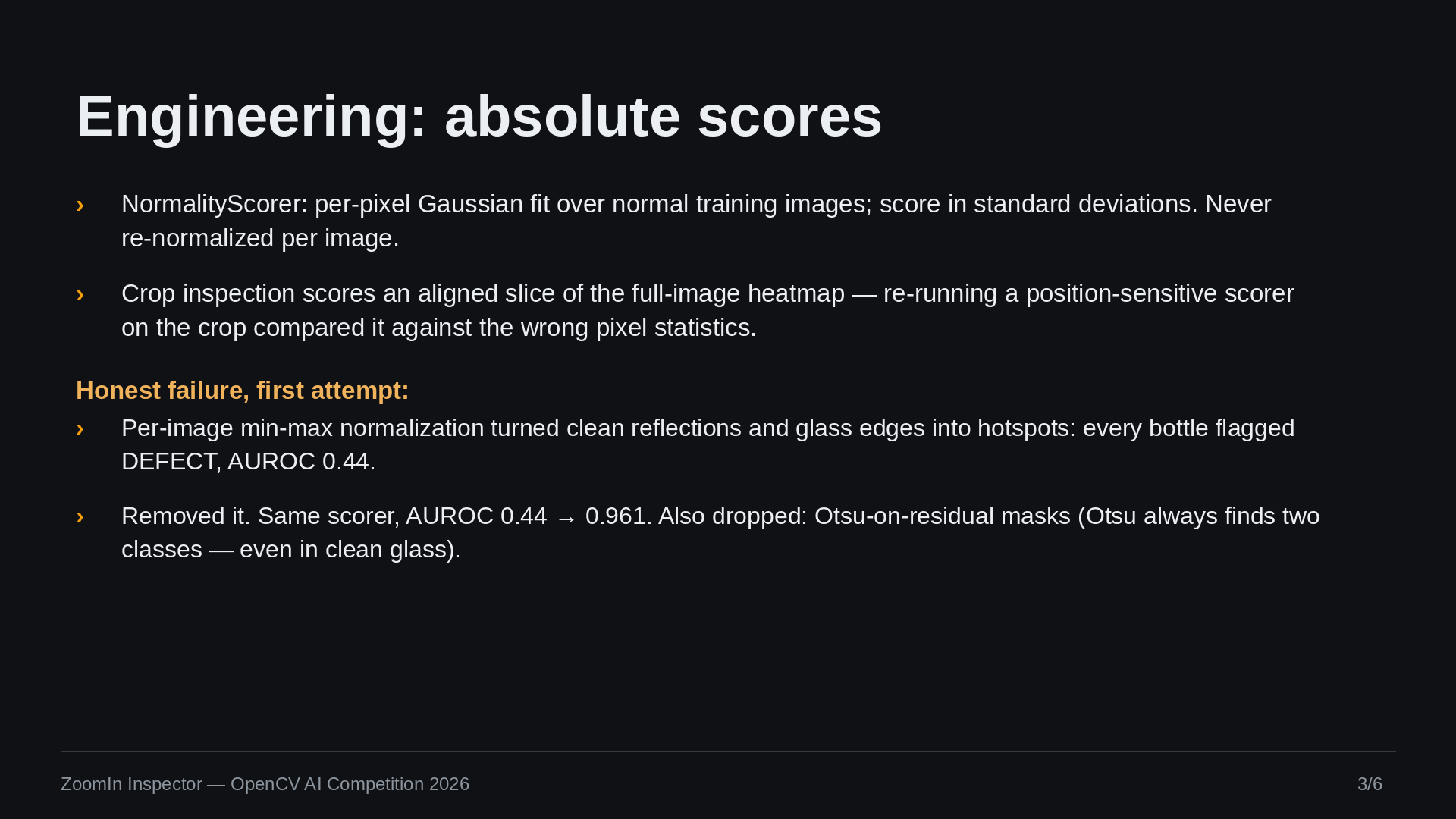
- Anomaly scores in absolute units, never per-image normalized. Our default scorer fits a per-pixel Gaussian over normal training images and scores every pixel in standard deviations. Our first attempt used per-image normalization — every bottle, good or bad, was flagged defect (AUROC 0.44). Removing it was the whole fix.
- A fixed zoom budget. The agent gets eight crops and must spend them where they matter, exactly like an inspector's attention.
One container serves the FastAPI API and the Gradio UI (docker compose up); every agent step is logged as a trace and visualized in the demo UI.
☁️ AWS + COOL
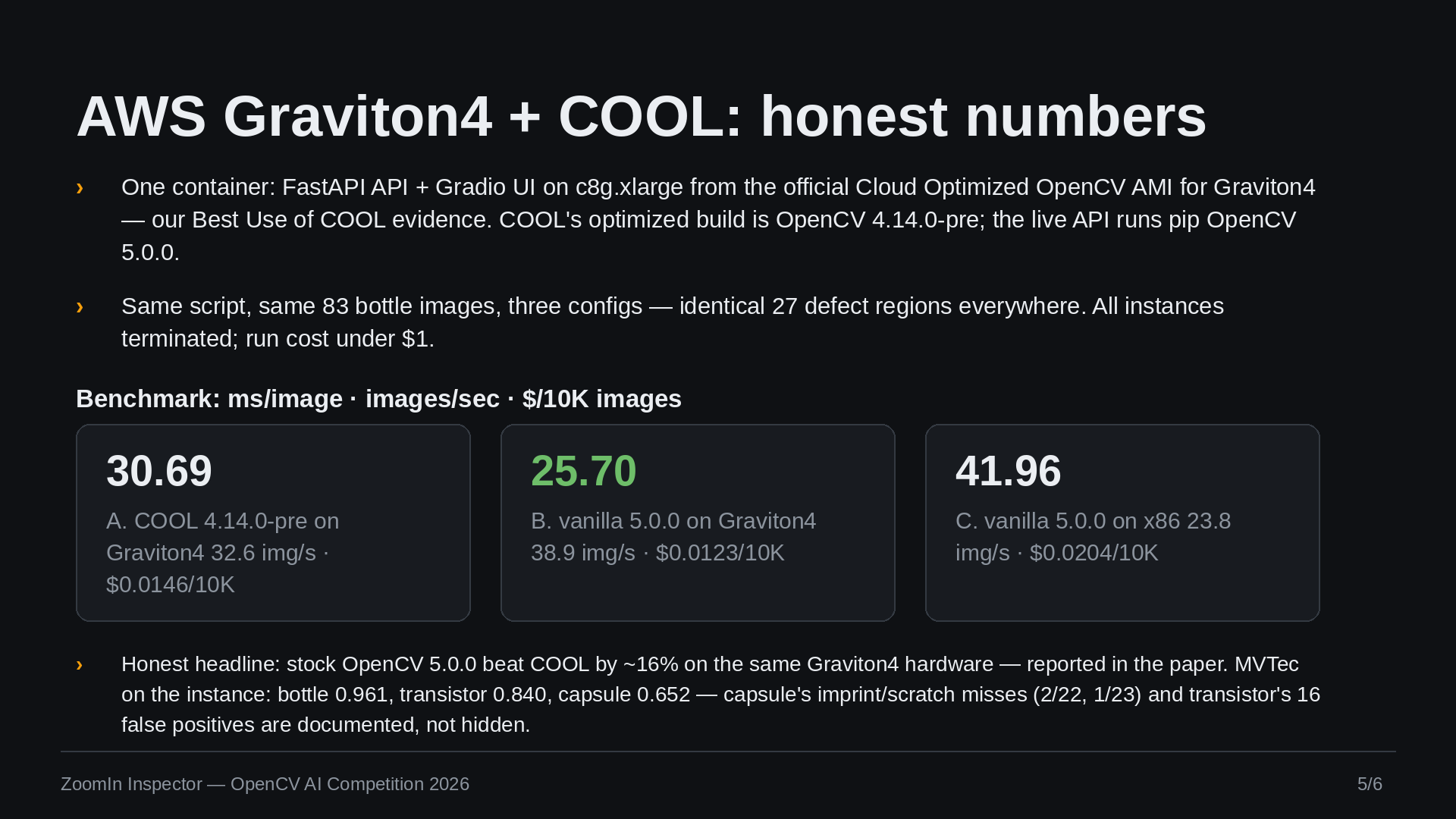
We deployed on AWS Graviton4 (c8g.xlarge) from the official Cloud Optimized OpenCV AMI for Graviton4 — our Best Use of COOL evidence. The benchmark harness ran the same script on the same 83 bottle images three ways:
| Config | OpenCV | ms/image | images/sec | $/10K images |
|---|---|---|---|---|
| A. COOL on Graviton4 | 4.14.0-pre (COOL) | 30.69 | 32.6 | $0.0146 |
| B. Vanilla on Graviton4 | 5.0.0 (pip) | 25.70 | 38.9 | $0.0123 |
| C. Vanilla on x86 | 5.0.0 (pip) | 41.96 | 23.8 | $0.0204 |
All three configs found the identical 27 defect regions — the pipelines agree, only the speed differs. The honest headline, stated in the report: stock OpenCV 5.0.0 beat COOL by ~16% on the same Graviton4 hardware for this workload (COOL still beat x86 by ~27%). One important detail we handled rather than hid: the COOL AMI's optimized build is OpenCV 4.14.0-pre, not OpenCV 5 — so the live API and the MVTec eval ran the pip 5.0.0 venv on the same instance, and every benchmark CSV records the exact cv2 version per config.
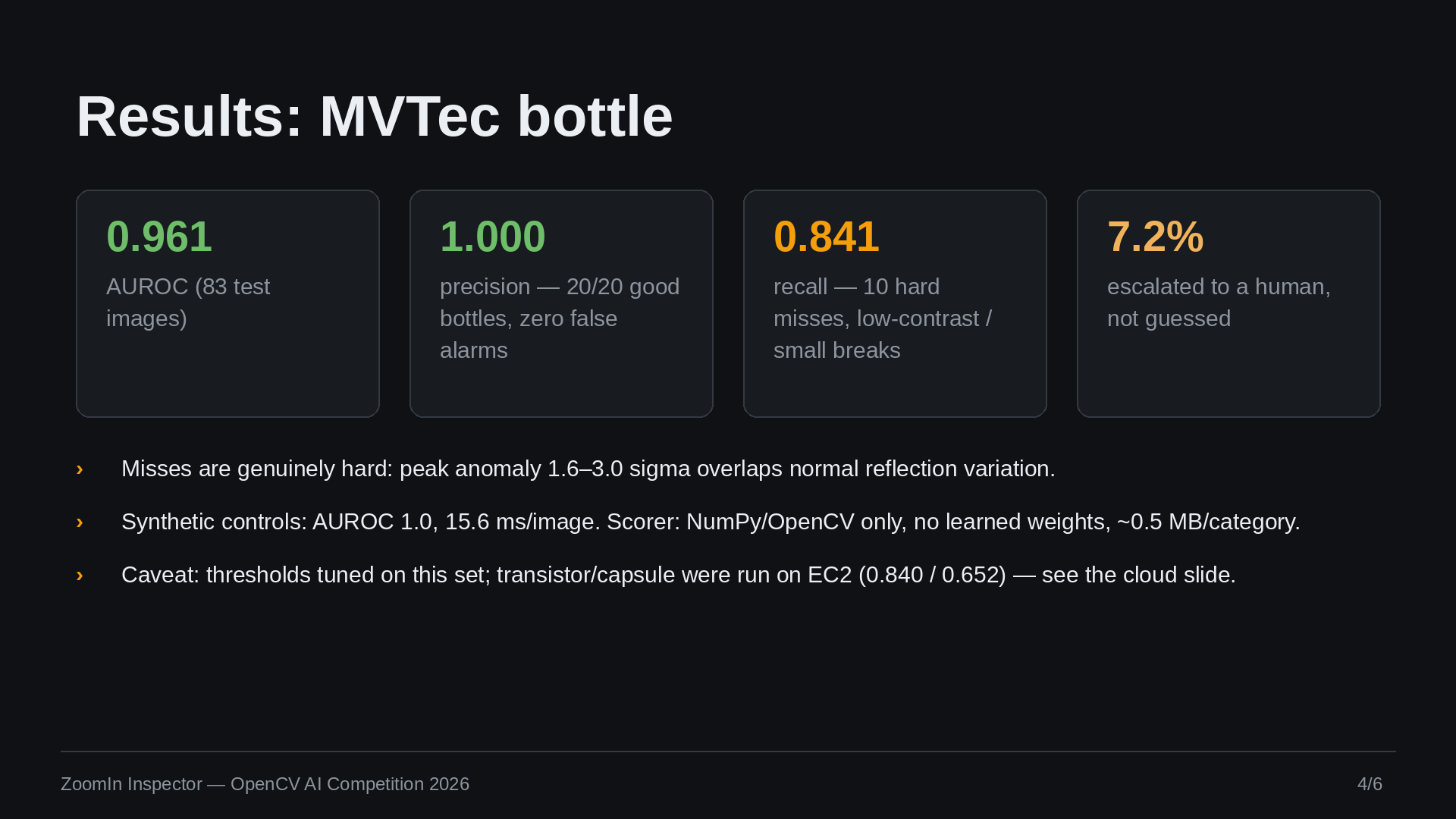
The same pipeline then measured three MVTec categories on the instance (n=315): bottle AUROC 0.961 (exact reproduction of the local run — harness cross-validated), transistor 0.836, capsule 0.653. All instances were terminated after the run; total AWS spend under $1.
🚧 Challenges we ran into
- Sandbox egress blocks SSH, and the Instance Connect Endpoint needed an IAM permission the deployer role didn't have. Rather than bounce Jack back to the console, both instances ran fully autonomously: boot scripts pulled code from S3, ran the benchmarks and eval, and uploaded logs, stage markers, and result CSVs back to S3.
- The COOL AMI is 4.14.0-pre, not OpenCV 5. Discovered mid-deploy; handled by running the API and eval on the pip 5.0.0 venv and recording exact versions in every CSV.
- Two script bugs (venv activation, requirements-file comment parsing) burned two Graviton runs before the clean v3 run.
🏆 Accomplishments
- End-to-end agentic inspection loop with a reproducible benchmark harness and a cross-validated eval (local bottle 0.961 == EC2 bottle 0.961).
- A benchmark result we reported against our own prize interest: stock OpenCV 5 beats COOL on this workload, with hypotheses and reproducible CSVs.
- Precision 1.0 on 20 good bottles — zero false alarms — with 7.2% of bottle images and 6.3% overall escalated to a human rather than guessed. Overall: AUROC 0.738, precision 0.881, recall 0.557 across 315 test images.
📉 Failure cases (required, and we agree they're the interesting part)
Capsule is a real failure: AUROC 0.652, with faulty_imprint 2/22 and scratch 1/23 detected — a pixel-Gaussian scorer cannot see print defects. Transistor (0.840 AUROC) is where the re-plan's precision cost lands: 16 of 60 good transistors are confirmed as DEFECT, dropping transistor precision to 0.667. These are in the report, not hidden: the escalation path exists precisely because a silent wrong call costs more than an honest "I can't tell", and the coverage-confirm threshold is exposed per scorer so an operator can shift that balance back toward human review.
🔭 What's next
- Wire the OpenCV 5 DNN hook (ONNXScorer is already stubbed in the repo) so fine textures like capsule print get a learned scorer.
- Submit before the Oct 26 deadline (repo pushed 2026-10-22; demo video upload is the remaining link).

Log in or sign up for Devpost to join the conversation.