-
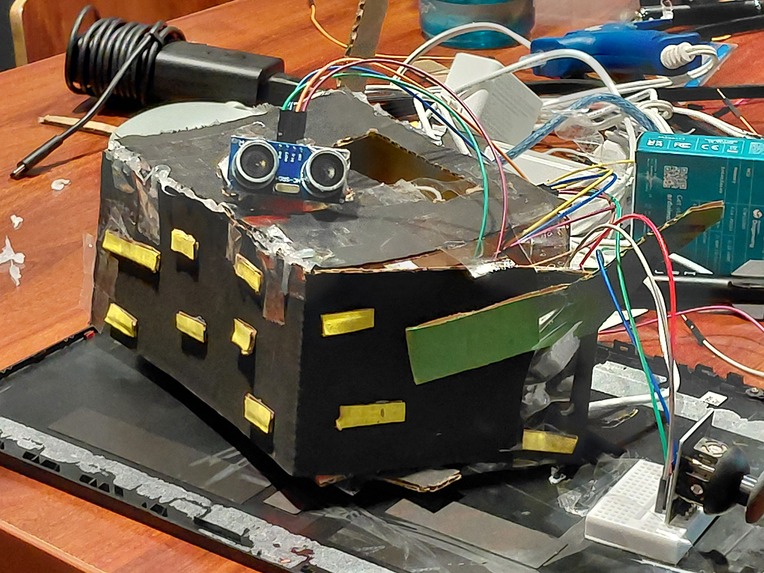
Zombie Spideroid
-
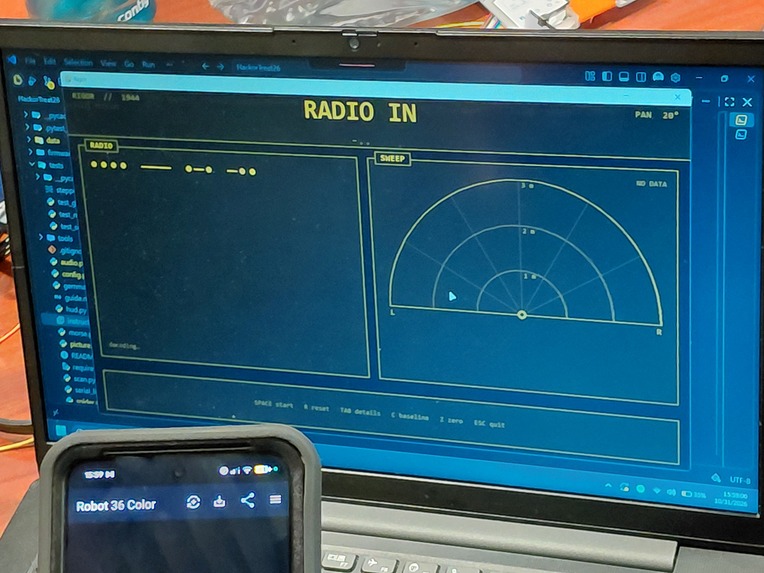
GUI on laptop
Inspiration
Our inspiration for the Zombie Spideroid came from the blend of Halloween horror and futuristic robotics; we wanted to create something that felt eerie, playful, and alive, like a haunted machine straight out of a sci-fi horror movie. The project was built for Hack-or-Treat at UofTHacks, where we wanted to turn a fun seasonal theme into a functional interactive robot that could entertain, surprise, and impress. The idea of a zombie’s “spider-shaped companion” was especially compelling because it combined spooky aesthetics with practical engineering, giving us a creative concept that still had real technical depth.
What it does
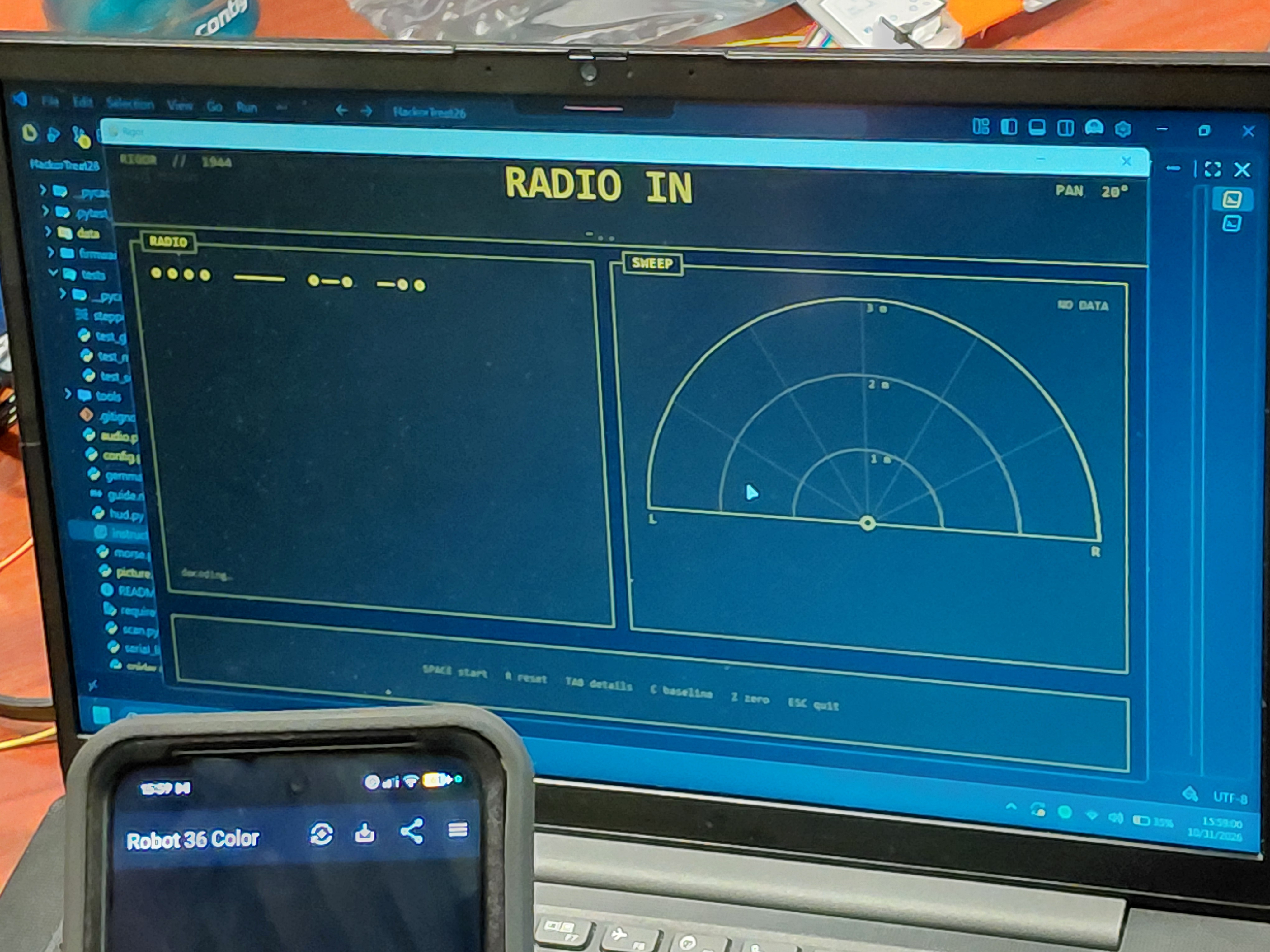
The Zombie Spideroid is a robotic companion that listens for Morse-code transmissions, decodes the message, scans a room using an ultrasonic sensor, and interprets the surrounding environment to estimate how many people are nearby and whether a threat is present. It then reacts with voice output, visual status updates, and dramatic narrative responses, making the robot feel like an intelligent, paranoid assistant to a zombie. In simple terms, it turns raw distance readings into an interactive story: the robot “senses” the room, identifies where the people are, and responds based on how close they are. Mathematically, its logic can be thought of as a function of sensing and distance analysis, such as f(\text{readings}, \text{baseline}, \text{angle}) \rightarrow \text{threat estimate}, connecting sensor data to a meaningful reaction.
How we built it
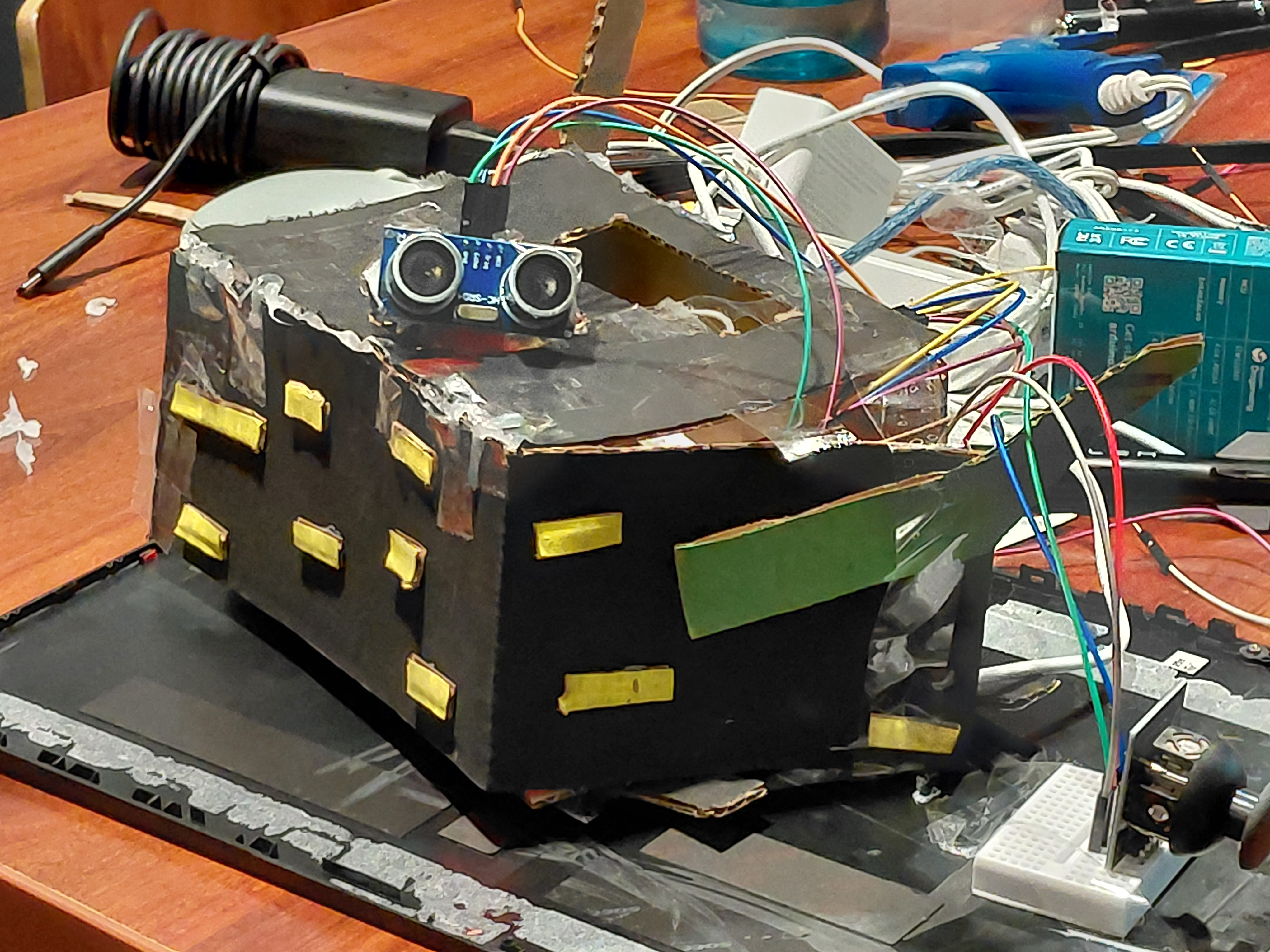
We built the Zombie Spideroid using a mix of custom hardware and software, with a cardboard frame painted black and accented with yellow highlights to create its spider-like appearance. The robot’s electronics were housed inside the frame, with some sensors and components exposed for visual effect, and the wiring was routed to support the system’s movement and sensing functions. The core hardware included an ultrasonic sensor, an Arduino-based control system, a stepper motor for sweeping the sensor head, a joystick for manual control, and a display to show operational status. On the software side, we used Python to run the project locally on a computer, where the robot logic, sensor analysis, and interaction flow were orchestrated through serial communication with the hardware. This combination of physical fabrication and software control allowed us to create a prototype that was both visually engaging and technically functional.
Challenges we ran into
A major challenge we faced was the wiring and electronics: several components were not connecting properly, and we had to spend a great deal of time troubleshooting, testing, and rechecking each connection to identify the root cause. Because the project involved both moving hardware and software communication, a single failed connection or timing issue could interfere with the entire system, making debugging a long and iterative process. We also had to fine-tune the sensor behavior so that the robot could accurately sweep the room and interpret readings without producing false positives or inconsistent results. These issues forced us to rely on careful debugging and repeated testing, but they also taught us how important reliability and calibration are in real-world hardware systems.
Accomplishments that we're proud of
We are proud that we created a project that successfully combined artistic design, hardware engineering, and software intelligence into one cohesive robot. The Spideroid not only looks impressive as a Halloween-inspired prop, but it also functions as an interactive system that can sense its surroundings, interpret movement, and respond in a way that feels alive. We are especially proud of building a project that could decode a message, analyze room data, and generate a dramatic reaction based on the environment, which made it feel much more advanced than a simple sensor demo. Bringing the concept from an idea to a working prototype within a hackathon timeframe was a huge accomplishment and a testament to our creativity, teamwork, and willingness to iterate.
What we learned
Through this project, we learned how important it is to integrate hardware, software, and design into a single system rather than treating them as separate tasks. We gained hands-on experience with wiring, troubleshooting, calibration, and serial communication, and we learned that even small hardware problems can have a major impact on the overall performance of a project. We also learned the value of iterative testing and adaptability, because the robot’s behavior often changed depending on sensor input, control timing, and environmental conditions. Beyond the technical aspects, we learned how important it is to build something with a clear creative vision and a good user experience, because the project becomes far more memorable when it is both functional and engaging.
What's next for Zombie Spideroid
The next step for the Zombie Spideroid is to make it mobile by adding a motorized base so it can move around the room and scan people without being tethered to a computer via USB. This would make the robot much more autonomous and much more impressive as a standalone system. Another major improvement would be wireless communication, allowing the computer to send data to the robot without a physical cable. Beyond that, we also want to refine the robot’s sensing and AI-driven reactions, making it smarter, more responsive, and better at interpreting the environment. In the long term, the goal is to turn the Zombie Spideroid into a fully autonomous, wireless, mobile robot that feels even more lifelike and immersive.

Log in or sign up for Devpost to join the conversation.