-
-
Zoduko app icon
-
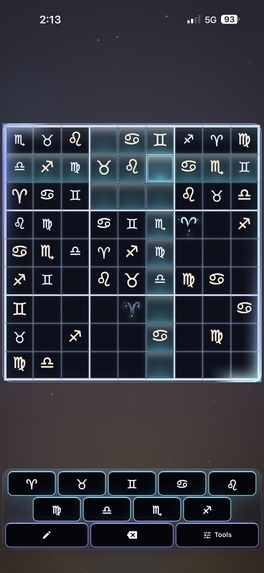
Entropy mode: solve the puzzle as unsolved clues decay over time.
Inspiration
Zoduko began because I wanted to make an app and had essentially no idea how to make one.
I asked ChatGPT whether someone without traditional coding experience could learn enough to actually build and ship an app. The first idea was simple: take Sudoku and replace the numbers with the twelve zodiac symbols.
But once I started building it, I became interested in how much further the familiar puzzle could be pushed. The board gained motion, sound, and feedback. Eventually, the board itself became part of the challenge. That exploration produced Entropy, a mode in which unsolved clues can decay as the puzzle progresses.
What began as symbolic Sudoku became something else: symbolic logic on a living board.
What it does
Zoduko is a logic puzzle game built around two primary experiences.
Classic takes the familiar rules of Sudoku and reimagines them with symbols, custom presentation, 9x9 and 12x12 boards, Daily puzzles, notes, possibility tools, and a deliberately atmospheric interface.
Entropy changes the relationship between the player and the puzzle. The board is no longer completely static. As time passes and the board Pulses, information can decay. The player is still solving through logic, but now must decide not only what can be deduced, but what information needs to be protected, remembered, or acted upon before it disappears.
That turns a traditionally static puzzle into something more temporal and alive.
How I built it
Zoduko is built in Flutter and has been developed as a cross-platform product for mobile and web.
The project grew far beyond the puzzle engine itself. I built persistence and resume behavior, curated puzzle libraries, tutorials, purchase and restore flows, entitlement handling through RevenueCat, custom board effects, responsive layouts, accessibility and interaction systems, and a complete sound system.
All of the audio is original and unusually homemade. Recordings including hot-tub jets, footsteps on gravel, sizzling bacon, and my own voice became raw material for Zoduko's interface and puzzle sounds. Building the game's identity meant treating sound, motion, symbols, and logic as parts of the same system rather than separate layers.
AI-assisted development has also been an important part of the process. I have used AI as a development partner for implementation, debugging, testing, analysis, and iteration while making the product, design, gameplay, and release decisions myself.
Challenges
The final stretch toward release became an exercise in discovering how different a working project is from a shippable product.
Persistence had to survive real interruptions. Purchases and restores had to work outside ideal test conditions. Audio that sounded right on mobile behaved differently on the web, leading to a dedicated web audio path. A 12x12 layout that looked correct in development broke on a physical iPhone. Manual Notes required their own rendering architecture to remain legible across all twelve symbols. Android rendered the zodiac Unicode characters through an emoji font, turning board symbols into blocks and colorful tiles, which required a platform-specific bundled symbol font while preserving the iOS presentation.
Even after submitting V1 for App Review, testing uncovered a persistence problem specific to unlocked Entropy games: progress could be saved but become inaccessible after leaving the game. I traced the problem to the way normal Entropy sessions were being persisted, fixed the session lifecycle, verified the behavior on a physical iPhone, and submitted a new build.
Real-device testing repeatedly overruled what looked correct in code.
Those failures became one of the most valuable parts of building Zoduko. Each one pushed the project further from "an app that works on my machine" toward an actual product that can survive other devices, other platforms, and other players.
What I learned
I learned that shipping is its own discipline.
A feature can be technically correct and still be visually wrong. A sound can work perfectly on one platform and fail on another. A puzzle can be logically valid and still provide a poor experience. Automated tests are invaluable, but a screenshot from an actual player's phone can invalidate an afternoon of assumptions.
I also learned how much identity can come from details that initially seem unnecessary: a symbol settling into a cell, the Pulse of the board, the sound of a completed house, the moment a fresh puzzle reveals itself.
Those details became Zoduko.
What's next
V1 is the foundation. Zoduko is currently available on iOS, with the Android version still in development.
After launch, I plan to expand Zoduko with additional board formats and modes, including a radial puzzle format, while continuing to explore how far Entropy's central idea of unstable information can be pushed. Zoduko is also the first released game from Orixe Labs, the independent studio I am building around the idea that small teams, and even individual creators using modern tools, can still make distinctive games with their own identity.

Log in or sign up for Devpost to join the conversation.