Inspiration
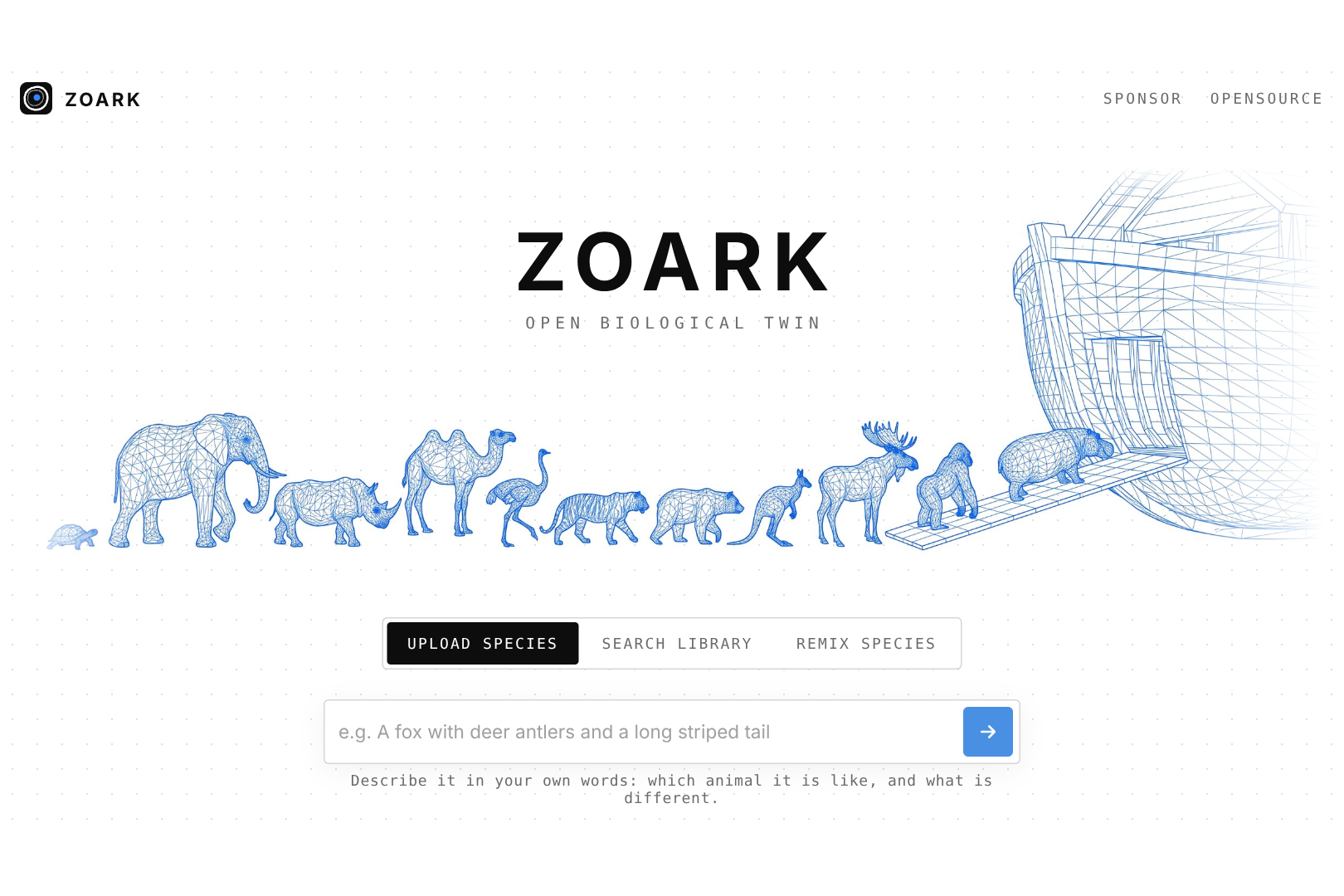
ZOARK extracts every real species on Earth into a physics-ready digital twin. Nature has already solved walking, climbing, carrying loads and balancing in thousands of different bodies. We want the biomimetics and robotics industry to learn from all of them, not only from the quadruped studies it relies on today. Bone lengths and body masses for thousands of animals already exist in published research; ZOARK turns them into skeletons that can be simulated, with every number traceable to its source.
Business model
ZOARK batch-simulates digital twins at scale: for each species or body plan, it generates many variants, runs stand-and-walk simulations in NVIDIA Newton on every one, and keeps only the runs that pass. Robotics teams receive physics-validated composite data (skeletons, joint limits, mass and center of mass, gait references and simulation results) to train and test robots. We sell the data per dataset or by API subscription; the generation engine stays in-house, and the species library stays open.
How we built it
Input is a one-sentence description, or a photo or sketch, of any animal, real or imagined.
- Understand – NVIDIA Nemotron on Nebius Token Factory (Nemotron 3 Nano 30B-A3B for text, Nemotron 3.5 Super VL for photos) parses the text and the image, finds the closest real species, and writes a structured spec (skeleton plan, proportions, joints, habits).
- Rebuild – our engine on Nebius AI Cloud builds every bone from measured data, grows the body, rigs and animates it. The same spec always gives the same result.
- Test – the engine computes mass, center of mass and support area, then NVIDIA Newton runs a full stand-and-walk simulation on Nebius AI Cloud GPUs and measures walking speed.
- Render – a realistic photo is generated from the body's depth map with Stable Diffusion 1.5 + ControlNet depth.
Every specimen gets a permanent ARK ID, and Remix mixes two species at the skeleton level.
- Species cards: an AI agent reads peer-reviewed papers and open datasets, extracts bone and body measurements, unifies units, and grades every value A–E by source. Empty fields stay empty; nothing is guessed. 4,606 species cards from 1,600+ sources; 1,806 species and subspecies can be built and tested.
- Web: Cloudflare Workers, D1 and R2; three.js for 3D, d3-geo for range maps.
- Open-source engine (github.com/Ariescar/Zoark, MIT): turns a request into body variants with Nemotron, tests every variant in NVIDIA Newton, and writes MJCF models and physics results. Verified runs with real Nemotron calls and Newton results are in the repository.
- Self-improving loop: every generation and simulation, pass or fail, is stored. Failures are traced back to the bone value, proportion rule or parsing step that caused them, and the fix is written back.
What's next
- Export URDF alongside the MJCF models the open-source engine already writes.
- Calibrate with museums and research labs, and add more Asia-Pacific native species.
Who it's for
Robot learning teams, synthetic data providers and biomechanics researchers who need physics-validated data for many species and body plans. The same digital twins also serve museums and science educators.

Log in or sign up for Devpost to join the conversation.