Inspiration
Small businesses in Africa are expected to survive problems that would overwhelm much larger companies: finding customers, managing sales, tracking inventory, understanding demand, dealing with suppliers, collecting payments and making the right decisions at the right time.
Many of them operate through WhatsApp, bank transfers, notebooks and fragmented tools.
We started ZionMatrix after seeing that the real problem was not simply the absence of business software. Small businesses lack an intelligence layer that can help them understand what is happening, identify opportunities and actually act on them.
The center of ZionMatrix is sales.
A business does not exist simply to record transactions. It needs to find customers, understand what people are likely to buy, know when to sell, know what to promote and avoid making bad decisions when market conditions change.
We therefore want ZionMatrix to move beyond software that simply records what already happened.
We want to build a system that can understand what is happening around a business and help answer:
Who should I sell to? What should I sell? When should I sell it? Where can I find customers? What should I do next?
This led us to another important idea: Market Weather.
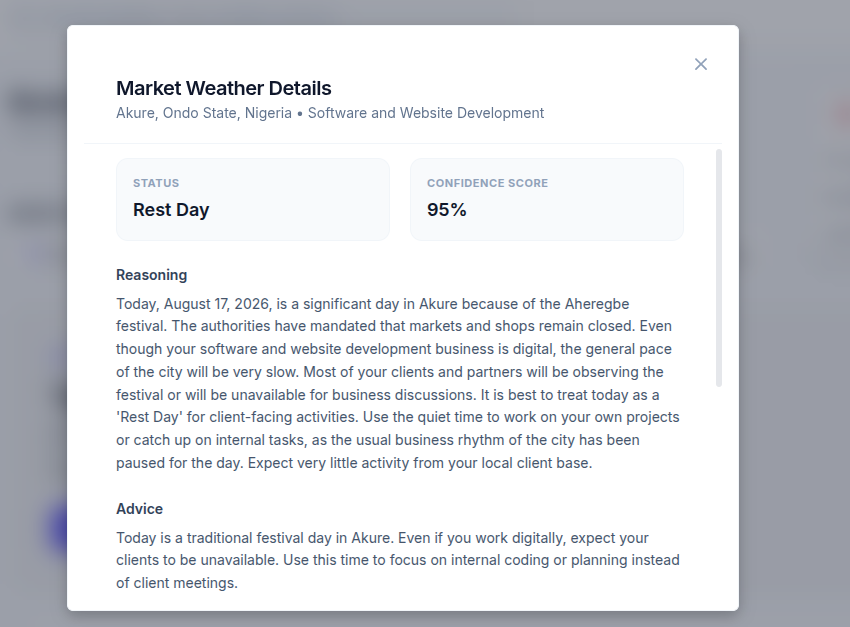
Market Weather is our concept for understanding the economic conditions surrounding a business, whether money is flowing or becoming tight, whether customers are spending or holding onto cash, what is happening to purchasing power, and what broader economic or local signals could affect demand.
A business owner should not have to panic every time sales fall.
A temporary decline could mean that customers are conserving cash. A sudden increase could mean that money has entered the market. Inflation, salary cycles, seasonal events, economic changes and other signals can change how people spend.
If a business understands this environment, it can make better decisions.
Instead of blindly discounting because sales dropped, it might protect cash and focus on existing customers.
Instead of missing an opportunity when purchasing power increases, it can increase customer outreach, prepare inventory and promote the products most likely to sell.
ZionMatrix is designed to help businesses understand the weather of their market before they react to it.
We spoke directly with ten (10) businesses while developing ZionMatrix. Their feedback changed what we built and showed us that the problem was much deeper than we initially expected.
One business even paid ₦10,000 specifically to join ZionMatrix before launch, while six additional businesses are currently waiting to use it.
That early commitment, before we had finished the product, convinced us that we were solving a problem worth pursuing.
What it does
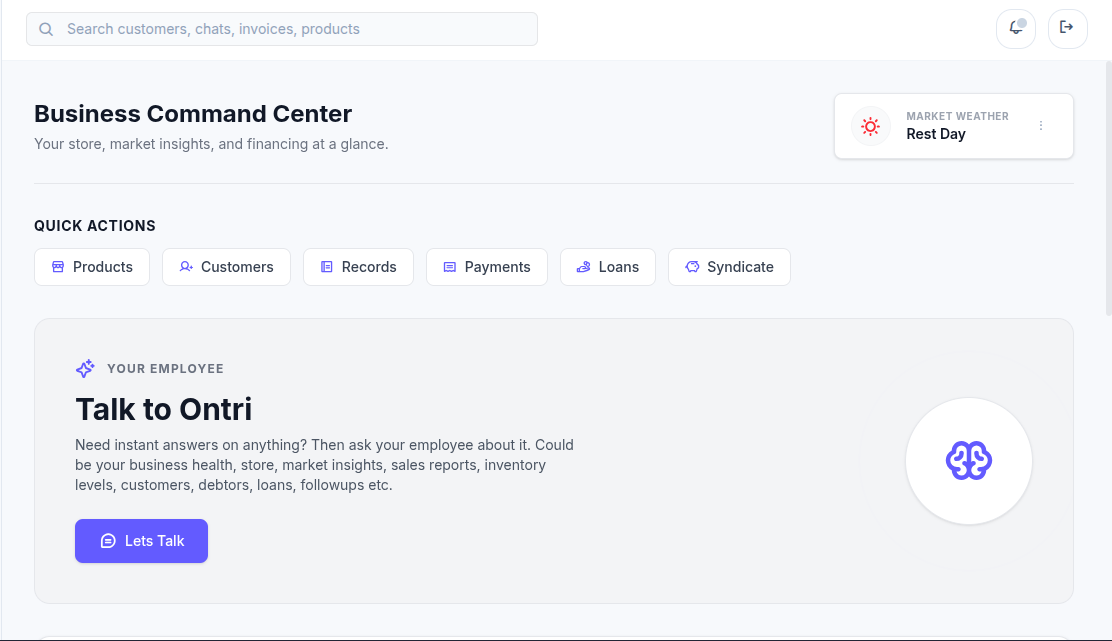
ZionMatrix is an intelligent operating and sales layer for businesses.
At its core, ZionMatrix is designed to help a business find customers, understand opportunities, make better selling decisions and act on those opportunities.
It is built around three AI agents working together:
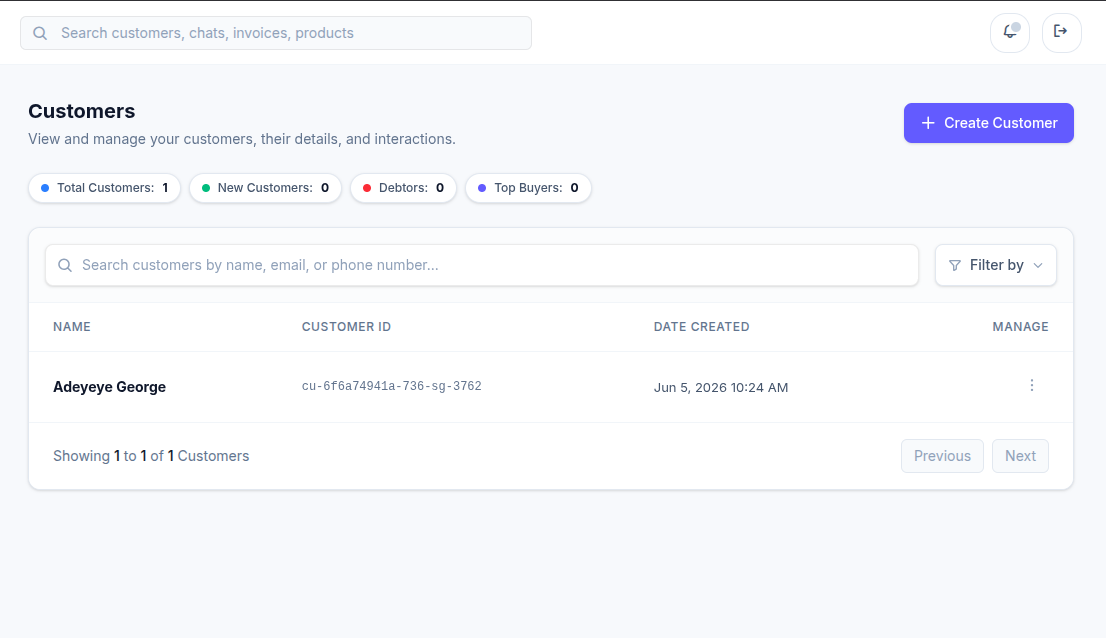
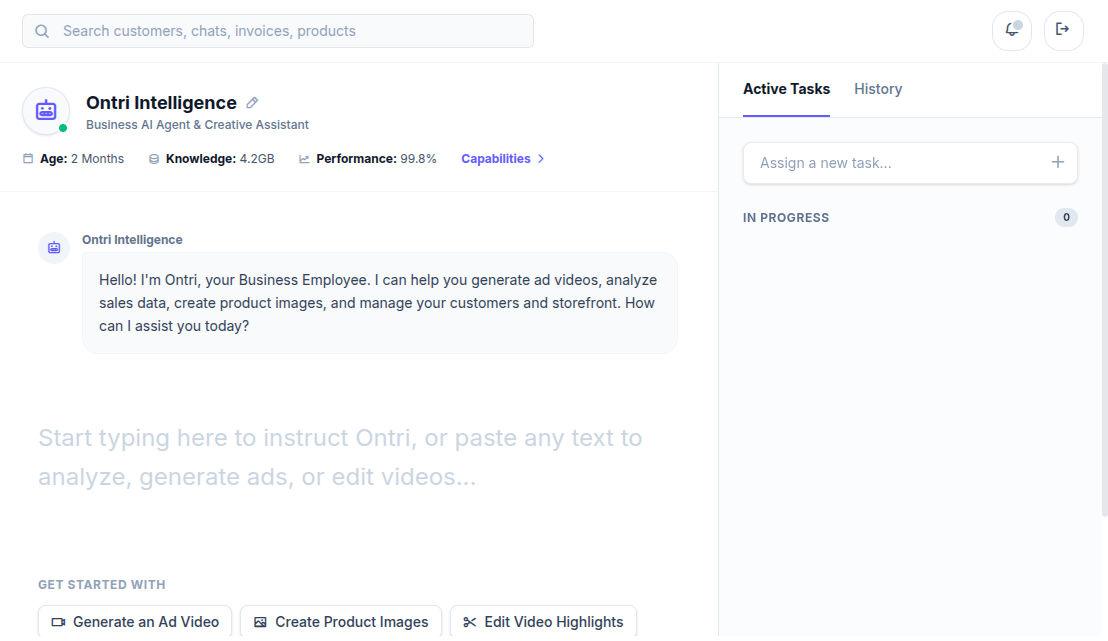
Ontri handles business operations and customer conversations. A customer can message a business through WhatsApp, ask about a product, receive payment instructions, make a payment, have the payment validated, provide a delivery address and have the sale and inventory updated.
This makes the path from customer interest → conversation → payment → completed sale possible within the business workflow.
Mira focuses on bringing and handling new customer opportunities. It acts as the business's marketing and customer-routing layer, helping turn incoming interest into actual business opportunities and helping the business reach customers rather than simply waiting for them to arrive.
Telo works in the background. It observes business and market signals, identifies opportunities and determines which customers, products or situations may need attention.
For example, Telo can identify customers who have not purchased recently, examine what they previously bought and identify a product or opportunity that may be relevant to them. It can then pass that opportunity to Ontri, which reaches out to the customer and handles the conversation.
Telo is also part of our broader Market Weather vision: helping a business understand whether its surrounding market is strengthening, weakening or changing, and what that should mean for its next decision.
The goal is not simply to tell a business that sales are down.
The goal is to help explain what may be happening and what the business should consider doing about it.
For example:
Market conditions are weakening. Customer purchasing activity is declining. Avoid panic discounting, preserve cash and prioritize your highest-performing products and existing customers.
Or, when conditions improve:
Purchasing activity is strengthening. This may be a good period to increase customer outreach and promote products with proven demand.
This turns business data and external signals into actionable intelligence.
The agents are designed to create a continuous cycle:
Understand the business → understand the market → identify an opportunity → take action → observe the result → learn → improve the next action.
Our vision is for ZionMatrix to eventually help a small business know:
Who to sell to. What to sell. When to sell. Where to sell. Why demand is changing. And what action to take next.
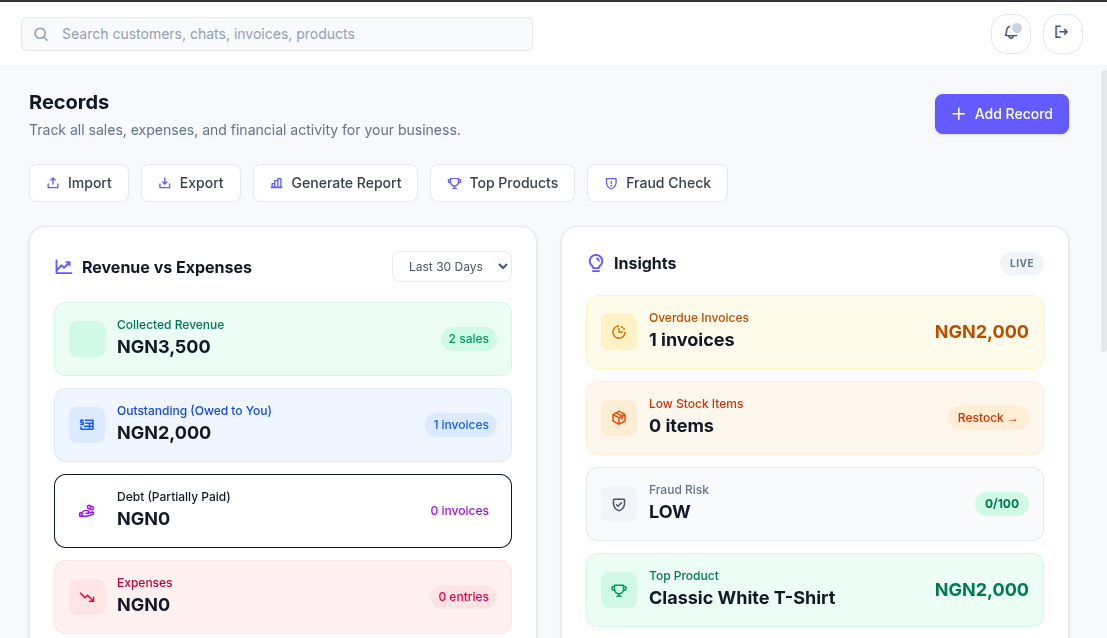
The bookkeeping, inventory and operational capabilities are therefore not the end goal. They provide important signals and context that allow the intelligence layer to make better decisions.
How we built it
We built ZionMatrix around three agents: Ontri, Telo and Mira.
Gemini is the core reasoning engine for our agents. We specifically relied on Gemini because its massive context window is critical for MemOS to process historical business data and extract accurate entity relationships without losing context. Gemini's speed and cost-effectiveness are also what make this ecosystem viable for African SMEs operating on tight margins.
We also built two important pieces of infrastructure underneath the agents.
MemOS gives the agents persistent memory. It supports long-term memories, conversation extraction, vector recall, reflection, entity relationships and shared business context.
Knowledge SDK gives ZionMatrix reusable operational knowledge while keeping each business's private knowledge isolated. It supports both general knowledge and tenant-specific knowledge that can be learned from business executions and feedback.
The system uses MongoDB, Redis/BullMQ and graph-based business relationships, with Memgraph support for larger graph workloads.
We focused heavily on the underlying architecture because ZionMatrix is highly interconnected.
A customer conversation can create a sales opportunity.
A sale changes inventory.
Inventory affects supplier decisions.
Customer behaviour affects recommendations.
Market conditions affect demand.
And every completed action creates new information that can improve future decisions.
This is why we designed ZionMatrix as an intelligence system rather than a collection of isolated business tools.
Rather than build a superficial demo that breaks when these pieces are connected, we have been building the foundation that will support the production system.
Challenges we ran into
The biggest challenge was scope.
We discovered that building an intelligent business operating and sales layer is significantly harder than building an AI chatbot.
Almost every component depends on another component. The agents need memory. Memory needs business context. Business context comes from transactions, customers and conversations. Actions affect inventory and sales, which then create new information for the agents.
We also discovered that building useful business intelligence requires more than the business's internal data. Understanding why sales are changing can require external signals about the economic environment and customer purchasing behaviour.
This is what led us to the Market Weather concept.
We also had limited resources and had to develop ZionMatrix alongside other work to support our family.
Several external integrations also require approval before the complete production workflow can be launched.
As a result, we were not able to finish the entire production platform within the competition period.
Instead of hiding that limitation, we chose to show what we have actually built and make the architecture available for inspection.
The current implementation demonstrates important parts of the system, while the remaining work is focused on completing the integrations and connecting the full production workflow.
Accomplishments that we're proud of
We are proud that ZionMatrix has progressed from an idea into a substantial working foundation.
We built:
- Three cooperating AI agents: Ontri, Telo and Mira
- WhatsApp customer interaction workflows
- Customer-to-sale workflows
- Payment and sales workflows
- Inventory interaction
- Persistent agent memory through MemOS
- Business knowledge infrastructure through Knowledge SDK
- Tenant-isolated business knowledge
- Customer recommendations
- Customer churn analysis
- Supplier and customer relationship modelling
- Business graph capabilities
- Background job processing
- Gemini and Qwen provider support
- A functioning public website and waiting list
- The foundation for market and business intelligence
But our most important accomplishment is validation from actual businesses.
We spoke with ten businesses and used their feedback to shape the product.
One business committed ₦10,000 specifically for ZionMatrix before launch, and six more businesses are waiting to join.
For a project being built with very limited resources, that early commitment means more to us than simply having a large number of registrations.
It demonstrated that businesses were willing to commit financially to the idea before the complete platform was even available.
What we learned
We learned that the difficult part of building AI for businesses is not simply connecting an LLM to a database.
The AI needs memory, context, reliable business data, tools, structured actions and safeguards before it can become genuinely useful.
We also learned that businesses don't want another system that gives them more information to process.
They want intelligence that helps them make decisions.
They don't just want to know:
“Sales dropped.”
They want to understand:
“Why did sales drop, is this temporary, and what should I do?”
They don't just want:
“This customer hasn't purchased recently.”
They want:
“Should I contact this customer, what should I offer them and when is the right time?”
They don't just want:
“This product is low in stock.”
They want:
“Should I restock this product now, or is demand weakening?”
Talking to businesses showed us that the real opportunity is not simply automating individual tasks.
It is helping a business understand its situation and decide what to do next.
Most importantly, we learned that business problems are interconnected. That is why ZionMatrix became much larger and more technically complex than our original idea.
What's next for ZionMatrix
Our next step is to complete the production foundation and onboard the businesses already waiting to use ZionMatrix.
We will continue building directly from their feedback.
We want to strengthen the intelligence layer that connects:
Customers → Sales → Business behaviour → Market conditions → Recommendations → Actions → Results.
A major part of that future is Market Weather: giving businesses a clearer understanding of whether money is flowing through their market, whether purchasing behaviour is changing, and how they should adapt their selling strategy.
We want ZionMatrix to help a business recognize an opportunity before it becomes obvious, and avoid making panic-driven decisions when the market temporarily becomes difficult.
Once the core platform is ready, we want to expand from individual business automation into a broader business ecosystem where intelligence connects customers, suppliers, payments, financing, market information and business operations.
The long-term vision is not to build another ERP.
We want to build the intelligence layer that helps a small business understand its market, find customers, sell more, adapt to economic changes and make better decisions.
We are starting with the businesses we can reach today, solving their real problems one workflow at a time, and building the infrastructure that can eventually support millions of businesses.
Built With
- gemini
- javascript
- memgraph
- mongodb
- node.js
- qwen
- redis

Log in or sign up for Devpost to join the conversation.